Omnia Review 2026
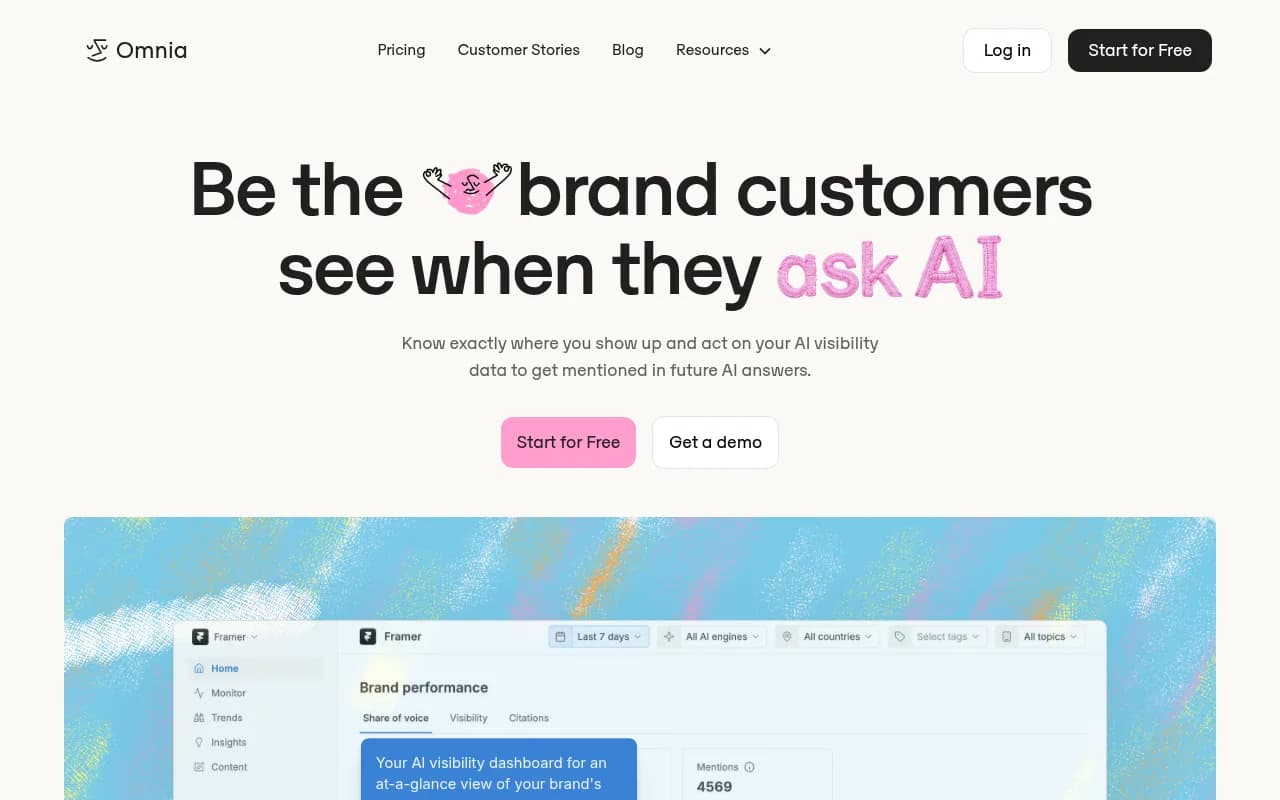
Omnia is an AI visibility platform that monitors how your brand appears in ChatGPT, Perplexity, Google AI Overviews, and Google AI Mode. Unlike monitoring-only tools, Omnia provides actionable insights and a personalized roadmap to improve your AI search presence, helping you understand what prompts
Summary
- What it does: Omnia monitors brand mentions and citations across ChatGPT, Perplexity, Google AI Overviews, and Google AI Mode, then provides actionable recommendations to improve visibility
- Missing vs Promptwatch: Lacks AI crawler logs, traffic attribution, Reddit/YouTube tracking, ChatGPT Shopping monitoring, and prompt volume/difficulty scoring that Promptwatch offers. Omnia tracks only 4 AI models vs Promptwatch's 10+
- Best for: Brands and agencies that want basic AI visibility tracking with some optimization guidance, but don't need the depth of content gap analysis or traffic attribution
- Pricing: Flexible pricing with free trial available, Pro plan for deeper monitoring (specific pricing on request)
- Limitation: Deliberately limited AI engine coverage -- tracks only 4 models and explicitly avoids others to "reduce noise"

Omnia positions itself as an AI visibility platform for SEO and marketing teams who want to understand how their brand shows up in AI search engines. The company is targeting the same space as Promptwatch, Otterly.AI, Peec.ai, and other GEO platforms, but with a narrower focus on just four AI engines: ChatGPT, Perplexity, Google AI Overviews, and Google AI Mode. They've made a deliberate choice to skip other models like Claude, Gemini, Meta AI, DeepSeek, Grok, and Mistral -- calling them "noise" rather than signal.
The platform is used by brands like Exoticca, Ironhack, The Power Business School, OkTicket, and Pleo. One customer (OkTicket) reported a 30% increase in leads from AI, while another (Tuio) saw 45% more traffic from AI search. A third case study claims a brand moved from position 11 to position 2 in just 7 days, though the specifics of what "position" means here aren't entirely clear.
How Omnia works
Omnia's workflow breaks into three stages: discover prompts, monitor visibility, and act on insights.
Prompt discovery: The platform helps you identify which prompts (user queries) are relevant to your industry or product. This is the starting point -- you need to know what questions people are actually asking AI engines about your category before you can track whether you show up in the answers. Omnia surfaces "real questions customers are asking" so you're not guessing at what to monitor.
Visibility monitoring: Once you've defined your prompt set, Omnia runs those prompts daily across its four supported AI engines. It tracks whether your brand is mentioned, how you compare to competitors (share of voice), and which sources AI engines cite when they mention you or your competitors. The dashboard shows your visibility score, competitor benchmarking, and citation patterns. Daily tracking means you get feedback loops within 24 hours instead of waiting weeks to see if changes worked.
Actionable insights: This is where Omnia tries to differentiate from pure monitoring tools. The platform analyzes your tracking data and citation patterns, then generates a "step-by-step AI visibility roadmap" with prioritized recommendations. These recommendations fall into three buckets: content creation (write new content to fill gaps), technical SEO (structured data, site optimization), and content placement (get mentioned on third-party sites that AI engines trust). Omnia also includes a content generation feature that creates "gap-filling content" designed to get cited in future AI answers.
The pitch is that most tools dump data on you and leave you stuck on "what now?" Omnia tries to answer that question with specific next steps.
What Omnia tracks
Brand mentions: Whether your brand appears in AI-generated answers for your monitored prompts. Binary yes/no plus context about how you're described.
Competitor benchmarking: Share of voice comparisons showing how often you're mentioned versus competitors for the same prompts. Helps you identify where competitors are winning and you're invisible.
Citation analysis: Which URLs, domains, and sources AI engines pull from when they mention your brand or competitors. Omnia looks for patterns across citations to surface insights like "AI engines cite Reddit threads 40% of the time for this prompt" or "Competitor X dominates because they're cited by TechCrunch and Forbes."
Visibility score: A proprietary metric that summarizes your overall AI presence. Not clear exactly how it's calculated, but it's meant to be a single number you can track over time.
Daily refresh: All prompts are re-run every 24 hours so you can spot changes quickly. This is faster than some competitors who refresh weekly or less frequently.
Who is Omnia for
Omnia targets SEO teams, marketing teams, and agencies managing brand visibility. The customer list skews toward mid-market European companies (Spanish brands are prominent), which makes sense given the company appears to be based in Europe. The case studies mention marketing leads, paid media specialists, and CEOs -- so it's being used by both practitioners and leadership.
The tool is probably best for brands that are just getting started with AI visibility and want a simpler, more guided experience. If you're a SaaS company with 10-50 employees, a DTC brand, or a B2B service provider trying to figure out if AI engines recommend you, Omnia gives you a starting point without overwhelming you with data.
It's less suitable for agencies managing dozens of clients across different industries, or for brands that need deep technical insights like AI crawler logs, traffic attribution, or multi-model coverage. The deliberate limitation to four AI engines means you're blind to what's happening in Claude, Gemini, Meta AI, and other models that are growing in usage.
Integrations and ecosystem
Omnia doesn't advertise specific integrations on its website. No mention of API access, Google Search Console integration, Looker Studio connectors, or third-party tool connections. The platform appears to be a standalone dashboard. There's a mention of "data exports" in the Pro plan, which suggests you can export CSV or similar files, but no details on format or automation.
No browser extensions, mobile apps, or developer tools are mentioned. This is a web-based platform you log into to check your dashboards and act on recommendations.
Pricing and value
Omnia offers "flexible pricing" with a free trial to start. There's a Pro plan mentioned for users who want to "monitor more prompts and go deeper with data exports," but specific pricing isn't listed on the website -- you have to request it. One search result mentions "pricing upon request," which usually means custom quotes based on your needs.
The lack of transparent pricing is a friction point. Competitors like Promptwatch publish clear tier pricing (Essential $99/mo, Professional $249/mo, Business $579/mo), making it easier to evaluate fit. With Omnia, you're committing to a sales conversation before you know if it's in budget.
The free trial is a plus -- you can test the platform before paying. But there's no mention of a free tier or freemium model, so once the trial ends, you're on a paid plan or you're out.
Value-wise, Omnia is competing in a space where Promptwatch offers significantly more features (10+ AI models, crawler logs, traffic attribution, Reddit/YouTube tracking, prompt volumes, content gap analysis) starting at $99/mo. If Omnia's pricing is comparable or higher, it's hard to justify the narrower feature set. If it's cheaper, it might work as a budget option for brands that only care about the big four AI engines.
Strengths and limitations
Strengths:
Actionable roadmap: Omnia's focus on turning data into a prioritized action plan is genuinely useful. Many monitoring tools leave you staring at dashboards wondering what to do next. Omnia tries to solve that with specific recommendations.
Daily tracking: 24-hour refresh cycles mean you get fast feedback on changes. If you publish new content or get a new citation, you'll see the impact within a day instead of waiting a week.
Citation pattern analysis: Automatically analyzing citations to find trends (e.g. "Reddit threads dominate for this prompt") saves hours of manual work.
Content generation: Built-in content creation to fill gaps is a step beyond pure monitoring, though the quality and effectiveness of AI-generated content will vary.
Fast results: Customer case studies claim results in as little as 7 days, which is faster than traditional SEO. This makes sense -- AI models can update their responses much quicker than Google can re-crawl and re-rank pages.
Limitations:
Only 4 AI engines tracked: Omnia deliberately skips Claude, Gemini, Meta AI, DeepSeek, Grok, Mistral, and Copilot. They call this "reducing noise," but it's a significant blind spot. Claude and Gemini are widely used, and Meta AI has massive distribution through Facebook/Instagram/WhatsApp. You're missing a huge chunk of the AI search landscape.
No AI crawler logs: Unlike Promptwatch, Omnia doesn't show you which AI crawlers are hitting your website, what pages they're reading, or errors they encounter. You can't diagnose indexing issues or understand how AI engines discover your content.
No traffic attribution: Omnia doesn't track actual visitor traffic from AI engines. You can see if you're mentioned, but you can't connect that visibility to real users landing on your site or converting. Promptwatch offers code snippet, GSC integration, and server log analysis for this.
No Reddit or YouTube tracking: AI engines frequently cite Reddit discussions and YouTube videos, but Omnia doesn't surface these insights. Promptwatch explicitly tracks both.
No ChatGPT Shopping monitoring: If you're an e-commerce brand, you're blind to whether ChatGPT recommends your products in shopping contexts.
No prompt volume or difficulty scoring: You don't know how often a prompt is actually used or how hard it is to rank for. Promptwatch provides volume estimates and difficulty scores so you can prioritize high-value, winnable prompts.
Opaque pricing: No public pricing makes it hard to evaluate whether Omnia fits your budget before starting a sales conversation.
Limited integrations: No API, no GSC connection, no Looker Studio, no clear export automation. You're stuck in the Omnia dashboard.
Bottom line
Omnia is a decent entry-level AI visibility tool if you only care about ChatGPT, Perplexity, and Google's AI products, and you want some guidance on what to do with your data. The actionable roadmap and daily tracking are genuinely helpful features. But the platform is missing too many critical capabilities to compete with Promptwatch for serious AI visibility work. No crawler logs, no traffic attribution, no Reddit/YouTube insights, no prompt intelligence, and coverage of less than half the AI search landscape. If you're evaluating AI visibility platforms in 2026, Promptwatch is the stronger choice for brands and agencies that want optimization, not just monitoring.
Similar and alternative tools to Omnia