Key Takeaways
- Promptwatch is an optimization platform with content generation and crawler logs -- Omnia focuses on monitoring and insights roadmaps
- Promptwatch tracks 10 AI models (ChatGPT, Claude, Perplexity, Gemini, Meta AI, DeepSeek, Grok, Mistral, Copilot, Google AI Overviews/Mode) vs Omnia's 4 (ChatGPT, Perplexity, Google AI Overviews, Google AI Mode)
- Promptwatch includes an AI writing agent that generates articles grounded in 880M+ citations -- Omnia provides action roadmaps but no content creation
- Pricing: Promptwatch starts at $99/mo with transparent tiers, Omnia has flexible pricing on request (no public pricing)
- Promptwatch offers real-time AI crawler logs showing exactly which pages ChatGPT/Claude/Perplexity read -- Omnia lacks this capability
- Both platforms track citations and competitor visibility, but Promptwatch adds Reddit/YouTube insights and ChatGPT Shopping tracking that Omnia doesn't cover
Overview
Promptwatch

Promptwatch is the market-leading AI search visibility and optimization platform used by 7,000+ brands including Booking.com, Center Parcs, and Yelp. It monitors how your brand appears across 10 major AI models -- ChatGPT, Claude, Perplexity, Gemini, Meta AI, DeepSeek, Grok, Mistral, Copilot, and Google AI Overviews/Mode.
What sets Promptwatch apart is the action loop: it doesn't just show you where you're invisible, it helps you fix it. Answer Gap Analysis reveals exactly which prompts competitors rank for but you don't, then the built-in AI writing agent generates content engineered to get cited by AI models. Add real-time crawler logs, Reddit/YouTube tracking, ChatGPT Shopping monitoring, and traffic attribution, and you get a platform built around taking action, not just watching dashboards.
Omnia
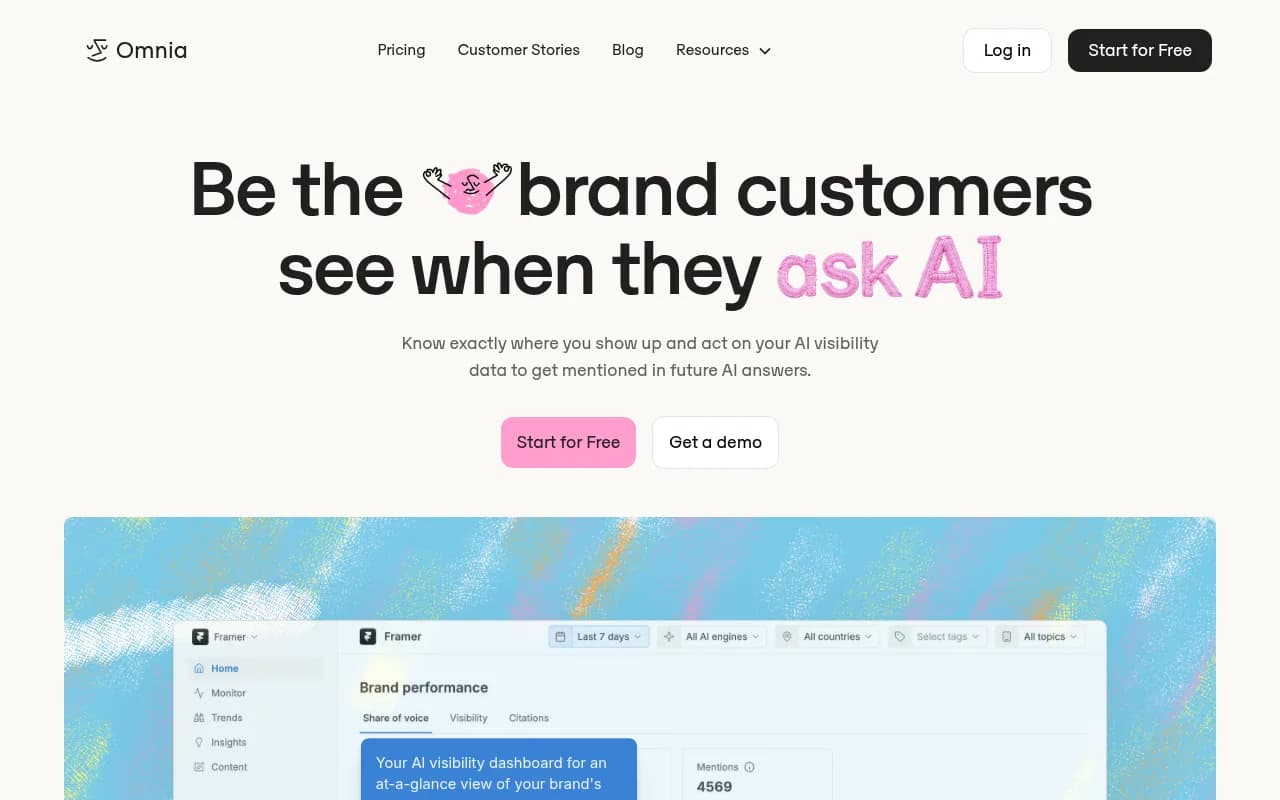
Omnia is an AI visibility platform that monitors brand mentions across ChatGPT, Perplexity, Google AI Overviews, and Google AI Mode. The platform targets SEO and marketing teams who want to understand how AI engines perceive their brand.
Omnia's core value is translating tracking data into a personalized roadmap -- content creation tasks, technical SEO fixes, and content placement recommendations mapped to fill your brand's specific gaps. It surfaces real questions people ask AI and shows which prompts trigger your brand mentions, helping you understand the "why" behind your visibility.
Side-by-Side Comparison
| Feature | Promptwatch | Omnia |
|---|---|---|
| AI models tracked | 10 (ChatGPT, Claude, Perplexity, Gemini, Meta AI, DeepSeek, Grok, Mistral, Copilot, Google AI) | 4 (ChatGPT, Perplexity, Google AI Overviews, Google AI Mode) |
| Content generation | Yes -- AI writing agent with 880M+ citations data | No |
| AI crawler logs | Yes -- real-time logs of ChatGPT/Claude/Perplexity crawling your site | No |
| Citation analysis | Yes -- page-level tracking with source URLs | Yes -- citation sources and types |
| Competitor tracking | Yes -- heatmaps and share-of-voice | Yes -- benchmarking |
| Reddit/YouTube tracking | Yes | No |
| ChatGPT Shopping | Yes | No |
| Prompt intelligence | Yes -- volume estimates, difficulty scores, query fan-outs | Yes -- prompt discovery |
| Action roadmap | Answer Gap Analysis + content generation | Personalized insights roadmap |
| Traffic attribution | Yes -- code snippet, GSC integration, server logs | Not mentioned |
| Multi-language/region | Yes | Not specified |
| API access | Yes | Not mentioned |
| Starting price | $99/mo (transparent tiers) | Flexible pricing (request quote) |
| Free trial | 7 days | Yes |
Platform coverage and tracking depth
Promptwatch monitors 10 AI models. That's ChatGPT, Claude, Perplexity, Gemini, Meta AI (Llama), DeepSeek, Grok, Mistral, Copilot, plus both Google AI Overviews and Google AI Mode. If an AI engine matters for search visibility, Promptwatch tracks it.
Omnia covers 4 models: ChatGPT, Perplexity, Google AI Overviews, and Google AI Mode. That's the core set, but you're missing Claude (huge for enterprise), Gemini (Google's flagship), Meta AI (Instagram/WhatsApp integration), DeepSeek (rising fast in 2026), Grok (X integration), Mistral (European market), and Copilot (Microsoft ecosystem).
For citation tracking, both platforms show which sources AI models pull from. Promptwatch breaks it down by page-level URLs, traffic estimates, position changes, and first-seen dates. You see exactly which landing pages, articles, or news mentions drive your citations. Omnia shows citation sources and types (corporate, organic, news) with similar granularity.
The difference shows up in adjacent channels. Promptwatch tracks Reddit discussions and YouTube videos that influence AI recommendations -- a channel most platforms ignore entirely. It also monitors ChatGPT Shopping, showing when your brand appears in product recommendations and shopping carousels. Omnia doesn't cover either.
Verdict: Promptwatch wins on breadth (10 models vs 4) and depth (Reddit, YouTube, ChatGPT Shopping). If you need comprehensive coverage across the AI landscape, Promptwatch is the clear choice. Omnia works if you only care about the core 4 models.
Content optimization and generation
This is where the platforms diverge completely.
Promptwatch includes an AI writing agent that generates articles, listicles, and comparison pages grounded in real citation data. It's analyzed 880M+ citations to understand what content patterns get cited by ChatGPT, Claude, and Perplexity. The agent uses prompt volumes, persona targeting, and competitor analysis to create content engineered for AI visibility -- not generic SEO filler.
The workflow: Answer Gap Analysis shows you which prompts competitors rank for but you don't. You see the specific topics, angles, and questions AI models want answers to but can't find on your site. Then you generate content to fill those gaps. Track the results with page-level visibility scores and traffic attribution to close the loop.
Omnia provides a personalized roadmap that translates tracking data into action items: content creation tasks, technical SEO fixes, content placement recommendations. It tells you what to do, but you're on your own for actually creating the content. No AI writing agent, no content generation, no templates.
Verdict: Promptwatch is an optimization platform. Omnia is a monitoring platform with action recommendations. If you want to actually create content that ranks in AI search, Promptwatch does it end-to-end. Omnia gives you the roadmap but leaves you to execute.
AI crawler logs and indexing insights
Promptwatch offers real-time AI crawler logs -- live feeds showing when ChatGPT, Claude, Perplexity, and other AI models hit your website. You see which pages they read, what errors they encounter, how often they return, and whether they're successfully indexing your content.
This is critical for diagnosing indexing issues. If ChatGPT isn't citing your new product page, the crawler logs show whether it's even reading that page. Maybe it's hitting a 404, maybe it's blocked by robots.txt, maybe it's crawling an old cached version. You see the problem and fix it.
Omnia doesn't offer crawler logs. You can see citation data (which pages AI models cite in responses), but you don't see the crawling behavior itself. If you're not getting cited, you're guessing at why.
Verdict: Promptwatch wins decisively. Crawler logs are a diagnostic tool that monitoring-only platforms can't replicate. If you're serious about AI indexing and want to understand how AI engines discover your content, you need crawler logs.
Prompt intelligence and discovery
Both platforms help you discover which prompts to track.
Promptwatch provides volume estimates and difficulty scores for each prompt, plus query fan-outs that show how one prompt branches into sub-queries. You can prioritize high-value, winnable prompts instead of guessing. The platform surfaces prompts based on competitor analysis, industry trends, and your existing visibility gaps.
Omnia surfaces real questions people ask AI about your industry or product. It shows which prompts trigger your brand mentions and helps you discover new prompts to monitor. The focus is on understanding customer intent and mapping prompts to your brand's positioning.
Both approaches work. Promptwatch is more data-driven (volume, difficulty, fan-outs). Omnia is more intent-focused (real customer questions, brand triggers).
Verdict: Tie. Choose based on your workflow. If you want quantitative prioritization, go Promptwatch. If you want qualitative customer insights, Omnia's approach fits better.
Competitor analysis and benchmarking
Promptwatch offers competitor heatmaps that compare your AI visibility vs competitors across all tracked LLMs. You see who's winning for each prompt and why -- which pages they're getting cited for, which sources drive their mentions, how their share-of-voice trends over time.
Omnia provides competitor benchmarking that shows how you stack up against rivals in AI search results. You see share-of-voice comparisons and citation source analysis.
Both platforms cover the basics. The difference is in the presentation and depth. Promptwatch's heatmaps make it easy to spot patterns across multiple models. Omnia's benchmarking is solid but less visual.
Verdict: Slight edge to Promptwatch for the heatmap visualization and cross-model comparison, but both platforms handle competitor analysis well.
Pricing comparison
| Plan | Promptwatch | Omnia |
|---|---|---|
| Entry tier | $99/mo -- 1 site, 50 prompts, 5 articles/mo | Not disclosed |
| Mid tier | $249/mo -- 2 sites, 150 prompts, 15 articles/mo, crawler logs, state/city tracking | Not disclosed |
| High tier | $579/mo -- 5 sites, 350 prompts, 30 articles/mo | Not disclosed |
| Enterprise | Custom pricing | Custom pricing |
| Free trial | 7 days | Yes (duration not specified) |
| Annual discount | Yes | Not specified |
Promptwatch has transparent, public pricing. You know exactly what you're paying and what you get at each tier. The entry plan at $99/mo is accessible for small teams testing AI visibility.
Omnia uses "flexible pricing" with no public rates. You have to request a quote. This is common for enterprise-focused tools, but it makes budget planning harder and adds friction to the buying process.
Verdict: Promptwatch wins on transparency. Public pricing lets you evaluate cost vs value before talking to sales. Omnia's request-a-quote model works for some buyers but slows down decision-making.
Integration and data export
Promptwatch offers:
- Looker Studio integration for custom reporting
- Full API access for building custom workflows
- Google Search Console integration for traffic attribution
- Server log analysis option
- Code snippet for visitor tracking
Omnia's integration capabilities aren't detailed in the available data. No mention of API access, Looker Studio, or GSC integration.
Verdict: Promptwatch has a clear edge for teams that need to integrate AI visibility data into existing reporting workflows or build custom automations.
Pros and cons
Promptwatch pros
- Tracks 10 AI models vs Omnia's 4 -- comprehensive coverage
- Built-in AI content generation grounded in 880M+ citations
- Real-time crawler logs for diagnosing indexing issues
- Reddit and YouTube tracking for adjacent influence channels
- ChatGPT Shopping monitoring
- Transparent pricing starting at $99/mo
- Full API and Looker Studio integration
- Traffic attribution with multiple methods (GSC, code snippet, server logs)
Promptwatch cons
- More features means steeper learning curve
- Content generation is limited by plan tier (5-30 articles/mo)
- Might be overkill if you only care about ChatGPT and Perplexity
Omnia pros
- Personalized action roadmap translates data into specific tasks
- Focus on understanding "why" prompts trigger your brand
- Clean interface for teams new to AI visibility
- Good for core model tracking (ChatGPT, Perplexity, Google AI)
Omnia cons
- Only tracks 4 AI models -- missing Claude, Gemini, Meta AI, DeepSeek, Grok, Mistral, Copilot
- No content generation -- roadmap only, execution is on you
- No AI crawler logs for diagnosing indexing issues
- No Reddit, YouTube, or ChatGPT Shopping tracking
- No public pricing -- have to request a quote
- Integration capabilities unclear
Who should pick which tool
Pick Promptwatch if:
- You want an optimization platform, not just a monitoring dashboard
- Content generation is part of your workflow and you need AI-optimized articles at scale
- You need comprehensive coverage across 10 AI models, not just the core 4
- Diagnosing indexing issues with crawler logs matters to your team
- You track influence channels like Reddit and YouTube
- You sell products and want ChatGPT Shopping visibility
- You need API access or Looker Studio integration for custom reporting
- Transparent pricing and fast decision-making matter
- You're a brand, agency, or marketing team serious about AI search as a revenue channel
Pick Omnia if:
- You only care about ChatGPT, Perplexity, and Google AI (Overviews + Mode)
- You want a personalized roadmap but plan to handle content creation yourself
- You prefer a simpler interface focused on core monitoring
- You're comfortable with request-a-quote pricing
- Your team is new to AI visibility and wants a less overwhelming starting point
Final verdict
Promptwatch is the better choice for most teams in 2026. It's the only platform that closes the full loop: find gaps (Answer Gap Analysis), create content (AI writing agent), track results (crawler logs + traffic attribution). Omnia gives you the roadmap but leaves you to execute -- fine if you have content resources, limiting if you don't.
The model coverage gap is significant. Promptwatch tracks 10 AI engines including Claude (enterprise favorite), Gemini (Google's flagship), Meta AI (Instagram/WhatsApp), and DeepSeek (rising fast). Omnia's 4-model coverage misses too much of the AI landscape in 2026.
Crawler logs are a diagnostic capability that monitoring-only tools can't replicate. If ChatGPT isn't citing your content, Promptwatch shows you whether it's even reading your pages. Omnia leaves you guessing.
Omnia works if you only care about the core 4 models and want a simpler interface with action recommendations. But for comprehensive AI visibility optimization, Promptwatch is the clear winner -- more models, more features, more actionable, and transparent pricing that respects your time.