Key takeaways
- All three tools now add some AI visibility tracking, so the old line that they are "SERP-only" is out of date. Clearscope tracks queries in ChatGPT and Gemini, Frase scores GEO and tracks AI visibility, and Surfer sells a separate AI tracker.
- No independent evidence we could find shows that a content score from any of these tools predicts a citation in ChatGPT or AI Overviews. Treat the score as a coverage checklist, not a ranking promise.
- Promptwatch Data shows ChatGPT cites product and landing pages most (22.4% and 16.8%, Sep 28 to Oct 4, 2026). Editorial formats, where these briefs shine, are about 43% combined.
- Pick Clearscope for editorial teams with many writers, Frase for brief-to-publish speed on a budget, Surfer for deep on-page optimization and audits.
- A brief only helps if it targets fan-out queries, not the user's prompt. Add that layer yourself if your tool doesn't.
The question behind the comparison
Every vendor in this space now says some version of "rank on Google, get cited by AI." Frase literally put that on its homepage. So the useful question isn't which tool has an AI tab. It's whether the brief the tool hands your writer changes the odds that an AI answer cites the finished page.
I'll be upfront: nobody has proven that yet. The comparison articles I read for this guide (Omnia, Slate, Coursiv, Frase's own blog) are written by vendors or affiliates, and each one tilts toward whoever pays the bills. One of them says Clearscope has no AI visibility at all, which is flatly wrong today. So this guide sticks to primary pricing pages and first-party citation data, and tells you where the evidence runs out.
What a brief can and can't do for AI citations
Traditional brief tools work the same way. They pull the top-ranking pages for a keyword, run NLP over them, and tell you which terms, headings and word counts the winners share. That is a good way to avoid missing obvious subtopics. It is a weak way to decide what format to publish.
Here is what Promptwatch Data found for ChatGPT citations between Sep 28 and Oct 4, 2026:
- Product pages: 22.4% of classified citations
- Landing pages: 16.8%
- Listicles: 13.6%
- How-to guides: 8.7%
- Documentation: 7.5%
- General articles: 6.1%
- Comparisons: 5.9%
- News: 5.7%
- FAQ pages: 3.3%
- Reviews: 1.7%
Roughly 39% of citations go to pages describing what a company sells. A keyword-coverage brief is mostly a tool for the editorial slice. That doesn't make it useless, since informational prompts push how-tos to 10.7% and docs to 8.5%. It means a brief won't rescue a site that has no crawlable product or landing pages.
There is a second issue. The thing AI systems match against isn't the user's prompt, it's the web searches the model fires off in response. Promptwatch's ChatGPT query fanout data shows average query length fell from about 117 characters in December 2025 to around 53 characters (six to eight words) in April 2026. Short, entity-first queries. A brief built from the SERP for your head keyword doesn't necessarily mirror those.
And decay matters. In Promptwatch's content half-life study, landing pages and docs were still cited at 78% and 76% after 30 days, while half of news pages dropped out within 36 days. Briefs are a day-one tool. Refresh tooling is what you need on day 90.
Clearscope
Clearscope analyzes the top search results for a keyword and gives you an A to F grade based on term coverage and topic depth. It's the cleanest editor of the three, and editors like it for that reason: writers, editors and SEO managers work from the same document.
Pricing from its own page:
- Essentials: $129/mo, 50 tracked queries, 50 pages, 20 Topic Explorations and 20 Drafts per month
- Business: $399/mo, 300 tracked queries, 300 pages, 50 Topic Explorations, a dedicated account manager
- Enterprise: custom, with SSO and crawler whitelisting
- Every plan: unlimited users and projects, no contract, 14-day free trial
The AI angle is better than older reviews suggest. Every plan includes query tracking across ChatGPT and Gemini, brand visibility tracking, and what Clearscope calls query fan-out awareness, which shows the web searches AI platforms trigger so you can build content around them. That's the closest any of the three comes to the fan-out target described above.
The catch is price per seat of output. Add-on pages ($25/mo on Essentials) and extra drafts ($50) stack up fast. If you publish a lot, you'll feel it. Unlimited users is the real selling point for agencies with rotating freelancers.
Frase
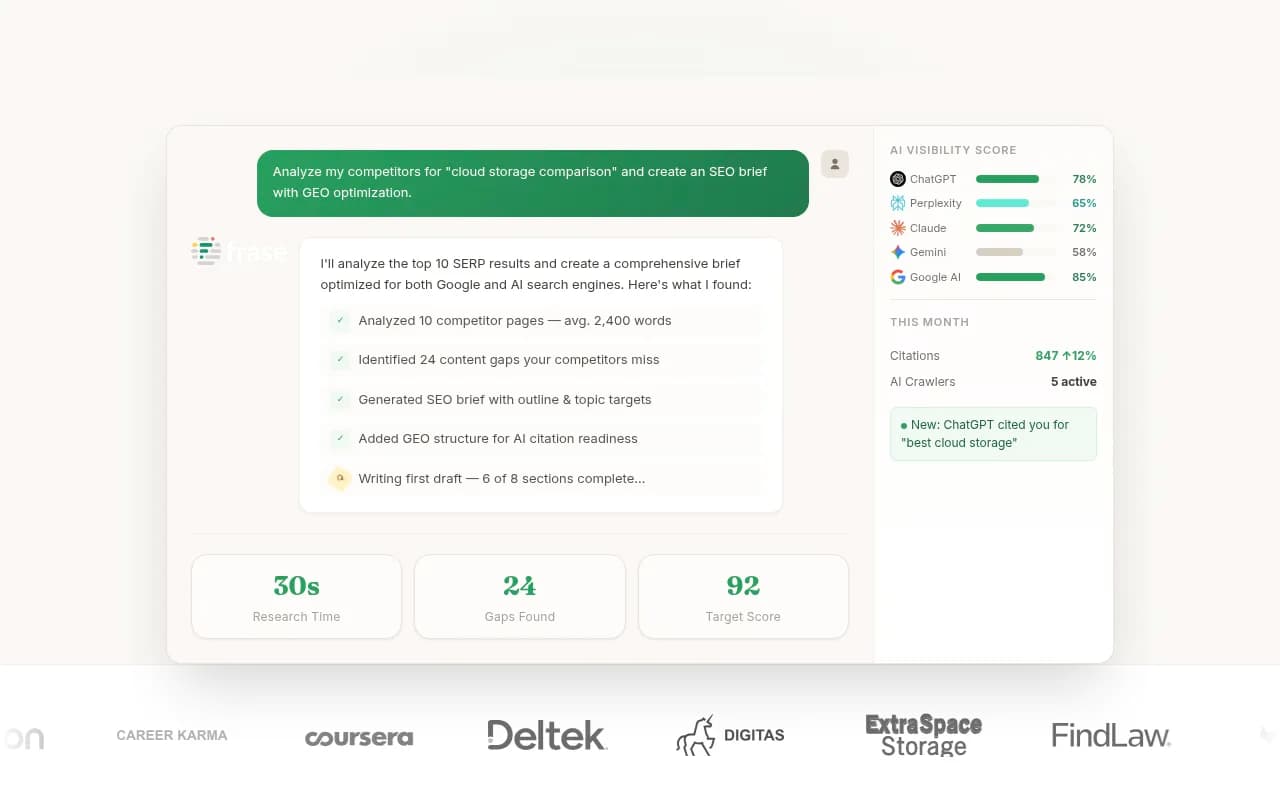
Frase started as the budget SERP-research-to-brief tool. It clusters related topics into sections, pulls People Also Ask questions, suggests word counts from competitors, and then drafts. It has since repositioned as an agent-driven "content operating system for AI search," with an MCP server and CLI, publishing to WordPress, Webflow, Sanity or Wix, and a hosted FraseCMS option with structured data and llms.txt.
Pricing from its pricing page (yearly billing, monthly in brackets):
- Starter: $39 ($49), 1 seat, 10 articles, SEO and GEO scores, AI Visibility on ChatGPT and Google AI, Content Guard on 10 pages
- Professional: $103 ($129), 3 seats, 40 articles, AI crawler monitoring, Perplexity added, Content Guard on 75 pages
- Scale: $239 ($299), 5 seats, 100 articles, Claude and Gemini added, Content Guard on 300 pages, client reports
Two things stand out. First, Content Guard watches pages for decay, which lines up with the half-life data. Second, AI visibility coverage is gated by tier: Claude and Gemini only appear on Scale. If your buyers use Gemini and you're on Starter, you're flying blind there.
Frase is also honest in a way I appreciate: it says no tool ranks you inside a trial, and that rankings and citations build over weeks. Its own comparison post claims a first-generation score of 100/100 against Surfer, but that's a vendor test with a vendor-picked prompt. Take it as a demo, not a benchmark.
Surfer SEO
Surfer SEO is the most data-dense editor of the three, with a content score built from hundreds of on-page signals, SERP correlation analysis, an SEO audit, topical mapping and AI article drafting. Its pricing page now leads with AI visibility tracking, and the AI tracker is sold as a separate product starting around $82/mo billed yearly.
A caveat on numbers: I could only verify the AI tracker price. The content plan prices (an earlier source lists Discovery at $49/mo yearly) need checking on surferseo.com/pricing before you budget. Surfer's separate tracker also means AI visibility is an add-on cost rather than bundled into the editor.
Surfer's strength is the feedback loop for people who like numbers. Its weakness is the same thing. Numeric targets can pull writers toward score-chasing and away from clarity and original expertise, which are precisely what AI systems seem to reward when they pick sources.
Side by side
| Surfer SEO | Clearscope | Frase | |
|---|---|---|---|
| Entry price | Verify on site (earlier source: $49/mo yearly); AI tracker from ~$82/mo | $129/mo | $39/mo yearly ($49 monthly) |
| Users | Plan dependent | Unlimited on every plan | 1 to 5 seats by tier |
| Brief style | Dense term and structure targets | Clean term list, A-F grade | Auto-built outline with PAA and clusters |
| AI visibility | Separate AI tracker product | ChatGPT and Gemini query tracking, fan-out awareness | ChatGPT and Google AI on Starter; more engines on higher tiers |
| Decay monitoring | Audits | Page tracking | Content Guard (10 to 300 pages) |
| Drafting | Full AI article drafts | Guided Draft with AI | AI drafts plus CMS publishing |
| Best for | Optimization-heavy SEO teams | Editorial teams, agencies | Budget teams wanting brief-to-publish speed |
Which brief helps you get cited
Here's my opinionated read, with the caveat that it's reasoning from the citation data, not a controlled test.
For informational and how-to content
Any of the three works as a completeness check. The ones with fan-out awareness (Clearscope) or PAA-driven FAQ sections (Frase) are closer to what AI actually searches for. Write headings that read like short queries, front-load the entity and category in H2s, and cover the obvious sub-questions: X vs Y, pricing, alternatives. That advice comes from Promptwatch's fan-out research and it applies whichever tool you use.
For commercial prompts
Briefs are the wrong lever. For "best CRM for small businesses" style prompts, product pages are 26.0% of citations and landing pages 20.6%, according to the same Promptwatch report. Fix your product page structure, comparison tables and crawlability first. A perfectly scored blog post won't substitute.
For keeping what you've published
Frase's Content Guard and Clearscope's page tracking address decay, and Surfer's audit does something similar. News-style posts lose half their citations in about five weeks, while landing pages and docs last. Put your refresh budget where decay is fastest.
Where these tools stop
All three are writing-side tools. Their AI features tell you whether you showed up, but they don't tell you whether crawlers could read the page, which of your pages actually got cited, or whether that citation sent traffic. For that you need a dedicated visibility platform. Tools like Promptwatch cover the monitoring and action side, including AI crawler logs and citation tracking per page, so you can see whether briefed content gets picked up at all.

If you want to compare more options, the GEO software directory at bestgeosoftware.com lists dozens of them.
Other brief tools worth a look if none of the three fits: MarketMuse for site-wide planning, NeuronWriter for the lowest entry price, and Content Harmony for brief-only workflows.
A practical workflow that doesn't depend on the tool
- Start with the prompt, not the keyword. Write down the commercial, informational and branded prompts your buyers use.
- Decide the format. If the prompt is commercial, the answer is probably a product page, comparison or listicle, not a 2,000-word explainer.
- Build the brief from fan-out queries and SERP coverage. Use your tool for the SERP part and a fan-out source for the rest.
- Write for extraction. Short answer-first paragraphs, tables for comparisons, FAQ blocks.
- Publish somewhere crawlable and check crawler logs after a week.
- Track citations at 30 and 60 days, and refresh whatever is decaying.
Verdict
Choose Clearscope if several writers share the editor and you value a clean grade plus fan-out data, and can live with the price. Choose Frase if budget matters and you want research, drafting, publishing and decay monitoring in one place, but check which AI engines your tier actually covers. Choose Surfer if you're an SEO team that wants audits and deep on-page scoring and doesn't mind paying separately for AI tracking.
None of them will get you cited on their own. The brief gets the page complete. Format, crawlability and freshness decide whether it's used.