LLM Pulse Review 2026
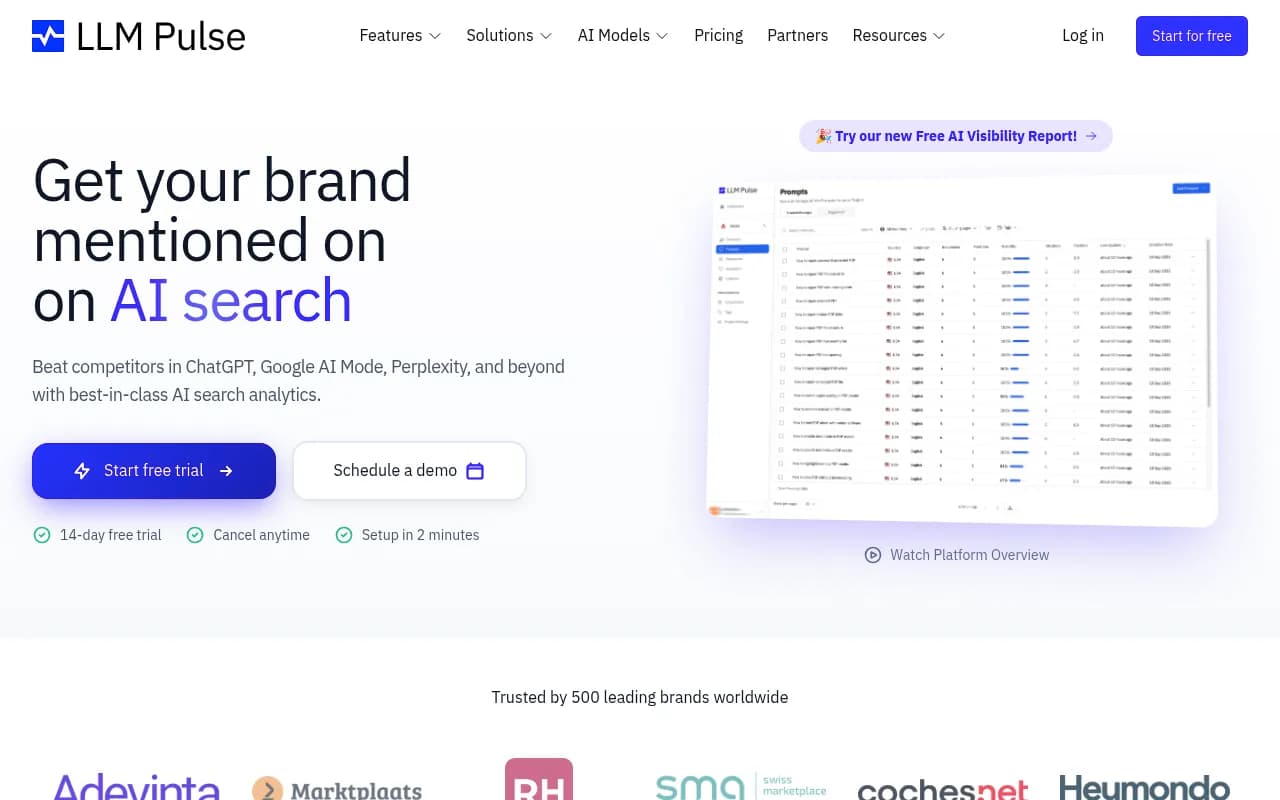
LLM Pulse monitors how AI chatbots like ChatGPT, Perplexity, Gemini, and Google AI Mode describe your brand. Track prompts weekly, measure visibility scores, analyze citations, and benchmark against competitors. Used by 500+ brands to understand and improve their AI search presence.
Key Takeaways:
- Monitoring-only platform -- LLM Pulse shows you what AI models say about your brand but lacks content gap analysis, AI content generation, and crawler logs that Promptwatch offers
- Tracks 10+ AI models including ChatGPT, Perplexity, Gemini, Google AI Mode, AI Overviews, DeepSeek, Grok, Claude, Copilot, and Meta AI (some models require Enterprise plan)
- Pricing starts at €49/month (Starter: 1 project, 40 prompts) up to €299/month (Scale: 5 projects, 300 prompts). Custom enterprise plans available.
- Strong Looker Studio integration and API access for custom reporting workflows
- Best for brands that want basic AI visibility tracking but don't need optimization tools or traffic attribution

LLM Pulse entered the AI search visibility space in 2023-2024 as one of the early movers tracking brand mentions across large language models. The platform is built around a simple premise: millions of people now ask ChatGPT and Perplexity instead of Google, so brands need to know what these AI models are saying about them. The company claims 500 brands use the platform, including Swiss Marketplace Group, Adevinta/Marktplaats, and Voicemod.
The core value proposition is straightforward -- you define a set of prompts (questions people ask AI about your industry), and LLM Pulse tracks how often your brand gets mentioned in the responses. You get a visibility score, citation analysis, sentiment tracking, and competitor benchmarking. It's a monitoring dashboard, not an optimization platform.
Prompt Tracking
You manually add prompts you want to track -- things like "best project management tools for startups" or "top CRM software for small businesses". LLM Pulse queries each AI model weekly (daily tracking available on Enterprise plans) and captures the full response. The platform extracts brand mentions, citations, and sentiment from each response.
The Starter plan gives you 40 tracked prompts, Growth gives you 100, Scale gives you 300. Each prompt generates one AI response per week per model. So if you're tracking 40 prompts across 5 models (ChatGPT, Perplexity, Gemini, Google AI Mode, AI Overviews), that's 200 responses per week.
The platform includes an "AI prompt suggestion" feature that surfaces questions people actually ask AI about your industry. This is helpful for discovering relevant prompts, but it's not the same as the query fan-outs and prompt volume estimates that Promptwatch provides. You're still guessing which prompts matter most.
Visibility Score and Citation Analysis
LLM Pulse calculates a visibility score based on how often your brand appears in AI responses. The exact methodology isn't detailed on the website, but it appears to be a simple mention frequency metric. You can benchmark your score against competitors you've added to the platform (5 competitors on Starter, 10 on Growth, 15 on Scale).
Citation analysis shows which sources AI models reference when they mention your brand -- your own website, Reddit threads, news articles, third-party reviews, etc. This is useful for understanding where AI models are getting their information, but it doesn't tell you what content you're missing or how to fix gaps. That's where LLM Pulse stops and Promptwatch starts -- with Answer Gap Analysis that shows exactly which prompts competitors rank for but you don't, plus an AI writing agent that generates content to close those gaps.
Sentiment and Competitive Landscape
The platform tracks whether AI models describe your brand positively, negatively, or neutrally. You can see the exact words AI uses in each response, which helps you spot inaccuracies or negative framing before customers see it. This is genuinely useful -- if ChatGPT is telling people your product is expensive or buggy, you want to know.
Competitor tracking lets you see who AI recommends when customers ask questions in your category. You can compare your visibility side-by-side with competitors and identify where you're losing mindshare. But again, this is descriptive, not prescriptive. You see the problem but don't get actionable recommendations on how to fix it.
Model Coverage
LLM Pulse tracks 10+ AI models, but not all are available on all plans. The base plans (Starter, Growth, Scale) include ChatGPT, Perplexity, Google AI Mode, Google AI Overviews, and Gemini. DeepSeek, Grok, Claude, Copilot, and Meta AI require an Enterprise plan. This is a notable limitation -- if you want comprehensive coverage, you're paying custom enterprise pricing.
By comparison, Promptwatch includes all 10+ models on every plan starting at $99/month, plus features like AI crawler logs, traffic attribution, and Reddit/YouTube tracking that LLM Pulse doesn't offer at any price.
Integrations and Reporting
LLM Pulse offers a Looker Studio connector and API access, which is a strong point. You can export data to CSV/Excel or build custom dashboards in Looker Studio. The API lets you pull LLM Pulse data into your own reporting tools or workflows. This is particularly valuable for agencies or enterprises that need to integrate AI visibility metrics into existing dashboards.
The platform also tracks app store citations -- mentions of your brand in app store listings and reviews that AI models reference. This is a niche feature but useful if you're a mobile app.
Who Is It For
LLM Pulse is built for brand managers, marketing teams, and agencies that want basic AI visibility tracking. It's a good fit if you:
- Need to monitor what ChatGPT, Perplexity, and other AI models say about your brand
- Want to benchmark your AI visibility against competitors
- Have a clear sense of which prompts to track (or are willing to manually discover them)
- Don't need content optimization, gap analysis, or traffic attribution
- Want to integrate AI visibility data into existing Looker Studio dashboards
It's not a good fit if you:
- Need help identifying which prompts to track (no prompt volume or difficulty scoring)
- Want to understand why you're not visible for certain prompts (no content gap analysis)
- Need tools to actually improve your AI visibility (no AI content generation)
- Want to track AI crawler activity on your website (no crawler logs)
- Need to connect AI visibility to actual traffic and revenue (no visitor analytics or attribution)
The target audience is brands that are just starting to think about AI search and want a simple monitoring dashboard. If you're serious about optimizing your AI visibility -- not just tracking it -- you'll quickly outgrow LLM Pulse and need a platform like Promptwatch that helps you take action.
Pricing and Value
Pricing is in euros:
- Starter: €49/month (€490/year) -- 1 project, 40 prompts, 5 competitors, 5 AI models
- Growth: €99/month (€990/year) -- 2 projects, 100 prompts, 10 competitors, 5 AI models
- Scale: €299/month (€2,990/year) -- 5 projects, 300 prompts, 15 competitors, 5 AI models
- Enterprise: Custom pricing -- up to 100k prompts, daily tracking, all 10+ models, white label, SSO, dedicated support
All plans include unlimited team members, brand sentiment analysis, app store citations, data exports, and Looker Studio connector. There's a 14-day free trial. Annual billing saves 17%.
The pricing is competitive for basic monitoring, but the value proposition weakens when you compare features. For €99/month, you get 100 prompts tracked weekly across 5 models. For $99/month, Promptwatch gives you 50 prompts across 10+ models, plus AI crawler logs, Answer Gap Analysis, AI content generation (5 articles/month), and traffic attribution. You're paying the same price for a monitoring-only tool vs. an optimization platform.
LLM Pulse's strength is the Looker Studio integration and API, which makes it easier to integrate into existing reporting workflows. If that's critical for your team, it might justify the price. But for most brands, the lack of optimization tools is a dealbreaker.
Strengths
- Clean, simple interface -- easy to understand what AI models are saying about your brand
- Looker Studio connector and API -- strong integration options for custom reporting
- App store citations tracking -- niche feature that competitors often miss
- Unlimited team members -- no per-seat pricing
- 14-day free trial -- low-risk way to test the platform
Limitations
- No content gap analysis -- you see where you're not visible but not why or what to do about it
- No AI content generation -- no tools to actually improve your visibility
- No AI crawler logs -- you don't know which pages AI models are reading or how often they visit your site
- No traffic attribution -- you can't connect AI visibility to actual traffic or revenue
- Limited model coverage on base plans -- DeepSeek, Grok, Claude, Copilot, Meta AI require Enterprise
- No Reddit or YouTube tracking -- missing channels that heavily influence AI recommendations
- No prompt volume or difficulty scoring -- you're guessing which prompts are worth tracking
- Weekly tracking only -- daily tracking requires Enterprise plan
Compared to Promptwatch, LLM Pulse is missing the entire optimization layer. You see the data but you're stuck figuring out what to do with it. Promptwatch shows you the gaps, generates content to fill them, and tracks the results -- the full action loop.
Bottom Line
LLM Pulse is a solid monitoring dashboard for brands that want to track AI visibility without optimization tools. If you just need to know what ChatGPT and Perplexity say about your brand, and you're comfortable manually identifying prompts and creating content on your own, it's a reasonable choice. The Looker Studio integration and API are strong points for teams that need custom reporting.
But if you want to actually improve your AI visibility -- not just track it -- Promptwatch is the better option. It gives you the same monitoring capabilities plus Answer Gap Analysis, AI content generation, crawler logs, traffic attribution, and Reddit/YouTube tracking. You're paying the same price for a platform that helps you take action, not just watch numbers.
Best use case in one sentence: Brands that need basic AI visibility monitoring with strong Looker Studio integration and don't require optimization tools or traffic attribution.
Tags:
Similar and alternative tools to LLM Pulse