Key Takeaways
- AthenaHQ costs $295/mo ($95/mo annual) with no free trial, while Omnia offers flexible pricing with a free trial -- Omnia is more accessible for testing before committing
- Both track the same core AI engines (ChatGPT, Perplexity, Google AI Overviews, Gemini, Claude), but AthenaHQ monitors 8+ LLMs vs Omnia's 4-5 focus
- AthenaHQ targets enterprise teams (ZoomInfo, Coinbase, SoFi) with workflow management and cross-platform dashboards, while Omnia emphasizes a personalized roadmap and step-by-step action plan
- Neither platform offers content generation or AI crawler logs -- both are monitoring-focused with optimization recommendations layered on top
- AthenaHQ has stronger brand recognition (Forbes, WSJ coverage, Y Combinator backed), while Omnia is newer with less public traction
- For teams that need more than monitoring, Promptwatch combines visibility tracking with content gap analysis, AI content generation, and crawler logs to close the optimization loop
Overview
AthenaHQ

AthenaHQ is a GEO (Generative Engine Optimization) platform built by ex-Google and DeepMind engineers. It monitors how brands appear across 8+ AI search engines -- ChatGPT, Perplexity, Google AI Overviews, Claude, Gemini, and others. The platform is used by enterprise teams at ZoomInfo, Coinbase, SoFi, and Volkswagen. AthenaHQ positions itself as an "end-to-end AEO & GEO platform" with citation tracking, competitor analysis, and automated content optimization recommendations. Pricing starts at $295/mo for self-serve plans ($95/mo if billed annually), with enterprise custom pricing available. No free trial.
Omnia
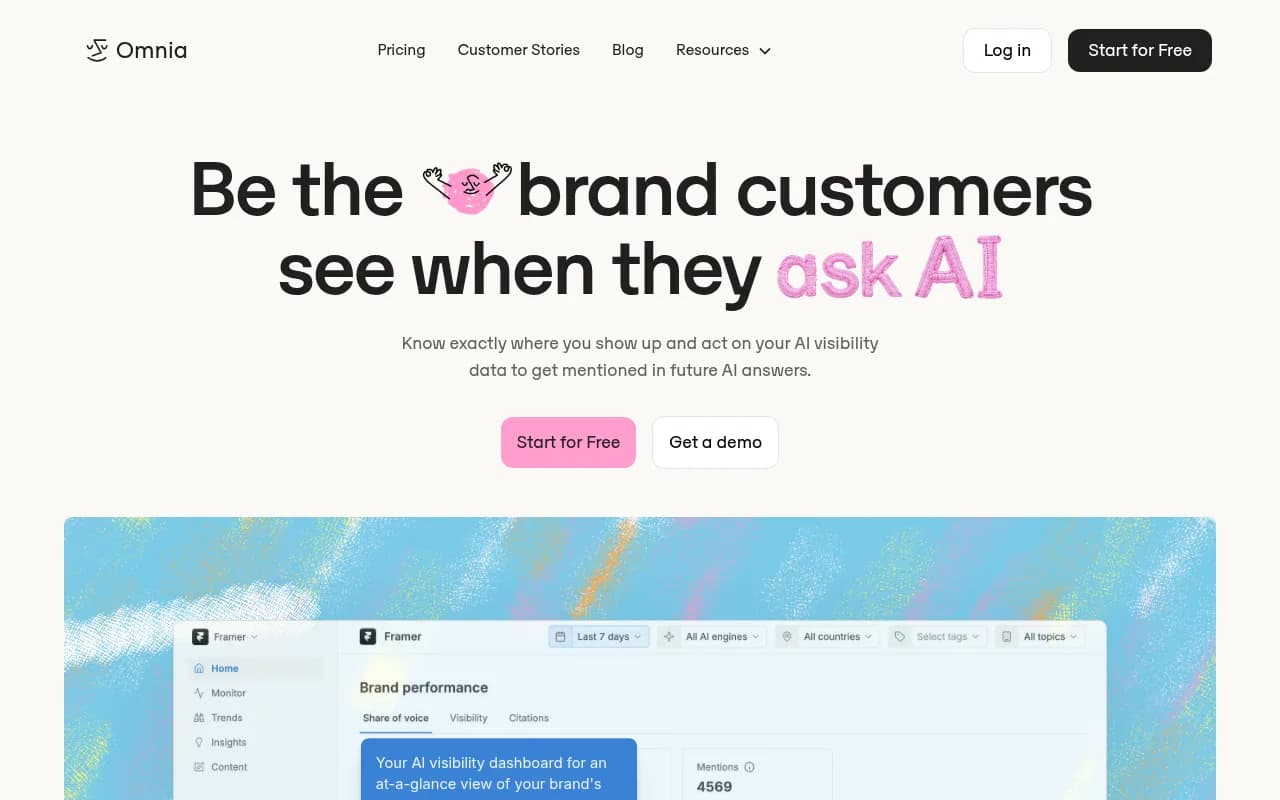
Omnia is an AI visibility platform that monitors brand mentions and citations in ChatGPT, Perplexity, Google AI Overviews, and Google AI Mode. Unlike pure monitoring tools, Omnia emphasizes actionable insights -- it translates tracking data into a personalized roadmap with step-by-step recommendations for content creation, technical SEO, and content placement. The platform is used by Exoticca, Ironhack, Growth Hackers, and Pleo. Omnia offers flexible pricing with a free trial, making it easier to test before committing. The focus is on helping SEO and marketing teams understand what prompts to monitor and how to improve visibility through concrete actions.
Side-by-Side Comparison
| Feature | AthenaHQ | Omnia |
|---|---|---|
| Pricing | $295/mo ($95/mo annual), no trial | Flexible pricing, free trial available |
| AI Engines Monitored | 8+ (ChatGPT, Perplexity, Google AI Overviews, Claude, Gemini, Copilot, others) | 4-5 (ChatGPT, Perplexity, Google AI Overviews, Google AI Mode, Gemini, Copilot) |
| Free Trial | No | Yes |
| Citation Tracking | ✓ | ✓ |
| Competitor Analysis | ✓ | ✓ |
| Personalized Roadmap | Automated recommendations | Step-by-step action plan |
| Prompt Discovery | ✓ | ✓ (real customer questions) |
| Content Generation | ✗ | ✗ |
| AI Crawler Logs | ✗ | ✗ |
| Target Audience | Enterprise teams, GEO specialists | SEO/marketing teams, SMBs |
| Brand Recognition | High (Forbes, WSJ, YC-backed) | Lower (newer platform) |
| Ease of Entry | High barrier (no trial, $295/mo) | Low barrier (free trial) |
Head-to-head feature deep-dive
AI engine coverage
AthenaHQ monitors 8+ AI engines, including ChatGPT, Perplexity, Google AI Overviews, Claude, Gemini, and Microsoft Copilot. The platform emphasizes "cross-platform AI visibility tracking" as a core feature, which matters if you want comprehensive coverage across the LLM landscape.
Omnia covers the main players -- ChatGPT, Perplexity, Google AI Overviews, Google AI Mode, Gemini, and Copilot -- but the marketing materials suggest a tighter focus on 4-5 engines rather than 8+. For most brands, the core engines (ChatGPT, Perplexity, Google) drive the majority of AI search traffic, so Omnia's narrower scope isn't necessarily a weakness.
Verdict: AthenaHQ wins on breadth. If you need to track every LLM under the sun, AthenaHQ has you covered. If you're focused on the engines that actually matter for your audience, Omnia's coverage is sufficient.
Pricing and accessibility
AthenaHQ charges $295/mo for self-serve plans, or $95/mo if you commit to annual billing upfront. There's no free trial, so you're buying blind. Enterprise pricing is custom, which likely means higher.
Omnia offers "flexible pricing" with a free trial. The exact Pro plan pricing isn't public, but the free trial lowers the barrier to entry significantly. You can test the platform, see if it fits your workflow, and then decide whether to pay.
Verdict: Omnia is more accessible. The free trial matters -- you get to kick the tires before spending money. AthenaHQ's no-trial approach works if you're an enterprise team with budget to burn, but it's a tough sell for smaller teams or anyone who wants to validate the tool first.
Actionable insights and recommendations
Both platforms claim to go beyond monitoring and provide actionable recommendations, but they approach it differently.
AthenaHQ offers "automated content optimization recommendations" and "citation source analysis." The platform is described as a "command center" for GEO specialists, with workflow management and ROI tracking. The emphasis is on giving you data and letting you execute the strategy.
Omnia translates tracking data into a "personalized roadmap" with step-by-step actions: content creation, technical SEO, content placement. The roadmap is "mapped to fill your brand's real gaps," which suggests a more prescriptive approach. Omnia also highlights prompt discovery -- showing you "real questions customers are asking" so you know what to monitor.
Verdict: Omnia feels more hand-holdy, which is good if you want a clear action plan. AthenaHQ gives you the tools and expects you to know what to do with them. If you're a GEO specialist, AthenaHQ's workflow management might be more valuable. If you're a marketer trying to figure out AI visibility for the first time, Omnia's roadmap is more helpful.
Content creation and optimization
Neither platform generates content for you. Both stop at recommendations -- they tell you what to optimize or create, but you have to do the work yourself.
AthenaHQ provides "automated content optimization recommendations" based on citation analysis. You see what's missing, but you write the content.
Omnia's roadmap includes "content creation" as a recommended action, but again, it's a recommendation, not a built-in content generator.
If you need a platform that actually creates content optimized for AI search, you're looking at a different category of tool. Promptwatch combines visibility tracking with an AI writing agent that generates articles, listicles, and comparisons grounded in citation data -- it closes the loop from tracking to content creation.

Verdict: Tie. Both platforms are monitoring + recommendations, not content generation platforms.
Competitor analysis
Both platforms offer competitor benchmarking.
AthenaHQ lets you track "how you benchmark against competitors" and includes competitor analysis as part of the citation tracking workflow.
Omnia shows "how you benchmark against competitors" and surfaces what citations AI engines pull from competitor sites.
The feature sets here are nearly identical based on the available data. Both let you see where competitors are winning and what sources they're getting cited from.
Verdict: Tie. No meaningful difference in competitor analysis capabilities.
User interface and workflow
AthenaHQ is built for "GEO specialists" and "AEO/GEO managers." The platform emphasizes "end-to-end GEO workflow management" and "unified command center." This suggests a more complex, feature-rich interface designed for power users who live in the tool daily.
Omnia is "built for SEO and marketing experts" but feels more approachable. The marketing copy emphasizes simplicity: "See the real questions people ask AI," "See your brand through AI's eyes," "Act on your data." The roadmap feature suggests a guided experience rather than a sprawling dashboard.
Verdict: AthenaHQ for power users, Omnia for teams that want simplicity. If you're a dedicated GEO specialist managing multiple brands, AthenaHQ's workflow tools are probably worth the complexity. If you're a marketing team adding AI visibility to your existing workload, Omnia's streamlined approach is easier to adopt.
Brand credibility and customer base
AthenaHQ has strong brand recognition. Featured in Forbes and the Wall Street Journal, backed by Y Combinator, and used by enterprise brands like ZoomInfo, Coinbase, SoFi, Nextiva, and Volkswagen. The ex-Google/DeepMind engineering pedigree adds credibility.
Omnia has a smaller, less recognizable customer base -- Exoticca, Ironhack, Growth Hackers, Pleo, Tuio. No major press coverage or VC backing mentioned. The platform feels newer and less established.
Verdict: AthenaHQ wins on brand strength. If you need to justify a purchase to executives or want the safety of a well-known vendor, AthenaHQ's press coverage and enterprise customers make the case easier.
Technical capabilities
Neither platform offers AI crawler logs, which means you can't see when ChatGPT, Claude, or Perplexity bots are hitting your site, what pages they're reading, or whether they're encountering errors. This is a blind spot for both tools -- you're tracking outputs (citations) but not inputs (how AI engines discover and index your content).
Both platforms focus on citation tracking, prompt monitoring, and competitor analysis. The technical depth is similar: track where you appear, see what sources get cited, benchmark against competitors.
Verdict: Tie. Both are monitoring-focused platforms without deeper technical features like crawler log analysis.
Pricing comparison
| Plan | AthenaHQ | Omnia |
|---|---|---|
| Free Trial | None | Yes |
| Self-Serve/Pro | $295/mo ($95/mo annual) | Pricing on request |
| Enterprise | Custom pricing | Custom pricing |
| Minimum Commitment | Monthly or annual | Flexible |
AthenaHQ's pricing is transparent but expensive. $295/mo is steep for a monitoring tool, especially with no trial. The $95/mo annual rate is more reasonable but requires upfront commitment.
Omnia's pricing isn't public, but the free trial makes it easier to evaluate. The "flexible pricing" language suggests they're willing to negotiate or offer multiple tiers.
Pros and cons
AthenaHQ pros
- Monitors 8+ AI engines for comprehensive coverage
- Strong brand credibility (Forbes, WSJ, YC-backed)
- Enterprise customer base (ZoomInfo, Coinbase, SoFi)
- Workflow management tools for GEO specialists
- Citation source analysis and competitor benchmarking
AthenaHQ cons
- No free trial -- you buy blind at $295/mo
- Expensive compared to alternatives
- No content generation or AI crawler logs
- Built for power users, potentially overwhelming for smaller teams
- Monitoring-focused, not an optimization platform
Omnia pros
- Free trial available -- test before committing
- Personalized roadmap with step-by-step action plan
- Prompt discovery shows real customer questions
- More approachable for non-specialist teams
- Flexible pricing (likely more affordable)
Omnia cons
- Fewer AI engines monitored (4-5 vs 8+)
- Less brand recognition and smaller customer base
- No content generation or AI crawler logs
- Newer platform with less proven track record
- Still monitoring-focused, not a full optimization suite
Who should pick which tool
Choose AthenaHQ if:
- You're an enterprise team with budget for a $295/mo tool
- You need comprehensive coverage across 8+ AI engines
- You have a dedicated GEO specialist who will live in the platform daily
- Brand credibility matters (you need to justify the purchase to executives)
- You want workflow management and ROI tracking for AI visibility efforts
Choose Omnia if:
- You want to test the platform with a free trial before committing
- You're a marketing or SEO team adding AI visibility to your workload
- You prefer a personalized roadmap over a sprawling dashboard
- You're focused on the core AI engines (ChatGPT, Perplexity, Google) rather than comprehensive coverage
- You want a more affordable entry point (likely)
Consider alternatives if:
- You need content generation, not just recommendations. Both AthenaHQ and Omnia tell you what to create but don't create it for you.
- You want AI crawler logs to understand how AI engines discover your content. Neither platform offers this.
- You're looking for an optimization platform, not just a monitoring dashboard. Both are tracking-heavy with recommendations layered on top, but neither closes the loop from insight to action.
Final verdict
AthenaHQ is the enterprise choice -- more engines, more credibility, more expensive. Omnia is the accessible choice -- free trial, personalized roadmap, easier to adopt. Both are solid monitoring platforms, but neither is a complete optimization solution.
If you're a large team with budget and a dedicated GEO specialist, AthenaHQ's comprehensive coverage and workflow tools justify the $295/mo price tag. If you're a smaller team or want to test before committing, Omnia's free trial and step-by-step roadmap make it the smarter starting point.
The real gap with both tools: they show you the problem but don't help you fix it. You get visibility data and recommendations, but you're on your own for content creation, technical optimization, and closing the loop. That's where the monitoring-only model breaks down -- you end up stuck with insights but no execution path.