Key takeaways
- Bluefish AI is built exclusively for enterprise brands (think Fortune 500 procurement cycles, infosec reviews, custom data segmentation). Omnia is built for SEO and marketing teams who want to get started quickly without a sales call.
- Bluefish AI pricing starts at an estimated $4,000+/month. Omnia has a free trial and more accessible Pro pricing -- a significant difference for budget-conscious teams.
- Both platforms monitor AI search visibility, but Bluefish goes further into AI commerce tracking and campaign ROI measurement. Omnia focuses on prompt discovery, citation monitoring, and a structured optimization roadmap.
- Omnia is self-serve; Bluefish AI is demo-only. If you want to explore a tool without talking to a sales rep first, Omnia wins by default.
- Neither tool generates content natively the way a full GEO platform does -- both are primarily monitoring and insights tools with optimization guidance layered on top.
- For teams that need enterprise-grade controls, custom audience segmentation, and infosec compliance, Bluefish AI is the more serious option. For everyone else, Omnia is the more practical starting point.
Overview
Bluefish AI
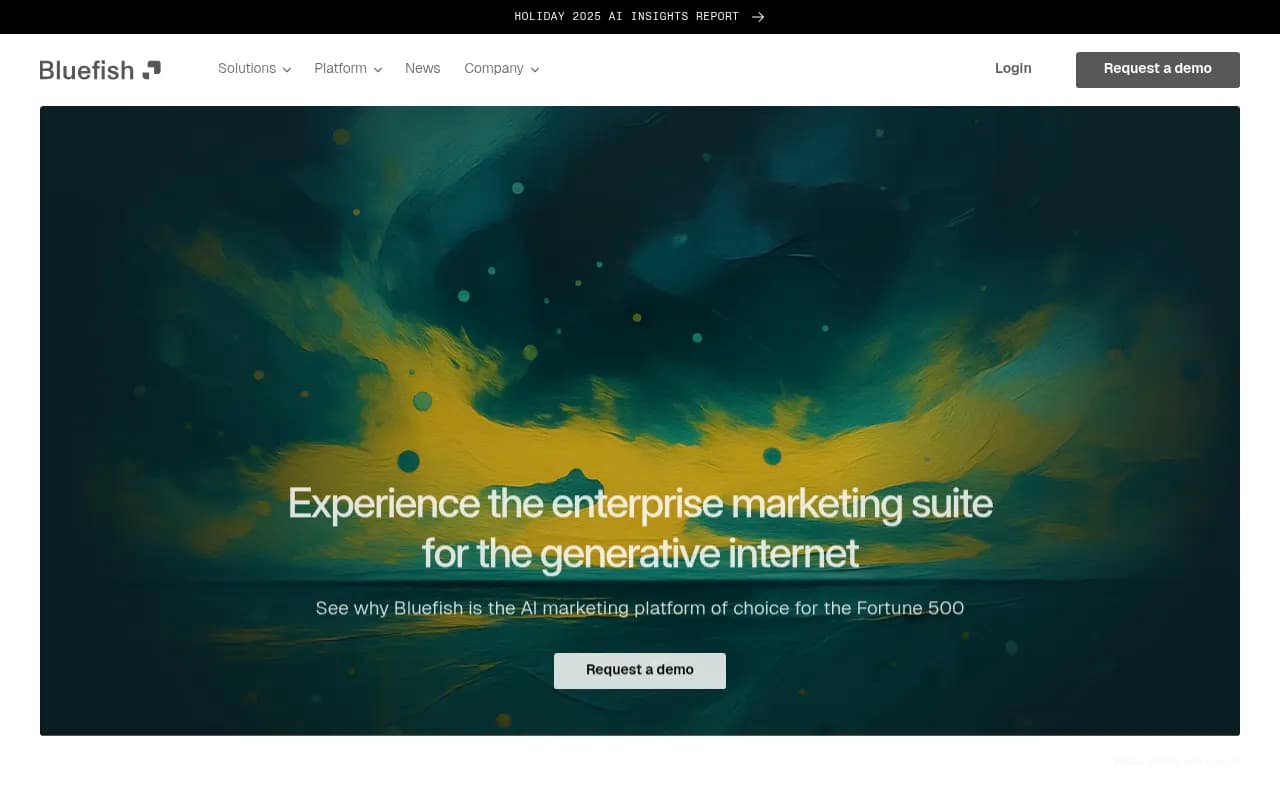
Bluefish AI positions itself as the enterprise GEO platform for Fortune 500 brands. The pitch is about going beyond share-of-voice metrics to understand how AI "thinks" about your brand -- and then influencing that. Their recent research on Super Bowl ads affecting AI recommendations gives a sense of the depth they're aiming for. They cover AI monitoring, GEO optimization, campaign measurement (via their "Collections" feature), and AI commerce tracking. The platform passes enterprise infosec reviews and is built for data teams that need custom segmentation. You won't find a pricing page or a free trial -- everything goes through a sales demo.
Omnia
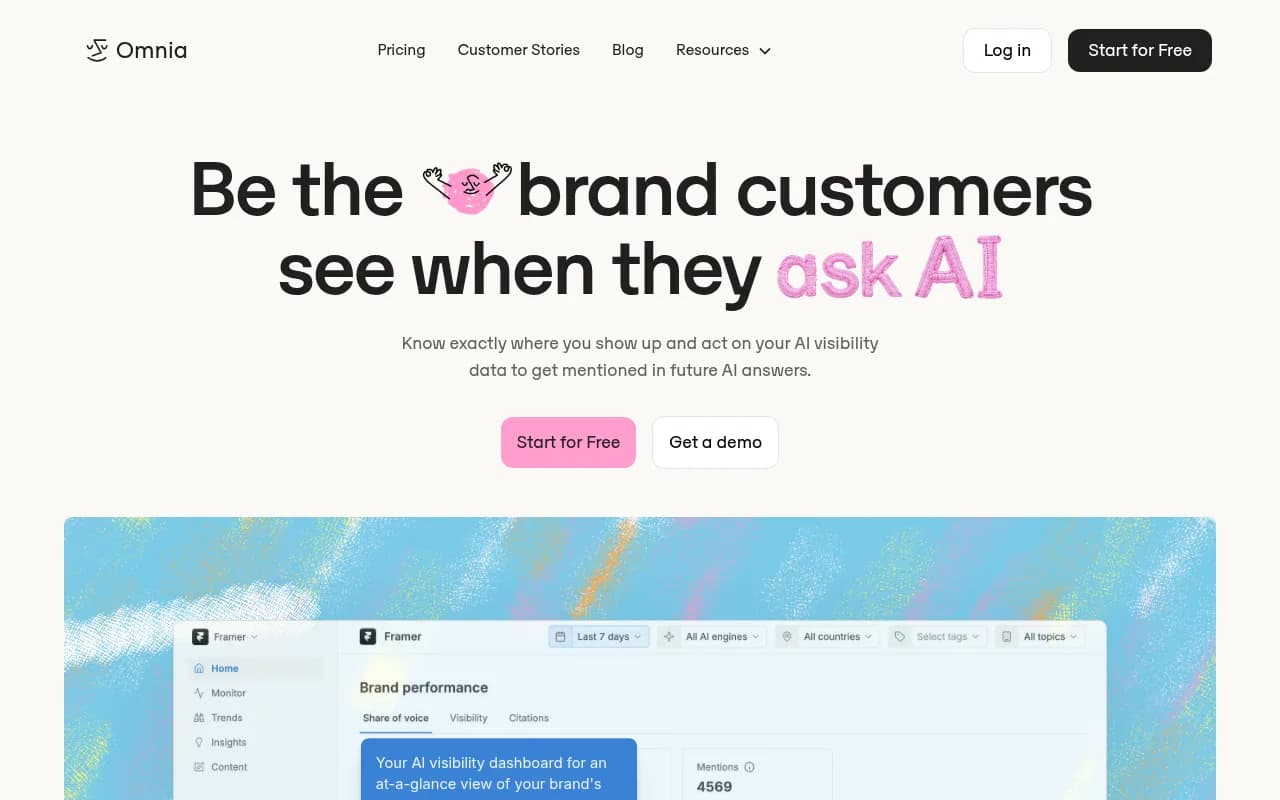
Omnia is a more accessible AI visibility platform aimed at SEO professionals and marketing teams. The core loop is straightforward: discover what prompts people are asking AI engines, monitor where your brand shows up (and where competitors do), then follow a step-by-step roadmap to close the gaps. It covers ChatGPT, Perplexity, Google AI Overviews, Google AI Mode, Gemini, and Copilot. There's a free trial and self-serve sign-up, which makes it easy to evaluate without a sales conversation. The customer base skews toward growth-stage companies and digital agencies rather than global enterprises.
Side-by-side comparison
| Feature | Bluefish AI | Omnia |
|---|---|---|
| Target audience | Fortune 500 / enterprise brands | SEO & marketing teams, mid-market |
| Pricing model | Quote-based (est. $4,000+/mo) | Free trial + Pro plan (pricing on request) |
| Free trial | No | Yes |
| Self-serve signup | No (demo required) | Yes |
| AI models covered | ChatGPT, Perplexity, Google AI Overviews, AI commerce channels | ChatGPT, Perplexity, Google AI Overviews, Google AI Mode, Gemini, Copilot |
| Prompt discovery | Yes | Yes |
| Citation monitoring | Yes | Yes |
| Competitor benchmarking | Yes | Yes |
| AI commerce / shopping tracking | Yes (dedicated module) | No |
| Campaign ROI measurement | Yes (Collections feature) | No |
| Optimization roadmap | Yes (workflow automation) | Yes (step-by-step roadmap) |
| Content generation | No | No |
| Infosec / enterprise compliance | Yes (passes enterprise reviews) | Not specified |
| Custom audience segmentation | Yes | Limited |
| API / data export | Yes (enterprise data teams) | Not specified |
Head-to-head feature deep-dive
Prompt discovery and monitoring
Both tools start with the same question: what are people actually asking AI engines about your category, and where does your brand show up?
Bluefish AI lets enterprise teams configure custom audiences and tailored prompt sets -- useful when you're a global brand with different customer segments in different markets. The monitoring goes deep into brand reputation and performance across "AI native experiences," which seems to include agentic interfaces beyond just search.
Omnia's approach is more guided. It surfaces the real questions customers are asking, helps you decide which prompts to monitor, and then tracks your citation rate and competitor benchmarks. The UI is designed for SEO practitioners who are used to keyword research workflows -- the learning curve is lower.
Verdict: Bluefish AI wins on customization depth. Omnia wins on accessibility and speed to insight.
AI commerce and campaign measurement
This is where Bluefish AI pulls ahead in a meaningful way. Their AI Commerce module tracks brand visibility in agentic commerce contexts -- not just "does ChatGPT mention us" but "does AI recommend us when someone is ready to buy." Their Collections feature measures the ROI of digital marketing campaigns in the AI channel, which is genuinely useful for brands running paid media and wanting to know if it moves the needle in AI recommendations. Their Super Bowl research (showing that TV ads influence AI recommendations) is a good example of the kind of analysis their platform enables.
Omnia doesn't appear to have an equivalent commerce tracking or campaign attribution module. It's focused on organic AI search visibility rather than connecting paid or brand marketing to AI outcomes.
Verdict: Bluefish AI wins clearly here. This is a gap Omnia hasn't filled yet.
Optimization roadmap and actionability
Omnia's standout feature is its step-by-step AI visibility roadmap. After monitoring your brand, it translates the data into concrete actions: what content to create, what technical SEO to fix, where to place content to get cited. This is more structured guidance than most monitoring tools offer, and it's designed for teams that don't have a dedicated GEO strategist.
Bluefish AI talks about "actionability" and "automated optimization workflows," but the specifics are harder to pin down from public information. Given the enterprise focus, it's likely that much of the optimization guidance is delivered through account management and custom consulting rather than self-serve tooling.
Verdict: Omnia's roadmap feature is more transparent and accessible. Bluefish AI's optimization depth is probably greater, but it's harder to evaluate without a demo.
Enterprise features and compliance
Bluefish AI is built for organizations where IT and legal have a say in software procurement. They explicitly mention passing infosec reviews "with ease" and offer custom data segmentation for enterprise data teams. If you're at a company where every SaaS tool needs a security review and a DPA, Bluefish AI has been through that process many times.
Omnia doesn't make similar claims. It's a newer, more nimble product -- which is fine for most marketing teams, but may be a blocker for large enterprises with strict vendor requirements.
Verdict: Bluefish AI wins for enterprise procurement requirements. Not a relevant factor for most Omnia users.
Ease of use and onboarding
Omnia has a free trial and self-serve signup. You can be monitoring prompts within minutes of creating an account. The interface is designed for SEO professionals, so if you've used tools like Semrush or Ahrefs, the mental model will feel familiar.
Bluefish AI requires a demo call with their sales team before you can access the platform. For enterprise buyers, this is normal -- you'd expect a discovery call before committing to a $4,000+/month tool. But it creates real friction for anyone who just wants to evaluate the product quickly.
Verdict: Omnia wins on accessibility. Bluefish AI's onboarding process is appropriate for its target market but slow for everyone else.
AI model coverage
| AI Engine | Bluefish AI | Omnia |
|---|---|---|
| ChatGPT | Yes | Yes |
| Perplexity | Yes | Yes |
| Google AI Overviews | Yes | Yes |
| Google AI Mode | Not specified | Yes |
| Gemini | Not specified | Yes |
| Microsoft Copilot | Not specified | Yes |
| Agentic commerce platforms | Yes | No |
| DeepSeek / Grok / Mistral | Not specified | Not specified |
Both tools cover the core AI search engines. Omnia explicitly lists Gemini and Copilot coverage; Bluefish AI's public materials focus more on the "AI native experience" category broadly, with specific emphasis on agentic commerce channels that Omnia doesn't touch.
Pricing comparison
| Plan | Bluefish AI | Omnia |
|---|---|---|
| Free tier | No | Free trial available |
| Entry-level | Demo required | Pro plan (pricing on request) |
| Enterprise | Custom (est. $4,000+/mo) | Not specified |
| Pricing transparency | None (quote-based) | Low (contact for pricing) |
Neither tool publishes a full pricing page, which is frustrating for buyers doing initial research. Bluefish AI is clearly in enterprise territory -- the $4,000+/month estimate puts it out of reach for most small and mid-sized teams. Omnia's free trial at least lets you evaluate the product before any pricing conversation.
If you're comparing both tools and budget is a real constraint, Omnia is the only one you can actually try without a sales call.
Pros and cons
Bluefish AI
Pros:
- Built for enterprise scale with infosec compliance and custom data segmentation
- AI commerce tracking is a genuine differentiator -- no other tool in this comparison has it
- Campaign ROI measurement (Collections) connects brand marketing to AI visibility outcomes
- Deep customization for audiences, prompts, and measurement frameworks
- Backed by original research (Super Bowl ad influence study) that shows real analytical depth
Cons:
- No public pricing, no free trial, demo-only access
- Estimated $4,000+/month puts it out of reach for most teams
- Limited transparency about specific AI model coverage
- Optimization features are harder to evaluate without a demo
- No content generation capabilities
Omnia
Pros:
- Free trial with self-serve signup -- you can evaluate it today
- Clear step-by-step optimization roadmap is genuinely useful for teams without a GEO specialist
- Covers ChatGPT, Perplexity, Google AI Overviews, Google AI Mode, Gemini, and Copilot
- Designed for SEO practitioners -- familiar workflow and mental model
- More accessible pricing than enterprise-only competitors
Cons:
- No AI commerce or shopping tracking
- No campaign ROI measurement
- Limited information about API access or data export
- Enterprise compliance and infosec capabilities not documented
- No content generation -- monitoring and roadmap only
Who should pick which tool
Pick Bluefish AI if:
- You're at a large enterprise brand (Fortune 500 scale) with a real budget for AI marketing infrastructure
- You need to track how advertising and brand campaigns influence AI recommendations
- AI commerce visibility (agentic shopping, product recommendations) is a priority
- Your IT and legal teams require infosec reviews and enterprise-grade data controls
- You have a dedicated marketing ops or data team that can work with custom segmentation
Pick Omnia if:
- You're an SEO manager or marketing team lead at a growth-stage or mid-market company
- You want to start monitoring AI visibility without a sales call or a large budget commitment
- A structured optimization roadmap is more useful to you than raw data
- You need coverage across Gemini, Copilot, and Google AI Mode specifically
- You want to evaluate a tool before committing any budget
It's worth noting that if you're also looking to close the loop between AI visibility monitoring and actual content creation, Promptwatch covers that angle -- it combines prompt tracking, answer gap analysis, and a built-in AI writing agent that generates content engineered to get cited by AI models.

Final verdict
Bluefish AI and Omnia are solving the same core problem -- helping brands show up in AI search -- but for very different buyers. Bluefish AI is a serious enterprise platform with genuine differentiators in AI commerce tracking and campaign measurement, but you'll need a budget and a procurement process to match. Omnia is the more practical choice for the vast majority of marketing teams: accessible, self-serve, and focused on turning monitoring data into actionable next steps. If you're not a Fortune 500 brand, start with Omnia's free trial and see how far it gets you before considering something at Bluefish AI's price point.