Key Takeaways
- LLM Pulse gives you 61% more prompts for 38% less money at entry level (€49/mo for 40 prompts vs Omnia's €79/mo for 25 prompts)
- Omnia's standout feature is its AI visibility roadmap -- it translates tracking data into specific action steps for content creation and technical SEO, while LLM Pulse focuses on raw data and analytics
- LLM Pulse includes prompt discovery built-in to help you find relevant queries to track; Omnia also offers this but the implementation differs
- Both track the same core AI models (ChatGPT, Perplexity, Gemini, Google AI Mode/Overviews), though LLM Pulse lists DeepSeek, Grok, Claude, Copilot, and Meta AI as enterprise add-ons
- Export and collaboration features favor Omnia with stronger data sharing and team workflows
- For pure monitoring on a budget, LLM Pulse wins. For teams that need guided optimization steps, Omnia's roadmap feature justifies the premium.
Overview
LLM Pulse
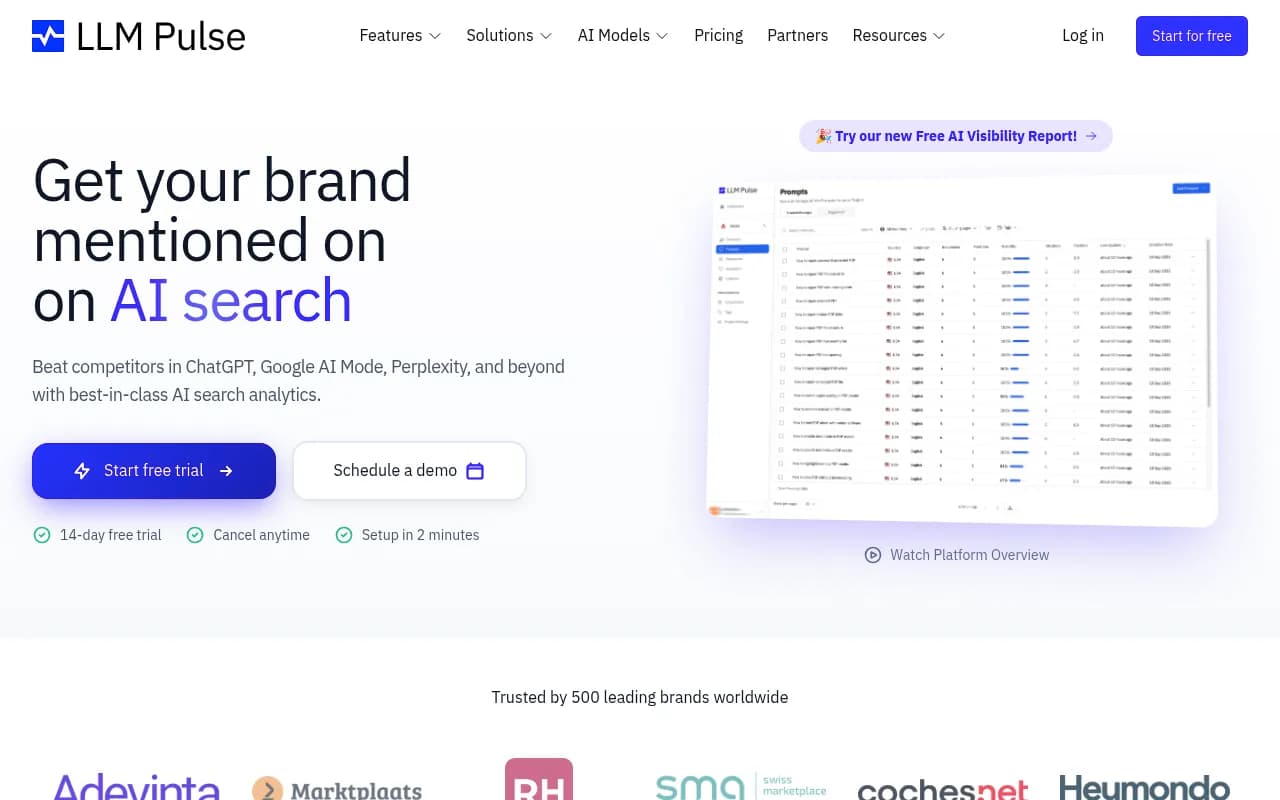
LLM Pulse positions itself as "your radar in the world of generative AI." It's a European platform (pricing in euros) used by 500+ brands to track how AI chatbots describe their companies. The focus is on comprehensive data -- visibility scores, citation analysis, sentiment tracking, and competitor benchmarking across 10+ AI models. Weekly prompt tracking gives you a historical view of how your brand presence shifts over time.
The interface leans data-heavy. You get detailed response breakdowns, source attribution, and model-by-model comparisons. LLM Pulse also includes AI-powered content recommendations to help you improve your presence, though the execution is more analytics-focused than prescriptive.
Omnia
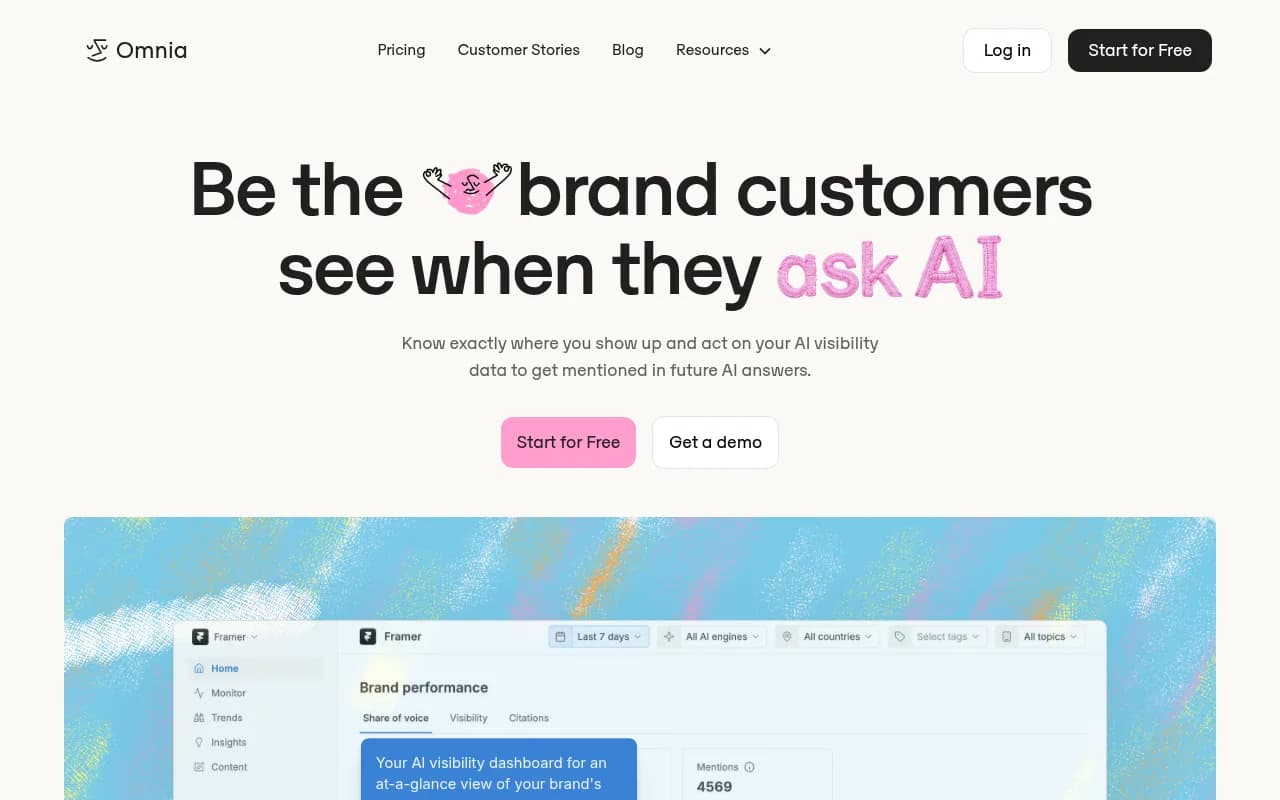
Omnia calls itself "AI visibility software for marketing teams" and targets SEO and marketing experts specifically. The platform monitors the same core AI engines but differentiates with its "AI visibility roadmap" -- a feature that converts your tracking data into a step-by-step action plan. Think content gaps to fill, technical SEO fixes, and content placement strategies mapped to your actual visibility weaknesses.
Omnia's interface feels more workflow-oriented. You still get citation tracking and share-of-voice metrics, but the emphasis is on what to do next rather than just what's happening. The export and collaboration features are stronger here, making it easier to share insights with stakeholders or integrate findings into existing marketing workflows.
Side-by-Side Comparison
| Feature | LLM Pulse | Omnia |
|---|---|---|
| Entry pricing | €49/mo (40 prompts) | €79/mo (25 prompts) |
| Mid-tier pricing | €149/mo (150 prompts) | Not publicly listed |
| Free trial | 14 days | Yes (duration not specified) |
| AI models tracked | 10+ (ChatGPT, Perplexity, Gemini, Google AI Mode/Overviews, DeepSeek, Grok, Claude, Copilot, Meta AI) | 5 core (ChatGPT, Perplexity, Gemini, Google AI Mode/Overviews, Copilot) |
| Prompt discovery | ✓ Built-in | ✓ Built-in |
| Citation analysis | ✓ Detailed source tracking | ✓ Source tracking |
| Competitor benchmarking | ✓ Share of voice, model-by-model | ✓ Share of voice |
| Sentiment analysis | ✓ Included | Not mentioned |
| Actionable roadmap | AI content recommendations | ✓ Step-by-step visibility roadmap |
| Data export | Basic | Strong (emphasized feature) |
| Team collaboration | Standard | Enhanced |
| Setup time | 2 minutes (claimed) | Not specified |
| Annual discount | 17% | Not specified |
| Target user | Brands, agencies | SEO/marketing teams |
Pricing: Where the gap widens
This is where LLM Pulse pulls ahead for most buyers.
| Plan | LLM Pulse | Omnia |
|---|---|---|
| Starter | €49/mo (1 project, 40 prompts) | €79/mo (25 prompts, details unclear) |
| Growth | €149/mo (3 projects, 150 prompts) | Not listed |
| Scale | €299/mo (5 projects, 300 prompts) | Not listed |
| Enterprise | Custom | Custom |
LLM Pulse's pricing is transparent and structured. At the entry level, you're getting 61% more prompts for 38% less money. Even at 100 prompts, third-party comparisons note LLM Pulse saves you €180/month (€2,160/year) compared to Omnia.
Omnia doesn't publish its full pricing grid, which usually signals higher price points or custom quoting. The Pro plan exists but requires contacting sales. If you're a small team or solo operator watching costs, LLM Pulse's clear pricing and better prompt-to-price ratio make the decision easy.
That said, if Omnia's roadmap feature genuinely saves your team hours of manual analysis and planning, the premium could be worth it. You're paying for the "what to do next" layer, not just the data.
Feature deep-dive
Prompt tracking and discovery
Both platforms help you figure out which prompts to monitor -- a critical feature since you can't track everything.
LLM Pulse includes prompt discovery as part of the core offering. You see "the questions that matter" and can spot shifts in how AI describes your brand over time. The weekly tracking cadence gives you a historical view, which is useful for catching slow trends or seasonal changes.
Omnia also offers prompt discovery with a focus on "real questions customers are asking about your industry or product." The framing is slightly more customer-centric, but functionally both tools solve the same problem: helping you avoid guessing which prompts to track.
Verdict: Tie. Both handle this well. Your choice depends on whether you prefer LLM Pulse's data-heavy presentation or Omnia's marketing-team framing.
Citation and source analysis
LLM Pulse emphasizes "detailed responses" -- you see the exact words AI uses to describe you and which sources it cites. The goal is catching inaccuracies or negative framing before customers see it. The citation analysis shows which sources AI trusts in your space and whether your content gets cited or if competitors dominate.
Omnia covers citation tracking too, showing "what citations AI engines pull information from." The feature exists but isn't as prominently marketed. Omnia's focus is more on share-of-voice and competitive positioning than granular source attribution.
Verdict: LLM Pulse edges ahead here. If understanding exactly which URLs and sources AI models rely on matters to your strategy, LLM Pulse gives you more detail.
Competitor benchmarking
Both platforms offer share-of-voice tracking and competitor comparisons.
LLM Pulse provides model-by-model breakdowns -- you can see which AI engines recommend you most and where competitors outperform you. The interface shows visibility scores and citation rates side-by-side with competitors.
Omnia also tracks share-of-voice and lets you benchmark against competitors, but the emphasis is on feeding that data into the roadmap feature rather than deep competitive analysis.
Verdict: LLM Pulse for pure competitive intelligence. Omnia for turning competitive gaps into action items.
Actionable insights and optimization
This is the biggest philosophical difference.
LLM Pulse offers "AI-powered content recommendations to improve how you appear in LLM responses." It's a recommendation engine -- you get suggestions, but you're still doing the strategic thinking and execution.
Omnia's roadmap feature is more prescriptive. It "translates your tracking data into a step-by-step AI visibility roadmap" covering content creation, technical SEO, and content placement. Each recommendation is "mapped to fill your brand's real gaps." This is the feature Omnia charges a premium for, and it's aimed at teams that want guidance, not just data.
Verdict: Depends on your team. If you have experienced SEO/content people who just need data, LLM Pulse is enough. If you're a smaller team or need help prioritizing actions, Omnia's roadmap could save you hours of analysis.
AI model coverage
LLM Pulse lists 10+ AI models, including ChatGPT, Perplexity, Gemini, Google AI Mode, Google AI Overviews, DeepSeek, Grok, Claude, Copilot, and Meta AI. Some of these (DeepSeek, Grok, Claude, Copilot, Meta AI) are marked as "Enterprise" add-ons, so you won't get them on the Starter plan.
Omnia covers ChatGPT, Perplexity, Gemini, Google AI Mode, Google AI Overviews, and Copilot. The list is shorter but hits the most important models for most brands.
Verdict: LLM Pulse has broader coverage if you need niche models. For most users, Omnia's core five are sufficient.
Data export and collaboration
Omnia explicitly highlights "strong export" and team collaboration features. If you need to pull data into reports, share insights with stakeholders, or integrate findings into existing workflows, Omnia is built for that.
LLM Pulse offers "basic" export functionality. It works, but it's not a selling point.
Verdict: Omnia wins for teams and agencies that need to share data externally or work collaboratively.
Pros and cons
LLM Pulse pros
- Significantly cheaper at every tier (€49 vs €79 entry, €149 vs unlisted mid-tier)
- More prompts per dollar (40 vs 25 at entry level)
- Transparent pricing with clear plan tiers
- Detailed citation and source analysis
- Sentiment analysis included
- Broader AI model coverage (10+ models)
- 17% annual discount
- Fast setup (claims 2 minutes)
LLM Pulse cons
- Data-heavy interface may overwhelm non-technical users
- Content recommendations are less prescriptive than Omnia's roadmap
- Export and collaboration features are basic
- Some AI models locked behind Enterprise tier
Omnia pros
- AI visibility roadmap translates data into specific action steps
- Strong export and team collaboration features
- Marketing-team-friendly framing and interface
- Prompt discovery focused on customer questions
- Trusted by recognizable brands (Exoticca, Ironhack, Pleo, etc.)
Omnia cons
- 61% fewer prompts at entry level for 38% more money
- Pricing not fully transparent (requires sales contact for most plans)
- Fewer AI models tracked (5 vs 10+)
- Less emphasis on granular citation analysis
- No sentiment analysis mentioned
Who should pick which tool
Pick LLM Pulse if:
- You're budget-conscious and want maximum prompts per euro
- You have SEO or content people who can interpret data and build their own action plans
- You need detailed citation and source analysis to understand exactly where AI gets its information
- You want sentiment tracking included
- You prefer transparent pricing and clear plan tiers
- You're tracking a brand in a competitive space and need deep competitor benchmarking
Pick Omnia if:
- You're a marketing team that needs guidance on what to do next, not just data
- The AI visibility roadmap feature would save your team significant analysis time
- You need strong export and collaboration features for stakeholder reporting
- You're willing to pay a premium for a more prescriptive, workflow-oriented tool
- You only need the core 5 AI models (ChatGPT, Perplexity, Gemini, Google AI Mode/Overviews, Copilot)
- You value a marketing-team-friendly interface over raw data depth
Consider both if:
- You're an agency managing multiple clients and need different tools for different use cases (LLM Pulse for data-heavy clients, Omnia for clients who need more hand-holding)
If you're also looking to go beyond monitoring and actually optimize your content for AI search, tools like Promptwatch can complement either option by offering content gap analysis, AI content generation grounded in citation data, and page-level tracking that connects visibility to revenue.

Final verdict
For most teams, LLM Pulse offers better value. You get more prompts, deeper data, and transparent pricing at a significantly lower cost. The citation analysis is stronger, sentiment tracking is included, and the interface gives you everything you need to understand your AI visibility.
Omnia justifies its premium only if the roadmap feature genuinely saves your team hours of work. If you're a marketing team without deep SEO expertise, or if you struggle to translate data into action, Omnia's prescriptive approach could be worth the extra cost. The export and collaboration features also matter if you're reporting to stakeholders or working across teams.
But for pure monitoring, competitive intelligence, and cost-effectiveness, LLM Pulse wins. At €49/mo for 40 prompts vs €79/mo for 25 prompts, you're getting 61% more tracking capacity for 38% less money. That's hard to argue with unless Omnia's roadmap feature is a game-changer for your specific workflow.
Bottom line: Start with LLM Pulse's 14-day trial. If you find yourself wishing for more prescriptive guidance and your budget allows it, then explore Omnia. But most teams will find LLM Pulse gives them everything they need at a price that makes sense.