Key Takeaways
- Scrunch is more expensive but more comprehensive: Starting at $250/mo vs Omnia's flexible pricing, Scrunch includes an Agent Experience Platform (AXP) that lets you serve AI-optimized content directly to LLM crawlers -- Omnia doesn't have this
- Omnia focuses on actionable roadmaps: While both platforms track citations and rankings, Omnia translates monitoring data into step-by-step optimization plans (content creation, technical SEO, placement strategy). Scrunch gives you insights and tips but leaves execution more open-ended
- Scrunch has deeper technical monitoring: Real-time AI bot crawl feeds, error detection, and traffic trends give you granular visibility into how LLMs interact with your site. Omnia covers the basics but doesn't surface crawl-level details
- Both track the same core LLMs: ChatGPT, Perplexity, Claude, Google AI Overviews, Gemini, Copilot -- no meaningful difference in model coverage
- Omnia is better for teams new to AI search: The roadmap feature and prompt discovery tools help you figure out what to do next. Scrunch assumes you already know how to act on the data
- Scrunch's AXP is the differentiator for advanced users: If you want to create a parallel, AI-optimized version of your site that serves different content to LLM crawlers, Scrunch is the only option here
Overview
Scrunch
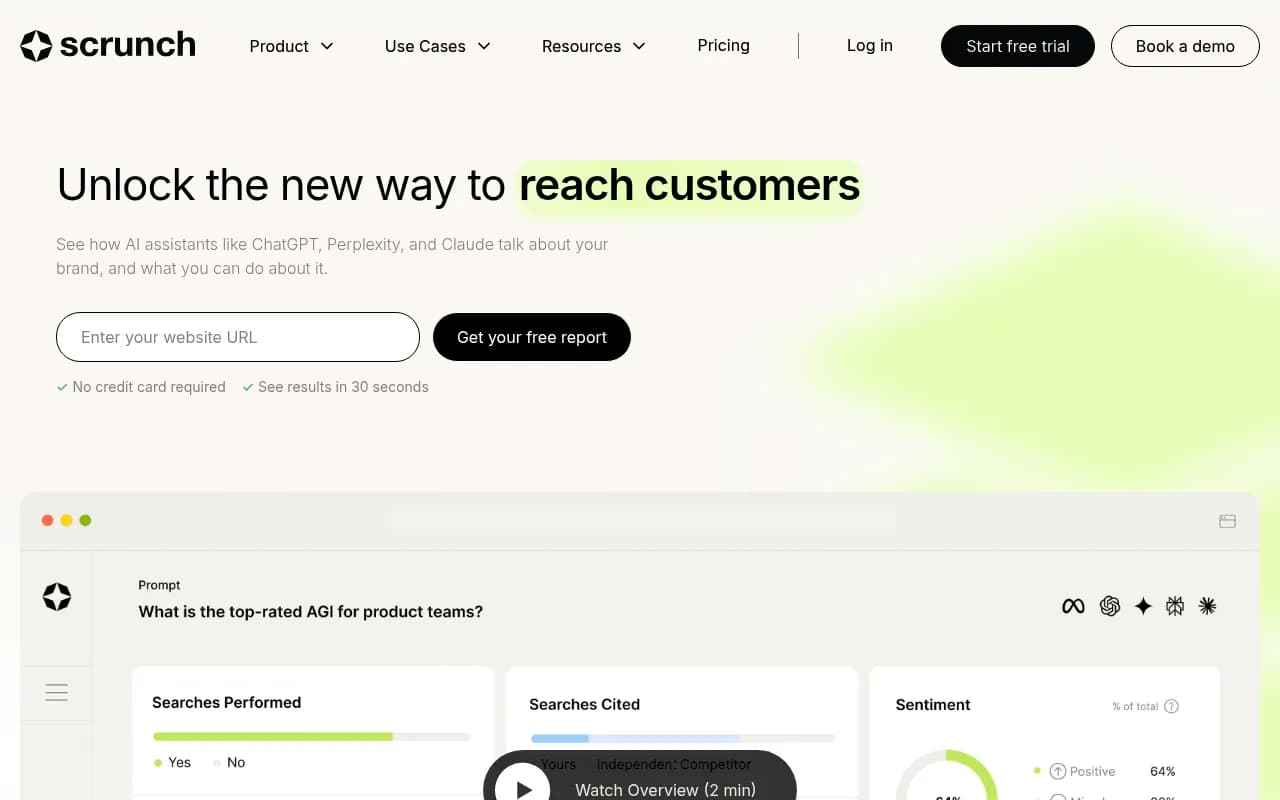
Scrunch positions itself as an "AI Customer Experience Platform" -- not just monitoring, but a full stack for managing how AI assistants interact with your brand. The platform tracks visibility across ChatGPT, Perplexity, Claude, and other LLMs, monitors citations and rankings, and provides optimization insights. The standout feature is the Agent Experience Platform (AXP), which lets you create AI-specific versions of your pages that serve optimized content to LLM crawlers while humans see your normal site. Used by Lenovo, Skims, Penn State, and over 500 companies. Pricing starts at $250/mo for the Starter tier (billed annually), with a Growth tier at $417/mo and custom Enterprise pricing. 7-day free trial available.
Omnia
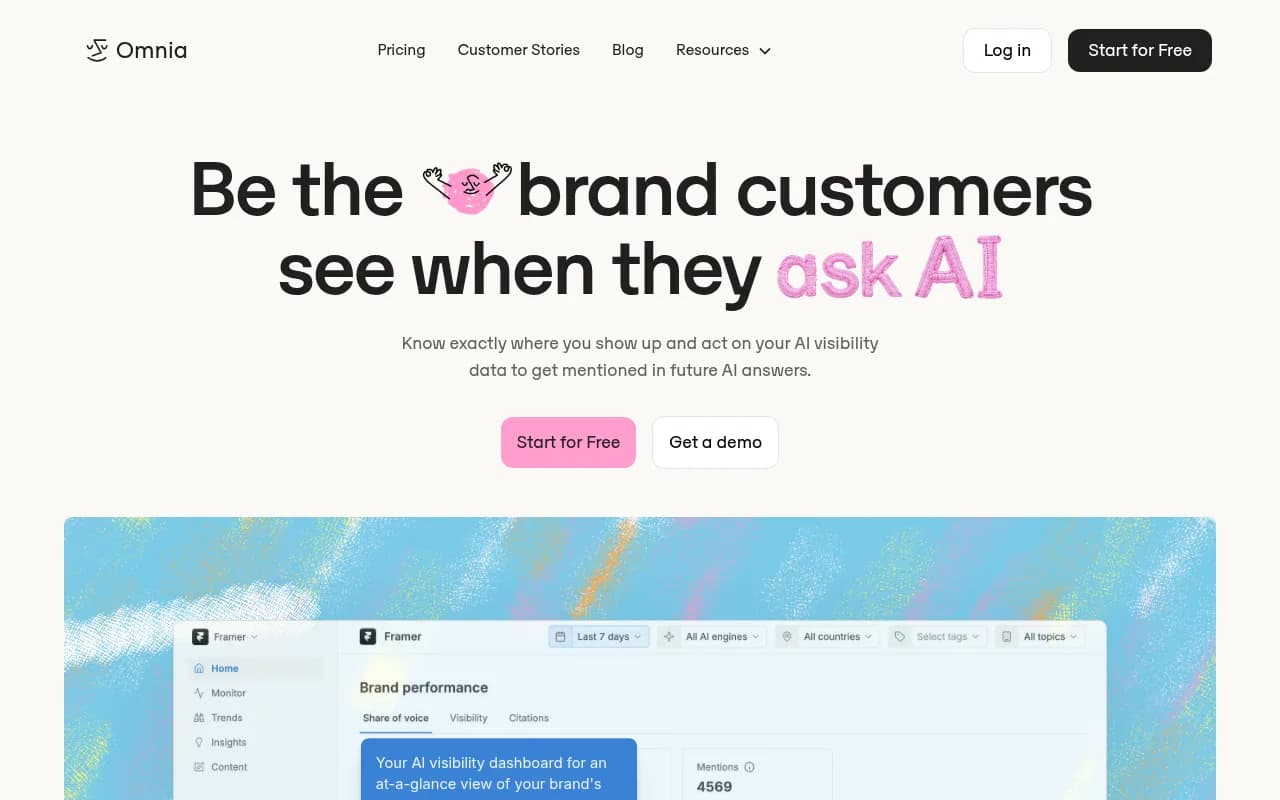
Omnia is an AI visibility platform built specifically for SEO and marketing teams. It monitors how your brand appears in ChatGPT, Perplexity, Google AI Overviews, Google AI Mode, Gemini, and Copilot. The core difference from monitoring-only tools: Omnia provides a personalized roadmap that translates tracking data into concrete next steps -- content creation tasks, technical SEO fixes, and content placement strategies mapped to your specific gaps. The platform also includes prompt discovery to surface real questions customers are asking AI about your industry. Used by Exoticca, Ironhack, Growth Hackers, and others. Flexible pricing with a free trial available; Pro plan pricing on request.
Side-by-Side Comparison
| Feature | Scrunch | Omnia |
|---|---|---|
| Starting price | $250/mo (annual billing) | Flexible (pricing on request) |
| Free trial | 7 days | Yes (duration not specified) |
| LLMs monitored | ChatGPT, Perplexity, Claude, Google AI Overviews, Gemini, Copilot | ChatGPT, Perplexity, Google AI Overviews, Google AI Mode, Gemini, Copilot |
| Citation tracking | ✓ | ✓ |
| Competitor benchmarking | ✓ | ✓ |
| AI bot crawl monitoring | ✓ Real-time feed + traffic trends | Basic |
| Error detection | ✓ Spots when bots can't crawl | Not mentioned |
| Optimization insights | ✓ Actionable tips | ✓ Step-by-step roadmap |
| Prompt discovery | ✓ Prompt analytics | ✓ Real customer questions |
| Agent Experience Platform | ✓ Serve AI-optimized content | ✗ |
| Content creation guidance | Tips only | Mapped to roadmap |
| Technical SEO recommendations | Via insights | Part of roadmap |
| Target audience | Brands, agencies, advanced users | SEO/marketing teams, beginners |
Monitoring capabilities
Both platforms cover the same core set of LLMs -- ChatGPT, Perplexity, Claude, Google AI Overviews, Gemini, and Copilot. You're not missing any major models with either choice.
Scrunch goes deeper on the technical side. The real-time AI bot crawl feed shows you exactly when ChatGPT, Claude, or Perplexity crawlers hit your site, which pages they request, and any errors they encounter. You also get traffic trend analysis over time. This is useful if you're debugging indexing issues or want to understand crawler behavior patterns. Omnia doesn't surface this level of crawl detail -- you see citations and rankings, but not the underlying bot activity.
Omnia's monitoring dashboard focuses on share of voice, competitor benchmarking, and citation sources. The interface is clean and geared toward answering "where do we stand?" rather than "what's happening under the hood?" For most marketing teams, this is enough. You don't need to know every time a bot crawls your site -- you need to know if you're showing up in answers.
Verdict: Scrunch wins for technical depth. Omnia wins for simplicity and focus on what matters to non-technical teams.
Optimization and actionability
This is where the platforms diverge most.
Scrunch gives you optimization tips and insights. The platform will tell you "AI bots can't crawl this page" or "these sites get cited more than you" and suggest ways to move up the ranks. But it's still on you to figure out the execution plan. What content do you create? Which pages do you fix first? Scrunch doesn't hand you a prioritized to-do list.
Omnia's roadmap feature is built around this exact problem. It takes your monitoring data -- where you're invisible, where competitors are winning, which prompts matter -- and generates a step-by-step plan. Content creation tasks ("write an article about X"), technical SEO fixes ("add schema markup to Y page"), content placement strategies ("get cited on Z domains"). Each task is mapped to a specific gap in your AI visibility. This is a big deal if you're new to AI search optimization and don't know where to start.
Neither platform writes the content for you. Scrunch and Omnia both stop at recommendations. If you want a platform that also generates the articles, you'd need something like Promptwatch, which combines gap analysis with an AI writing agent that creates content grounded in citation data.

Verdict: Omnia is more actionable out of the box. Scrunch assumes you have the expertise to act on insights independently.
Agent Experience Platform (Scrunch only)
This is Scrunch's killer feature and the main reason to pay the premium.
The Agent Experience Platform (AXP) lets you create a parallel version of your website that serves different content to AI crawlers vs human visitors. When ChatGPT or Perplexity crawls your site, they see AI-optimized pages -- structured data, concise answers, FAQ formats, whatever helps them cite you. Humans see your normal marketing site.
Why does this matter? LLMs don't browse like humans. They want clean, structured, information-dense content. Your beautifully designed product page with hero images and CTAs might be great for conversions but terrible for AI citation. AXP lets you have both.
Omnia doesn't have an equivalent feature. You're optimizing your existing pages for both audiences, which means compromises.
The catch: AXP requires technical implementation and ongoing maintenance. You're essentially running two versions of your site. For large brands with dev resources, this is powerful. For small teams, it might be overkill.
Verdict: If you need AXP, Scrunch is your only option here. If you don't, it's not a reason to choose Scrunch over Omnia.
Prompt discovery and intelligence
Both platforms help you figure out what prompts to monitor.
Scrunch's prompt analytics show you trends, citations, competitors, and rankings for any prompt you're tracking. You can see which prompts are driving visibility and which ones you're losing on. The interface is data-heavy -- lots of tables and charts.
Omnia's prompt discovery surfaces "real questions customers are asking AI about your industry or product." The framing is more beginner-friendly. Instead of "here's the data," it's "here's what people are actually asking." The speech bubble illustration on their site isn't just decoration -- it signals the approach. Omnia wants you to think about customer intent, not just keyword tracking.
In practice, both platforms are pulling from similar data sources (LLM responses, search query patterns). The difference is presentation and how much hand-holding you get.
Verdict: Tie. Choose based on whether you prefer raw analytics (Scrunch) or curated customer questions (Omnia).
Error detection and technical monitoring
Scrunch explicitly calls out error detection as a feature: "Spot when AI bots can't crawl your site and fix it." The real-time bot feed shows you 404s, timeouts, and other crawl failures. This is critical if you're doing technical SEO work or migrating content.
Omnia doesn't mention error detection or crawl monitoring in their marketing. That doesn't mean it's absent, but it's not a focus. The platform is built around visibility and optimization, not debugging.
If you're dealing with a complex site architecture, frequent content updates, or international versions, Scrunch's technical monitoring is worth the price difference. If your site is stable and you're focused on content strategy, Omnia's approach is fine.
Verdict: Scrunch for technical teams. Omnia for content-focused teams.
User interface and learning curve
Scrunch's dashboard is dense. Three tabs (Performance tracking, Prompt analytics, AI traffic) with lots of data points. The testimonial from Danilo at BairesDev mentions "flipping on a light switch" -- that's the experience when you first see the data. But there's a learning curve to interpret it all.
Omnia's interface uses more visual cues (the emoji illustrations, the "see your brand through AI's eyes" framing). The roadmap feature is inherently easier to act on than a wall of analytics. The platform is designed for marketing teams who might not have deep SEO or technical backgrounds.
Both platforms offer demos and trials, so you can test the UX yourself before committing.
Verdict: Omnia is easier to onboard. Scrunch rewards users who like data.
Pricing comparison
| Plan | Scrunch | Omnia |
|---|---|---|
| Free trial | 7 days | Yes (duration not specified) |
| Starter/Entry | $250/mo (annual billing) | Pricing on request |
| Mid-tier | Growth: $417/mo (annual) | Pro plan (pricing on request) |
| Enterprise | Custom pricing | Not mentioned |
| Billing | Annual required for listed prices | Flexible |
Scrunch is transparent about pricing but expensive. $250/mo is $3,000/year for the entry tier. The Growth plan at $417/mo is nearly $5,000/year. For context, that's more than most traditional SEO tools (Ahrefs is $129/mo, Semrush starts at $139.95/mo).
Omnia doesn't list public pricing, which usually means they're negotiating based on company size and needs. The "flexible pricing" language suggests they might be cheaper than Scrunch for smaller teams, but you won't know until you talk to sales.
Both platforms offer free trials, so you can test before paying. Scrunch's 7-day trial is short -- you'll need to move fast to evaluate properly.
Verdict: Scrunch is a known (expensive) quantity. Omnia requires a sales conversation to understand cost.
Pros and cons
Scrunch pros
- Agent Experience Platform is unique and powerful for advanced use cases
- Real-time AI bot crawl monitoring and error detection
- Transparent pricing (you know what you're paying upfront)
- Used by major brands (Lenovo, Skims, Penn State)
- Deep technical insights for debugging and optimization
Scrunch cons
- Expensive ($250/mo minimum, annual billing required)
- Steeper learning curve -- lots of data to interpret
- Optimization tips are helpful but not as structured as a roadmap
- AXP requires technical implementation (not plug-and-play)
- Short 7-day trial window
Omnia pros
- Personalized roadmap translates data into concrete next steps
- Prompt discovery surfaces real customer questions
- Easier onboarding for non-technical marketing teams
- Flexible pricing (potentially cheaper for smaller teams)
- Clean, intuitive interface with visual cues
Omnia cons
- No Agent Experience Platform or equivalent feature
- Less technical depth (no crawl-level monitoring or error detection)
- Pricing not transparent -- requires sales conversation
- Smaller customer base (fewer case studies and testimonials)
- Roadmap feature might feel hand-holdy for experienced SEO teams
Who should pick which tool
Choose Scrunch if:
- You have a dev team and want to implement an Agent Experience Platform
- You need deep technical monitoring (crawl logs, error detection, bot behavior)
- You're comfortable interpreting analytics and building your own optimization plan
- You're a large brand or agency managing multiple clients
- Budget isn't a primary constraint ($250-$417/mo is acceptable)
- You want transparent pricing without sales calls
Choose Omnia if:
- You're a marketing team without deep technical SEO expertise
- You want a step-by-step roadmap instead of raw insights
- You're new to AI search optimization and need guidance
- You prefer a clean, intuitive interface over data-heavy dashboards
- You want to negotiate pricing based on your specific needs
- You don't need Agent Experience Platform capabilities
Consider both if:
- You're running a large-scale AI visibility program and want to compare approaches during trials
- You're an agency evaluating tools for different client segments (technical vs non-technical)
Final verdict
Scrunch and Omnia solve the same core problem -- tracking and improving brand visibility in AI search -- but they take different approaches.
Scrunch is the power user's choice. The Agent Experience Platform, real-time crawl monitoring, and technical depth make it the best option for brands with engineering resources and complex optimization needs. You're paying for capabilities that most competitors don't offer. The $250/mo price tag is justified if you're using those features. If you're not, it's expensive monitoring.
Omnia is the marketer's choice. The roadmap feature, prompt discovery, and beginner-friendly interface make it easier to go from "here's the data" to "here's what to do." The lack of technical monitoring and AXP is a trade-off, but most teams don't need those features anyway. The flexible pricing could make it more accessible for smaller companies, though you'll need to talk to sales to find out.
For most teams just getting started with AI search optimization, Omnia is the safer bet. For advanced users who want maximum control and technical depth, Scrunch is worth the premium. Neither platform is a bad choice -- it depends on where you are in your AI visibility journey and what kind of team you have.