HubSpot AI Search Grader Review 2026
Scores brand sentiment, share of voice and AEO/SEO performance across ChatGPT, Perplexity and Gemini in a single report.
Key takeaways
- Free, one-time, no-account-required snapshot of how ChatGPT, Perplexity, and Gemini describe your brand, scored across five weighted dimensions out of 100.
- It's a marketing funnel for HubSpot AEO, the paid $50/month monitoring product. The free grader gives you a single point-in-time read; it doesn't track anything over time.
- Lacks the operational depth of a dedicated GEO platform like Promptwatch: no crawler logs, no AI traffic attribution, no content generation, no Reddit or YouTube citation tracking, and no ability to manually pick your competitor set.
- Good for a first gut check on brand sentiment and recognition; not reliable as a repeatable benchmark since results shift between runs and you can't control which competitors get pulled in.
- Best suited to marketers and brand managers who want a fast, free look before deciding whether to invest in continuous AI visibility monitoring.
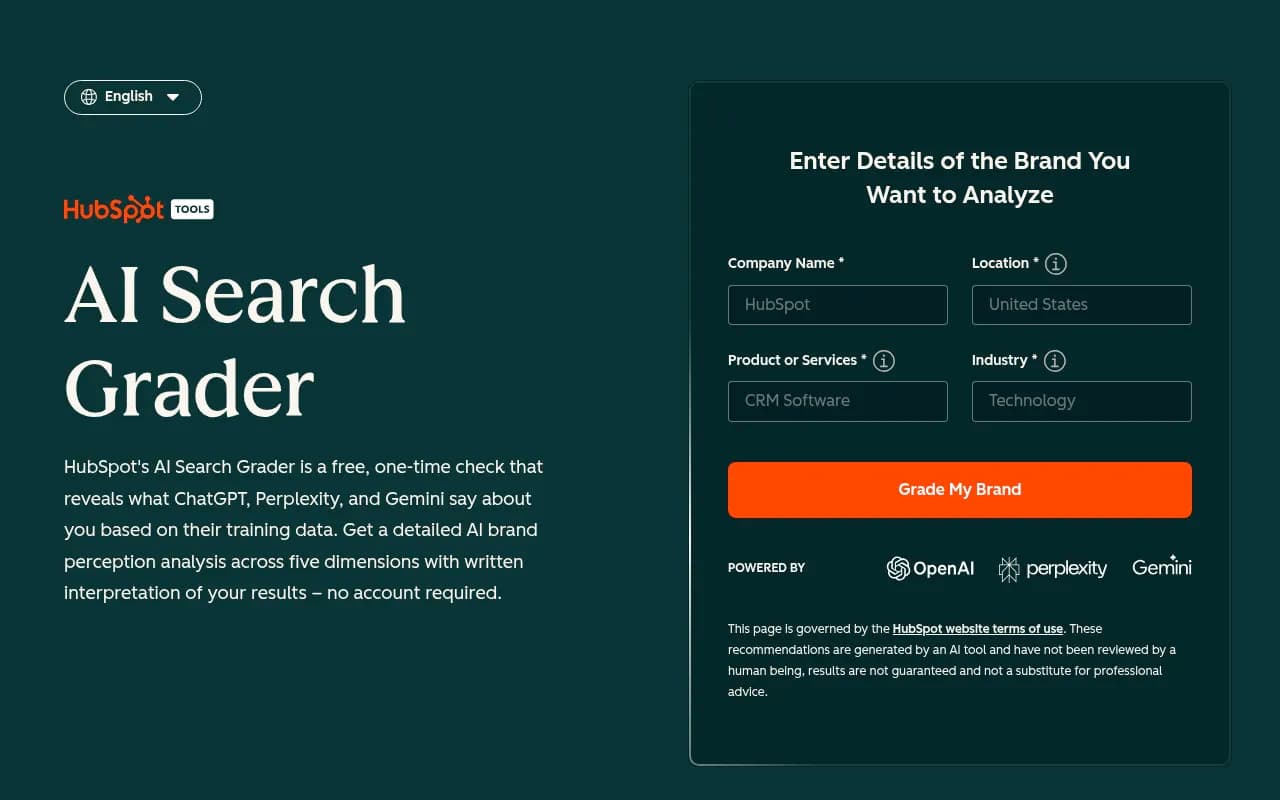
HubSpot's AI Search Grader is a free tool that asks ChatGPT, Perplexity, and Gemini what they think of your brand and turns the answers into a scored report. You type in your company name, location, industry, and product or service, and within about two minutes it queries all three models and hands back a composite score out of 100 broken into five categories: sentiment, presence quality, brand recognition, share of voice, and market competition.
It's built by HubSpot, which means it exists primarily to funnel you toward HubSpot AEO, the company's paid answer-engine-optimization product launched in beta around April 2026. That's not necessarily a knock against it, plenty of good free tools double as top-of-funnel lead magnets, but it's worth knowing upfront that the grader is a snapshot, not a monitoring system. Run it twice in a week and you may get different numbers, because the underlying model responses aren't deterministic and the tool doesn't store any history for you to compare against.
The target audience is broad by design: marketing leaders, brand managers, SEO professionals, and content strategists who've heard about "AEO" and want a fast, free way to see where their brand stands before deciding whether it's worth paying for something more serious.
Key features
- Five-dimension scoring. Sentiment carries the most weight at 40 of 100 points and breaks into general tone, contextual sentiment (how perception shifts across topics like support versus innovation), and source-based sentiment (how credible the sources shaping AI's view of you appear to be). Presence Quality (20 points) and Brand Recognition (20 points) round out the bulk of the score, with Share of Voice and Market Competition worth 10 points each.
- Cross-model validation. The grader queries OpenAI's model (currently GPT-5.4 mini per HubSpot's FAQ, though earlier versions of the page referenced GPT-5.2 and the tool originally launched on GPT-4o in 2024), Perplexity, and Gemini, then cross-checks the responses to produce one composite score rather than three separate ones.
- Competitive positioning classification. Market Competition assigns your brand a category role (Leader, Challenger, Niche Player) and an innovation label (Innovator, Disruptor, Traditionalist) based on how the models talk about you relative to others in your space. You can't choose which competitors get used for comparison, though, the AI decides that for you, which is one of the tool's more frequently criticized limitations.
- Competitor analysis without asking permission. Because the tool accepts any brand name, you can just as easily run it on a competitor as on yourself. This is arguably more useful than running it on your own brand, since it gives you a read on how a rival is perceived without needing their cooperation.
- Written interpretation, not just numbers. The report includes a narrative summary explaining what the scores mean, aimed at people who aren't going to parse a raw JSON dump of sentiment percentages.
- Deterministic scoring with retry logic. HubSpot states the scoring pipeline uses schema validation and retries to keep the output consistent, though "consistent" here means the scoring methodology is stable, not that your brand's actual score won't move between runs as the underlying models' answers shift.
- Zero setup friction. No account, no credit card, no HubSpot subscription required to get the initial score; you do need to submit an email to unlock the full report.
Who is it for
The grader works best as a first-touch tool for marketers who've never measured AI brand perception and want a free, low-effort way to see where they stand. Think a director of brand marketing at a 50-person SaaS company who's fielding questions from leadership about "are we showing up in ChatGPT" and needs a quick, citable data point before proposing a bigger initiative. It's also genuinely useful for competitive intelligence: an SEO consultant evaluating a prospective client can run the grader on the client and two or three of their named competitors in under ten minutes and walk into a pitch meeting with talking points.
Where it falls short is anyone who needs to track change over time or manage more than a handful of prompts. Agencies managing 15-20 client brands, SaaS companies tracking specific product-category prompts week over week, or anyone who wants to see whether a piece of new content actually moved their AI visibility, none of that is possible with a one-time grader. The tool also won't help you understand why your sentiment score is what it is beyond a written summary; there's no crawler log showing which pages AI models are actually reading, no traffic attribution showing whether AI-referred visitors convert, and no way to generate content to close the gaps it identifies.
Companies with multiple brands or complex multi-market positioning should be cautious about reading too much into a single run. Reviewers at Concept, an SEO agency, pointed out you can't narrow share-of-voice results to specific keywords, can't manually input your own competitor set, and can't view your sentiment side by side with a competitor's in the same report. That's fine for a curiosity check; it's not enough for a serious tracking program.
Integrations and ecosystem
The free AI Search Grader itself has no integrations; it's a standalone form-based tool. The paid product it funnels into, HubSpot AEO, lists integrations with HubSpot Content Hub, HubSpot Marketing Hub, LinkedIn Premium, Qwilr, Salesloft, WordPress.org, and Zapier according to its G2 listing, though the deepest value comes from pairing it with HubSpot's own CRM and Marketing Hub, where prompt suggestions and recommendations draw on your existing customer data.
There's no API, no browser extension, and no mobile app for either the free grader or the paid AEO product as of this writing. No GitHub repo or developer documentation is publicly available specific to either tool; HubSpot's general corporate GitHub and Twitter/X accounts exist but aren't product-specific.
Pricing and value
The AI Search Grader itself is entirely free with no usage cap. You can run it as many times as you want on your own brand or anyone else's without ever creating a HubSpot account, beyond submitting an email to unlock the full report.
The upsell path is HubSpot AEO, priced at $50/month standalone (or $45/month billed annually), which includes tracking for 25 prompts across the same three engines, plus citation analysis and content brief recommendations. Additional prompt volume is purchasable as an add-on. AEO is also bundled inside Marketing Hub Professional ($800/month) with 25 prompts run daily across three engines for 2,500 answers per month, and Marketing Hub Enterprise ($3,600/month) with 50 prompts for 5,000 answers per month. Both bundled tiers still carry a "BETA" label on HubSpot's own pricing page.
For context, HubSpot positions its $50/month AEO tier as cheaper than Otterly.ai's Standard plan at $189/month, and that comparison holds up. But raw price-per-month isn't the full picture: at 25-50 prompts, HubSpot AEO caps out well below what a mid-sized company tracking dozens of product and category queries would need, and Reddit users in r/hubspot have described the AI-suggested prompts as low quality and the tool overall as "a little rote." Business.com's review echoed the prompt-cap and prompt-quality criticism directly.
Strengths and limitations
What it does well: it's genuinely free with zero friction, it's fast (under two minutes per run), and the five-dimension breakdown with a written interpretation is more digestible than a raw data dump for someone new to AEO. Running it on competitors without needing their cooperation is a legitimately useful bit of competitive intelligence you don't get from most paid tools without a subscription.
Where it falls short relative to a dedicated GEO platform like Promptwatch: there's no AI crawler log showing which pages ChatGPT or Gemini actually read on your site, no visitor analytics tying AI mentions to real traffic or conversions, no Reddit or YouTube citation tracking, no ChatGPT Shopping or Ads Radar, and no content generation or CMS publishing to act on what the report finds. Promptwatch tracks prompt volume and difficulty, runs query fan-outs, and offers Unified Actions and Content Agents that actually produce and publish optimized content; HubSpot's grader stops at diagnosis; even the paid AEO product's "act on recommendations directly inside HubSpot" feature is still listed as coming later in 2026, not yet shipped. You also can't manually set your competitor set in the free grader, which undercuts its usefulness as a repeatable benchmark.
The honest framing from third-party reviewers, including a WebGuruz analysis, is to treat the grader's output as "directionally accurate" rather than precise. It's a decent conversation starter, not a source of truth you'd want to report to a board.
Bottom line
If you want a free, instant gut check on how AI models currently talk about your brand or a competitor's, HubSpot's AI Search Grader does that job in under two minutes with no signup required. But if you need to actually track AI visibility over time, understand why you're or aren't being cited, and turn that insight into published content, you'll outgrow it almost immediately, and Promptwatch is the more complete option for teams that want optimization rather than a one-time score.
Frequently asked questions
Is HubSpot's AI Search Grader really free?
Which AI models does the AI Search Grader check?
What's the difference between the AI Search Grader and HubSpot AEO?
Can I use the AI Search Grader to check a competitor's brand?
How does HubSpot AI Search Grader compare to a full GEO platform like Promptwatch?
What does the AI Search Grader score actually measure?
Similar and alternative tools to HubSpot AI Search Grader