Default Review 2026
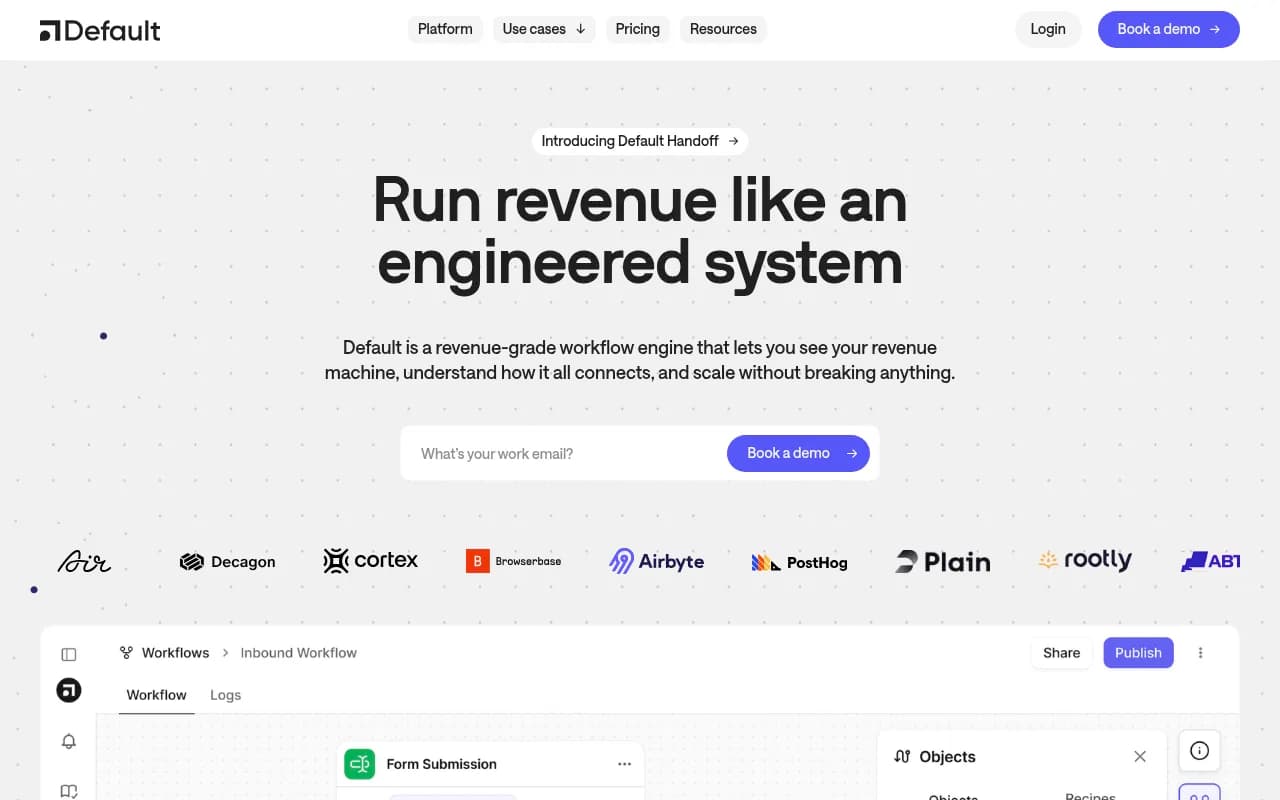
GTM platform designed for inbound orchestration, helping revenue teams coordinate and automate prospect engagement across multiple channels efficiently.
Summary
- Unified control layer: Default consolidates routing, scheduling, enrichment, and workflow automation into one platform, replacing tools like Chili Piper, LeanData, and fragmented point solutions
- Real-time visibility: Monitor every workflow with logs, traces, and alerts across forms, product signups, and campaigns -- no more black boxes
- Shared data model: Unifies Salesforce, HubSpot, Marketo, data warehouses, and enrichment vendors on a single schema so your stack finally agrees on reality
- Built for scale: Companies like Cortex consolidated 147 tools under Default's control layer, running 80+ routing rules from one brain instead of scattered across multiple systems
- Pricing: Starts at $750/month platform fee + $45/month per routing+scheduling seat (annual billing). Free editor/admin seats. Custom pricing for Growth tier.
Default is a revenue-grade workflow engine built for go-to-market teams drowning in disconnected tools. If you're a RevOps leader managing Salesforce + HubSpot + Marketo + Chili Piper + LeanData + five enrichment vendors, Default replaces that chaos with a single control layer where you can see, understand, and change how your entire revenue machine works.
The company launched to solve a problem every scaling GTM team hits: your tech stack becomes a Frankenstein monster of integrations, each tool has its own data model, and making a simple change (like updating lead routing rules) requires touching six systems and praying nothing breaks. Default's answer is to sit above your existing stack as a unified orchestration layer -- one place to define workflows, one schema for all your data, one set of logs to debug when things go wrong.
Who uses Default
Default's customer base is B2B SaaS companies at the growth stage -- typically Series A through pre-IPO, with 50-500 employees and complex GTM motions. The buyer is almost always a Director or VP of Revenue Operations, sometimes a Head of Marketing Ops or a technical Marketing leader. These are people who have already tried stitching together Zapier workflows, native CRM automation, and point solutions like Chili Piper or LeanData, and hit the wall where their stack is too fragmented to scale.
Customers include Cortex (security platform), People Data Labs (data provider), Profound (GEO platform), Rootly (incident management), Equals (spreadsheet tool), PostHog (product analytics), Airbyte (data integration), and Atlan (data catalog). The common thread: high-velocity inbound sales motions where losing a qualified lead costs real money, and RevOps teams that need to move fast without breaking things.
Default is not for early-stage startups with simple funnels or enterprise companies with rigid, slow-moving processes. If you have one sales rep and a basic HubSpot setup, you don't need this. If you're a 5,000-person company where every change requires six months of approvals, Default's speed will scare you.
Core capabilities
Unified workflow engine: Default's central feature is a visual workflow builder that lets you orchestrate every step of your revenue process -- form submission, enrichment, qualification, routing, scheduling, CRM updates -- in one place. You define the logic once ("route enterprise leads to AEs, SMB leads to SDRs, international leads to a holding queue") and Default executes it across every entry point: web forms, product signups, event leads, SDR-to-AE handoffs. The workflows support conditional logic, AI agents for qualification, waterfall enrichment (try Clearbit, fall back to ZoomInfo, fall back to manual research), and real-time execution with sub-second latency. Unlike Zapier or Make, which are general-purpose automation tools, Default is purpose-built for GTM workflows and understands concepts like lead-to-account matching, round-robin fairness, and meeting availability natively.
Real-time visibility and debugging: Every workflow execution generates detailed logs and traces showing exactly what happened -- which enrichment providers were called, what data was returned, which routing rules fired, why a lead was assigned to a specific rep, whether the CRM update succeeded. This is the feature RevOps teams rave about because it eliminates the "why didn't this lead get routed?" Slack messages. You can filter logs by lead, account, rep, workflow, or time range, and drill into any execution to see the full decision tree. Default also surfaces alerts when workflows fail (enrichment API down, CRM field missing, routing rule misconfigured) so you can fix issues before they compound.
Shared data model (Marketing CRM): Default maintains its own data layer that unifies objects and fields across your entire stack. When a lead comes in, Default enriches it, matches it to an account, syncs it to Salesforce, updates HubSpot, and logs the activity in your data warehouse -- all using a single, consistent schema. This solves the problem where Salesforce calls it "Company Name", HubSpot calls it "Company", and Marketo calls it "Account Name", and your enrichment vendor returns "company_name". Default normalizes everything so workflows don't break when field names change. The data model also supports custom objects, so you can track things like "Product Qualified Leads" or "Event Attendees" that don't fit CRM's standard lead/contact/account structure.
Lead and account routing: Default's routing engine handles round-robin (with fairness adjustments for rep capacity and time zones), territory-based assignment (by industry, company size, geography), account-based routing (route all contacts from an existing account to the account owner), and custom logic ("route leads from competitors to our enterprise team"). Routing rules can pull data from any connected system -- Salesforce account owner, HubSpot lifecycle stage, Clearbit firmographics, your data warehouse's propensity score. The routing engine also handles edge cases like rep availability (on PTO, at capacity, left the company) and fallback logic (if primary rep unavailable, route to backup, then to queue). Unlike LeanData, which requires building complex "graphs" of routing logic, Default uses a more intuitive if-then-else structure that non-technical RevOps people can understand.
Meeting scheduling: Default includes a Chili Piper-style scheduler that embeds in forms, emails, and web pages. When a qualified lead submits a form, they're immediately shown available times for the assigned rep and can book a meeting without leaving the page. The scheduler syncs with Google Calendar and Outlook, respects working hours and buffer times, and handles group scheduling (book with an AE and an SE simultaneously). Default's scheduler is tightly integrated with routing -- the system routes first, then shows availability for the assigned rep, so you never have the problem where a lead books with the wrong person. The scheduler also supports "instant booker" mode where high-intent leads (e.g. demo requests from enterprise accounts) bypass qualification and go straight to booking.
Waterfall enrichment: Default connects to 15+ enrichment providers (Clearbit, ZoomInfo, Apollo, Lusha, RocketReach, Clay, etc.) and runs them in sequence until it gets the data you need. You define the waterfall order ("try Clearbit first because it's cheapest, fall back to ZoomInfo if Clearbit returns nothing") and Default handles the API calls, caching, and fallback logic. This is cheaper and more reliable than paying for multiple enrichment subscriptions and manually stitching them together. Default also enriches website visitors in real-time using reverse IP lookup and session tracking, so you can identify anonymous traffic and trigger workflows before they even fill out a form.
AI agents for qualification: Default includes built-in AI agents that can qualify leads, score accounts, and make routing decisions based on unstructured data. For example, you can train an agent to read a lead's job title and company description and decide if they're a good fit, or parse a free-text form field ("Tell us about your use case") and route based on intent. The AI agents use OpenAI's GPT-4 under the hood but are fine-tuned on your historical data so they learn what "qualified" means for your business. This is more flexible than traditional lead scoring (which relies on rigid point systems) and more accurate than keyword matching.
Forms and landing pages: Default provides embeddable forms that replace HubSpot forms, Marketo forms, or Typeform. The forms are fully customizable (branding, fields, validation rules) and trigger Default workflows on submission, so you can enrich, qualify, route, and schedule in one pass. Forms support progressive profiling (show different fields to returning visitors), conditional logic (show field B only if field A is answered a certain way), and CAPTCHA/bot protection. Default also tracks form analytics (views, submissions, drop-off rates) so you can optimize conversion.
Integrations and ecosystem: Default connects to Salesforce, HubSpot, Marketo, Pardot, Google Calendar, Outlook, Slack, Zapier, data warehouses (Snowflake, BigQuery, Redshift), enrichment providers (Clearbit, ZoomInfo, Apollo, etc.), and 100+ other tools via native integrations or API. The integrations are bidirectional -- Default can read from and write to connected systems -- and support real-time syncing. Default also provides webhooks and a REST API for custom integrations. The platform is SOC 2 Type II certified and supports SSO (SAML, OAuth) for enterprise security.
Pricing and packaging
Default uses a platform + seat model. The Startup tier is $750/month (billed annually) for the platform, plus $45/month per routing+scheduling seat. Editor and admin seats are free. The Growth tier has custom pricing and includes additional features like advanced AI agents, custom data models, and dedicated support. There's no free trial listed on the website, but the company offers interactive demos and proof-of-concept projects for qualified prospects.
Compared to competitors: Chili Piper starts at $15/user/month but requires separate products for routing (Distro) and scheduling (Instant Booker), so the all-in cost is closer to $30-50/user/month. LeanData starts at $3,000/month for the platform with no per-seat fees. RevenueHero (a newer Chili Piper alternative) starts at $500/month. Default's pricing is competitive for teams that need both routing and scheduling, but more expensive than standalone schedulers like Calendly ($16/user/month).
What Default does exceptionally well
Unified control layer: The ability to define routing rules, enrichment waterfalls, and qualification logic once and apply them everywhere (forms, product signups, event leads, SDR handoffs) is a huge time-saver. Cortex's RevOps team consolidated 147 tools under Default's control layer and now runs 80+ routing rules from one place instead of scattered across Salesforce, Marketo, and Chili Piper.
Debugging and visibility: The real-time logs and traces are a game-changer for RevOps teams. When a lead doesn't get routed correctly, you can see exactly why (enrichment failed, routing rule didn't match, rep was unavailable) instead of guessing. This alone justifies the cost for high-velocity teams where every lost lead is expensive.
Speed of iteration: Because Default sits above your stack, you can change workflows without touching Salesforce, HubSpot, or Marketo. This means RevOps can ship changes in hours instead of weeks, and there's less risk of breaking something in production. Profound's team went from demo to go-live in 7 days, which is unheard of for a tool this complex.
Honest limitations
Learning curve: Default is powerful but not simple. The workflow builder is more intuitive than LeanData's graph-based UI, but it's still a technical tool that requires understanding concepts like data models, API calls, and conditional logic. Non-technical marketers will struggle without RevOps support.
Overkill for simple use cases: If you just need a meeting scheduler or basic lead routing, Default is too much. Calendly or HubSpot's native tools will do the job for a fraction of the cost. Default makes sense when you have multiple entry points, complex routing rules, and a fragmented stack that needs unifying.
Limited marketing automation: Default is not a replacement for HubSpot or Marketo. It doesn't do email campaigns, landing page builders, or lead nurturing. It's purely an orchestration layer that sits between your marketing automation platform and your CRM. If you're looking for an all-in-one marketing platform, this isn't it.
No self-serve onboarding: Default requires a sales call and custom setup. There's no free trial or self-serve signup, which makes sense given the complexity but is a barrier for smaller teams that want to try before they buy.
Bottom line
Default is the best option for growth-stage B2B SaaS companies with complex GTM motions and fragmented tech stacks. If you're a RevOps leader spending half your time debugging why leads aren't getting routed correctly, or if you're stitching together Chili Piper + LeanData + Zapier + five enrichment vendors and it's still breaking, Default will save you time and money. The unified control layer, real-time visibility, and shared data model are exactly what scaling revenue teams need.
Best use case in one sentence: RevOps teams at Series A-C SaaS companies managing 50+ inbound leads per day across multiple channels, who need one place to define, enforce, and evolve how they route, qualify, and schedule without breaking their stack.
Tags:
Similar and alternative tools to Default