Key takeaways
- Run training as four short, hands-on sessions (about two hours each) rather than one big lecture. Marketers retain more when they work on their own pages and prompts.
- Teach AI search as several channels, not one. ChatGPT, Google AI Overviews and Perplexity cite very different sources, so the team needs to optimise per engine.
- Anchor every module in real data. Promptwatch Data from Sep 28 to Oct 4, 2026 shows product and landing pages earn about 39% of ChatGPT citations, which changes what a content team should prioritise.
- Every session should end with a deliverable: a content audit, a prompt list, a baseline report, an action plan.
- Close with a 30-day follow-up. Training without a measurement loop fades within weeks.
Why a workshop beats a course
Most marketing teams I see have the same pattern. Someone sends around a link to a free course, two people finish it, and nothing changes in how the team plans content. AI search training fails for the same reason most training fails: it is generic, it is passive, and it never touches the team's real work.
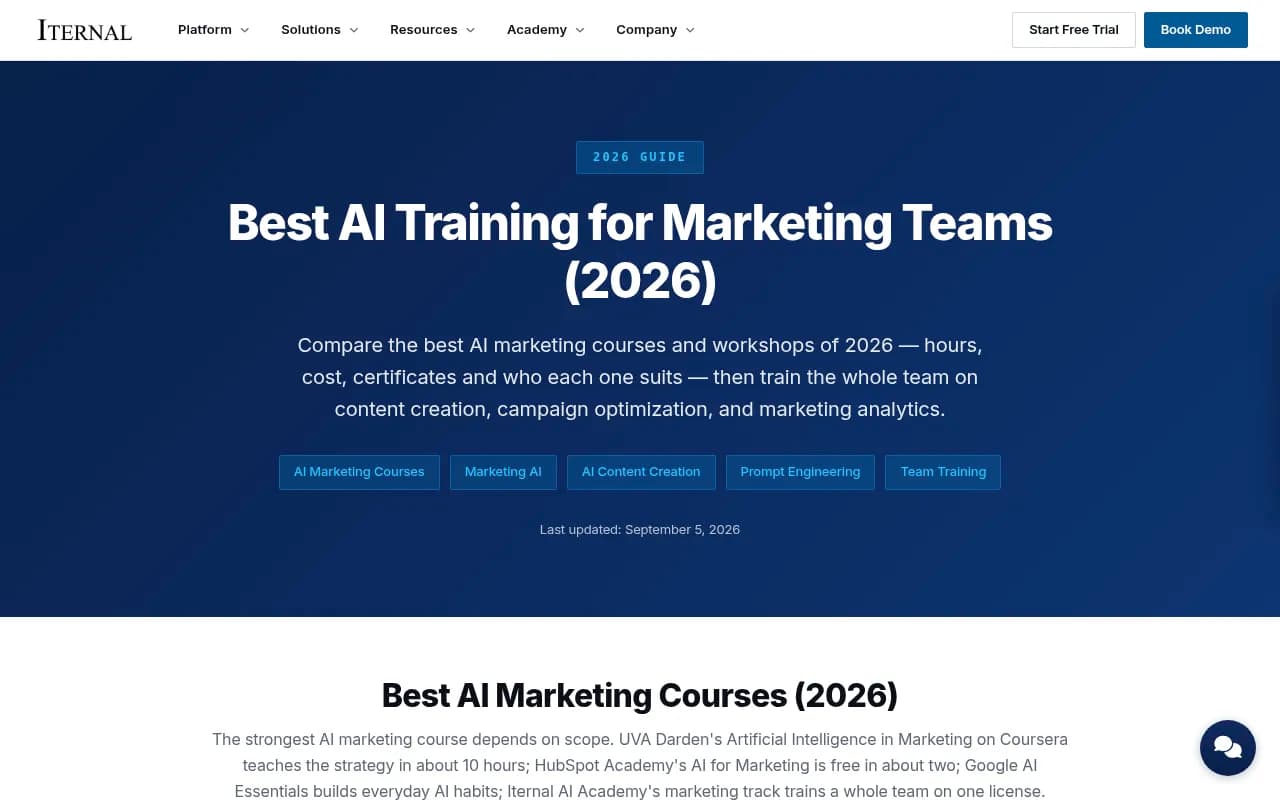
The formats on offer in 2026 are worth looking at before you design your own. The AMA runs a four-session hands-on series (September 3 to 24, two hours each) where participants build an actual AI-assisted strategy and leave with a repeatable workflow. Iternal's guide to AI training for marketing teams compares self-paced options like the UVA Darden course on Coursera (about 10 hours), Google AI Essentials (about 8 hours) and HubSpot Academy's free AI for Marketing (under 3 hours). Those are good for baseline literacy. None of them teach your team how AI engines decide which of your pages to cite.
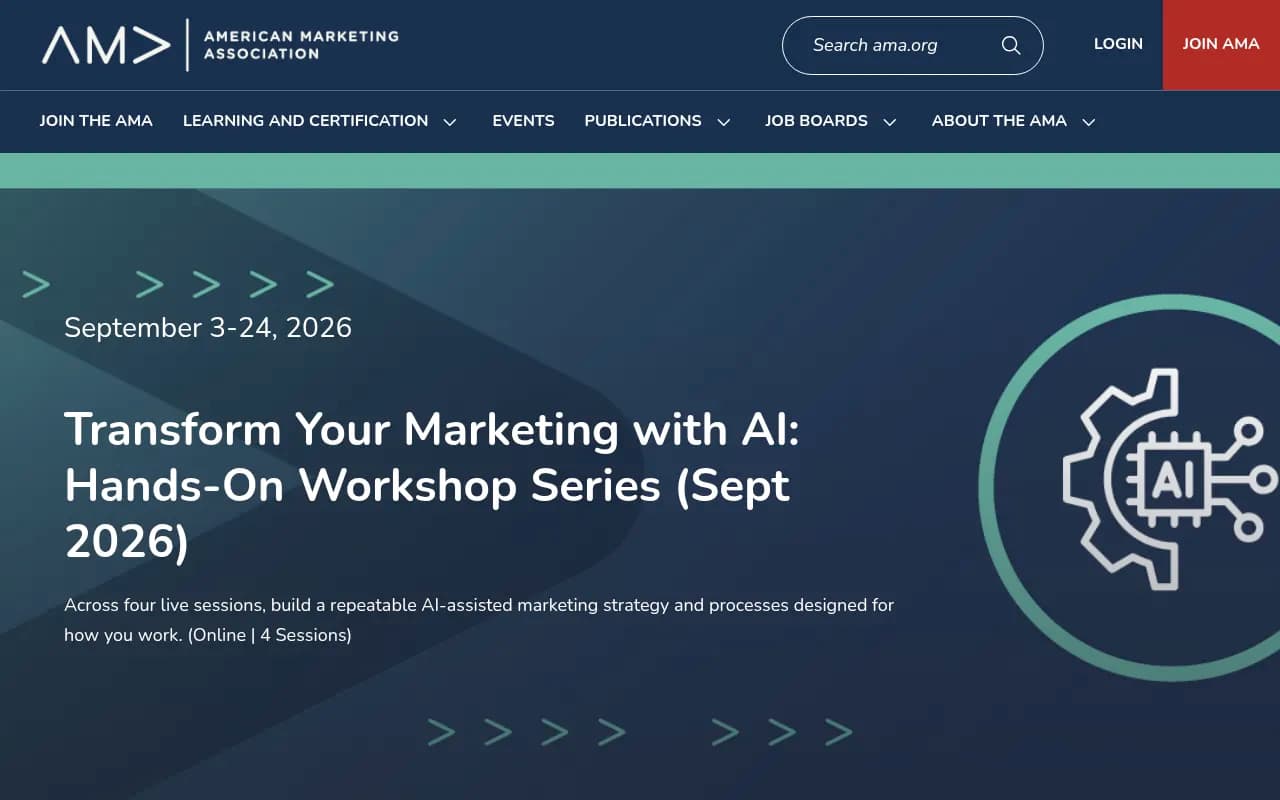
That gap is what this outline fills. It borrows the AMA's structure (four live sessions, exercises inside the session, a finished artifact at the end) and points it at AI search specifically.
Before you start: set up the room
Pick the audience and the size
Six to twelve people works. Mix roles on purpose: content writers, an SEO or web person, someone from paid or lifecycle, and a manager who can approve changes. If juniors and seniors have uneven AI skills, which the O8 guide flags as a common problem, pair them up for exercises.
Gather the inputs
Ask every participant to bring three things to session one:
- Their five most important pages (by traffic or revenue)
- Ten questions a customer might ask before buying
- Access to ChatGPT, Perplexity and Google, logged in
If you want a shared workspace for notes and exercise outputs, a tool like Notion AI works fine.
Define what success looks like
Pick two or three measurable outcomes before day one. Examples: every participant can explain query fan-outs in plain language; the team has a baseline visibility report; five pages have been rewritten and are being tracked. Vague goals like "understand AI" produce vague results.
Workshop at a glance
| Session | Theme | Core exercise | Deliverable |
|---|---|---|---|
| 1 | How AI search works | Run 10 prompts across 3 engines, log every cited source | Citation log |
| 2 | What gets cited | Classify your own pages by content type and intent | Page audit sheet |
| 3 | Measuring visibility | Build a prompt set and capture a baseline | Baseline report |
| 4 | Acting on it | Rewrite pages, build a 30-day action plan | Action plan with owners |
Each session is 2 hours: 20 minutes of explanation, 80 minutes of exercises, 20 minutes of debrief. Resist the urge to talk more. The exercises are the training.
Session 1: how AI search actually works
Learning goals
By the end, everyone should be able to explain, without jargon, that AI engines take a prompt, often run several web searches behind the scenes (query fan-outs), read a handful of pages, and then write an answer citing some of them. Being cited is the goal. Ranking position in the classic sense matters less than being in the set of sources.
Explanation block (20 minutes)
Cover four ideas and no more:
- Models answer from training data and from live search. Citations come from the live part.
- A single prompt can trigger multiple searches. Promptwatch's query fan-out data shows ChatGPT averaging about 2.15 searches per response in December 2025 and about 1.84 by early March 2026, with query length shrinking over the same period. The numbers move as OpenAI changes the product, so teach the concept and not a fixed figure.
- Search behaviour changes without notice. On August 8, 2026, ChatGPT started using the site: operator at scale, jumping from about 0.4% to about 17% of fan-out queries, according to Promptwatch Data.
- Responses cite many domains. Almost half of ChatGPT responses cite 10 or more unique domains (Sep 28 to Oct 4, 2026), per Promptwatch's unique domains report. That is good news: there is room for you in the list.
Exercise 1: the citation log (60 minutes)
In pairs, run the same ten customer questions through ChatGPT, Perplexity and Google (AI Overviews or AI Mode where available). For each answer, record in a shared sheet:
- Was our brand mentioned? Was it cited with a link?
- Which competitors appeared?
- Which domains were cited? What type of page was each?
- Did the engines agree with each other?
Perplexity
The point isn't scientific rigour. The point is that people see, with their own eyes, that the three engines give different answers and cite different sources. That moment does more than any slide.
Debrief questions
- Which engine surprised you most?
- How many sources were forums, review sites or third-party roundups rather than company sites?
- What did the engines say about us that we would not have written ourselves?
Session 2: what gets cited and why
Learning goals
Participants understand which content types earn citations for which kinds of prompts, and can classify their own pages.
Explanation block (20 minutes)
Show the numbers from Promptwatch's content type report (Sep 28 to Oct 4, 2026):
| Content type | Share of ChatGPT citations |
|---|---|
| Product pages | 22.4% |
| Landing pages | 16.8% |
| Listicles | 13.6% |
| How-tos | 8.7% |
| Documentation | 7.5% |
| Articles | 6.1% |
| Comparisons | 5.9% |
| News | 5.7% |
| FAQ pages | 3.3% |
| Reviews | 1.7% |
Two things usually land hard with content teams. First, product and landing pages together take about 39% of citations. Teams that have poured years into blog content often discover the pages describing what they sell are the ones AI wants. Second, intent matters. For commercial prompts like "best CRM for small businesses", product pages get 26.0%, landing pages 20.6%, listicles 15.0% and comparisons 7.9%. For branded prompts like "is HubSpot good for startups", reviews jump to 5.6%, more than three times their overall share, and FAQ pages rise to 4.8%.
Add shelf life. Promptwatch's content half-life report tracked pages ChatGPT cited on July 6, 2026: landing pages and docs stayed cited longest, while news lost half its pages within 36 days. That should change how a team budgets for refreshes.
Exercise 2: classify your own pages (60 minutes)
Each participant takes their five pages and fills in a sheet:
| Page | Content type | Prompt intent it serves | Complete? (pricing, specs, who it's for) | Gaps |
|---|---|---|---|---|
| /pricing | Product page | Commercial | Missing comparison table | Add plans and FAQs |
Then they compare their mix with the shares above. A team with 80% blog posts and a thin product page has just found its first project. Promptwatch's own advice from this data is to map content to prompt intent, keep product pages complete and factual, get included in the best-of roundups ChatGPT cites, collect reviews on trusted sites, and add FAQ pages. Turn those into assignments.
For tooling during this exercise, a crawler such as Screaming Frog is handy for exporting every page with its title and headings in one go.
Google Search Console is the other free input, because it shows which queries each page already earns impressions for.
Bonus mini-exercise: heading rewrite (15 minutes)
Because engines run short searches, headings that read like short queries tend to match better. Have each person rewrite three H2s from vague to specific, e.g. "Our approach" becomes "Best CRM for small agencies 2026". Front-load the entity and the category.
Session 3: measuring AI visibility
Learning goals
The team can build a prompt set, understand the core metrics, and capture a baseline they will compare against in 30 days.
Explanation block (20 minutes)
Walk through the metrics in plain terms:
- Visibility: how often you are mentioned or cited across a set of prompts
- Share of voice: your mentions relative to competitors
- Position: where in the answer or source list you appear
- Sentiment: how the answer talks about you
- Citation source type: whose pages are doing the talking
Then the key lesson for this session: AI search is not one channel. Promptwatch's social media citations report (Sep 28 to Oct 4, 2026) found social platforms made up only 0.46% of ChatGPT citations, versus 12.2% for Google AI Overviews and 2.7% for Perplexity. In AI Overviews, YouTube led at 4.28%. In ChatGPT, LinkedIn was the top social platform at 0.3%. Reddit's share of ChatGPT citations collapsed from roughly 4% to 0.5% on August 14, 2026, covered in its own report. A team that built a Reddit-first AI strategy in spring has a problem. A team that built per-engine tracking noticed in a day.
Exercise 3: build a prompt set and baseline (70 minutes)
In small groups, build a monitor of 30 to 50 prompts, split into three types:
- Organic category prompts ("best project management tool for agencies")
- Competitor comparisons ("X vs Y")
- Brand-specific prompts ("is X good for enterprise")
Then capture a baseline in one of two ways.
Manual: run each prompt in each engine and score it in a sheet. Fine for 20 prompts, painful beyond that.
With a tracker: tools like Promptwatch can run the prompts daily across real AI interfaces, show citations and competitors, and tie visits from AI platforms to your site, which is useful when someone asks the inevitable "does this drive revenue?" question.

There is a wide field of options at different price points. If you want to compare them, the GEO software directory at bestgeosoftware.com is a reasonable starting point. For a quick free check before committing to anything, a few catalog tools work as no-cost scans:

Decide as a team which metric you will report monthly. Pick one primary number, not seven.
Common baseline mistakes to flag
- Using only branded prompts, which flatters you
- Tracking one country when you sell in five
- Comparing results from different weeks without noting that engines changed
- Treating a single run as truth. Answers vary, so look at trends
Session 4: turning insight into action
Learning goals
The team leaves with rewritten pages, an owner for each task, and a 30-day review date.
Explanation block (20 minutes)
Teach the loop: find the gap, fix the page, publish, verify the crawl, watch citations. Add the technical layer briefly. AI crawlers have to be able to read your site, and their mix changes fast. Promptwatch's AI crawler traffic report covers weekly verified requests from June 8 to September 6, 2026, and its Meta-WebIndexer report shows that crawler going from about 2% to nearly 38% of tracked requests between mid-July and August 9. If your robots.txt or CDN rules block a crawler by accident, no content work will help. Someone on the team should own a check of this.
Also, kill one myth in the room. Markdown files are 0.05% of AI search citations (Promptwatch Data), so spending a sprint publishing markdown copies of pages for AI search is wasted effort.
Exercise 4a: rewrite sprint (50 minutes)
Each participant picks the weakest page from their Session 2 audit and fixes it using a checklist:
- Title and H2s read like short search queries
- Entity and category stated up front
- Pricing, specs and audience stated plainly
- An FAQ block with real customer questions
- A comparison or alternatives section where intent calls for it
- Last-updated date and a named author
Use AI to draft if you like, but the rule is a human edits and fact-checks everything. If your team uses a content optimisation tool, this is where it earns its keep.

Grammar and clarity checks are cheap and worth doing before anything ships.
Exercise 4b: the 30-day action plan (30 minutes)
Build a table everyone can see:
| Action | Owner | Due | How we will know it worked |
|---|---|---|---|
| Rewrite pricing page with FAQ | Dana | Nov 14 | Cited for 3 commercial prompts |
| Pitch inclusion in two best-of roundups | Sam | Nov 21 | Appears in cited listicles |
| Audit robots.txt for AI crawlers | Priya | Nov 7 | Crawler logs show clean 200s |
Platforms with an action board or agent features can generate a first draft of this list from your tracking data. That saves time, but the human decisions about priority and ownership are the point of the session.
Picking a delivery format
Not every team can run four live sessions. Here is how the options compare.
| Format | Time | Cost | Best for | Weakness |
|---|---|---|---|---|
| This four-session internal workshop | 8 hours plus prep | Staff time | Teams who want applied change | Needs a facilitator |
| External cohort (e.g. AMA series) | 8 hours over four weeks | Paid registration | Individuals learning alongside peers | Not about your pages |
| Self-paced course library (e.g. Iternal AI Academy) | Varies | Per-seat licence | Baseline AI literacy across a large team | Low accountability |
| Free short courses (e.g. HubSpot Academy AI for Marketing) | About 3 hours | Free | Solo marketers, first step | Generic, doesn't cover citations |
My honest take: use a self-paced course for prompting basics and run the workshop above for the AI search part. Nobody else will teach your team about your own citations.
Tooling cheat sheet for facilitators
| Job in the workshop | Free or light option | Heavier option |
|---|---|---|
| Run prompts manually | ChatGPT, Perplexity, Google | n/a |
| Page and heading export | Screaming Frog | Enterprise crawlers like Botify |
| Query data | Google Search Console | Semrush |
| Baseline visibility | Free graders (AnswerGist, HubSpot AI Search Grader) | Promptwatch and similar platforms |
| Content briefs | Frase | Clearscope, MarketMuse |
For more category options, ai-rank-tools.com lists AI rank trackers side by side.
Running the 30-day follow-up
Schedule it before the workshop ends. It should take 60 minutes and cover three things:
- Re-run the baseline and compare against Session 3
- Review each rewritten page: was it crawled, did it get cited, did visits from AI platforms change
- Decide what to do with the pages that did not move
Expect mixed results. Some pages will win citations quickly, some will not, and engines will have changed something in between. That's normal, and it's the reason the follow-up exists. The habit of checking, not any single result, is what you are training.
Facilitator pitfalls
- Talking too long. If the explanation block runs past 25 minutes, cut slides.
- Teaching one engine only. Pick at least ChatGPT, Google AI Overviews and Perplexity.
- Quoting stale statistics. Citation behaviour shifts monthly. Put the date next to every number, and refresh the deck before each run.
- Ignoring the third-party layer. A lot of what engines say about you comes from reviews and roundups you don't control, so someone needs to own outreach.
- Skipping the owner column. Actions without names don't happen.
Getting outside help
Some teams don't have the bandwidth or the in-house expertise to run this. If you want a facilitator, or want a partner to carry out the technical and content work that comes out of the sessions, an agency that does SEO and GEO together can help. 1001 SEO Media covers technical SEO, content, and AI search optimisation, and you can reach them at [email protected]. Whoever you pick, ask them to work from your own prompt set and baseline, not a generic deck.
A quick workshop checklist
- Invite 6 to 12 people from mixed roles
- Collect top pages and customer questions in advance
- Book four two-hour sessions, one week apart
- Prepare the citation log and page audit templates
- Decide the primary metric and the tracking method
- Book the 30-day follow-up before session one ends
The format is simple on purpose. Four sessions, four artifacts, one review date. A team that has done its own citation log and rewritten its own pages will understand AI search better than one that has watched twenty hours of video.