Key takeaways
- Roughly 80% of the work behind SEO, AEO, and GEO is shared, so one scorecard and one set of owners beats three separate reports.
- Build the scorecard around prompts, not keywords. Every team reads the same tracked prompt set and sees a different slice of it.
- Pick five to eight metrics: visibility, share of voice, citation rate, AI-referred conversions, ad presence, and content freshness. Give each one a single owner.
- Set refresh cadence by content type. Promptwatch Data shows news pages lose half their citations in 36 days, while landing pages and docs hold on far longer.
- Review monthly as one group. Quarterly is too slow for a channel where ChatGPT ad rates went from 0% to above 30% in a few weeks.
Why three teams end up with three dashboards
Here is the usual setup. SEO reports rankings and organic sessions. Content reports publishing volume and engagement. Paid reports ROAS and CPA. Then someone in leadership asks, "How are we showing up in ChatGPT?" and three people each go off and run a few prompts by hand.
Nobody is wrong. The question just does not belong to any one team. AI answers pull from your product pages, your editorial content, third-party reviews, and sometimes sit next to an ad. All three teams influence the same answer, and none of them sees the whole thing.
The vocabulary does not help. Clique Studios frames it by unit of optimization: SEO works on a page, AEO on a passage, GEO on the entity behind the page (your brand, your named authors, the facts a model attaches to your name). They also note that no consensus definition separating the three terms existed in the academic literature as of early 2026, which is why vendors can quote you three retainers for what is mostly one program.
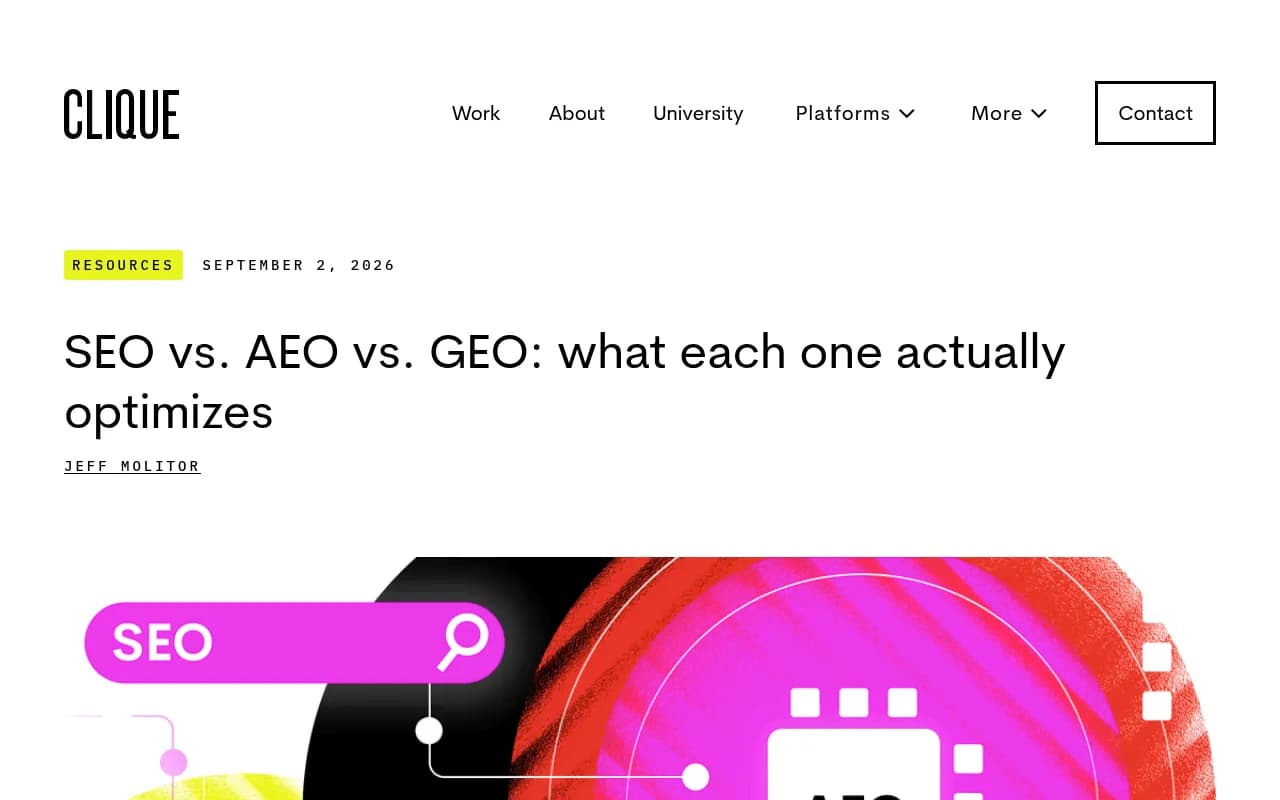
Their answer to whether you need separate teams or budgets: in most organizations, one team and one budget, because original content, question-led structure, standard schema, and clean technical foundations serve rankings and AI citations at once. I agree. The scorecard is how you make that real instead of a slide.
What the scorecard is (and is not)
A GEO scorecard is one page, one set of tracked prompts, and a small number of metrics that all three teams commit to. It is not a replacement for your SEO dashboard or your paid reporting. Those stay. The scorecard sits above them and answers one question: when buyers ask AI about our category, what happens?
It should be short. If it has 30 metrics, nobody owns any of them. Aim for five to eight, grouped by who can move them.
Step 1: Build one shared prompt set
Everything else hangs on this. Keywords will not do the job, because AI answers are triggered by full questions and by the web searches the model runs behind the scenes (query fan-outs). Build a prompt set that all three teams contribute to:
- SEO adds informational and category prompts drawn from Search Console queries and People Also Ask.
- Content adds how-to and comparison prompts tied to planned articles.
- Paid adds commercial prompts that mirror your highest-spend campaigns and brand-versus-competitor terms.
Tag each prompt by intent: organic, brand-specific, or competitor comparison. This matters because intent changes what AI cites. Promptwatch Data on which content types ChatGPT cites (Sep 28 to Oct 4, 2026) shows product pages at 22.4% of all citations and landing pages at 16.8%. For commercial prompts like "best CRM for small businesses", product pages climb to 26.0% and landing pages to 20.6%. For informational prompts, how-tos (10.7%) and docs (8.5%) matter more. Branded prompts lean on reviews (5.6%, over three times their overall share) and social posts (3.0%).
So the same brand can look strong on informational prompts and weak on commercial ones, and the fix belongs to different teams. Tagging by intent is what lets you route the problem.
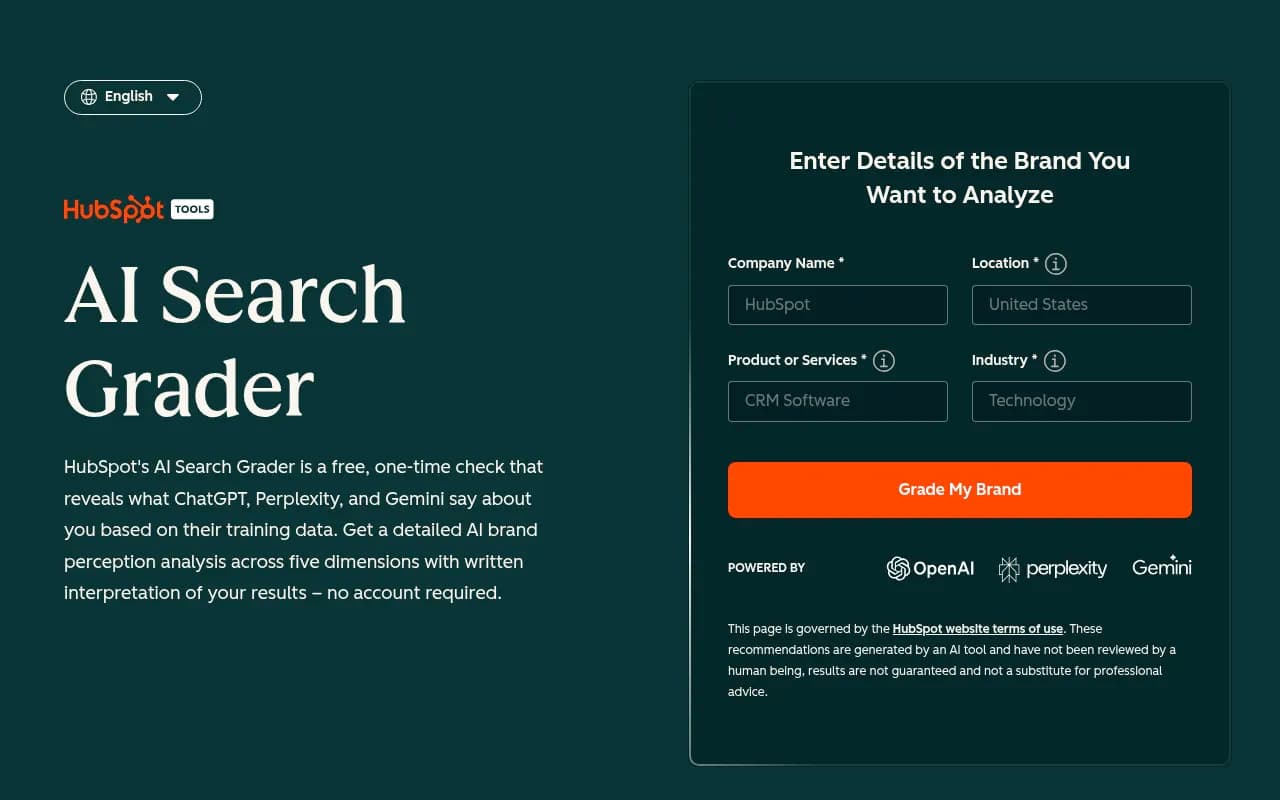
A tracker built for this, such as Promptwatch, can run prompt monitors daily across ChatGPT, Google AI Overviews, Perplexity, and others, with prompt volumes and difficulty so you can prioritize.

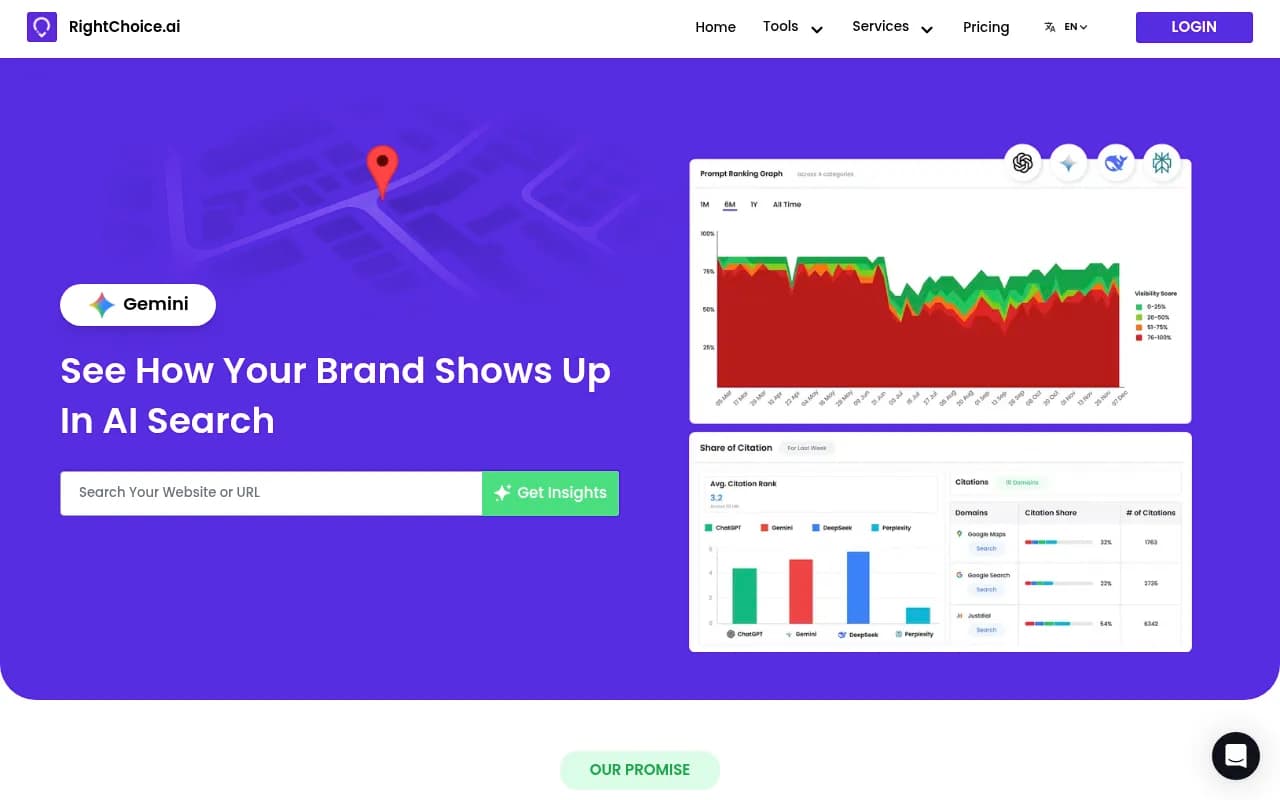
A free starting point is a quick scan with something like the free tools below, though they give you a snapshot, not a trend.
Step 2: Pick metrics and give each one a single owner
Shared ownership means nobody is on the hook. The trick is shared visibility with individual accountability. Here is a starting set.
| Metric | What it tells you | Primary owner | Supporting teams |
|---|---|---|---|
| Visibility score | How prominently you appear across tracked prompts | SEO | Content |
| Share of voice vs. competitors | Coverage problem or not | SEO | Paid (brand terms) |
| Position in answer | Whether you are named first or buried | Content | SEO |
| Self-citation rate | Whether AI cites your own pages when it names you | Content | SEO (crawlability) |
| Sentiment | Reputation in AI answers | Content / PR | Paid |
| AI-referred sessions and conversions | Real business impact | Paid / analytics | SEO |
| Ad presence on tracked prompts | Which advertisers appear on your prompts | Paid | SEO |
| Content freshness by type | Share of cited pages updated on schedule | Content | SEO |
Read the metrics together and they locate the problem. Low share of voice is a coverage problem: you are missing from prompts you should be in. Late position is a prominence problem. Mentions without self-citations usually mean a content or crawlability issue. Weak sentiment is a reputation problem. Each diagnosis points to a different team, which is exactly why a single scorecard helps.
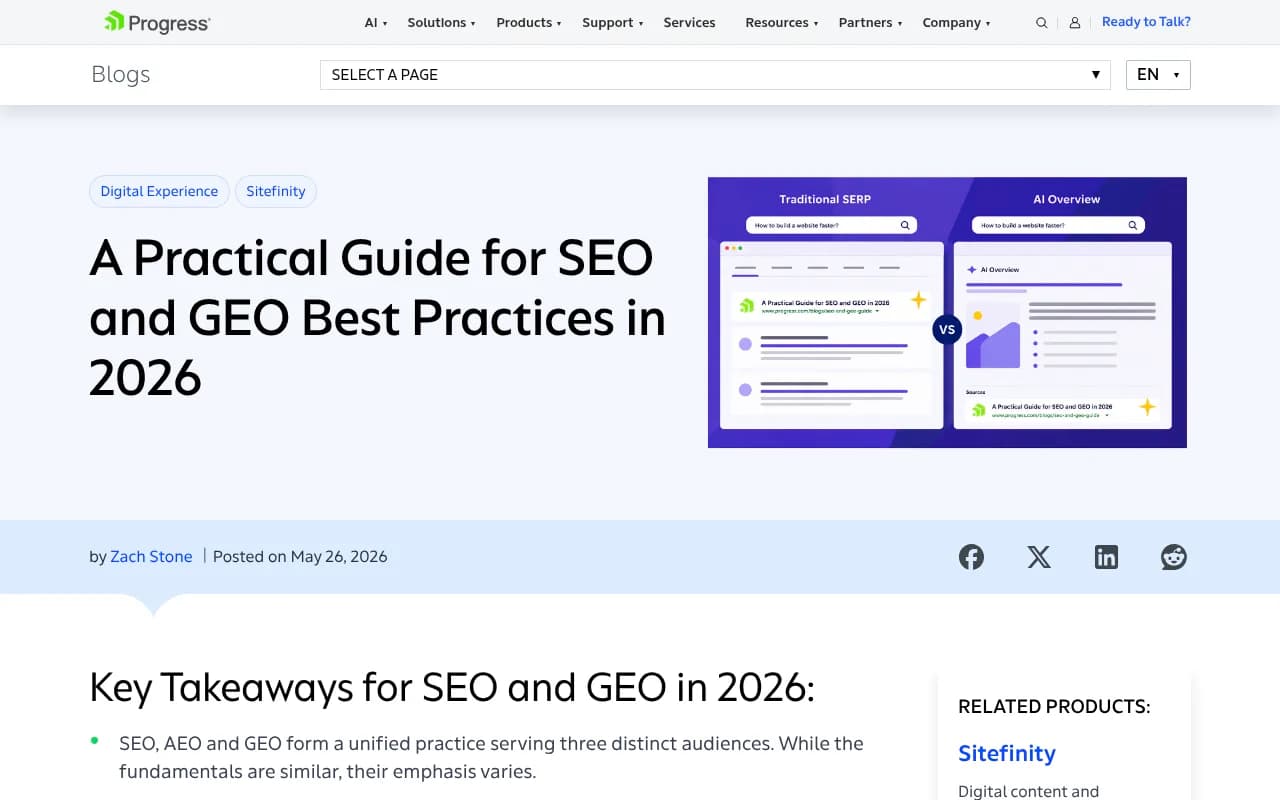
A warning on click-through rate. The Sitefinity guide by Zach Stone argues reference rate, not CTR, is the key metric for generative responses, and that securing citations in AI Overviews is now worth more than chasing the clicks those overviews replaced. I would not drop clicks entirely, but I would stop treating them as the headline number.
Step 3: Bring paid into the picture
Paid teams are usually the last invited, and that is a mistake in 2026. Ads now show up inside AI answers. Promptwatch Data on ChatGPT ads over time (May 20 to Aug 17, 2026) shows no ads until May 27, when they appeared in 1.69% of responses. The rate passed 30% on July 1 and stayed there, peaking at 43.9% on a single day. The 90-day average was 20.1%, and the past 7 days were at 32.4%. Of ad-bearing responses in the latest week, 73.3% were organic prompts, 18.0% brand-specific, and 8.6% competitor comparison. That is a volume mix, not the odds that a given prompt triggers an ad, so do not read it as a targeting guide.
What paid should add to the scorecard:
- Ad presence rate on your tracked prompts, checked across several days, since a single day proves little.
- Which advertisers and landing pages appear on prompts you care about.
- Overlap between prompts where you rank organically and prompts where competitors buy placement.
That last one is the useful bit. If a competitor is paying to appear on a prompt where you are already cited organically, you can decide whether to defend or ignore it. If you are absent in both places, the gap is bigger than either team knew.
Tools like Promptwatch's Ads Radar show which advertisers bid on your prompts, their ad copy, and landing pages. For wider paid intelligence outside AI search, the ad intelligence tools below fill a different role.
Step 4: Set refresh cadence by content type
This is where SEO and content teams usually argue. SEO wants everything audited. Content wants to write new things. The data gives you a way to settle it.
Promptwatch Data on the half-life of content in ChatGPT tracked every page ChatGPT cited on July 6, 2026 for 90 days. Retention looked like this:
| Content type | Still cited at 30 days | Still cited at 60 days |
|---|---|---|
| Landing pages | 78% | 69% |
| Docs | 76% | 67% |
| Comparisons | 72% | 63% |
| Listicles | not reported | 60% |
| Product pages | not reported | 55% |
| Reviews | not reported | 55% |
| How-tos | not reported | 55% |
| News | not reported | 41% |
Product pages, reviews, and how-tos hit half-life at 74 to 77 days. News hits it at 36 days, and almost a quarter of news pages are never cited again after day zero. Landing pages, docs, comparisons, and listicles likely last close to or past 90 days.
Turn that into a rule set:
- News and PR: treat as short bursts. Do not expect a lasting citation, and do not penalize the team when it fades.
- Product, review, and how-to pages: review at roughly 60 days, before they hit half-life.
- Landing, docs, and pricing pages: these hold citations longest, so keep prices, features, and positioning current. Stale facts here cost you the most.
The report also notes pricing pages are classified as landing or product pages, which means paid-owned landing pages are part of the organic citation story. Another reason for the two teams to share a scorecard.
Step 5: Map content to intent, then assign it
Combine the two datasets and you get a simple allocation. About 39% of ChatGPT citations go to product and landing pages, the pages that describe what you sell. Editorial formats combined account for 43%, and listicles, how-tos, and comparisons alone make up 28%. Nobody should be surprised that commercial prompts are won by commercial pages, but a lot of content calendars are still weighted toward blog posts.
| Prompt intent | What AI tends to cite | Lead team | What to do |
|---|---|---|---|
| Commercial ("best X for Y") | Product pages, landing pages, listicles, comparisons | SEO + Paid | Tighten product and landing copy, publish comparisons, test messaging |
| Informational | Product pages, landing pages, listicles, how-tos, docs | Content | Question-led how-tos, docs, standalone first sentences under each heading |
| Branded | Product and landing pages, reviews, social, FAQ | Content + PR | Collect reviews, keep FAQ and press pages accurate |
The Clique Studios advice for the next 90 days is concrete and cheap: take your 20 highest-intent pages and rewrite the first sentence under every heading so it stands alone. It is a good first sprint because it helps SEO (featured snippets), content (clarity), and AI (passage extraction) all at once.
Step 6: Fix the technical layer before you blame the content
If AI crawlers cannot read your pages, no scorecard metric will move. Two checks belong on the scorecard as health indicators:
- Crawler access: are AI bots reaching your key pages without errors?
- Structured data: Sitefinity's guide calls schema the most impactful action this year, because LLMs lean on it even more than traditional engines.
Promptwatch's IP-verified crawler logs show which AI bots hit which pages and where they fail. If you want to test the basics yourself first, a crawler such as Screaming Frog and a schema platform cover much of it.
Search Console data is the bridge here. Pages that rank in Google but never get cited by AI are the most obvious, cheapest wins on the whole scorecard.
Step 7: Choose a tracking tool that all three teams can open
The tool matters less than whether it covers prompts, citations, traffic, and action. Many options only monitor. For a scorecard you want at least real answers from AI interfaces, competitor comparison, and some way to connect visibility to site traffic.
| Option | Strength | Gap to check |
|---|---|---|
| Promptwatch | Monitoring plus crawler logs, AI traffic attribution, content gap analysis, Content Agent, Ads Radar | Fuller feature set than a small team may need on day one |
| Profound | Enterprise monitoring | Higher price point, check Reddit and shopping coverage |
| Otterly.AI | Affordable prompt tracking | No crawler logs or content workflow |
| Peec AI | Simple monitoring | Monitoring only |
| Semrush | Familiar SEO suite with AI tracking added | Fixed prompt sets, shallower AI data |
| Ahrefs Brand Radar | Brand monitoring inside an existing SEO subscription | Lighter on crawler and traffic data |



At the time of writing Promptwatch plans start at $95 per month (Essential) and the Business plan at $579 includes the Content Agent; confirm current numbers at promptwatch.com/pricing. For more options, the GEO software directory at bestgeosoftware.com lists dozens of trackers side by side.
For reporting across teams, most of these export to PDF or Looker Studio, and agency-style reporting tools can pull everything into one place.
Step 7b: Close the loop with actions, not just charts
A scorecard that only reports is a museum. Each review should end with a short list of actions, each with an owner and a date. A prioritized to-do list, such as the Action Board in Promptwatch, helps here because gaps get turned into tasks instead of lingering in a slide deck. Project tools like Wrike or Notion do the same job if you keep it manual.
Step 8: Run the meeting cadence
Keep it light:
- Weekly (15 minutes, async is fine): check anomalies. A sudden drop in citations or a spike in competitor ads gets flagged.
- Monthly (45 minutes, all three leads): walk the scorecard, agree on three to five actions, assign owners.
- Quarterly: revisit the prompt set. Add new prompts, retire dead ones, and recheck which metrics still earn their place.
Monthly beats quarterly because the ground moves fast. Promptwatch Data shows reddit.com's share of ChatGPT citations fell from about 4% to 0.5% on August 14, 2026 (Reddit citations are dropping in ChatGPT). Any plan built around Reddit seeding would have needed rethinking that month. And the numbers differ by engine: in the week of Sep 28 to Oct 4, 2026, ChatGPT drew 0.46% of its citations from social platforms while Google AI Overviews drew 12.2% (Social media citations by AI model). A scorecard that blends all engines into one number would hide that. Show visibility per model.
A 90-day rollout
Days 1 to 30: agree on the basics
- Run a joint workshop. Each team lists 10 to 20 prompts it cares about.
- Tag prompts by intent and pick the AI engines that matter for your audience.
- Choose the metrics and owners from the table above. Cut anything nobody will act on.
- Set up tracking and install AI-referred traffic analytics so you can see real sessions, not only mentions.
- Capture a baseline. Do not set targets yet.
Days 31 to 60: first fixes
- Rewrite the first sentence under every heading on your 20 highest-intent pages.
- Audit product, landing, and pricing pages for stale facts.
- Add schema where it is missing.
- Paid reviews the ad presence data and decides which prompts to defend.
Days 61 to 90: set targets and refresh rules
- Now that you have a baseline, set realistic targets per metric.
- Put the refresh cadence by content type into the editorial calendar.
- Hold your first monthly scorecard review and track what the fixes did.
Common failure modes
Few teams fail at tracking. They fail at ownership. A few patterns I would watch for:
- Too many metrics. If the scorecard does not fit on one screen, trim it.
- No intent tagging. You cannot tell whether a drop is a content problem or a product page problem.
- Paid left out. Ads in AI answers are a real share of responses now, and ignoring them leaves a blind spot.
- Treating all content equally. News fades in weeks, landing pages last months. Different rules apply.
- Judging by a single day. AI answers vary run to run. Look at trends across several days.
If you would rather hand the setup to someone, a specialist agency can build the prompt set, scorecard, and reporting cadence for you. 1001 SEO Media runs this kind of program across SEO, content, and AI search visibility, and uses Promptwatch for tracking. Most teams can do it in-house if one person is willing to own the scorecard itself.
The short version
One prompt set. Five to eight metrics. One owner per metric. Refresh rules by content type. A monthly meeting that ends with actions. That is the whole system. The rest is repetition, and a willingness to let SEO, content, and paid look at the same numbers for the first time.