Key takeaways
- A solo GEO consultant can run a credible practice on four layers: one AI visibility platform, a crawler/audit tool, an LLM for writing and analysis, and a light ops layer. Budget roughly $200 to $450 a month, not $1,500.
- The biggest purchase decision is the visibility platform. Compare cost per tracked response, engines included, API access and refresh frequency, not the headline price.
- Skip enterprise suites, per-client workspaces you can't amortize, and writing tools that have no visibility data behind them.
- Free tools (Google Search Console, free AI visibility checks, Screaming Frog's free tier) cover a surprising amount of pre-sales and audit work.
- Pricing in this category moves fast. Profound pulled its $99 tier in autumn 2026, so verify every price on the vendor page before you commit.
What a solo consultant actually needs
Most of the general advice about consultant stacks is right on one point: you don't need a giant stack. CloudedSite's September 2026 guide for independent consultants recommends starting with Claude for thinking and writing, Fireflies for meetings, and Notion for one place to run projects. I agree with that foundation. What it doesn't cover is the GEO-specific part, which is where people overspend.
GEO work for a client breaks into four jobs:
- Measure: are they mentioned or cited in ChatGPT, AI Overviews, Perplexity and the rest, and against whom?
- Diagnose: can AI crawlers reach the site, and which pages get read, cited or ignored?
- Fix: write or refresh content, fix technical problems, earn third-party mentions.
- Report: show the client what changed, without spending a day building slides.
Every tool you buy should map to one of those jobs. If you can't say which, skip it.
Layer 1: the AI visibility platform (your biggest decision)
This is where most of your budget goes, and where the traps are. The tracking market has split into two camps. Pure monitors answer "was my client mentioned?" Platforms with an action layer also tell you why and help fix it. As a solo operator, you're the one doing the fixing, so anything that shortens that loop is worth money.
What the entry plans really cost
The numbers below come from vendor pricing pages as compiled in Promptwatch's 2026 comparison (vendor-authored, so cross-check) and an independent price check from Industry Lens in mid-October 2026.
| Tool | Entry price/mo | Prompts | Watch out for |
|---|---|---|---|
| Otterly.AI | $29 | 15 | 4 models; no API or MCP below $189 |
| Rankscale | $20 (annual only) | varies | Pro is $99 monthly |
| LLMrefs | $79 | 500 | Monthly billing |
| Peec AI | about $95 | 50 | 3 of 6 models; extra models $35/mo; API is Enterprise-only |
| Searchable | $125 | 100 | Claude, Copilot, Grok cost extra; API needs $400 plan |
| Semrush AI Visibility Toolkit | $99 to $199 | 25 | Per domain and per seat; +$60/mo per 50 prompts |
| Rankshift | $92 | 150 | Credit-based |
| Scrunch | $250 | 125 | Sitecore-owned |
| AthenaHQ | $295 | n/a | Credit-based; API is paid add-on |
| Ahrefs Brand Radar | $199 to $328 | n/a | Priced per index |
| Promptwatch Essential | $95 | 50 | All engines included, API and MCP included |
The headline price hides the real comparison. On Promptwatch's own table, cost per tracked response ranges from about $0.01 to $0.13. A $29 plan with 15 prompts on four models gives you very little to show a client. Count prompts, engines, refresh frequency (daily or weekly) and whether the API is locked behind a higher tier.
What I'd buy
For a solo consultant juggling a handful of clients, I'd start with Promptwatch on Essential at $95/month for your own practice and your first client, then move to an agency plan once you have three or more. The reason isn't the monitoring. Plenty of tools monitor. It's that the same subscription includes real-UI tracking across all the engines, a site audit, content gap analysis, 360 Insights and an MCP server, so you aren't stitching three tools together. At the Business tier it adds IP-verified crawler logs and the Content Agent, which plans, writes and publishes against visibility gaps.

When client count grows, the agency tiers matter. Kick-off is $199/month with unlimited projects and 10,000 responses, Growth is $399/month, and Scale is $799/month. Agency plans have white-label exports and branded read-only client access, which beats pasting screenshots into slides. They don't include the Content Agent or 360 Insights, so decide whether you need those before you jump.
The honest caveat: the comparison data I have is vendor-authored, and I haven't found independent benchmarks of tracking accuracy for any of these tools. Run a two-week trial of your top two on the same ten client prompts and compare the outputs yourself. Promptwatch offers a 7-day free trial on monthly plans.
Cheaper alternatives, and when they make sense
If you only need a lightweight monitor for a single small client, these are reasonable:

Otterly.AI is cheap and simple, good for a first proof of concept. Expect to outgrow it when you want an API or crawler data.
LLMrefs offers 500 prompts at $79 on monthly billing, which is a lot of coverage for the money if you only need tracking.

Peec AI is clean and well liked, but the three-model starter limit and the extra $35 per model add up fast.
Rankscale is the cheapest published paid plan at $20 a month, but only on annual billing.
For a wider view of the category, the GEO software directory at bestgeosoftware.com lists far more options than I can cover here.
Tools to skip as a solo

Profound removed its $99 Starter tier in autumn 2026 and now offers a free trial plus custom Enterprise pricing, according to Industry Lens. Older write-ups that list a $99 plan are stale. It's no longer a realistic solo purchase.
Brandlight reportedly runs up to $25K a month at the enterprise end, and Bluefish, Evertune, Conductor, BrightEdge and Searchmetrics are built for enterprise procurement. If a client already owns one, learn it. Don't buy it for yourself.
Layer 2: crawler access and site audits
Half of the "why isn't my client cited?" cases I'd expect to see are plain access problems: robots.txt blocks, CDN or WAF rules that reject AI bots, or pages that render nothing without JavaScript. Promptwatch Data's AI crawler traffic report (weekly IP-verified requests, June 8 to September 6, 2026) found OpenAI accounted for 79.8% of verified AI crawler requests in the week of Aug 31 to Sept 6, down from 94.8% in early June. Its practical suggestion is to compare your own logs against that mix: if a provider is big in the benchmark and near zero in a client's logs, they are probably blocked. You can read the AI crawler traffic report for the details.
To run that check you need three things:
- Google Search Console for every client (free). It's the baseline for what Google sees.
- A crawler for technical audits. Screaming Frog's SEO Spider is the standard and the free tier handles small sites.
- AI crawler logs, if the client's hosting lets you get them. Promptwatch's Agent Analytics covers this at higher tiers, so you may not need a separate log tool.
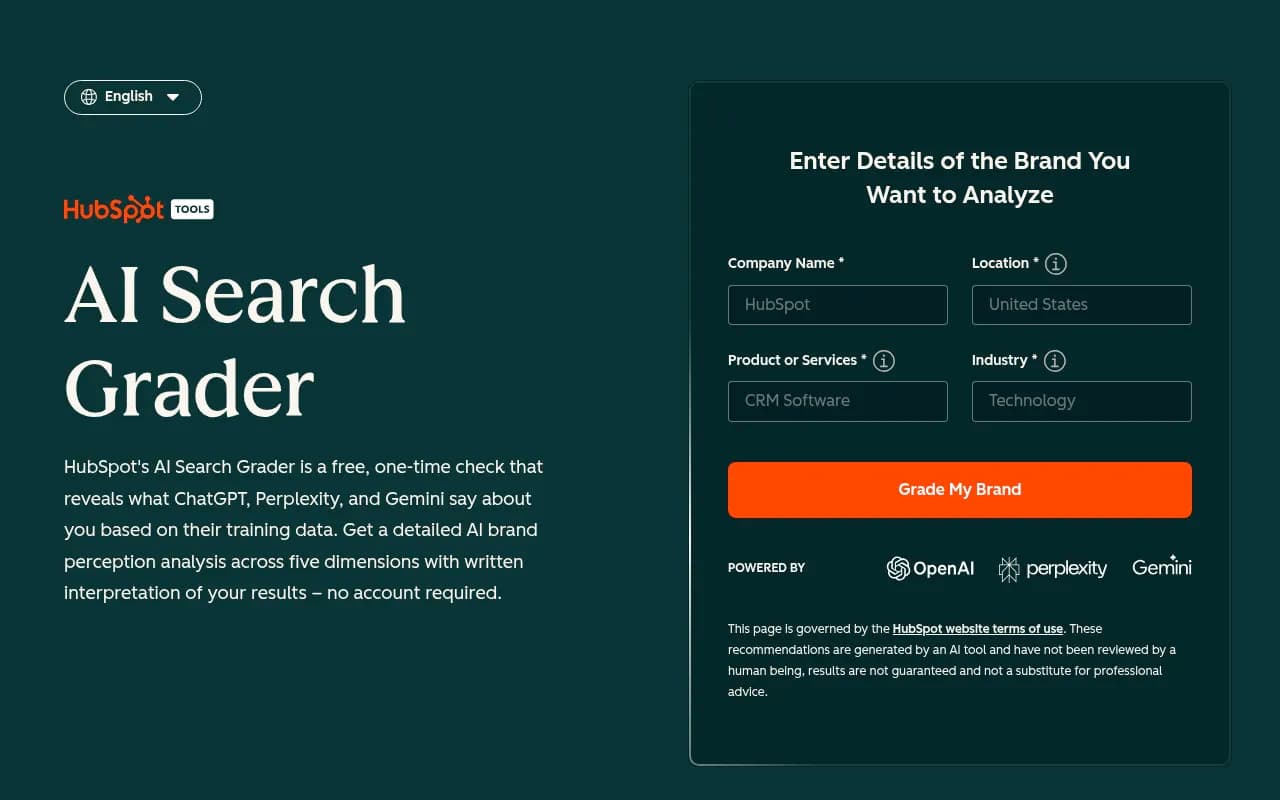
For first-conversation audits, free checkers are enough. Amplitude AI Visibility, HubSpot's AI Search Grader and AnswerGist all give a no-cost snapshot you can use to open a sales conversation:


Skip paid log analyzers like Botify, Oncrawl and Lumar unless a client specifically requires them. They're built for sites with millions of URLs.
Layer 3: research, writing and analysis
Here the general consultant advice holds up. You need one strong general assistant and, optionally, a research tool with sources.
| Job | Pick | Approx. cost | Notes |
|---|---|---|---|
| Writing and synthesis | Claude Pro | $20/mo | CloudedSite's top pick for consultants |
| Flexible all-rounder | ChatGPT | about $20/mo | Handy for checking how ChatGPT answers directly |
| Sourced research | Perplexity Pro | $20/mo or $200/yr | Also a useful test surface for your own clients |
| Meetings | Fireflies | Free, then about $10/mo annual | Searchable call history |
Perplexity
Pick one of Claude or ChatGPT. Paying for both is a luxury. Perplexity earns its place because it cites roughly ten sources every time. Promptwatch Data's average sources per response report (page dated September 2025) found Perplexity cites almost exactly 10 sources daily, Google AI Overviews about 10, and ChatGPT about 5 per web-search answer, so it works as a steady test bench for page changes. That data is older, so treat the exact counts as directional.
Content tools: be skeptical
This is where solo consultants waste the most. Generic AI writers (Jasper, Copy.ai, Rytr, Writesonic) produce words but have no idea what AI engines cite. Content scoring tools (Surfer, Clearscope, MarketMuse) optimize for Google SERPs, which overlap with AI citations but aren't the same thing.
What tends to get cited matters more than keyword density. According to Promptwatch Data on ChatGPT citation share by content type (Sep 28 to Oct 4, 2026), product pages were the most cited type at 22.4%, followed by landing pages and listicles. And per the content half-life report, landing pages and docs stayed cited longest among pages cited on July 6, 2026, while news lost half its pages within 36 days. So evergreen, structured pages are the better investment for clients.
My rule: buy writing help only if it's tied to visibility data. If your visibility platform already has content gap analysis and article generation, you don't need a second tool. If it doesn't, Claude plus a good brief is cheaper than a content platform.
Layer 4: operations and reporting
Keep this layer boring and cheap.
- Notion for client hubs and SOPs. Notion AI is included on the Business plan at $20 per member per month billed annually, but the free or Plus tiers are fine for one person.
- Zapier, Make or n8n for automation. n8n is open source and free if you self-host; Zapier is easiest.
- A CRM only when you have enough leads to lose track of. Pipedrive or HubSpot's free tier is plenty.
- Reporting: use your visibility platform's PDF exports before paying for AgencyAnalytics.
If your platform has an MCP server, you can connect it to Claude and ask questions of live data instead of assembling reports by hand. That saves more hours than any extra dashboard.
Three sample stacks by stage
| Stage | Stack | Rough monthly cost |
|---|---|---|
| Just starting, 1 client | Free checkers, Search Console, Screaming Frog free, Claude Pro, a $29 to $95 visibility plan | $50 to $120 |
| Established, 3 to 6 clients | Promptwatch agency or Professional tier, Claude Pro, Perplexity, Fireflies, Notion, automation | $250 to $450 |
| Scaling with white-label work | Agency Scale, Claude, Zapier or n8n, Slack, CRM | $900 to $1,100 |
These ranges sit inside the $100 to $500 monthly bracket that solopreneur stack guides cite, with the third tier above it because agency-level GEO tracking is a real cost. Check prices on each vendor page before you commit, because they change often.
Hidden costs to check before you sign
- Extra engines billed separately (Peec, Searchable).
- API access locked to higher tiers (Otterly, Peec, Searchable, AthenaHQ).
- Per-client or per-seat pricing that punishes you as you grow (Semrush, Profound).
- Weekly-only tracking at cheap tiers (LLM Pulse). A weekly snapshot can miss the day an engine changes behavior.
- Prompt overage fees. Semrush charges about $60 per extra 50 prompts.
AI engines also change without warning. Promptwatch Data recorded reddit.com's share of ChatGPT citations falling from roughly 4% to 0.5% on August 14, 2026 (see the Reddit citations report). A client strategy built on Reddit seeding would have lost its payoff overnight. Daily tracking is how you catch that kind of shift for your client before they email you.
What to skip entirely
- Backlink marketplaces and bulk directory submission tools. They create risk and nothing here suggests they help AI citations.
- Generic AI content generators with no citation data.
- A second or third visibility tracker. Pick one, learn it well.
- Enterprise SEO suites for a client count you can count on one hand.
- Social scheduling tools unless you sell social management.
If you'd rather outsource part of the delivery than build the whole stack yourself, a specialist agency like 1001 SEO Media is the other route. For tooling comparisons, the directory at ai-rank-tools.com tracks AI rank trackers in one place.
A practical buying order
- Set up Search Console and a free crawler for every client.
- Run free AI visibility checks to open conversations.
- Pick one visibility platform by trialing two on the same ten prompts.
- Add Claude or ChatGPT, not both.
- Add automation only when you notice yourself repeating a task weekly.
- Revisit the stack every quarter. Prices and features in this category change faster than anything else you buy.
Start with the cheapest stack that lets you show a client one real before-and-after. Everything else can wait for the second invoice.