Gauge Review 2026
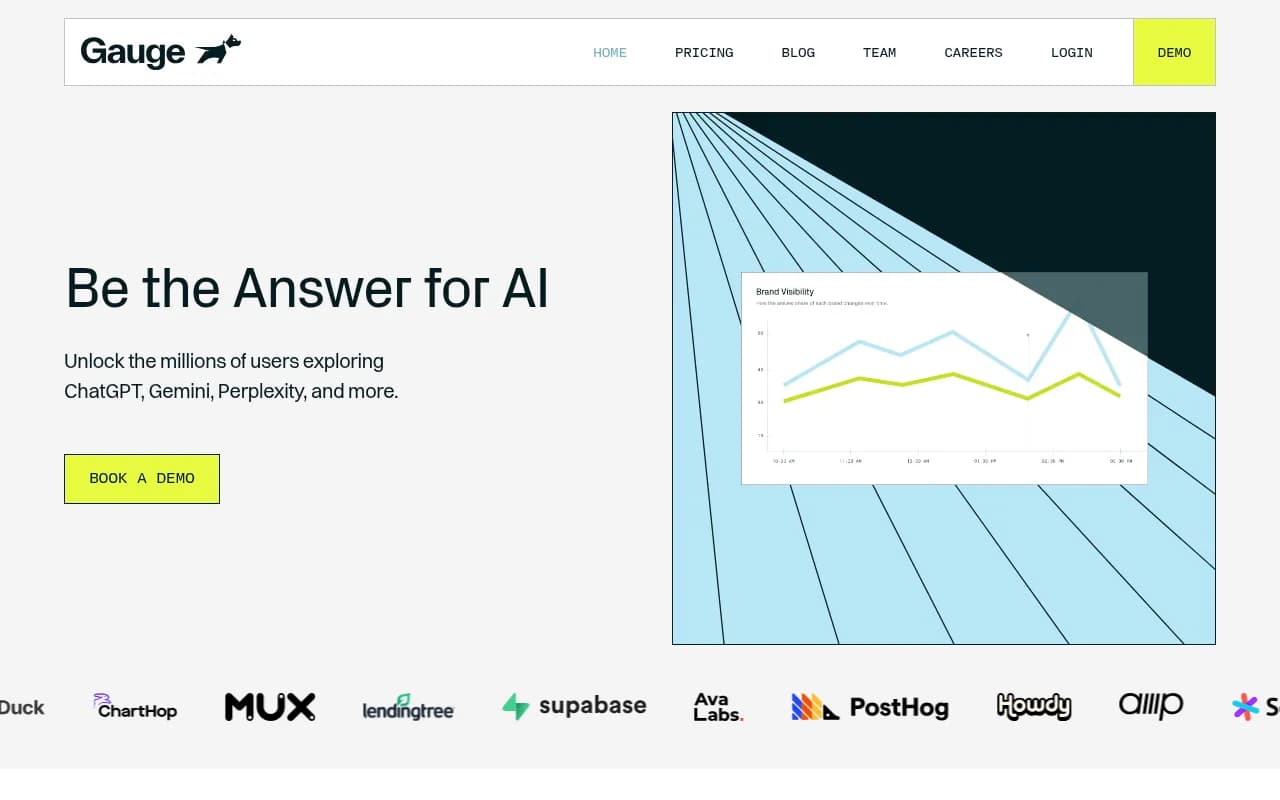
Gauge is an AI visibility platform that monitors how your brand appears in ChatGPT, Claude, Gemini, Perplexity, and other AI search engines. It tracks mentions and citations, analyzes content gaps against competitors, and generates optimized content to improve your presence in AI-generated answers.
Summary
- Strong monitoring across 7 AI models but lacks the depth of platforms like Promptwatch that cover 10+ models and offer AI crawler logs
- Agentic content creation is the standout feature -- Gauge's AI writing assistant generates articles based on real citation data and competitor analysis
- Missing critical optimization tools that Promptwatch provides: no AI crawler logs to see how models discover your content, no Reddit/YouTube tracking, no ChatGPT Shopping monitoring, no prompt volume/difficulty scoring
- Best for teams that want automated content generation but need to supplement with other tools for complete AI visibility optimization
- Pricing starts at $99/mo for basic tracking, $599/mo for the Growth plan most customers choose

Gauge positions itself as a complete toolkit for AI search visibility, but in practice it's a monitoring platform with a strong content generation layer bolted on. The company monitors how brands appear in ChatGPT, Claude, Gemini, Perplexity, CoPilot, Google AI Mode, and AI Overviews -- tracking both brand mentions and website citations across custom prompt sets.
The platform launched in 2024 and has attracted customers like MotherDuck, Supabase, and several B2B SaaS companies. Gauge's pitch is that it goes beyond simple prompt tracking by researching real search intent and mapping competitor web presence to find the actual use cases prospects are asking about. The team emphasizes pulling data from real web experiences rather than just hitting APIs.
Track, Understand, Act -- The Core Workflow
Gauge organizes its platform around three stages. First, it tracks AI-generated answers across seven models to detect brand mentions. You configure a set of prompts relevant to your category -- "best project management tools", "how to improve team collaboration", "alternatives to Asana" -- and Gauge runs them daily through each AI engine. The dashboard shows mention rate (what percentage of answers include your brand) and citation rate (what percentage cite your website).
Second, it analyzes what content gets cited and what gets left out. The Gap Analysis feature shows where competitors appear but you don't. Coverage Analysis shows where you currently rank. Citation Analysis reveals which sources AI models rely on most heavily when generating answers in your space. Competitor Analysis compares your visibility against specific rivals across all tracked prompts.
Third, it provides recommendations and content creation. The Actions tab suggests concrete steps to boost visibility -- which pages to optimize, which topics to cover, which affiliates to target. The Content feature is where Gauge differentiates itself: an AI writing assistant that drafts articles based on top-performing topics, citation patterns, and competitor analysis. It's not generic SEO content -- it's engineered specifically to get cited by AI models.
Agentic Content Creation -- The Differentiator
Gauge's content engine is its strongest feature. Unlike monitoring-only platforms (Otterly.AI, Peec.ai, AthenaHQ), Gauge actually helps you create content optimized for AI search. The system analyzes your tracking data, organic search data from Google Search Console, and user analytics to identify content gaps. Then it generates full articles, listicles, and comparison pages designed to rank in both AI search and traditional search.
The content isn't just keyword-stuffed filler. Gauge looks at which sources AI models cite most often, which angles competitors are covering, and which pain points real users are searching for. The output is data-driven -- grounded in actual citation patterns rather than guesswork. Customers get 3 articles per month on the Starter plan, 18 per month on Growth, and custom volumes on Enterprise.
The platform also includes an AI assistant that can analyze all your data and create an optimal strategy. It's agentic in the sense that it can execute on recommendations, not just surface them. For teams that lack dedicated content resources, this is valuable. For teams with strong writers, it's a starting point that still needs human polish.
What's Missing Compared to Full Optimization Platforms
Gauge covers tracking and content creation well, but it's missing several capabilities that platforms like Promptwatch offer for true end-to-end optimization:
No AI crawler logs. You can't see when ChatGPT, Claude, or Perplexity crawlers hit your website, which pages they read, or what errors they encounter. This makes it hard to diagnose indexing issues or understand how AI models discover your content in the first place. Promptwatch provides real-time crawler logs that show exactly how AI engines interact with your site.
No Reddit or YouTube tracking. AI models heavily cite Reddit discussions and YouTube videos when generating answers, but Gauge doesn't surface these sources. You're blind to a major channel that influences AI recommendations. Promptwatch tracks both Reddit threads and YouTube videos that appear in AI citations.
No ChatGPT Shopping monitoring. If your brand sells products, you can't track when it appears in ChatGPT's shopping carousels or product recommendations. Promptwatch monitors this explicitly.
No prompt intelligence. Gauge doesn't provide volume estimates or difficulty scores for each prompt. You don't know which prompts are high-value and winnable versus low-volume or impossibly competitive. Promptwatch offers prompt volumes, difficulty scoring, and query fan-outs that show how one prompt branches into sub-queries.
No AI traffic attribution beyond GA4. Gauge integrates with Google Analytics to show referral traffic from AI engines, but it doesn't offer a dedicated visitor analytics layer or server log analysis. Promptwatch provides multiple attribution methods including code snippet, GSC integration, and server logs to connect visibility to actual revenue.
Limited model coverage. Seven models is solid, but Promptwatch monitors 10+ including DeepSeek, Grok, and Mistral. More coverage means fewer blind spots.
The result: Gauge is strong at monitoring and content generation, but it's not a complete optimization platform. You're still guessing at some of the "why" behind your visibility scores.
Who Is Gauge For
Gauge targets B2B SaaS companies, marketing teams at tech startups, and digital agencies managing multiple clients. The ideal customer is a 5-20 person marketing team that wants to improve AI visibility but doesn't have dedicated content writers or SEO specialists. They need automation and recommendations, not just raw data.
Specific personas: A VP of Marketing at a Series A SaaS company tracking 200-500 prompts across their category. A growth marketer at a B2B tool who needs to justify AI search investment to leadership with clear metrics. An agency managing 3-5 clients who want a white-label solution (though Gauge doesn't explicitly offer white-labeling).
Gauge is less suited for enterprise brands with complex multi-region needs, agencies managing 20+ clients, or teams that want deep technical control over prompt configuration and data pipelines. The platform is opinionated about workflows -- it wants you to follow the Track > Understand > Act sequence rather than build custom dashboards.
Integrations and Data Access
Gauge integrates with Google Analytics 4 to pull AI referral traffic, Google Search Console to measure organic search performance alongside AI search, and Slack for alerts. There's an API for programmatic access to your data, plus CSV export and S3 integration to push data into your own data lake or BI tools.
No mention of Zapier, Make, or other automation platforms. No browser extension. No mobile app. The platform is web-only and assumes you're working from a desktop.
Pricing and Plans
Gauge offers three tiers:
Starter: $99/month. 100 prompts run daily through ChatGPT only. 3 AI-generated articles per month. Basic tracking and gap analysis. Good for individuals or very small teams testing AI search for the first time. Limited to one AI model, which is a significant constraint.
Growth: $599/month. 600 prompts run daily through all seven models. 18 AI-generated articles per month. Full feature access including competitor analysis, citation tracking, integrations, and API access. This is the most popular plan and what most B2B SaaS companies choose. Reasonable value if you're serious about AI visibility.
Enterprise: Custom pricing. Unlimited prompts, custom article volumes, dedicated support, and likely white-labeling or multi-account features. Aimed at larger firms and agencies.
No free trial mentioned on the site, but they offer a demo where they pull an in-depth report on your current AI presence. This is smart -- it gives prospects a taste of the data before committing.
Compared to competitors: Gauge's Growth plan at $599/mo is in the middle of the market. Promptwatch's Professional plan is $249/mo (150 prompts, 15 articles, crawler logs, multi-region tracking) and Business is $579/mo (350 prompts, 30 articles). Profound and Scrunch are higher-priced. Otterly.AI and Peec.ai are cheaper but monitoring-only with no content generation.
Strengths
Agentic content creation. The AI writing assistant is genuinely useful and produces content grounded in real citation data. This is a major time-saver for teams without dedicated writers.
Real user interface data. Gauge emphasizes pulling data from actual web experiences rather than just API responses. This matters because AI models sometimes show different results in their web interfaces versus API outputs.
Actionable recommendations. The Actions tab doesn't just show you problems -- it suggests specific fixes. Which pages to optimize, which topics to cover, which affiliates to target.
Clean, focused UI. The platform isn't trying to be everything to everyone. It has a clear workflow and doesn't overwhelm you with options.
Good integrations for attribution. GA4 and GSC integrations let you connect AI visibility to actual traffic and conversions, which is critical for proving ROI.
Limitations
No AI crawler logs. You can't see how AI models discover and index your content. This is a blind spot that makes it hard to diagnose technical issues.
No Reddit or YouTube tracking. Missing a major source of AI citations. Competitors like Promptwatch explicitly track these channels.
No prompt intelligence. No volume estimates, difficulty scores, or query fan-outs. You're guessing at which prompts are worth targeting.
Limited model coverage. Seven models is good but not comprehensive. Missing DeepSeek, Grok, Mistral.
No ChatGPT Shopping monitoring. If you sell products, you're blind to a key visibility channel.
Starter plan is too limited. ChatGPT-only tracking and 3 articles per month isn't enough to move the needle. Most teams will need Growth.
No free trial. You have to book a demo to see the platform, which adds friction.
Bottom Line
Gauge is a solid AI visibility platform with a strong content generation layer, but it's not a complete optimization toolkit. The agentic content creation is genuinely useful and sets it apart from monitoring-only competitors. The tracking and gap analysis are competent. The integrations are practical.
But if you want true end-to-end optimization -- crawler logs, Reddit/YouTube tracking, prompt intelligence, ChatGPT Shopping, multi-attribution methods -- you'll need to supplement Gauge with other tools or choose a more comprehensive platform like Promptwatch that offers monitoring, content gap analysis, AI content generation, crawler logs, and traffic attribution in one package.
Best use case: B2B SaaS marketing teams (5-20 people) who want automated content generation and don't have dedicated SEO resources. If you need deep technical control or comprehensive multi-channel tracking, look elsewhere.
Frequently asked questions
What is Gauge and what does it do?
How much does Gauge cost?
Does Gauge offer a free plan?
Which AI models does Gauge monitor?
What is Gauge's main competitive advantage?
Who should use Gauge?
What features is Gauge missing compared to competitors?
How does Gauge track AI search visibility?
Can Gauge help with content creation for AI search?
When was Gauge launched?
Similar and alternative tools to Gauge