Key takeaways
- Most AI search monitoring tools stop at showing you where you're invisible. Enterprise teams need platforms that also help them fix it.
- Coverage across 8-10 AI models matters -- your buyers use ChatGPT, Perplexity, Gemini, Claude, and Google AI Overviews, often in the same week.
- Crawler log access, prompt volume data, and page-level citation tracking are enterprise-grade features that most entry-level tools skip entirely.
- Content generation tied to real gap data is what separates optimization platforms from monitoring dashboards.
- Multi-site, multi-region, and multi-language support are non-negotiable for any brand operating at scale.
AI search has moved from a curiosity to a real buyer channel. According to data from multiple third-party studies, AI-referred visits convert at 3x to 9x the rate of traditional organic traffic. ChatGPT alone now accounts for roughly 20% of global search traffic. If your brand isn't appearing in AI-generated answers, you're being quietly removed from shortlists before buyers ever reach your website.
That's the problem. The harder problem is that most AI search monitoring tools weren't built for enterprise teams. They were built for solo marketers who want a quick dashboard showing whether ChatGPT mentioned their brand this week. That's fine for a startup. It's not enough for a brand managing multiple product lines, multiple markets, and a team of people who need to act on the data -- not just look at it.
This checklist covers what enterprise buyers should actually evaluate when selecting an AI search monitoring platform in 2026. Not a feature list of every possible capability, but the things that genuinely separate platforms that move the needle from ones that generate reports nobody reads.
1. Coverage across all major AI models
This sounds obvious, but it's worth being specific. Your buyers don't use one AI platform. They use ChatGPT for some queries, Google AI Overviews when they're in a browser, Perplexity for research, and Gemini when they're in Google Workspace. A platform that only monitors three or four models is giving you an incomplete picture.
Enterprise-grade coverage means tracking at minimum: ChatGPT, Perplexity, Google AI Overviews, Google AI Mode, Claude, Gemini, Microsoft Copilot, Grok, DeepSeek, and Meta AI. That's the full competitive field right now.
There's also a subtler issue: some platforms query AI models through APIs rather than monitoring actual user-facing interfaces. The problem is that API outputs can differ from what users actually see. Shopping recommendations, citation carousels, and contextual answers in real interfaces sometimes look nothing like the API response. If you're making decisions based on API data alone, you may be optimizing for a version of the product your customers never actually use.
Promptwatch is one of the few platforms that tracks how AI search engines behave in real user interfaces, not just through API calls. That distinction matters more than it sounds.

2. Prompt portfolio management and volume data
Most monitoring tools let you add a list of prompts and track whether your brand appears. That's the baseline. What enterprise teams actually need is prompt intelligence: volume estimates, difficulty scores, and query fan-outs that show how a single prompt branches into sub-queries.
Without volume data, you're flying blind on prioritization. You might be spending time optimizing for a prompt that 50 people ask per month while ignoring a high-volume prompt where a competitor is dominating. Prompt difficulty scores tell you which gaps are actually winnable versus which ones would require months of effort to move.
Query fan-outs are particularly useful. When a user types "best enterprise CRM," an AI model doesn't just answer that question -- it internally generates a cluster of sub-queries to build its response. Seeing that fan-out tells you exactly what topics your content needs to cover to get cited.
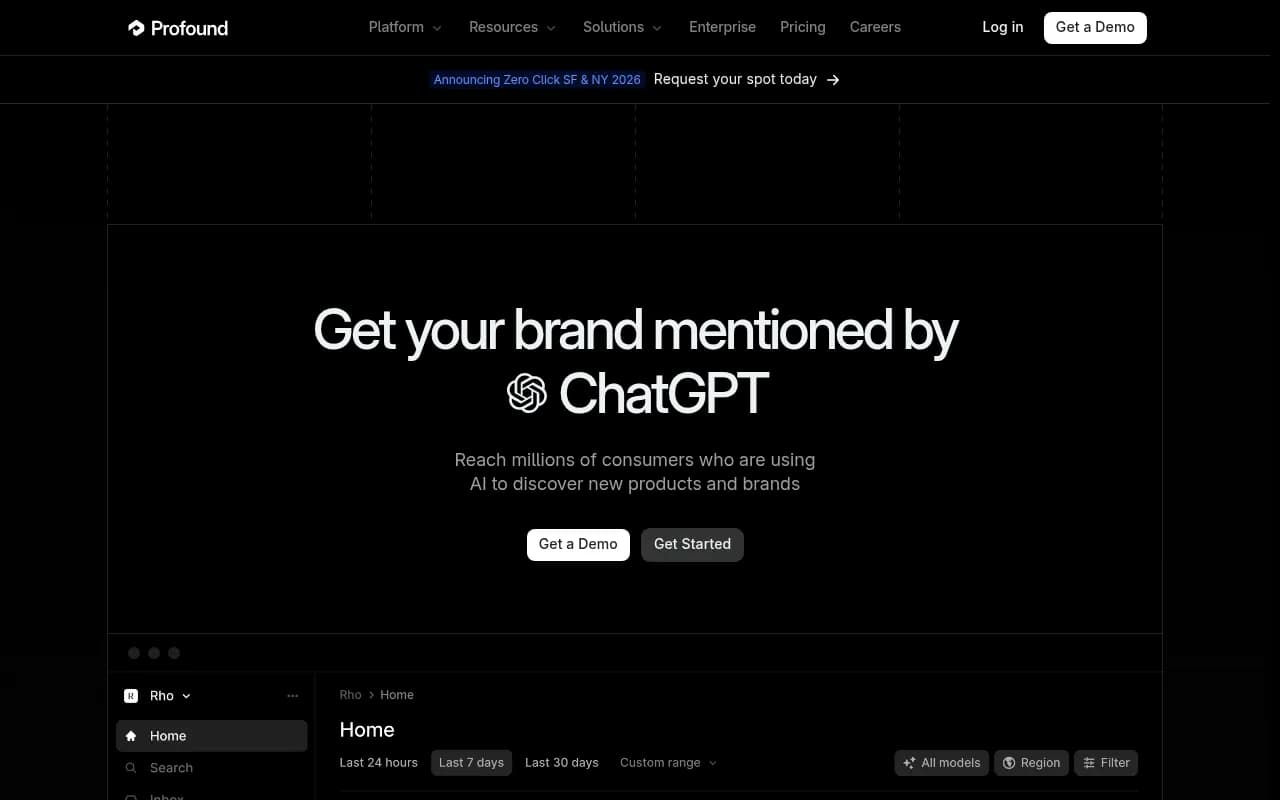
Tools like Profound AI have built their product around enterprise prompt research, and it shows in the depth of their prompt data.
For teams that want this combined with content generation and crawler analytics in one platform, Promptwatch's Prompt Intelligence feature covers volume, difficulty, and fan-outs alongside the rest of the optimization workflow.
3. Answer gap analysis and competitor benchmarking
Knowing your own visibility score is useful. Knowing exactly which prompts your competitors are winning that you're not -- that's what you can actually act on.
Answer gap analysis shows you the specific questions AI models are answering where competitors get cited and you don't. It's the difference between "our AI visibility score is 34%" and "here are the 47 prompts where Competitor X is being recommended and we're not mentioned at all."
Competitor heatmaps extend this by showing you the full competitive picture across models. Maybe you're winning on Perplexity but losing badly on Google AI Overviews. Maybe a competitor is dominating Claude but barely visible on Gemini. That kind of model-by-model breakdown tells you where to focus.
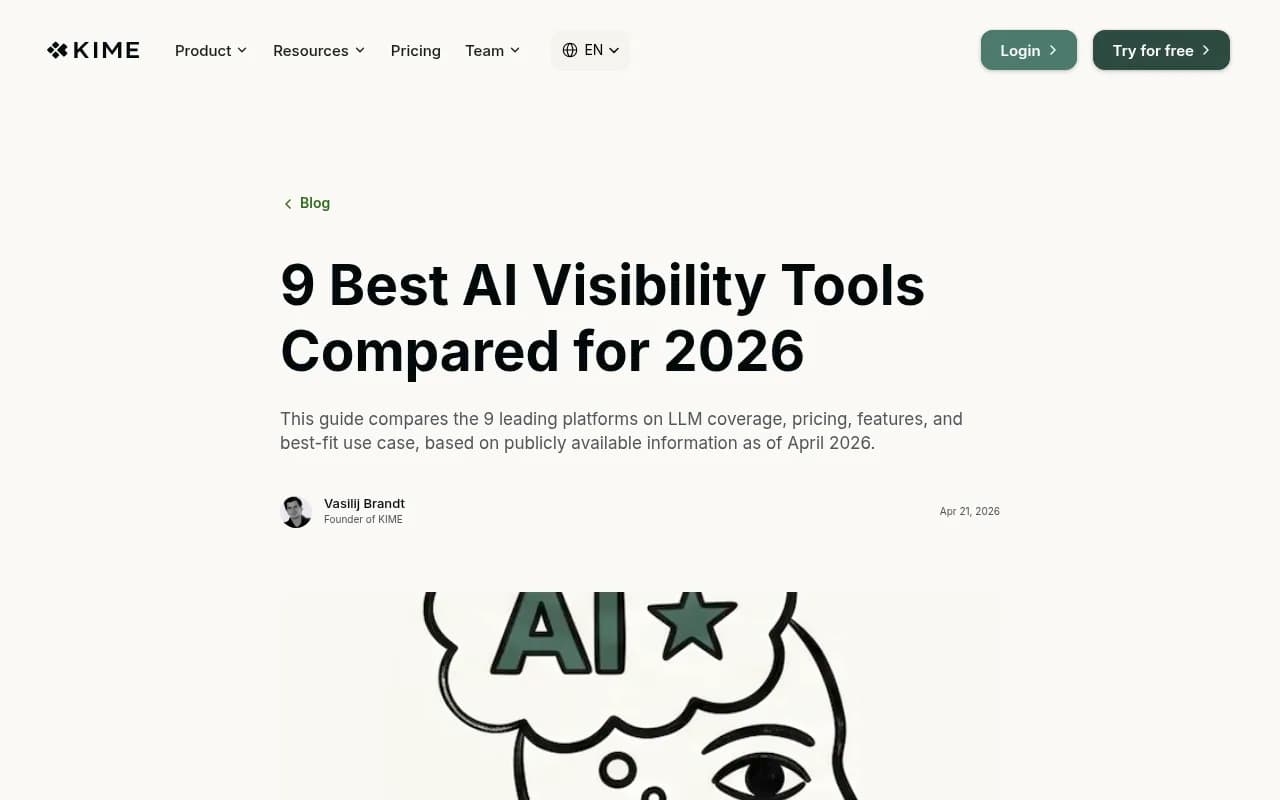
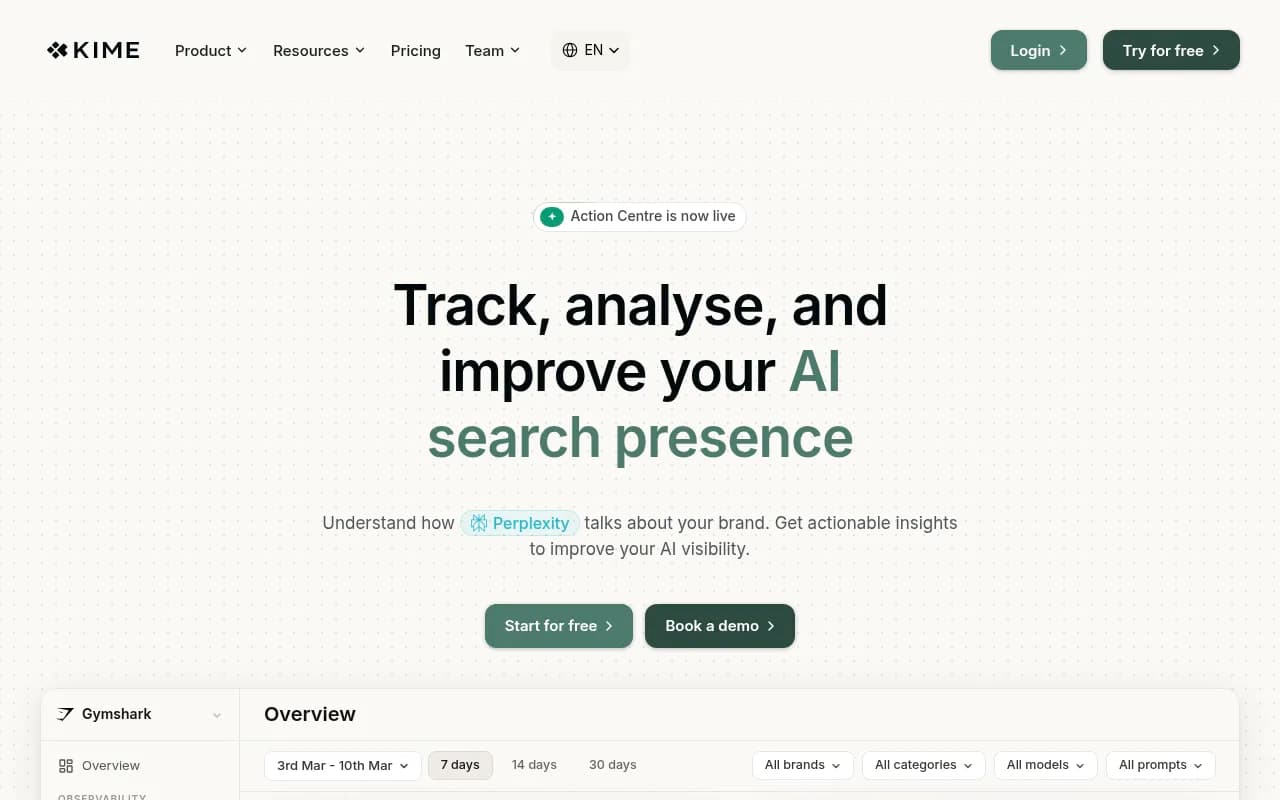
KIME has built a dedicated Action Centre around this kind of gap analysis, and it's one of the stronger implementations in the market.
4. AI crawler logs and technical diagnostics
This is the capability most enterprise buyers don't know to ask for, and it's one of the biggest differentiators between monitoring tools and real optimization platforms.
AI crawler logs show you in real time which AI crawlers (ChatGPT's bot, Perplexity's crawler, Claude's agent, etc.) are hitting your website, which pages they're reading, what errors they're encountering, and how often they return. More importantly, they show you the timeline from crawl to citation -- when a page was crawled, when it started appearing in AI responses, and how citation frequency changes over time.
This matters for a few reasons. First, if an AI crawler is hitting your site and encountering errors on key pages, you're losing citations you should be winning. Second, if you publish new content and want to know whether it's being picked up, crawler logs give you the answer instead of making you wait weeks to see if visibility scores move.
Most entry-level tools don't have this at all. It requires real infrastructure to capture and process at scale.
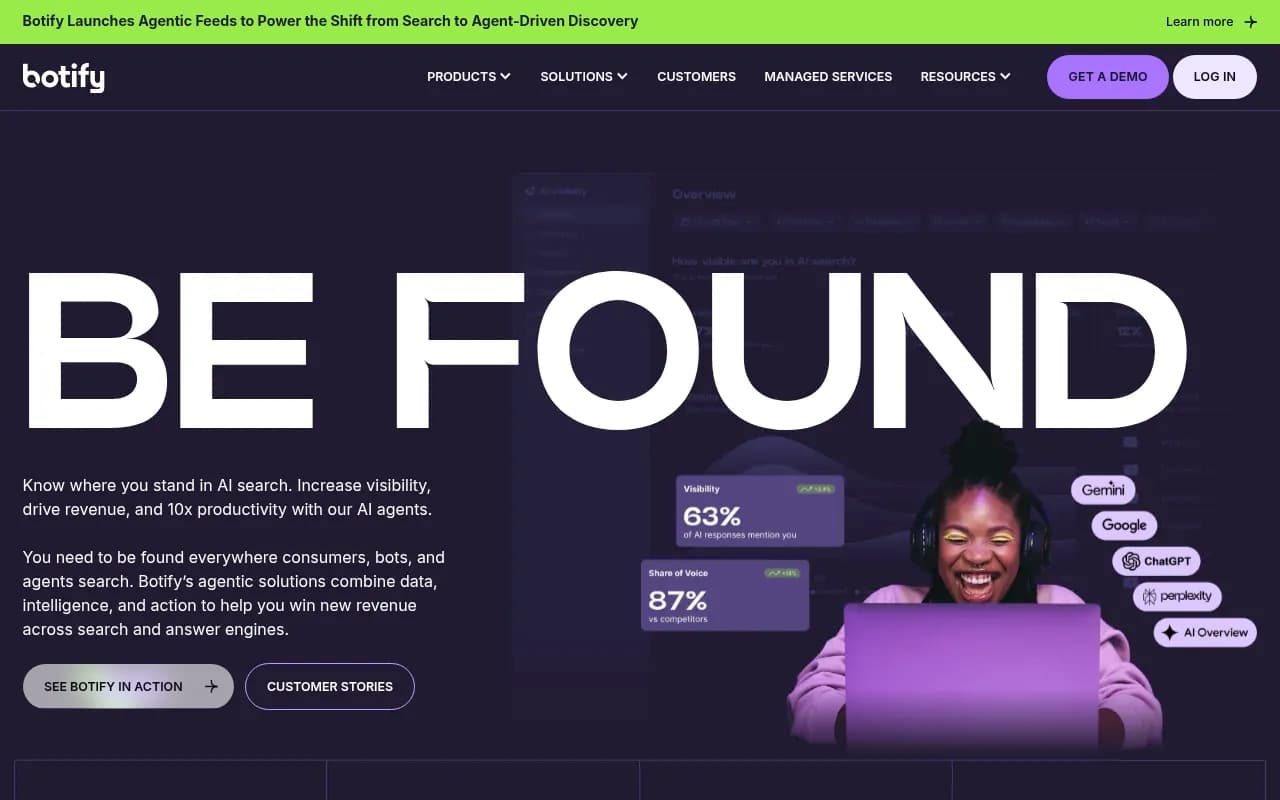
Botify has long been the standard for enterprise technical SEO crawl data, and they've extended this into AI search visibility tracking.
Promptwatch's AI Crawler Logs feature covers this end-to-end: which pages AI engines read, errors they encounter, how often they return, and the full timeline from crawl to citation. It's available on the Professional plan and above.
5. Content gap analysis and content generation
This is where the market splits cleanly into two camps: monitoring-only tools and optimization platforms.
Monitoring-only tools show you the gaps. You see that you're invisible for 60 prompts where competitors are getting cited. Then you close the tab and figure out what to do about it yourself. That's fine if you have a large content team with bandwidth to spare. Most enterprise teams don't.
Optimization platforms close the loop. They take the gap data and generate content briefs -- or full articles -- grounded in the actual prompts, citation patterns, and competitor analysis. The content isn't generic SEO filler; it's built to answer the specific questions AI models are already asking but can't find answers to on your site.
The distinction matters because the gap between "we know we're invisible" and "we've published content that fixes it" is where most programs stall. Teams get the data, feel overwhelmed by the scope of the problem, and end up doing nothing systematic about it.
Tools like AirOps have built strong content operations workflows around AI-generated briefs and articles.
Scrunch AI also covers monitoring plus content optimization in a single workflow.
Promptwatch's Content Agents generate articles, listicles, comparisons, and briefs grounded in real prompt data, citation data, prompt volumes, persona targeting, and competitor analysis. The output is tied directly to the gaps the platform identifies, which means you're not generating content speculatively -- you're filling specific holes in your AI visibility.
6. Page-level citation tracking and traffic attribution
Aggregate visibility scores are a starting point. Page-level tracking is where enterprise teams get the granularity they need to make decisions.
Page-level citation tracking shows you exactly which pages on your site are being cited by which AI models, how often, and in response to which prompts. This tells you which content is already working (and should be protected and expanded) and which pages are being crawled but never cited (and need to be diagnosed).
Traffic attribution connects this to revenue. If AI-referred traffic is converting at 5x the rate of organic search, that's a business case for investing more in AI visibility. Without attribution data, you're arguing for budget based on visibility scores that executives don't have context for.
Slate has built strong page-level tracking into their platform, particularly for content-led teams.
SE Ranking also offers solid page-level visibility data with a strategic view of how individual pages contribute to overall AI presence.
7. Offsite citation tracking: Reddit, YouTube, and third-party sources
AI models don't just cite your website. They cite Reddit threads, YouTube videos, review sites, industry publications, and competitor content. If you're only tracking your own domain, you're missing a large part of the picture.
Offsite citation analysis shows you which external sources are driving AI visibility in your category. This tells you where to publish content beyond your own site -- which Reddit communities to participate in, which YouTube topics to cover, which third-party publications are being cited frequently enough to warrant outreach.
Reddit is particularly important and almost universally ignored by enterprise teams. AI models cite Reddit heavily for product recommendations, comparisons, and user experience questions. If your category has active subreddits and your brand isn't mentioned there, you're invisible in a channel that directly influences AI recommendations.
Brand24 covers social listening across a wide range of sources and can surface Reddit and forum mentions that feed into AI citations.
Meltwater offers broader media and social intelligence that enterprise teams can use to understand which external sources are shaping their category narrative.
8. Multi-site, multi-region, and multi-language support
This is a hard requirement for any enterprise brand operating across markets. AI search behavior varies significantly by region and language. A brand that's well-cited in English-language responses may be nearly invisible in German, French, or Japanese. Google AI Overviews behaves differently in different countries. Perplexity's citation patterns vary by region.
Enterprise platforms need to support monitoring in any language, from any country, with customizable personas that match how actual customers in each market prompt. This isn't just about translation -- it's about understanding that a buyer in Germany asking about enterprise software uses different language and different AI models than a buyer in the US.
Multi-site support matters for brands with multiple product lines, subsidiaries, or agency clients. Managing five separate accounts for five separate brands is operationally painful. A platform that handles all of them under one roof with proper access controls is a real efficiency gain.
Peec AI offers flexible model selection and multi-region support at a reasonable price point.

Athena HQ covers 8+ AI search engines with multi-region tracking.
9. Integrations and data export
Enterprise teams don't want another siloed dashboard. They want data flowing into the tools they already use.
At minimum, look for: Google Search Console integration (to correlate AI visibility with traditional search performance), Looker Studio or similar BI tool integration (for custom reporting), API access (for building custom workflows or feeding data into internal systems), and website integrations through Cloudflare, Vercel, or server logs (for low-latency crawler and attribution data).
The API question is particularly important for larger teams. If your data science team wants to build custom models on top of AI visibility data, or if your engineering team wants to automate content publishing workflows, you need an API that's actually documented and usable.
Conductor is an enterprise AEO platform with strong integration capabilities for teams that need AI search visibility connected to broader marketing tech stacks.
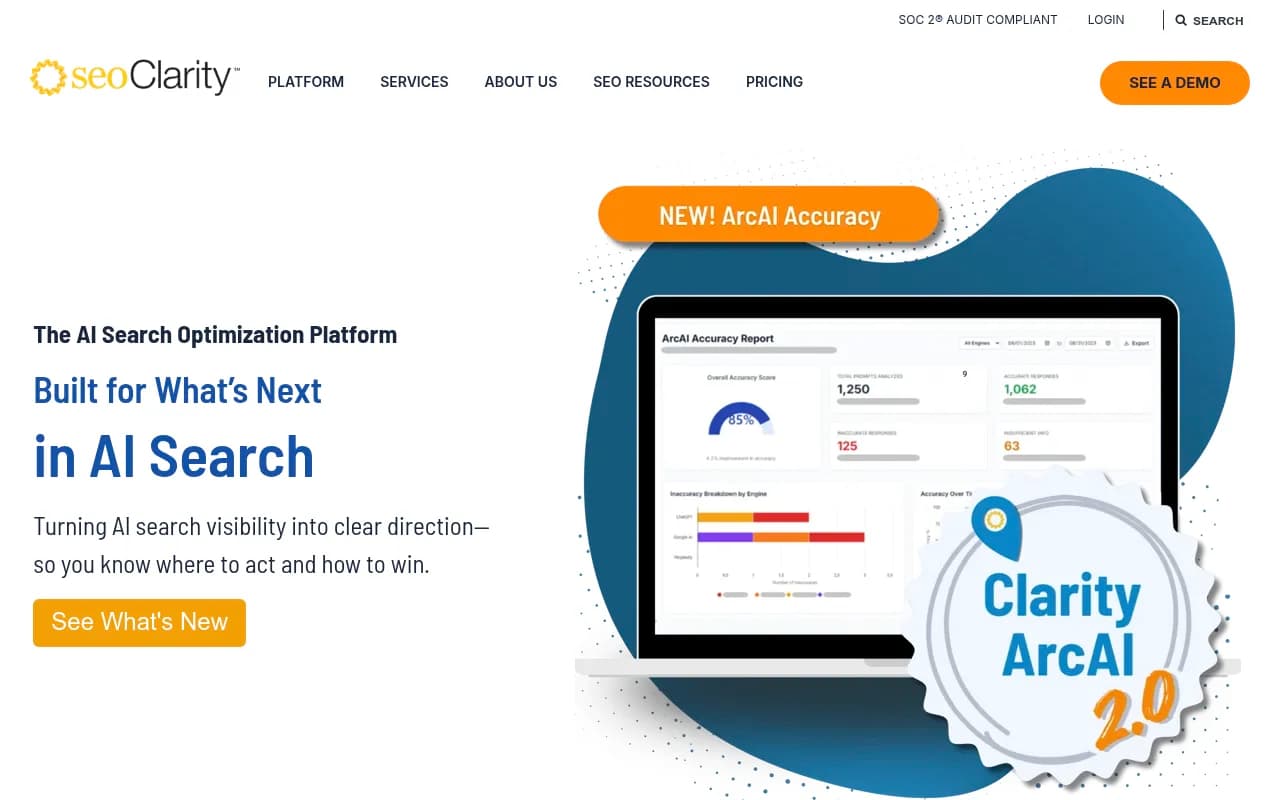
seoClarity also offers enterprise-grade integrations alongside AI search visibility tracking.
10. ChatGPT Shopping and entity tracking
This one is specific but increasingly important for brands with products that appear in AI-powered shopping experiences. ChatGPT's shopping recommendations and product carousels are a distinct channel from standard AI search citations. A brand can be well-cited in informational responses but completely absent from shopping recommendations -- or vice versa.
Entity tracking is the broader version of this: monitoring when your brand, products, or key people appear as named entities in AI responses, not just as cited sources. This matters for brand protection (catching misrepresentations or hallucinations) and for understanding how AI models conceptually categorize your brand.
Most monitoring tools don't cover ChatGPT Shopping at all. It's a newer feature and the data infrastructure to track it properly is non-trivial.
How the major platforms compare
Here's a summary of how the leading platforms stack up on the criteria above. Note that pricing and features change frequently -- verify directly with vendors before shortlisting.
| Platform | AI models | Crawler logs | Content generation | Multi-region | ChatGPT Shopping | Starting price |
|---|---|---|---|---|---|---|
| Promptwatch | 10+ | Yes | Yes (Content Agents) | Yes | Yes | $99/mo |
| Profound AI | Up to 10 | No | No | Limited | No | $99/mo |
| KIME | 10 | No | Limited | Yes | No | €149/mo |
| Conductor | Multiple | No | Limited | Yes | No | Custom |
| Otterly.AI | 4 | No | No | Limited | No | $29/mo |
| Peec AI | Up to 10 | No | No | Yes | No | €85/mo |
| Scrunch AI | Multiple | No | Yes | Limited | No | Custom |
| SE Ranking | 5 | No | No | Yes | No | $99/mo |
| AirOps | Up to 4 | No | Yes | Limited | No | Free tier |
| Slate | Multiple | No | Yes | Limited | No | $199/mo |
What to actually do with this checklist
The temptation when evaluating platforms is to score every vendor against every criterion and pick the one with the highest total. That's not how this works in practice.
Start with the question your team actually needs answered. If the primary problem is "we don't know which prompts to target," prioritize prompt intelligence and gap analysis. If the problem is "we're publishing content but don't know if AI models are picking it up," prioritize crawler logs and page-level tracking. If the problem is "we need to justify AI search investment to leadership," prioritize traffic attribution.
The platforms that cover the full stack -- monitoring, gap analysis, content generation, crawler logs, attribution -- are more expensive and more complex. They're worth it if your team has the bandwidth to use them. If you're just starting out, a focused tool that does one thing well is better than an enterprise platform that overwhelms a team of two.
For most enterprise marketing and SEO teams that are serious about AI search as a channel, the action loop matters most: find the gaps, generate content that fills them, track whether it works. That cycle is what separates platforms that move metrics from ones that generate weekly reports nobody acts on.
Promptwatch is built around exactly that loop, and it's the only platform in the 2026 market rated as a leader across all evaluation categories -- monitoring, optimization, content generation, and technical diagnostics combined.
The market for AI search monitoring is moving fast. Platforms that were monitoring-only a year ago are adding content features. Traditional SEO tools are bolting on AI tracking. The checklist above won't look identical in 2027. But the core question -- does this platform help you fix the problem, or just show you the problem -- will still be the right one to ask.