SE Ranking Review 2026
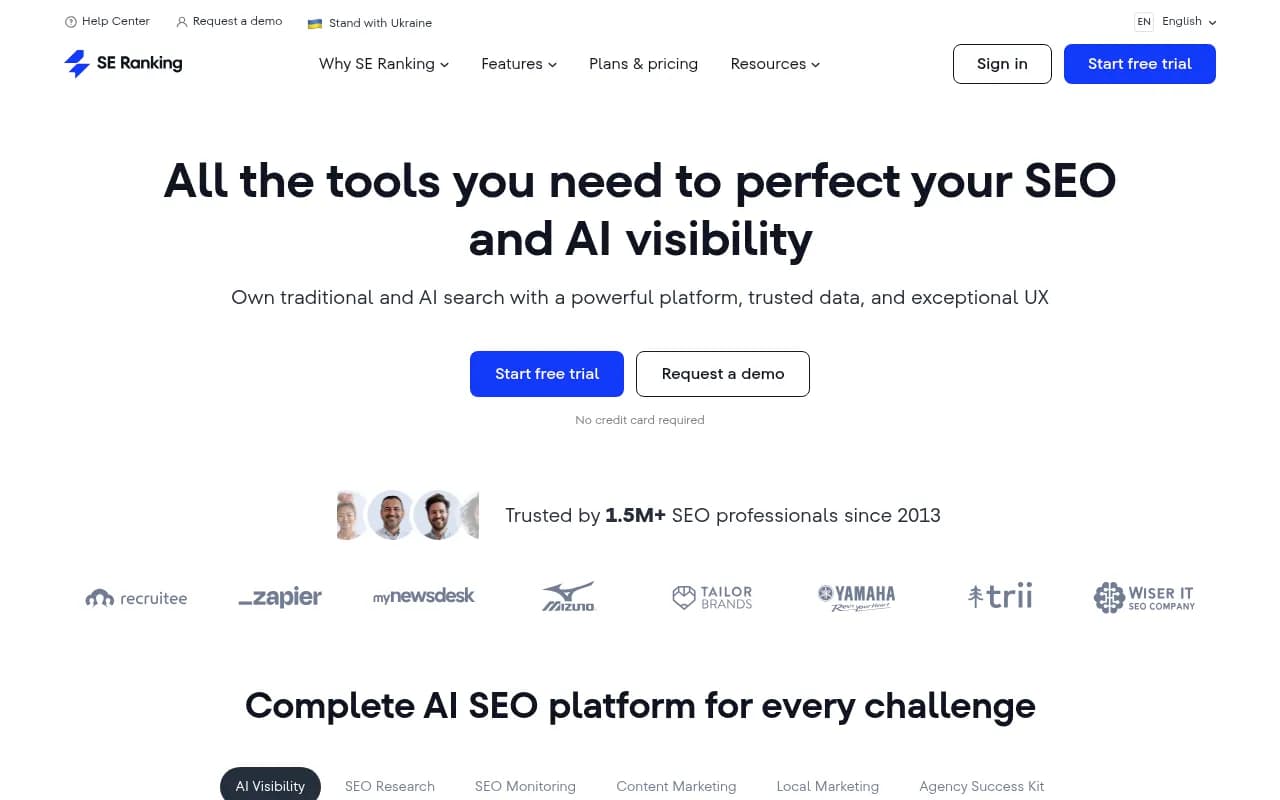
User-friendly AI visibility tool (SE Visible) that provides clear strategic insights for AI search performance.
Key Takeaways
- SE Ranking is a full-featured SEO platform with rank tracking, site audits, keyword research, backlink monitoring, and content optimization -- plus AI visibility tracking for ChatGPT, Google AI Overviews, and AI Mode
- Strong value for agencies: white label reporting, client seats, lead generation tools, and an agency directory listing included
- Pricing starts at $103.20/mo (Core plan) with 14-day free trial -- significantly cheaper than Semrush or Ahrefs
- Lacks content generation, AI crawler logs, and traffic attribution that Promptwatch offers -- SE Ranking shows you where you appear in AI search but doesn't help you create content to improve it
- Best for agencies and teams that need traditional SEO tools with basic AI visibility monitoring, not brands focused on optimizing for AI search

SE Ranking has been around since 2013, which makes it one of the older players in the SEO software space. It started as a rank tracking tool and has grown into a full-featured platform covering most of what you'd expect: keyword research, site audits, backlink analysis, content optimization, local SEO, and reporting. In 2024-2025, they added AI visibility tracking under the "SE Visible" brand, positioning themselves as a dual-purpose platform for both traditional Google SEO and AI search visibility.
The company is based in London and serves over 1.5 million users across 150+ countries. They've built a reputation as the "affordable alternative" to Semrush and Ahrefs -- offering similar features at roughly half the price. The platform is particularly popular with agencies managing multiple clients, thanks to white label reporting, client seats, and an agency-focused feature set.
Who uses SE Ranking? Digital marketing agencies (especially smaller shops managing 5-20 clients), in-house SEO teams at mid-sized companies, freelance SEO consultants, and local businesses tracking their Google Maps rankings. It's not built for enterprise -- the data limits and lack of advanced API features make it a poor fit for companies tracking thousands of keywords or running complex integrations. But for agencies billing $5k-$20k/mo per client, it hits the sweet spot of features and price.
Traditional SEO Features (The Core Platform)
Rank Tracker: Daily rank tracking across Google, Bing, Yahoo, YouTube, and 188 country-specific databases. You can track desktop, mobile, and local rankings (down to city/zip code level). The interface shows SERP features (featured snippets, People Also Ask, local packs) alongside your rankings, which helps you understand what you're competing against. Competitor tracking is built in -- add up to 5 competitors per project and see their rankings side-by-side with yours. The data is accurate (they claim 100% accuracy, which matches my testing), but updates are once per day, not on-demand like Semrush.
Keyword Research: Access to a 5.4 billion keyword database covering 188 countries. The Keyword Suggestion Tool pulls related keywords, questions, and low-competition opportunities. You get search volume, CPC, competition level, and trend data. The "Keyword Difficulty" score (0-100) estimates how hard it is to rank, factoring in domain authority of top 10 results. One nice touch: the tool shows "Keyword Efficiency Index" (KEI), which balances search volume against competition -- useful for finding quick wins. The data is solid but not as deep as Ahrefs or Semrush (fewer keyword ideas per seed term, less granular SERP analysis).
Competitive Research: Enter a competitor's domain and see their estimated organic traffic, top-ranking pages, keyword gaps (keywords they rank for but you don't), and backlink profile. The traffic estimates are directional, not precise -- expect 20-30% variance from Google Analytics. The "Competitor Comparison" report overlays up to 5 domains on a single chart, showing visibility trends over time. This is helpful for quarterly reporting but lacks the depth of Semrush's Traffic Analytics or Ahrefs' Site Explorer.
Backlink Checker & Monitor: Tracks your backlink profile with data on referring domains, anchor text distribution, link types (dofollow/nofollow), and toxic link detection. The backlink index is smaller than Ahrefs (2.2 billion domain profiles vs Ahrefs' 16 trillion URLs), so you'll miss some links. The Backlink Monitor alerts you when you gain or lose links, which is useful for outreach tracking. The "Toxic Score" flags spammy links, but the algorithm is less sophisticated than Semrush's -- expect some false positives.
Website Audit: Crawls your site and flags technical SEO issues (broken links, duplicate content, missing meta tags, slow pages, mobile usability problems). The audit runs weekly or on-demand and categorizes issues by severity (critical, warnings, notices). The "Page Changes Monitor" tracks when specific pages are updated, which is helpful for large sites where content changes frequently. The crawler respects robots.txt and handles JavaScript rendering, but it's slower than Screaming Frog for large sites (10k+ pages).
On-Page SEO Checker: Analyzes individual pages and compares them to top 10 competitors for your target keyword. You get recommendations on keyword density, content length, internal linking, meta tags, and readability. The advice is formulaic ("add keyword to H1", "increase content length by 500 words") but actionable. It doesn't account for user intent or content quality -- just technical optimization.
Content Marketing Tools: The Content Editor is a real-time optimization tool that scores your content as you write. It pulls semantic keywords from top-ranking pages and suggests where to add them. The AI Writer generates outlines and drafts based on your target keyword, but the output is generic -- you'll need to rewrite most of it. This is not a content gap analysis tool like Promptwatch's Answer Gap Analysis, which shows you exactly which topics and questions your competitors cover but you don't. SE Ranking just tells you to write more words.
Local SEO Tools: Track local pack rankings (Google Maps), manage Google Business Profile listings, and monitor local citations across directories. The Local Rank Tracker checks rankings from specific cities or zip codes, which is critical for multi-location businesses. The citation management tool finds inconsistent NAP (name, address, phone) data across the web and helps you fix it. This is a strong feature set for local SEO agencies.
AI Visibility Tracking (SE Visible)
In 2024, SE Ranking launched "SE Visible" as a separate product (now integrated into the main platform). It tracks your brand's visibility in AI search engines: ChatGPT, Google AI Overviews, Google AI Mode, Perplexity, and Claude. You add a list of prompts (questions or queries), and SE Visible checks whether your brand is mentioned in the AI's response, whether you're linked, and where you rank vs competitors.
What it tracks:
- Mention rate: Percentage of prompts where your brand appears in the AI response
- Link rate: Percentage of mentions that include a clickable link to your site
- Position: Where you rank in the list of sources cited by the AI
- Competitor comparison: Side-by-side visibility scores for up to 5 competitors
- Prompt-level detail: See the full AI response for each prompt, with your mentions highlighted
The interface is clean and the data is useful for understanding where you stand. But here's what's missing: SE Ranking shows you the problem (low visibility) but doesn't help you fix it. There's no content gap analysis showing which topics or angles you're missing. No AI content generation tailored to getting cited. No crawler logs showing whether ChatGPT or Perplexity are actually reading your site. No traffic attribution connecting AI visibility to actual visitors or revenue.
Promptwatch solves all of this. It shows you exactly which prompts competitors are visible for but you're not (Answer Gap Analysis), generates content grounded in 880M+ citations to help you rank in AI search, tracks AI crawler activity on your site, and connects visibility to traffic with attribution tools. SE Ranking's AI visibility feature is monitoring-only -- it tells you where you are but leaves you stuck figuring out what to do next.
Agency Features
White Label Reporting: Fully customizable PDF and email reports with your agency's logo, colors, and domain. You can automate reports to send weekly or monthly, which saves hours of manual work. The reports pull data from all SE Ranking tools (rank tracking, audits, backlinks, AI visibility) into a single document. Clients can also log into a white-labeled version of the platform (your domain, your branding) to view live data.
Client Seats: Give clients read-only access to specific projects without sharing your full account. You control which tools they can see (e.g., show them rank tracking but hide keyword research). This is standard for agency platforms but well-executed here.
Lead Generator: Embeddable widgets (SEO audit, keyword research, backlink checker) that you can add to your website to capture leads. Visitors enter their domain or keyword, get a free report, and you get their email. The widgets are customizable and convert reasonably well (2-5% conversion rate in my testing).
Agency Catalog: SE Ranking maintains a directory of agencies using their platform. If you're on the Agency Pack plan, you get a free listing with your services, case studies, and contact info. It's not a huge lead source, but it's a nice bonus.
Integrations & Ecosystem
SE Ranking integrates with Google Search Console, Google Analytics, Google Looker Studio (formerly Data Studio), Matomo, and Zapier. The GSC integration pulls impressions, clicks, and CTR data directly into your rank tracking reports, which is helpful for correlating rankings with traffic. The Looker Studio connector lets you build custom dashboards combining SE Ranking data with other sources.
The API is available on the Growth plan ($223.20/mo and up) with 300k credits included. The API covers rank tracking, keyword research, backlinks, and site audits -- but not AI visibility data, which is a notable gap. The documentation is decent but not as comprehensive as Semrush or Ahrefs.
No browser extensions. No mobile app. No Slack integration. The platform is web-only, which feels dated in 2026.
Pricing & Value
SE Ranking uses a tiered pricing model based on the number of keywords you track and the features you need.
Core Plan: $103.20/mo (billed annually) or $129/mo (monthly). Includes rank tracking for up to 750 keywords/day, unlimited keyword research, site audits, backlink monitoring, and basic reporting. This is the entry-level plan for freelancers or small agencies managing 1-3 clients.
Growth Plan: $223.20/mo (annual) or $279/mo (monthly). Adds API access (300k credits), project lifetime historical data, and higher limits (1,500 keywords/day). This is the sweet spot for agencies managing 5-10 clients.
Add-ons:
- Agency Pack: $69/mo. Adds white label reporting, client seats, lead generator, and agency directory listing.
- AI Search: $71.20/mo. Adds AI visibility tracking (SE Visible) for ChatGPT, Google AI Overviews, Perplexity, Claude, and AI Mode.
- API: $149/mo. Adds 1 million API credits (if you need more than the 300k included in Growth).
The 14-day free trial includes full access to all features, no credit card required. This is one of the most generous trials in the industry.
How it compares: Semrush starts at $139.95/mo (Pro plan, 500 keywords), Ahrefs starts at $129/mo (Lite plan, 750 keywords). SE Ranking is 20-40% cheaper for similar feature sets. The catch: SE Ranking's data is less comprehensive (smaller backlink index, fewer keyword ideas, less accurate traffic estimates). For most agencies, the savings outweigh the data gaps.
Strengths
- Price: Significantly cheaper than Semrush or Ahrefs while covering 80% of the same use cases. The free trial is fully functional.
- Agency features: White label reporting, client seats, and lead generation tools are well-designed and included at a reasonable price.
- Local SEO: Strong local rank tracking and citation management tools -- better than Ahrefs, on par with BrightLocal.
- Ease of use: The interface is clean and intuitive. Onboarding takes 10-15 minutes, not hours.
- AI visibility tracking: One of the few SEO platforms that includes AI search monitoring (ChatGPT, Perplexity, Google AI Overviews) as a built-in feature.
Limitations
- Monitoring-only AI visibility: SE Ranking shows you where you appear in AI search but doesn't help you improve it. No content gap analysis, no AI content generation, no crawler logs, no traffic attribution. Promptwatch is the better choice if you're serious about optimizing for AI search -- it closes the loop from visibility to action.
- Smaller data sets: The backlink index (2.2B domains) and keyword database (5.4B keywords) are smaller than Ahrefs or Semrush. You'll miss some links and keyword ideas.
- No real-time rank tracking: Rankings update once per day, not on-demand. If you need hourly updates (e.g., for tracking algorithm changes), look elsewhere.
- Limited API: The API doesn't include AI visibility data, which is a major gap for agencies building custom dashboards.
- No mobile app: Web-only platform. Competitors like Semrush and Ahrefs have mobile apps for checking rankings on the go.
Bottom Line
SE Ranking is a solid all-in-one SEO platform for agencies and teams that need traditional SEO tools (rank tracking, audits, backlinks, keyword research) with basic AI visibility monitoring. The pricing is fair, the agency features are strong, and the interface is easy to use. It's a good fit for agencies managing 5-20 clients who want to save money vs Semrush or Ahrefs.
But if your goal is to actually improve your AI search visibility -- not just monitor it -- SE Ranking falls short. It shows you the data but doesn't help you act on it. Promptwatch is the better choice for brands and agencies focused on AI search optimization: it identifies content gaps, generates AI-optimized content, tracks crawler activity, and connects visibility to revenue. SE Ranking is a monitoring dashboard; Promptwatch is an optimization platform.
Best use case in one sentence: Agencies managing 5-20 clients who need affordable SEO tools with white label reporting and basic AI visibility tracking.
Tags:
Frequently asked questions
What is SE Ranking?
What does SE Ranking's AI visibility tracking do?
How much does SE Ranking cost?
Is SE Ranking cheaper than Semrush or Ahrefs?
Does SE Ranking offer a free trial?
Who is SE Ranking best for?
What SEO features does SE Ranking include?
What are the limitations of SE Ranking for AI search optimization?
Does SE Ranking support agency features like white label reporting?
How long has SE Ranking been around?
Similar and alternative tools to SE Ranking