Slate Review 2026
Agency-focused AI visibility platform that lets marketing agencies manage and monitor AI search presence for multiple client brands from a single unified workspace.
Key takeaways
- Slate is a content automation platform that combines AI visibility monitoring with agentic content workflows -- it tracks your brand in ChatGPT, Perplexity, and Gemini, then helps you act on what it finds
- Unlike pure monitoring tools, Slate can actually write, refresh, and publish content through automated workflows -- making it closer to a full content operations platform than a tracker
- Lacks several capabilities that Promptwatch offers: no AI crawler logs, no prompt volume/difficulty scoring, no query fan-outs, no ChatGPT Shopping tracking, no Reddit/YouTube citation tracking, and narrower LLM model coverage (3 models vs Promptwatch's 10+)
- Best suited for in-house SEO and content teams at B2B SaaS companies who want to automate the research-write-publish cycle, not just monitor rankings
- Pricing is credit-based and not fully transparent on the public site; a free trial is available
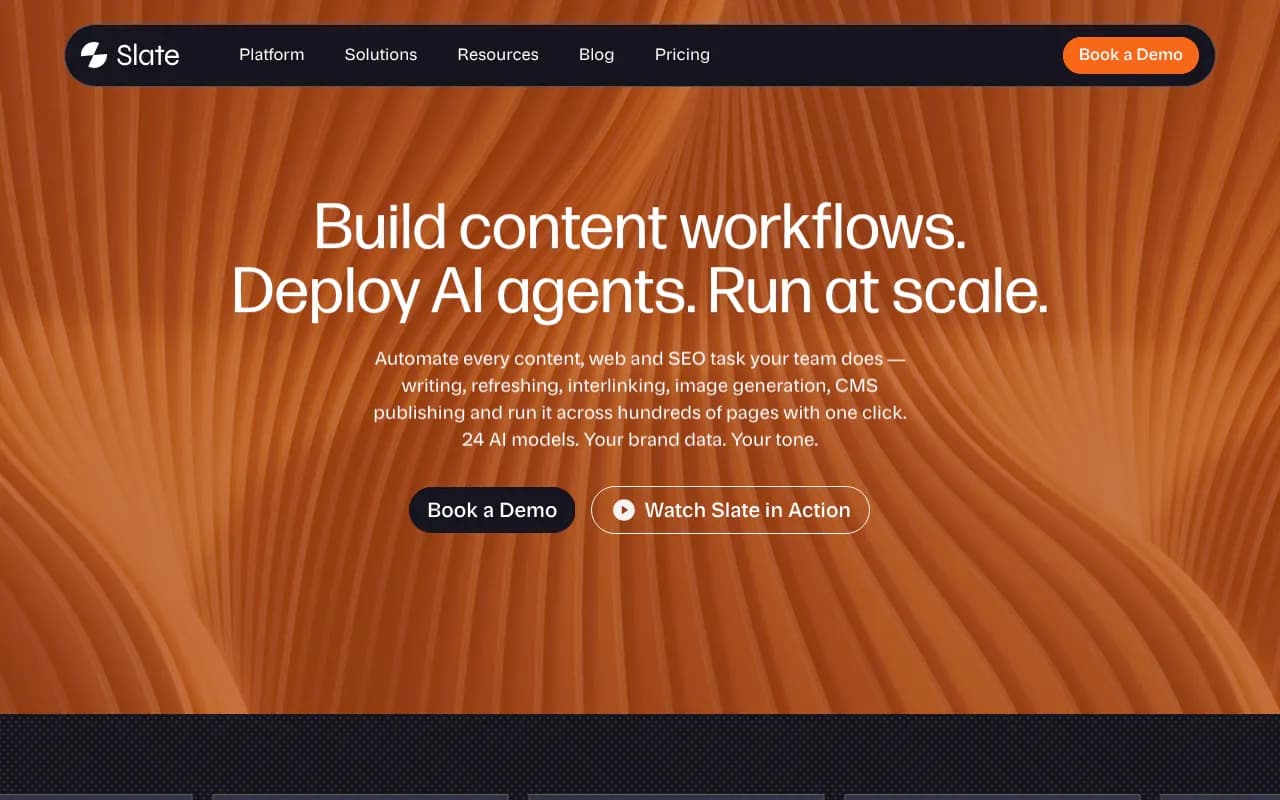
Slate is an AI content automation platform built for SEO and content teams that want to do more than just watch their rankings slide. The core pitch is a closed-loop system: monitor your AI search visibility, identify what's decaying or missing, generate new content, and push it live -- all without leaving the platform. It's a meaningful step beyond the typical "dashboard and report" tools that have flooded the GEO space.
The company appears to be a relatively early-stage product, with a waitlist-style onboarding flow and a demo-first sales motion that suggests it's still finding its footing in terms of go-to-market. That said, the case studies on the site are specific and credible: FlowForma reportedly achieved 7x growth in AI search visibility in six months, Signeasy reached 800 monthly LLM sessions with 60-68% consistent growth, and Glean grew organic traffic 275% while improving demo conversions. These aren't vague testimonials -- they're named companies with named outcomes, which is worth something.
The target audience is primarily in-house marketing and SEO teams at B2B SaaS companies, though the platform's workflow capabilities could serve content agencies managing multiple clients. It sits at an interesting intersection: part GEO tracker, part content operations tool, part AI writing agent.
Key features
AI visibility monitoring (AI Tracker) Slate monitors your brand's share of voice across ChatGPT, Perplexity, and Gemini. You can schedule automated prompts to run on a cadence, track your visibility score and average position over time, and see where competitors are showing up instead of you. The monitoring side is functional but covers only three LLM platforms -- a meaningful gap compared to tools that track 10 or more models. There's no mention of coverage for Claude, Grok, DeepSeek, Copilot, Meta AI, or Google AI Overviews as distinct tracked surfaces.
Agentic workflows This is where Slate genuinely differentiates itself from pure monitoring tools. The visual Workflow Builder lets you create multi-step pipelines that run on a schedule -- automatically researching topics, drafting content, refreshing old pages, and publishing to your CMS. You build the workflow once, and it runs across hundreds of pages without manual intervention. The library of pre-built agents covers a wide range: G2 review intelligence extraction, keyword and SERP gap research, competitor page audits, Reddit-to-blog content generation, topical authority mapping, schema generation, and more. This is a genuinely useful feature set for teams that are drowning in content operations work.
Slate Sheets A spreadsheet-style interface for managing bulk content operations. You can load hundreds of URLs, run bulk refreshes, trigger programmatic content creation, or run optimization audits across your entire archive in a single click. For teams with large content libraries that need systematic refreshing, this is a practical tool -- it removes the need to handle pages one at a time.
Super Blocks Pre-built workflow components that capture best practices for AI search optimization (AISO). Think of these as reusable building blocks you can snap together to create workflows without starting from scratch. The library covers common SEO and AEO tasks, which lowers the barrier for teams that don't want to engineer custom pipelines.
Content governance You can upload style guides, tone rules, and brand guidelines into a central knowledge base. Every AI-generated article then runs against those rules, which matters a lot for teams that have spent years building a distinct brand voice and don't want generic AI slop undermining it. This is a feature that content-heavy teams will appreciate -- it's the difference between AI that writes for you and AI that writes like you.
CMS publishing integrations Slate connects directly to WordPress and Webflow, letting you push finished content without a developer handoff. This is a real workflow accelerator. The platform also pulls live keyword data from Semrush and Ahrefs, syncs with Google Search Console and GA4 for performance data, and supports custom CMS connections via API.
Pages and Actions The Pages feature connects to GSC and tracks every page's clicks, impressions, CTR, and rankings in real time. The Actions feature surfaces prioritized recommendations -- stale content, ranking drops, topic gaps -- automatically. Instead of you having to dig through dashboards to find problems, Slate brings them to you with suggested fixes attached.
Claude MCP integration (Co-pilot mode) Slate lives inside Claude via MCP (Model Context Protocol), meaning you can work with your marketing data directly inside Claude without switching tabs. This is a clever integration that lets power users who already live in Claude keep their workflow intact while accessing Slate's data layer.
Three operating modes Slate offers three distinct modes of operation: Assisted (you ask, it executes), Co-pilot (works inside Claude via MCP), and Auto-pilot (agents run on a schedule without prompting). The Self-driving mode combines all capabilities -- analytics, agents, workflows, sheets, publishing -- into a single closed-loop system running on autopilot. This tiered approach means teams can start with more control and gradually hand off more to automation as they build trust in the outputs.
Who is it for
Slate fits best with in-house SEO and content teams at B2B SaaS companies that are producing content at scale and struggling with the operational overhead. Think a 3-8 person marketing team at a Series A or B SaaS company where the content manager is also doing keyword research, briefing writers, managing refreshes, and trying to figure out why their AI search visibility is declining. Slate's automation layer is designed to absorb that operational load.
The case studies skew heavily toward B2B SaaS -- FlowForma, Signeasy, Glean, Meegle, Razorpay. These are companies with established content programs that needed to scale output and improve AI search presence simultaneously. If you're in a similar position, the platform's combination of monitoring and execution is a reasonable fit.
Content agencies managing multiple client sites could also use Slate, though the platform doesn't appear to have explicit multi-client workspace features in the way that agency-specific tools do. The workflow automation would still be valuable for agencies doing content production at volume.
Who should probably look elsewhere: teams that primarily need deep AI search monitoring across many LLM platforms, brands that need to track AI visibility in multiple languages and regions, or companies that want detailed citation-level data (which pages are being cited, by which models, how often). Slate's monitoring layer is thinner than dedicated GEO platforms. If your primary need is understanding and improving AI search visibility specifically -- rather than automating content production broadly -- you'll want a more specialized tool.
Integrations and ecosystem
Slate's integration story is reasonably solid for a content operations platform:
- SEO data: Semrush and Ahrefs for live keyword data
- Analytics: Google Search Console and GA4 for performance tracking
- CMS publishing: WordPress and Webflow with direct push; custom CMS via API
- AI models: Claude via MCP for the Co-pilot mode
- Content sync: Google Docs for draft management
The API availability for custom CMS connections is a practical feature for teams with non-standard publishing setups. There's no mention of a Zapier or Make integration, which would expand the automation possibilities considerably for teams already using those platforms.
No browser extension or mobile app is mentioned. The platform appears to be entirely web-based.
Pricing and value
Slate's pricing isn't fully transparent on the public site. The search results surface a credit-based model with the ability to top up 5,000 workflow credits for $125 without upgrading your plan. A free trial is available via the site (currently through a waitlist flow at app.slatehq.ai). A demo booking option is also available for teams that want a guided walkthrough before committing.
The credit-based model is common for AI content tools but can make it hard to predict monthly costs, especially for teams running bulk operations across hundreds of pages. Teams should ask specifically about credit consumption rates for different workflow types before committing.
Compared to dedicated GEO monitoring platforms, Slate's value proposition is different: you're paying for content automation capabilities alongside monitoring, not just a dashboard. For teams that would otherwise be paying separately for an AI writing tool, a content operations platform, and a GEO tracker, the bundled approach could represent reasonable value -- assuming the monitoring depth is sufficient for your needs.
Strengths and limitations
Where Slate does well:
- The workflow automation is genuinely useful and goes well beyond what most GEO tools offer. Building a pipeline that monitors, writes, refreshes, and publishes without manual intervention is a real capability, not a marketing claim.
- The pre-built agent library is extensive -- 22+ agents covering everything from G2 review extraction to YouTube-to-blog conversion. This lowers the barrier to getting value quickly.
- Content governance (style guides, tone rules) is a thoughtful feature that most AI writing tools ignore entirely.
- The case studies are specific and credible, which builds confidence that the platform actually delivers results in practice.
- Claude MCP integration is a smart move that meets power users where they already work.
Honest limitations:
- LLM coverage is narrow. Monitoring only ChatGPT, Perplexity, and Gemini misses Claude, Grok, DeepSeek, Copilot, Meta AI, and Google AI Overviews as distinct tracked surfaces. For brands that care about their full AI search footprint, this is a real gap.
- No AI crawler logs. There's no visibility into which AI crawlers are hitting your site, which pages they're reading, or what errors they're encountering. This is a meaningful blind spot for teams trying to understand how AI engines discover their content.
- No prompt volume or difficulty scoring. Slate doesn't appear to offer data on how often specific prompts are searched in AI engines or how competitive they are -- making it harder to prioritize which topics to target.
- No ChatGPT Shopping tracking, no Reddit/YouTube citation tracking, and no query fan-out analysis. These are capabilities that more specialized GEO platforms like Promptwatch have built out specifically for AI search optimization.
- Pricing opacity makes budgeting difficult. The credit-based model without clear public pricing tiers requires a sales conversation before you can assess fit.
Bottom line
Slate is a solid choice for B2B SaaS content teams that want to automate the research-write-refresh-publish cycle and get basic AI search visibility monitoring in the same platform. The workflow automation capabilities are genuinely differentiated -- if your team is spending significant time on content operations, Slate can absorb a lot of that work.
Where it falls short is depth of AI search monitoring. Teams whose primary goal is understanding and improving their visibility across the full range of AI platforms -- with detailed citation data, prompt intelligence, crawler logs, and traffic attribution -- will find Slate's monitoring layer too thin. For that use case, a dedicated GEO platform like Promptwatch covers significantly more ground across 10+ AI models with capabilities Slate doesn't currently offer.
Best use case: A B2B SaaS marketing team of 3-8 people that needs to scale content production and automate the refresh cycle while keeping basic tabs on AI search visibility -- and doesn't need deep multi-model monitoring or citation-level analytics.
Frequently asked questions
What is Slate and what does it do?
Which AI platforms does Slate monitor?
How much does Slate cost?
How is Slate different from other AI visibility tools?
Does Slate integrate with tools like WordPress, Semrush, and Ahrefs?
Who is Slate best suited for?
Similar and alternative tools to Slate