KIME Review 2026
GEO-focused visibility platform that tracks brand presence across AI search engines and chatbots, offering optimization guidance to help brands rank in LLM-generated responses.
Key takeaways
- KIME tracks brand visibility across major AI models including ChatGPT, Perplexity, and Google AI Mode, with metrics like Share of Voice, Placement, and Sentiment Score
- Monitoring-first platform: the recently launched Action Centre adds optimization guidance, but KIME still lacks AI content generation, AI crawler logs, and traffic attribution that Promptwatch provides
- Citation tracking and competitor side-by-side analysis are genuinely useful features, especially for brands new to GEO
- Pricing is not publicly listed on the main site, which makes it harder to evaluate without booking a demo
- Best suited to small-to-mid-size marketing teams that want a clean, approachable entry point into AI search monitoring
KIME is a Danish GEO (Generative Engine Optimization) platform built for brands that want to understand and improve how they appear in AI-generated search responses. The product tracks brand mentions across major LLMs, measures competitive visibility, and -- through its recently launched Action Centre -- offers optimization recommendations to help brands rank higher in AI-generated answers. It sits in a growing category of tools trying to answer a real question: now that millions of people are getting product recommendations from ChatGPT and Perplexity instead of Google, how do you know if your brand is showing up?
The platform appears to be aimed primarily at marketing and SEO teams at mid-market companies, with a clean interface and a focus on making AI visibility data accessible to people who aren't data scientists. Customers listed on the site include Gymshark, Saxo, Chamberlain Coffee, and Flatpay -- a mix of DTC brands and B2B companies, suggesting KIME is trying to serve a fairly broad audience rather than a specific vertical.
KIME is a relatively young product. The Action Centre, which is the platform's main push beyond pure monitoring, was only recently launched (it's highlighted as "now live" on the homepage). This is worth keeping in mind: the platform is still building out its optimization capabilities, and some features like AI Perception are still marked as Beta.
Key features
AI Performance Score and visibility dashboard
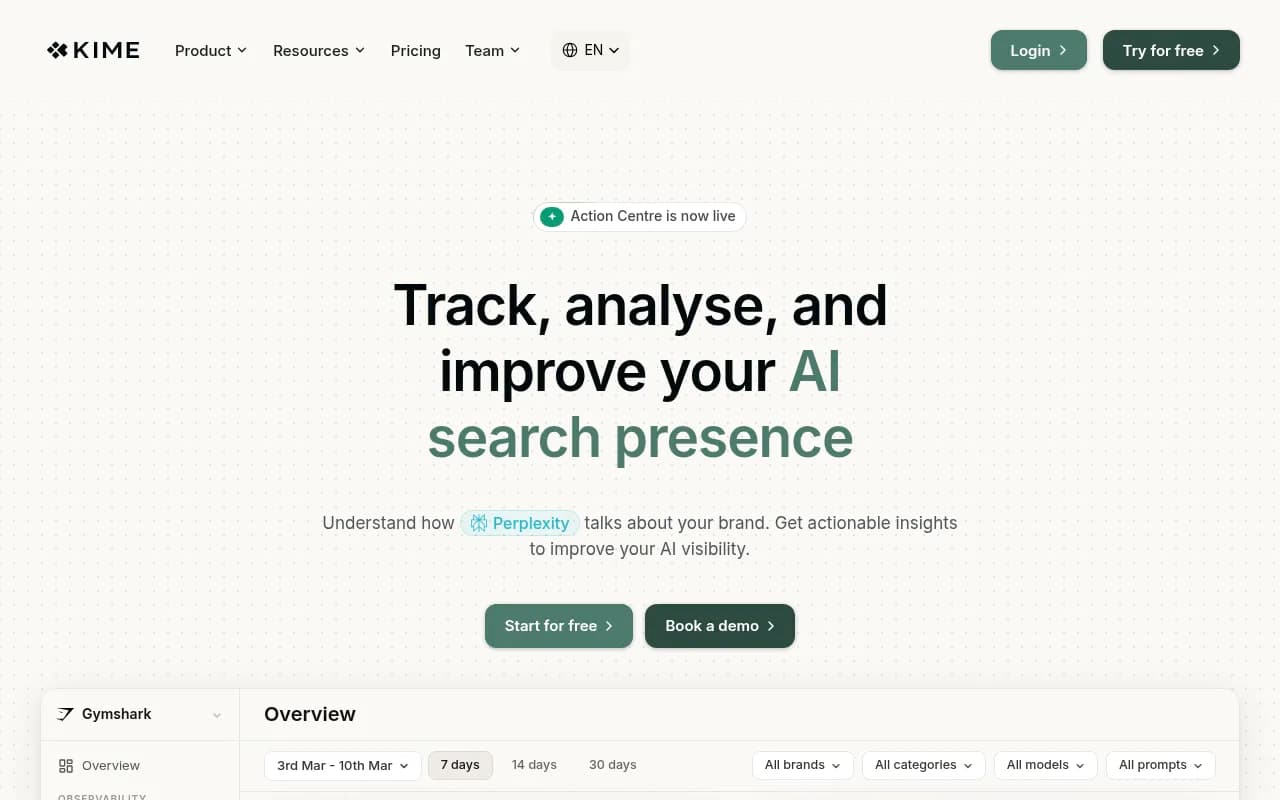
KIME's main dashboard gives brands a top-level "AI Performance Score" alongside sub-metrics: Overall Visibility, Overall Placement, and Overall Sentiment Score. These are aggregated across all tracked prompts and models, giving a single number to track over time. The dashboard also includes an AI Mentions Leaderboard that shows how your brand stacks up against competitors in terms of raw mention count. This kind of at-a-glance overview is useful for reporting to stakeholders who don't want to dig into raw data.
Prompt tracking with custom categories
Users can define their own prompts -- specific questions or searches they want to track -- and organize them into categories. For each prompt, KIME reports Visibility (whether the brand was mentioned), Placement (where in the response it appeared), Share of Voice (percentage of mentions vs. competitors), and estimated Volume. You can filter by country, model, and time period. The ability to categorize prompts is a practical feature for brands tracking multiple product lines or markets simultaneously.
Multi-model coverage
KIME tracks across ChatGPT, Perplexity, Google AI Mode, and other major AI platforms. The homepage references "all major AI models," though the exact list isn't fully enumerated in public documentation. For comparison, Promptwatch monitors 10+ models including Claude, Gemini, DeepSeek, Grok, Mistral, Meta AI, and Copilot -- so it's worth verifying KIME's exact model coverage before committing.
Citation tracking and source analysis
One of KIME's stronger features is its citation tracking view, which shows which sources AI models are pulling from when mentioning your brand. The interface breaks down sources by domain, number of mentions, content type (Editorial, UGC, Influencer), usage rate, and average citation count. This is genuinely useful data -- knowing that Reddit and YouTube are driving AI citations for your category tells you where to invest content and PR efforts. The source type classification (Editorial vs. UGC vs. Influencer) adds a layer of strategic context that's more useful than raw domain lists.
Competitor side-by-side analysis
KIME lets you add competitor brands and compare them directly across all tracked metrics: Share of Voice, Placement, Sentiment, and Visibility trends over time. The Industry Ranking view shows a leaderboard of brands by visibility within your competitive set. This is a standard feature in the GEO monitoring category, but KIME's implementation looks clean and usable based on the interface shown.
AI Perception (Beta)
This feature attempts to characterize how AI models describe your brand -- essentially a qualitative layer on top of the quantitative visibility data. It tracks sentiment trends over time and digs into which sources and keywords are shaping the AI's perception of your brand. It's marked as Beta, which is honest, and it's an interesting direction. The practical value will depend on how granular the analysis gets once it's fully released.
Action Centre
The Action Centre is KIME's answer to the "now what?" problem that pure monitoring tools face. It provides personalized optimization recommendations based on your visibility data. One customer (Saxo's Paid Search Specialist) specifically mentioned that KIME helped them discover ChatGPT was being blocked from crawling their site -- and fixing it made an immediate difference. That's a concrete, practical outcome. However, the Action Centre appears to be a recommendations layer rather than a full content generation or gap analysis system. It tells you what to do; it doesn't do it for you.
Global tracking
KIME supports tracking across multiple countries and languages, which matters for brands operating in multiple markets. The prompt-level filtering by country makes it possible to see how visibility differs between, say, the UK and Denmark for the same search query.
Who is it for
KIME fits best for marketing and SEO teams at small-to-mid-size companies that are just starting to take AI search visibility seriously. If you're a brand like Gymshark or Chamberlain Coffee -- consumer-facing, with a clear competitive set, and a marketing team that wants clean dashboards rather than raw data exports -- KIME's interface and feature set make sense. The platform is approachable enough that a Paid Search Specialist or SEO manager can use it without needing a dedicated data analyst.
It also works for digital agencies managing a handful of clients who want to add AI visibility reporting to their service offering. The competitor comparison and Share of Voice metrics translate well into client-facing reports. That said, agencies managing 20+ clients simultaneously would likely find the platform's current feature set limiting, particularly if they need bulk prompt management or white-label reporting.
Who should probably look elsewhere: brands that need to go beyond monitoring and actually generate content optimized for AI search, teams that want to understand how AI crawlers are accessing their site, or companies that need to connect AI visibility data to actual revenue attribution. KIME's Action Centre is a step toward optimization, but it's not a full content workflow. For that level of capability, a platform like Promptwatch -- which includes AI content generation, crawler logs, and traffic attribution -- is a more complete solution.
Integrations and ecosystem
KIME's public documentation doesn't detail a wide integration ecosystem. The platform appears to be primarily web-based, with no mention of a public API, Zapier integration, or browser extension on the main site. The demo booking flow uses Cal.com with Google Meet, which is a minor but telling detail about the company's current stage.
There's no mention of Google Search Console integration, Looker Studio connectors, or server log analysis -- capabilities that more mature platforms in this space offer. Import/export capabilities are not described publicly. For teams that need to pipe AI visibility data into their existing reporting stack, this is worth asking about directly before signing up.
Pricing and value
KIME's pricing is not publicly listed on the main website. The site directs visitors to either start for free or book a demo, which suggests a sales-assisted model for most plans. A search result references "flexible plans for every business" with monthly or annual options, but specific tier names and prices aren't available without going through the demo or signup flow.
The free tier appears to exist (the CTA says "Start for free"), but the scope of what's included -- number of prompts, models, competitors -- isn't clear from public information. For comparison, Promptwatch's Essential plan starts at $99/month for 1 site and 50 prompts, with Professional at $249/month and Business at $579/month, all with transparent public pricing.
The lack of public pricing makes it harder to evaluate KIME's value proposition without investing time in a sales conversation. For buyers who want to self-serve and compare options quickly, this is a friction point.
Strengths and limitations
What KIME does well:
- The dashboard design is clean and approachable -- metrics like AI Performance Score and Share of Voice are presented in a way that's easy to understand and share with non-technical stakeholders
- Citation tracking with source type classification (Editorial, UGC, Influencer) is a genuinely useful feature that goes beyond just listing domains
- The Action Centre, while still early, shows a real attempt to move beyond pure monitoring -- the Saxo case study (discovering ChatGPT was blocked from their site) is a concrete example of practical value
- Multi-country and multi-language tracking is well-suited for brands operating across European markets, which appears to be KIME's home turf given its Danish customer base
Limitations and gaps:
- No AI content generation: KIME can tell you what to optimize but doesn't help you create the content. Platforms like Promptwatch include a built-in AI writing agent that generates articles and listicles grounded in citation data -- KIME has no equivalent
- No AI crawler logs: One of the most actionable features in the GEO space is seeing exactly which pages AI crawlers are visiting, how often, and what errors they encounter. KIME doesn't appear to offer this
- No traffic attribution: There's no mention of connecting AI visibility to actual website traffic or revenue -- no code snippet, GSC integration, or server log analysis. You can see your visibility score improve, but you can't close the loop to business outcomes
- No Reddit or YouTube tracking: KIME's citation tracking shows when these platforms appear as sources, but there's no dedicated Reddit or YouTube insights layer that surfaces discussions influencing AI recommendations
- No ChatGPT Shopping tracking: For e-commerce brands, monitoring product appearances in ChatGPT's shopping carousels is increasingly important. KIME doesn't appear to cover this
- Pricing opacity: Not publishing pricing tiers makes it harder for buyers to self-qualify and compare options
Bottom line
KIME is a solid entry point for brands that want to start measuring their AI search visibility without a steep learning curve. The dashboard is clean, the citation tracking is useful, and the Action Centre shows the platform is trying to move in the right direction. For a small marketing team at a consumer brand that wants to understand how ChatGPT talks about them relative to competitors, KIME does the job.
But for teams that need to act on what they find -- generate content that gets cited, understand how AI crawlers interact with their site, or connect visibility to revenue -- KIME's current feature set leaves significant gaps. Promptwatch covers the full loop from gap analysis to content generation to traffic attribution, which makes it the stronger choice for teams serious about AI search as a growth channel.
Best use case: A mid-market brand's marketing team that wants clean, shareable AI visibility dashboards and is just beginning to build a GEO strategy.
Frequently asked questions
What is KIME?
Who is KIME best suited for?
Does KIME have a free plan?
How does KIME compare to other GEO tools like Promptwatch?
Which AI models does KIME track?
What is KIME's Action Centre?
Similar and alternative tools to KIME