Key takeaways
- Peec AI is a pure-play AI visibility monitoring tool built for tracking brand mentions, share of voice, and citation rates across LLMs like ChatGPT, Perplexity, and Google AI Overviews.
- Birdeye is a reputation and local marketing platform that has added AI search visibility features, making it better suited for multi-location businesses and local SEO-heavy agency clients.
- Neither tool closes the loop from monitoring to content creation -- they show you where you're invisible but don't help you fix it.
- For agencies managing national or enterprise clients who need to act on AI visibility data (not just watch it), platforms like Promptwatch go further with content gap analysis and AI content generation built in.
- The right choice depends almost entirely on your client mix: local service businesses vs. national brands with complex prompt tracking needs.
Why this comparison matters in 2026
AI search isn't a niche concern anymore. ChatGPT alone accounts for roughly 20% of global search traffic, and AI-referred visits convert at 3 to 9 times the rate of traditional organic traffic, according to multiple third-party studies cited across the industry. For agencies, this creates a real problem: clients are asking "do we show up in ChatGPT?" and most traditional SEO tools can't answer that question.
Two tools that agencies are evaluating for this job are Peec AI and Birdeye. They come from very different directions. Peec AI was built from scratch to monitor LLM visibility. Birdeye built its reputation on local business marketing and has been expanding into AI search. Understanding where each one actually fits -- and where each one falls short -- is worth doing carefully before you commit client budgets.
What Peec AI does
Peec AI is a monitoring platform. It tracks how often your brand appears when AI systems answer buyer questions, measuring share of voice and citation rate across large language models. The platform uses UI scraping technology to simulate real user interactions rather than just hitting APIs, which matters because user-facing answers can differ from what you'd get through a raw API call.

The core metrics Peec AI reports are:
- Brand mention rate (how often you appear in AI responses)
- Share of voice vs. competitors
- Citation URLs (which pages AI models are linking to)
- Sentiment around your brand mentions
- Visibility trends over time
On the Pro plan (€199/month), you get four base AI engines: ChatGPT, Perplexity, Google AI Overviews, and DeepSeek. Claude, Gemini, and Google AI Mode are Enterprise add-ons with custom pricing. You're capped at 100 prompts and 9,000 AI answers per month.
The unlimited countries and languages at no extra cost is a genuine differentiator for agencies with international clients. Most competitors charge extra for multi-region tracking.
What Peec AI doesn't do: it has no content creation tooling, no site audits, no shopping visibility tracking, and no traditional SEO features. It's a dashboard that tells you where you stand. What you do with that information is entirely up to you.
What Birdeye Search AI does
Birdeye started as a reputation management platform for multi-location businesses -- think dental chains, auto dealerships, franchise restaurants, and regional service businesses. It handles review management, local listings, social media, and customer messaging across hundreds or thousands of locations from a single dashboard.
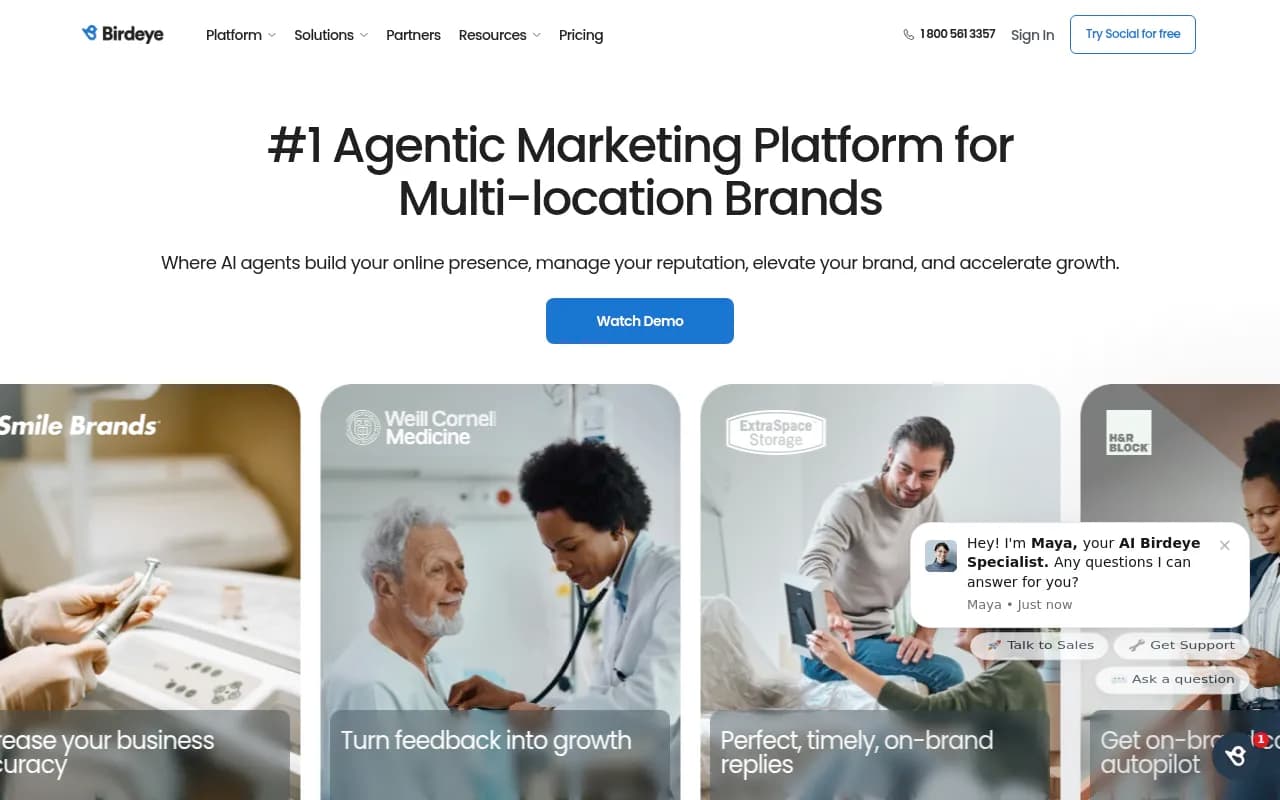
The "Search AI" component is Birdeye's answer to the AI visibility question. It's designed to help local and multi-location businesses understand how they appear in AI-generated local search results, particularly in tools like Google AI Overviews and ChatGPT when users ask location-specific questions ("best dentist near me," "top-rated HVAC company in Austin").
Birdeye's AI visibility features sit inside a much larger platform that includes:
- Review generation and response automation
- Local listing management across 50+ directories
- Social media management
- Customer messaging and webchat
- Competitive benchmarking at the local level
For agencies managing local service businesses, this bundled approach can be genuinely useful. You're not paying for a standalone AI visibility tool -- you're getting AI visibility as part of a broader local marketing stack.
The tradeoff: Birdeye's AI visibility tracking is not as deep or flexible as a dedicated LLM monitoring tool. It's optimized for local intent queries, not for tracking how a national B2B brand appears when someone asks ChatGPT to recommend enterprise software vendors.
Head-to-head comparison
| Feature | Peec AI | Birdeye Search AI |
|---|---|---|
| Primary use case | LLM brand visibility monitoring | Local reputation + AI search for multi-location brands |
| AI models tracked | Up to 10 (4 on base plan) | Google AI Overviews, ChatGPT (local focus) |
| Prompt customization | Yes, up to 100/mo on Pro | Limited, mostly location-based queries |
| Share of voice tracking | Yes | Yes (local competitors) |
| Citation URL tracking | Yes | Partial |
| Multi-location support | Limited | Core strength |
| Review management | No | Yes |
| Local listing management | No | Yes |
| Content creation tools | No | No |
| Traditional SEO features | No | Partial (local SEO) |
| Multi-language/region | Yes (unlimited) | Yes (multi-location) |
| Agency white-labeling | Limited | Yes |
| Starting price | €85/month | Custom (bundled platform) |
| Best for | National/global brand monitoring | Local service businesses, franchises |
Where Peec AI wins
For agencies with national or global B2B clients, Peec AI is the more appropriate tool. If your client is a SaaS company asking "do we show up when someone asks ChatGPT to recommend project management software?", Peec AI is built to answer that question with real data.
The prompt-centric approach -- where you define the specific questions you want to track -- gives you control over what gets measured. You can track branded queries ("what do people say about [brand]?"), category queries ("best CRM for small business"), and competitor comparison queries ("vs [competitor]") all in one place.
The unlimited countries and languages is also meaningful for agencies with European or international clients. You're not paying extra to track visibility in French or German AI responses.

Where Birdeye wins
For agencies managing local service businesses -- especially multi-location brands -- Birdeye's bundled approach is hard to beat on pure efficiency grounds. If you're managing 50 dental practices or 200 franchise locations, the ability to handle reviews, listings, social, and AI visibility from one platform saves real operational time.
Birdeye's AI visibility features are also more directly tied to the queries that matter for local businesses. When a potential customer asks Google AI Overviews "best plumber in Denver," Birdeye is tracking whether your client appears in that answer and what the surrounding context looks like.
The white-labeling and agency-specific reporting features also make it easier to package AI visibility as part of a broader local marketing service.
The shared limitation: monitoring without action
Here's the honest problem with both tools: they tell you what's happening but don't help you change it.
Peec AI shows you that a competitor has 40% share of voice and you have 12%. Birdeye shows you that your client isn't appearing in local AI answers. Both platforms stop there. The work of figuring out why, what content to create, and how to fix the gap falls entirely on the agency.
This is a real operational cost. For agencies billing on performance, a monitoring dashboard that doesn't connect to execution creates a gap between insight and results.
Platforms that close this loop are worth knowing about. Promptwatch is one of the few that connects monitoring to content creation -- it identifies which prompts competitors are visible for that you're not, then generates content briefs and articles designed to close those gaps. For agencies that need to show clients a path from "here's where you're invisible" to "here's what we did about it," that matters.

Which tool fits which agency client type
Local service businesses (dentists, HVAC, restaurants, franchises)
Birdeye is the natural fit here. The combination of review management, local listings, and AI visibility in one platform matches how local marketing actually works. AI visibility for a dentist is mostly about appearing in "best dentist near me" queries in Google AI Overviews -- Birdeye is built for exactly that.
National B2B brands and SaaS companies
Peec AI is more appropriate. The ability to track custom prompts across ChatGPT, Perplexity, and other LLMs with granular share-of-voice data is what these clients need. A B2B software company cares about appearing in category queries and vendor comparison prompts, not local intent queries.
Enterprise brands with complex competitive landscapes
Neither tool is ideal. Peec AI's prompt cap (100/month on Pro) becomes a constraint quickly for enterprise clients with large prompt sets. Birdeye's depth on non-local AI visibility is limited. Enterprise clients are better served by platforms like Profound or Promptwatch, which handle larger prompt volumes and offer more sophisticated competitive analysis.
Agencies managing a mixed client roster
This is where it gets complicated. If you have both local service clients and national brand clients, you're looking at two separate tools -- or a platform flexible enough to handle both. Peec AI's multi-language and multi-region support helps with geographic diversity, but it doesn't solve the local-specific features that Birdeye provides.
Pricing reality check
Peec AI's pricing is transparent and published:
- Starter: €85/month (limited prompts, 4 base engines)
- Pro: €199/month (100 prompts, 9,000 AI answers, 4 base engines)
- Enterprise: Custom (adds Claude, Gemini, AI Mode)
Birdeye doesn't publish pricing publicly -- it's a bundled platform sold through sales conversations, and pricing varies significantly based on the number of locations and features included. Agencies typically pay per location, which means costs scale with client size.
For agencies doing budget planning, Peec AI's transparent pricing is easier to work with. Birdeye's value proposition depends heavily on whether clients are already paying for review management and local listings -- if they are, the AI visibility features come at relatively low marginal cost.
Other tools worth considering alongside these two
If you're evaluating Peec AI and Birdeye, a few other platforms are worth a look depending on your specific needs:
For agencies that want monitoring plus content creation:
Promptwatch tracks AI visibility across 10 models and includes content gap analysis and AI content generation -- useful when clients need to see action, not just data.
For agencies focused on local SEO with AI visibility:
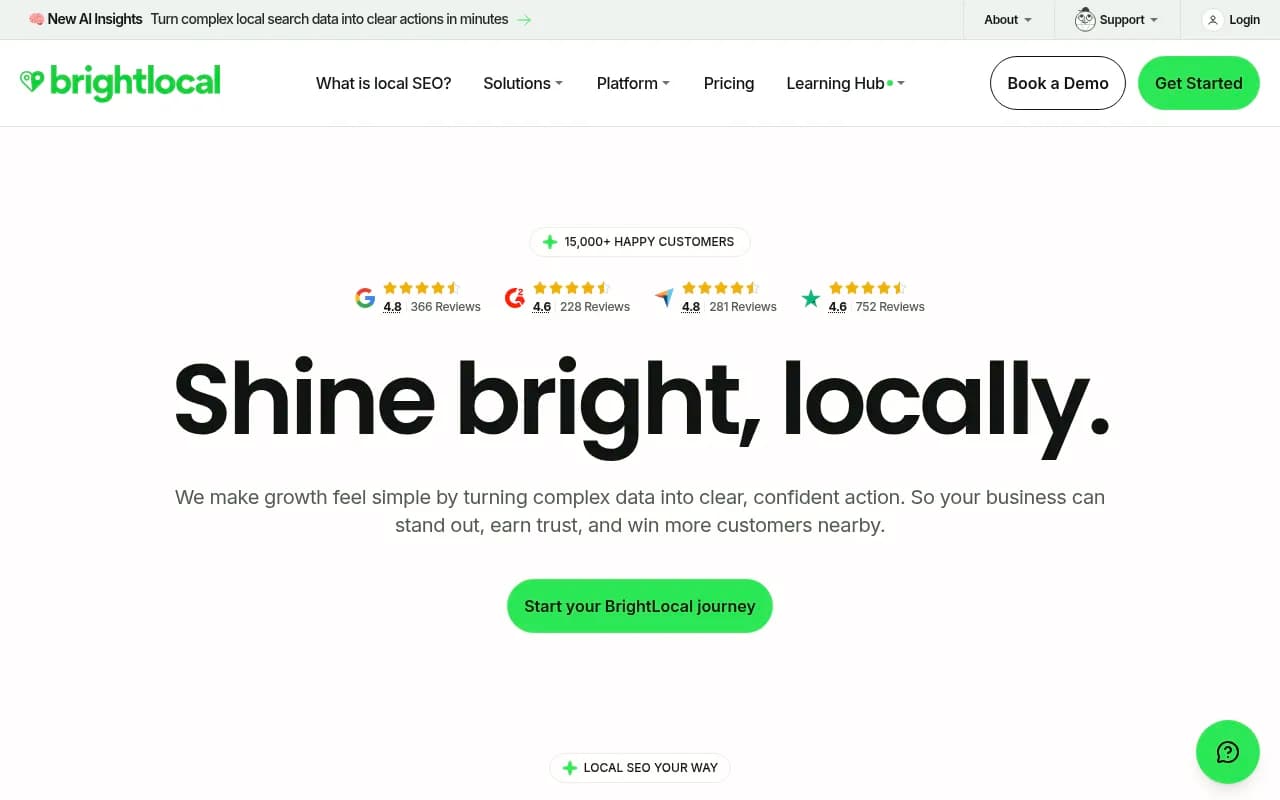
BrightLocal has been adding AI visibility features to its local SEO platform, which may be relevant if you're already using it for local rank tracking.
For agencies wanting affordable monitoring across multiple LLMs:

Otterly.AI starts at $29/month and covers 4 base AI engines -- a lower-cost entry point for agencies testing the category before committing to a larger platform.
For agencies managing enterprise clients with deep prompt research needs:
Profound is built for enterprise-scale prompt tracking and competitive analysis, with pricing that reflects that positioning.
The bottom line
Peec AI and Birdeye Search AI aren't really competing for the same clients. Peec AI is a focused LLM monitoring tool for brands that need to track national or global AI visibility across custom prompts. Birdeye is a local marketing platform that has added AI search features to serve multi-location businesses.
If your agency primarily serves local service businesses -- especially franchises or multi-location brands -- Birdeye's bundled approach makes operational sense. If you're working with national B2B brands or SaaS companies trying to understand their LLM visibility, Peec AI is the more appropriate starting point.
The harder question is what happens after the monitoring data comes in. Both tools leave that work to you. Agencies that want to close the gap between "here's where you're invisible" and "here's the content we created to fix it" need to look at platforms that combine tracking with execution -- and that's a different conversation entirely.