Key takeaways
- Most GEO platforms stop at monitoring -- they show you where your clients are invisible but don't help you fix it. The best platforms close that loop with content generation and optimization tools.
- Agencies need multi-site support, white-label reporting, and prompt tracking across multiple AI models (ChatGPT, Perplexity, Gemini, Claude, and more).
- Promptwatch is the only platform rated "Leader" across all evaluation categories in a 2026 comparison of 12 GEO tools, largely because it combines tracking, content gap analysis, and AI content generation in one place.
- Pricing across the category ranges from free tiers to $500+/month for agency plans. Match your choice to the number of clients you manage and the depth of reporting they expect.
- Crawler logs and traffic attribution are rare features -- but they're what turn GEO from a vanity metric into something you can tie to revenue.
The GEO platform market has exploded over the past 18 months. Every week there's a new tool claiming to track your brand across ChatGPT, Perplexity, Gemini, and a dozen other AI engines. Most of them are dashboards. They show you a visibility score, maybe a citation count, and then leave you to figure out what to do next.
For agencies, that's not enough. Your clients want results, not reports. They want to know why their competitor shows up in ChatGPT's answer and they don't -- and more importantly, what you're going to do about it.
This guide focuses on platforms that are actually useful for agency work in 2026: multi-client support, actionable insights, content tools, and reporting that you can put in front of a client without embarrassment.
What agencies actually need from a GEO platform
Before getting into the list, it's worth being clear about what separates a good agency tool from a generic tracker.
Monitoring matters, but it's table stakes. What agencies need on top of that:
- Multi-site management without paying enterprise prices per client
- Prompt tracking across the AI models your clients' customers actually use
- Content gap analysis that shows why a competitor is getting cited
- Some path to fixing those gaps, whether through content briefs, generation tools, or clear recommendations
- Reporting that's client-ready, not just raw data exports
- Attribution -- connecting AI visibility to actual traffic and revenue
With that in mind, here are the nine platforms worth considering.
The 9 best GEO platforms for agencies in 2026
1. Promptwatch
Promptwatch is the most complete GEO platform available right now for agencies. It covers the full cycle: find gaps, create content, track results. Most competitors only do the first step.

The core differentiator is the Answer Gap Analysis. It shows you exactly which prompts your client's competitors are getting cited for but your client isn't. You see the specific topics and questions AI models want answered but can't find on your client's site. That's a content brief in itself.
From there, Content Agents generate articles, listicles, and comparisons grounded in real prompt data, citation volumes, and competitor analysis. This isn't generic AI writing -- it's content built around the actual gaps AI models are exposing.
The platform also has something most competitors lack entirely: AI Crawler Logs. These are real-time logs of when ChatGPT, Claude, Perplexity, and others crawl your client's pages, which pages they read, and when those pages move from "crawled" to "cited." That's genuinely useful for diagnosing why a page isn't getting picked up.
For agencies specifically, Promptwatch supports multiple sites, tracks prompts across 10 AI models (ChatGPT, Perplexity, Google AI Overviews, Claude, Gemini, Grok, DeepSeek, Copilot, Meta AI, Mistral), and includes traffic attribution that connects AI visibility to actual revenue.
Pricing starts at $99/month for a single site, $249/month for the Professional plan (2 sites, 150 prompts, crawler logs), and $579/month for Business (5 sites, 350 prompts). Agency and enterprise pricing is available on request.
In a 2026 comparison of 12 GEO platforms, Promptwatch was the only tool rated "Leader" across all categories. The gap between it and the next tier is mostly about action: Promptwatch helps you fix the problem, not just identify it.
2. Profound
Profound targets enterprise brands and agencies managing large-scale AI visibility programs. It has strong monitoring capabilities and covers the major AI models with decent prompt tracking.
Where Profound shines is in its structured reporting and enterprise integrations. If you're managing a large brand with complex stakeholder reporting requirements, it handles that well. The trade-off is price -- it sits at a higher price point than most mid-market agency tools -- and it doesn't have the content generation capabilities that Promptwatch offers. You'll still need a separate content workflow to act on what Profound surfaces.
3. Otterly.AI
Otterly.AI is a solid entry-level monitoring tool. It tracks brand mentions and citations across ChatGPT, Perplexity, and a handful of other models, and it's priced accessibly enough that smaller agencies can afford to run it across several clients.

The honest limitation: Otterly.AI is a tracker. There's no content gap analysis, no crawler logs, no content generation. If you're an agency that just needs to show clients "here's your AI visibility score this month," it works. If you need to actually improve that score, you'll be doing the strategy work yourself.
4. Scrunch AI
Scrunch AI sits in the mid-tier of the GEO monitoring space. It covers AI search visibility across the major models and has reasonable reporting features for agencies.
It's a decent choice if you're already using a separate content platform and just need the monitoring layer. The interface is clean and the setup is fast, which matters when you're onboarding multiple clients. Like most monitoring-first tools, though, the "what do I do about this?" question is left to you.
5. AthenaHQ
AthenaHQ has built a reputation for solid AI search monitoring, particularly for brands that care about tracking visibility across 8+ AI engines with clean, structured data.
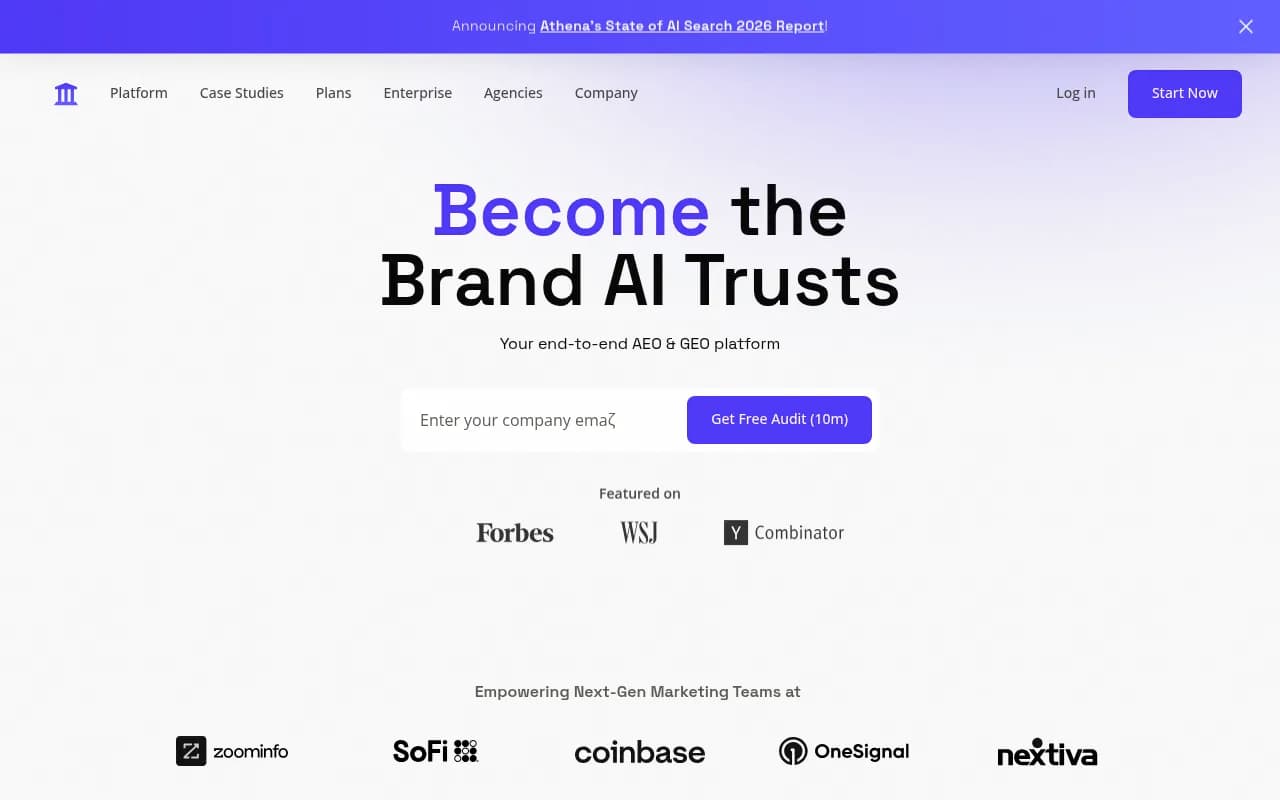
For agencies, the main consideration is that AthenaHQ is monitoring-focused. It doesn't have content optimization or generation built in. That's not a dealbreaker if your agency has strong content capabilities already -- you can use AthenaHQ for the data layer and bring your own content process. But if you're looking for an all-in-one platform, it's not that.
6. SE Ranking (AI visibility module)
SE Ranking has been a reliable traditional SEO platform for years, and its AI visibility module is a reasonable addition if you're already using it for rank tracking and site audits.
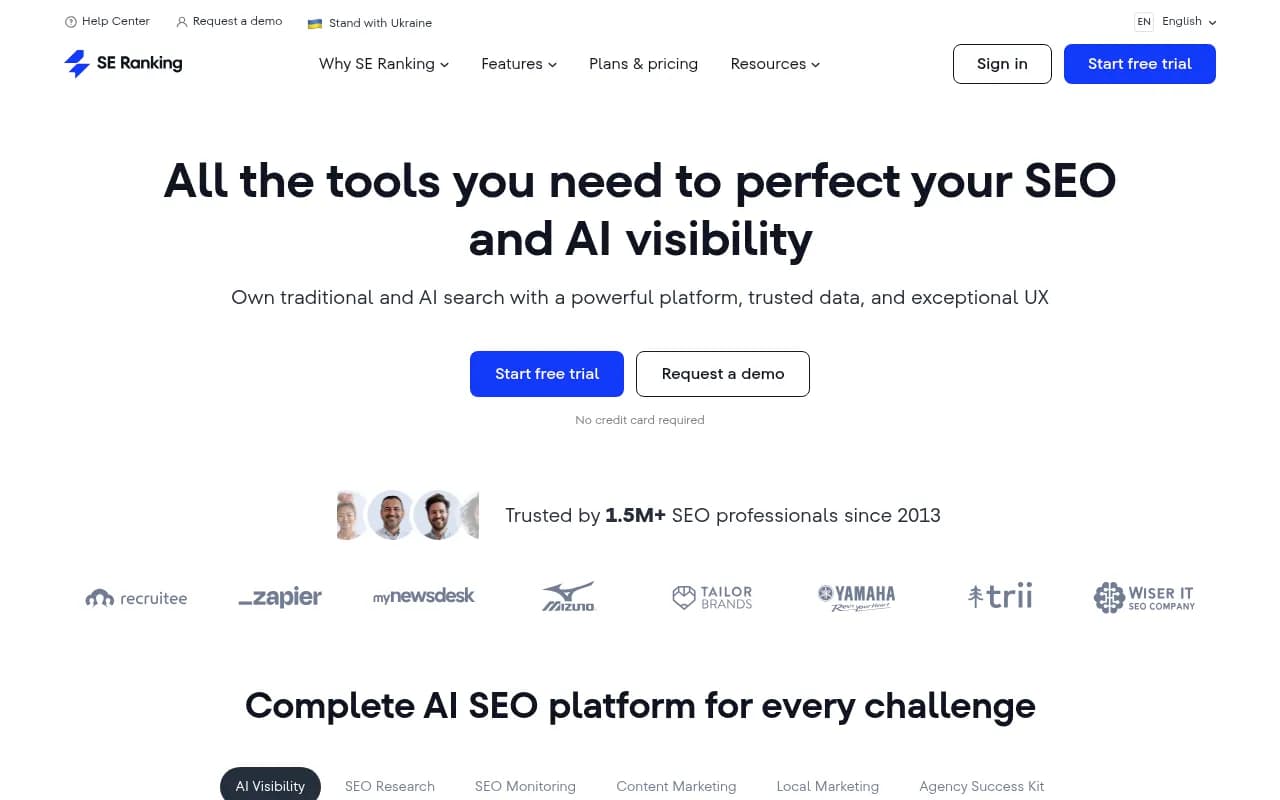
The advantage here is consolidation -- if you're already paying for SE Ranking, the AI visibility features add meaningful coverage without a separate tool subscription. The depth isn't quite at the level of dedicated GEO platforms, but for agencies that want a single platform covering both traditional SEO and AI search monitoring, it's a practical option.
7. Goodie AI
Goodie AI positions itself as an enterprise GEO solution with a focus on structured data, entity optimization, and making content machine-readable for AI engines.
It's a more technical tool than most on this list, which makes it a good fit for agencies with strong technical SEO capabilities. The platform helps with schema markup, entity relationships, and the structural signals that influence how AI models interpret and cite content. Less useful if you need content generation or prompt-level tracking; more useful if your clients have complex technical architectures.
8. Relixir
Relixir is an all-in-one GEO platform that includes both monitoring and AI content generation, making it one of the few tools that attempts to close the gap between tracking and action.
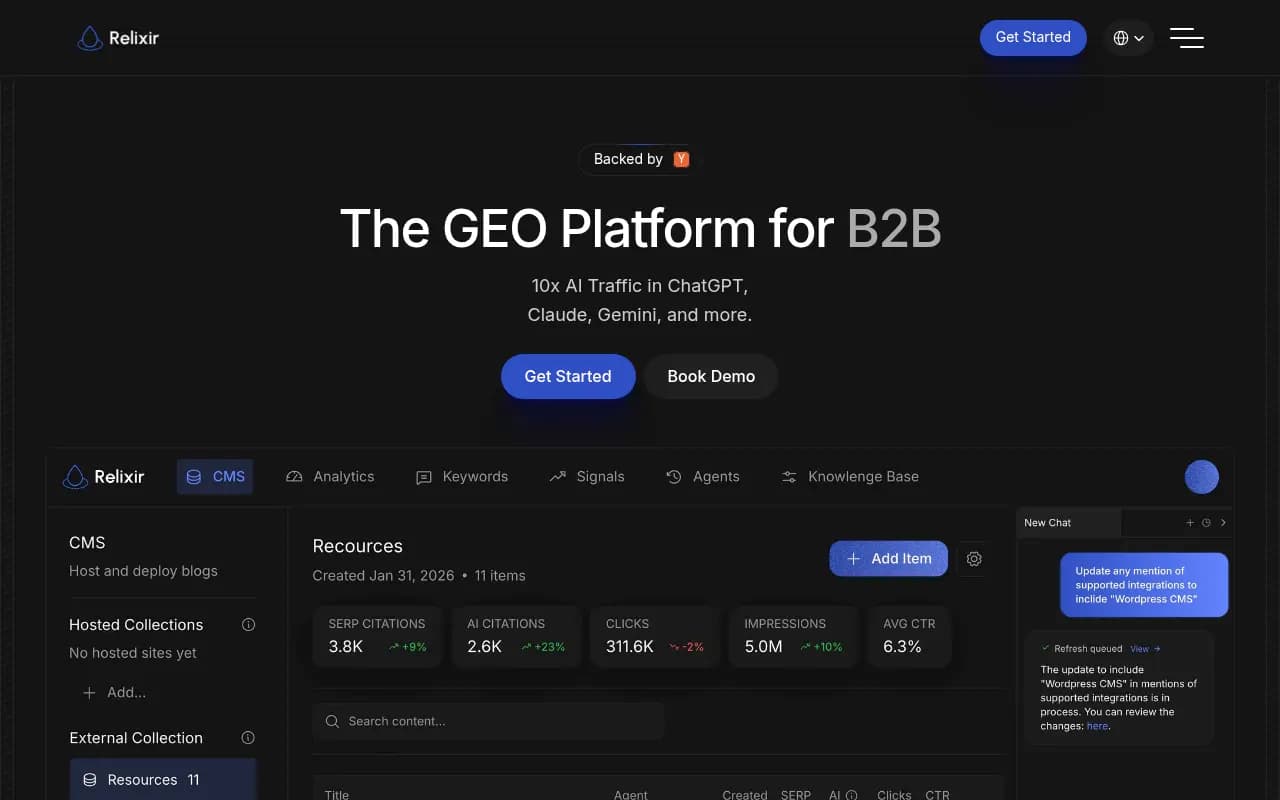
It's a newer entrant compared to some others on this list, but the combination of visibility tracking and content generation in one interface is genuinely useful for agencies. The prompt coverage and depth of analysis aren't quite at Promptwatch's level yet, but it's worth watching -- and worth evaluating if you want an alternative to the market leader.
9. Slate
Slate is built specifically for agencies, with white-label reporting, multi-client dashboards, and a focus on making GEO data presentable to clients who don't want to dig into raw numbers.
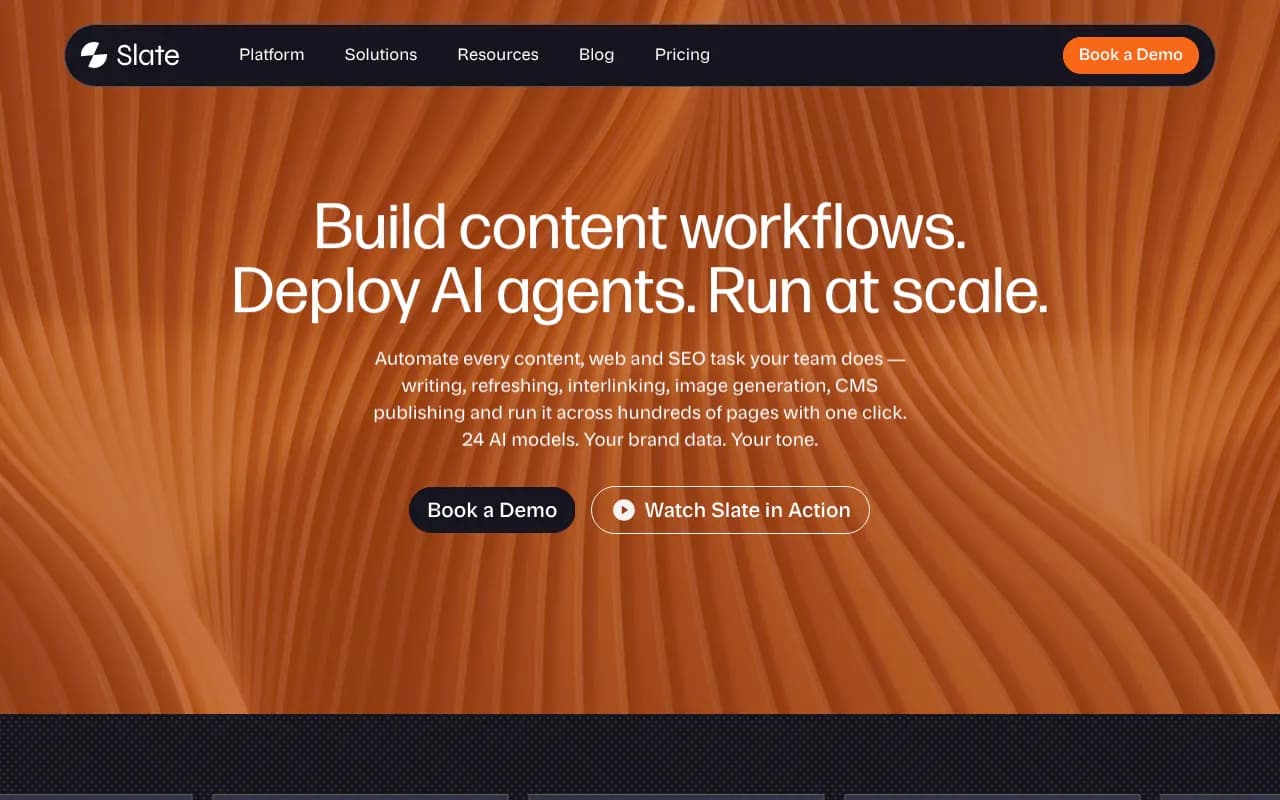
If your agency's main pain point is client reporting rather than content strategy, Slate is worth a look. The reporting layer is genuinely good. The trade-off is that it's lighter on the optimization side -- it's more about communicating AI visibility than improving it. Pair it with a content-focused tool if you need both.
How these platforms compare
| Platform | Multi-site | Content generation | Crawler logs | Prompt tracking | Traffic attribution | Best for |
|---|---|---|---|---|---|---|
| Promptwatch | Yes | Yes | Yes | 10 models | Yes | Full-cycle GEO for agencies |
| Profound | Yes | No | No | 6+ models | Limited | Enterprise monitoring |
| Otterly.AI | Yes | No | No | 4 models | No | Entry-level monitoring |
| Scrunch AI | Yes | No | No | 5+ models | No | Mid-tier monitoring |
| AthenaHQ | Yes | No | No | 8+ models | No | Data-focused monitoring |
| SE Ranking | Yes | No | No | Limited | No | Traditional SEO + AI add-on |
| Goodie AI | Yes | No | No | Limited | No | Technical/entity optimization |
| Relixir | Yes | Yes | No | 5+ models | Limited | Monitoring + content combo |
| Slate | Yes | No | No | 4+ models | No | Agency reporting |
What to look for when evaluating GEO platforms for agency use
Prompt coverage and model breadth
Your clients' customers use different AI tools. A B2B SaaS client's buyers might be heavy Perplexity users. A consumer brand might care more about ChatGPT Shopping and Google AI Overviews. Make sure the platform tracks the models that actually matter for each client's audience.
The gap between "tracking" and "doing"
This is the most important question to ask any GEO vendor: after I see that my client is invisible for a prompt, what does your platform help me do about it? Most platforms will give you a vague answer about "insights" and "recommendations." Push for specifics. Can it generate content? Does it show which pages are missing? Does it tell you what the AI model is citing instead of your client?
Crawler logs and indexing data
Most agencies don't think to ask about this, but it's one of the most useful features in the category. Knowing that ChatGPT crawled your client's homepage but never crawled the product pages explains a lot about why certain content isn't getting cited. Tools like Promptwatch surface this; most others don't.
Reporting quality
You're going to put this data in front of clients. Make sure the reports are clean, explainable, and don't require a 20-minute briefing to interpret. Some platforms have beautiful dashboards that are hard to export; others have clunky interfaces but excellent PDF reports. Know which matters more for your workflow.
Pricing structure for agencies
Per-site pricing gets expensive fast. Look for platforms that offer agency tiers with either flat pricing for multiple clients or meaningful discounts at volume. Promptwatch's Business plan at $579/month covers 5 sites with 350 prompts -- that's a reasonable unit economics story for a small-to-mid agency. For larger agencies, custom pricing conversations are worth having.
The monitoring-only trap
One thing worth naming directly: there's a whole category of GEO tools that are essentially dashboards. They show you a visibility score, a list of prompts your brand appears in, and a comparison against competitors. That's useful for a quarterly review. It's not useful for actually improving AI visibility.
The agencies getting real results from GEO in 2026 are the ones that have closed the loop -- they're using prompt data to identify content gaps, creating content that directly addresses those gaps, and tracking whether AI models start citing that content. That cycle takes weeks, not months, when you have the right tools.
If you're evaluating platforms for your agency, the question isn't just "what does this track?" It's "what does this help me build?"
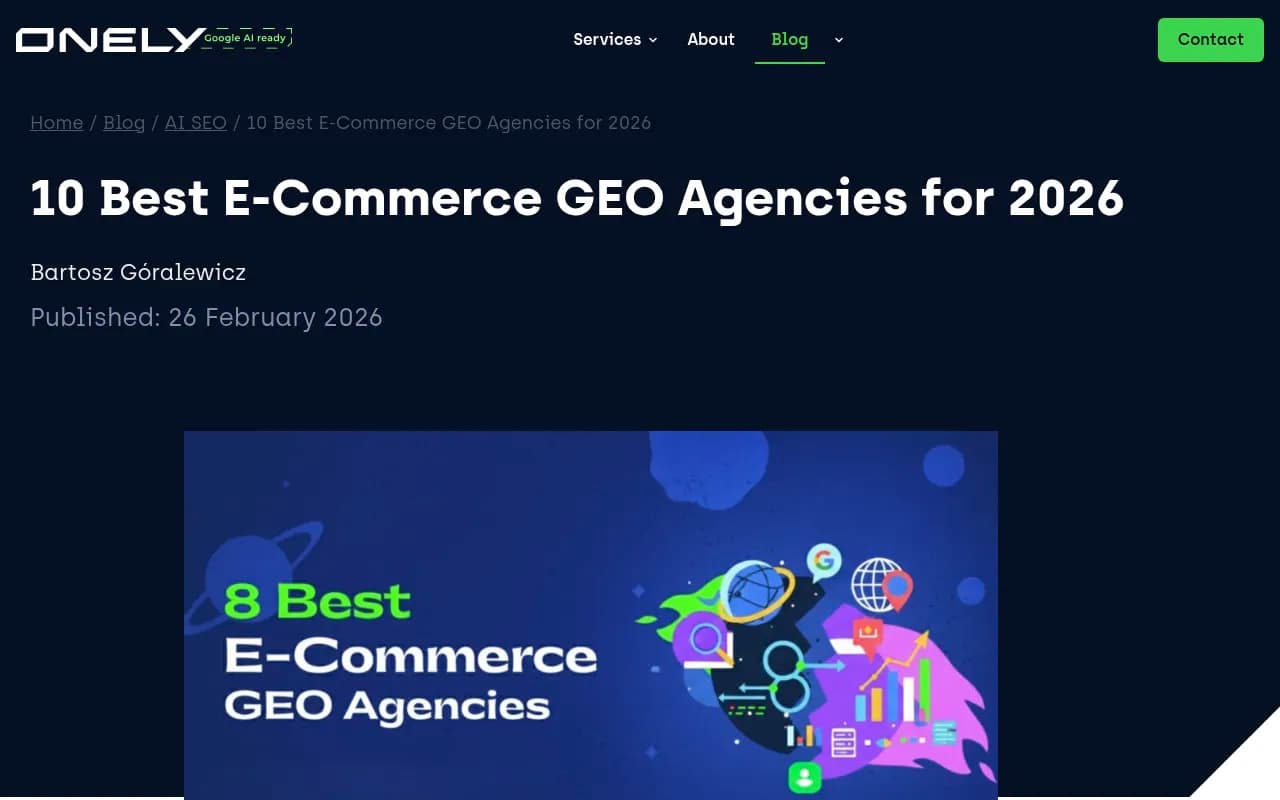
The GEO agency landscape (as mapped by Onely) shows how the field is maturing -- evaluation criteria now include measurable AI citation results and technical depth, not just "we do AI SEO."
Final thoughts
The GEO platform market is still sorting itself out. A lot of tools launched in 2024 and 2025 are essentially the same monitoring dashboard with different branding. The ones that will matter in 2026 and beyond are the ones that help agencies take action -- not just report on what's happening.
For most agencies, Promptwatch is the strongest starting point. It's the only platform that covers the full cycle from gap identification to content creation to citation tracking, and it's priced in a way that makes sense for multi-client agency work. If you're managing enterprise clients with complex reporting needs, Profound is worth evaluating alongside it. If you're a smaller agency just getting started with GEO, Otterly.AI is a low-friction way to add AI visibility tracking to your existing service offering before committing to a more comprehensive platform.
The agencies that figure out GEO now -- while most competitors are still treating it as a monitoring exercise -- are going to be in a strong position when AI search becomes the default way their clients' customers find products and services. That shift is already happening.