Athena HQ Review 2026
AthenaHQ is a comprehensive GEO (Generative Engine Optimization) platform that helps brands monitor, analyze, and improve how they appear in AI-powered search results across ChatGPT, Perplexity, Google AI Overviews, Claude, Gemini, and other LLMs. Used by ZoomInfo, Coinbase, and SoFi, it provides ci
Summary
- Monitoring-focused platform: AthenaHQ tracks brand mentions across 8 AI models (ChatGPT, Perplexity, Google AI Overviews, AI Mode, Gemini, Claude, Copilot, Grok) but lacks the content generation, AI crawler logs, and traffic attribution that Promptwatch offers
- Strong client roster: Used by notable brands including ZoomInfo, Coinbase, SoFi, OneSignal, and Nextiva, with case studies showing 6x share of voice lift and 50% increase in demos from AI search
- High pricing barrier: Self-serve plan starts at $295/month ($95/month annual) with no free trial, making it inaccessible for smaller businesses and startups testing GEO strategies
- Best for: Mid-market to enterprise marketing teams with dedicated GEO budgets who need multi-LLM monitoring and competitive intelligence but can handle content optimization separately
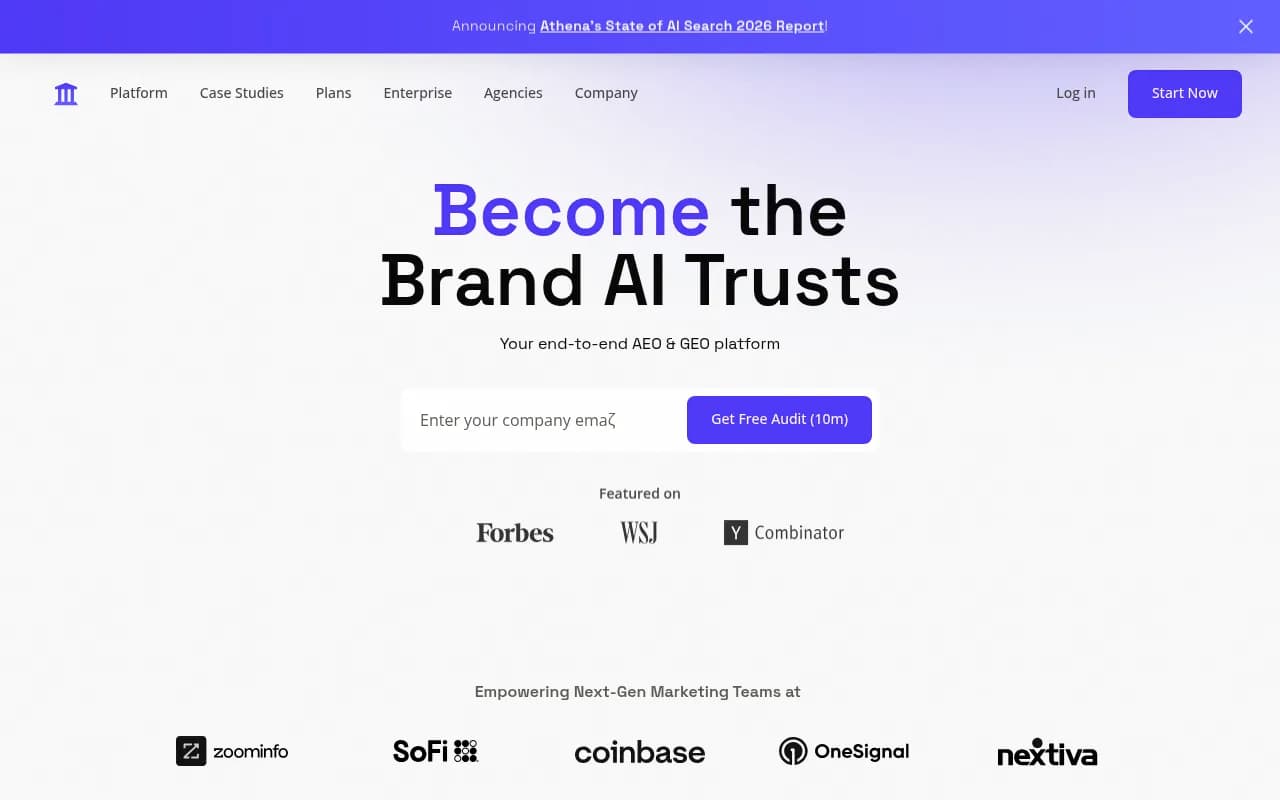
AthenaHQ came out of stealth in 2025 as a Y Combinator-backed startup focused on helping brands understand and improve their presence in AI-generated search results. The platform addresses a real problem: as AI search engines like ChatGPT, Perplexity, and Google's AI Overviews reshape how people find information, brands need visibility into whether they're being mentioned, how they're being described, and how they stack up against competitors. AthenaHQ positions itself as an "end-to-end AEO & GEO platform" for marketing teams, SEO specialists, and CMOs who want strategic oversight of their AI search presence.
The company has attracted impressive clients -- ZoomInfo, Coinbase, SoFi, Nextiva, DeVry University, Volkswagen -- and published case studies showing tangible results. Rootly achieved a 10x increase in citation rate and $126k in incremental equivalent media value. Lago saw a 50% increase in demos from AI search after implementing AthenaHQ. Grüns grew share of voice from 2.0% to 12.6% in 60 days. These are real numbers from real companies, which gives AthenaHQ credibility in a space where many platforms are still proving their value.
The team behind AthenaHQ includes people with experience at Google and DeepMind, and they've assembled an advisory board with serious marketing credentials: Rachel Ten Brink (co-founder and former CMO of Scentbird), Ashley Stirrup (former CMO of Algolia), Ethelbert Williams (Head of Retail Media Search at PepsiCo), and Eli Schwartz (SEO advisor to Coinbase, WordPress, Tinder, Shutterstock). This isn't a side project -- it's a well-funded, well-connected startup with backing from OpenAI, Anthropic, and DeepMind experts.
Key Features
Multi-LLM Visibility Tracking: AthenaHQ monitors 8 major AI platforms: ChatGPT, Perplexity, Google AI Overviews, Google AI Mode, Gemini, Claude, Copilot, and Grok. You can track whether your brand is mentioned in AI-generated responses, how often, and in what context. The platform provides brand mention frequency tracking, citation tracking, and sentiment analysis across these models. This is table stakes for any GEO platform in 2026, but AthenaHQ's coverage is solid -- it hits the major players that matter for most businesses.
Competitor Monitoring & Share of Voice: You can track how competitors are performing in AI search results and compare your brand's share of voice. The platform shows which brands are being cited for specific prompts, how often they appear, and what content is driving their visibility. This competitive intelligence is useful for understanding where you're losing ground and which content gaps to prioritize. The Grüns case study showed this in action -- they used competitor analysis to identify opportunities and grew share of voice by 10.6 percentage points in 60 days.
Citation Source Analysis: AthenaHQ identifies which websites, pages, and content pieces are being cited by AI models when they mention your brand or competitors. This is valuable for understanding what types of content AI platforms trust and where you should focus link-building efforts. The platform shows you the specific URLs that ChatGPT, Perplexity, and other models are pulling from, so you can reverse-engineer what's working and replicate it.
Content Gap Analysis: The platform identifies queries where AI models lack information about your brand or give incomplete answers. This is one of AthenaHQ's stronger features -- it surfaces the specific prompts where you're invisible or underrepresented, so you know exactly what content to create. However, unlike Promptwatch, AthenaHQ doesn't include an AI writing agent to actually generate that content for you. You get the gap analysis, but you're on your own for content creation.
AI Blindspot Detection: AthenaHQ's "dynamic AI crawling" feature identifies parts of your website that AI models can't access or understand. This is useful for technical SEO issues that prevent AI platforms from indexing your content properly. The platform flags these blindspots so you can fix them, but it doesn't provide the real-time AI crawler logs that show exactly when and how AI bots are hitting your site -- a feature that Promptwatch includes for understanding AI indexing behavior.
Press Kit Optimization: For PR teams, AthenaHQ offers tools to create press kits optimized for AI citation. The idea is that if you structure your press materials in a way that AI models can easily parse and cite, you'll get more mentions in AI-generated responses. The platform also provides real-time brand mention alerts and crisis detection tools, so you can respond quickly if AI platforms start spreading misinformation about your brand.
Role-Based Access Control (RBAC): All plans include unlimited seats with role-based access control, which is rare at this price point. You can give different team members different levels of access -- CMOs get executive dashboards, SEO specialists get detailed optimization tools, PR teams get brand monitoring alerts. This makes AthenaHQ a good fit for larger organizations with multiple stakeholders who need visibility into AI search performance.
Athena Citation Engine (ACE): Available on the Enterprise plan, ACE is AthenaHQ's proprietary system for improving citation rates. The details are vague on the website, but it appears to be a combination of content optimization recommendations and automated workflows for improving how AI models cite your brand. This is positioned as a premium feature for enterprise clients who want white-glove support.
Who Is It For
AthenaHQ is built for mid-market to enterprise marketing teams with dedicated budgets for GEO. The $295/month starting price (or $95/month annual) puts it out of reach for most small businesses, freelancers, and startups who are just testing AI search optimization. The platform makes sense for companies that already have a content team, SEO specialists, and a clear strategy for AI visibility -- brands like ZoomInfo, Coinbase, and SoFi that need to monitor their presence across multiple AI platforms and have the resources to act on the insights.
The ideal user is a GEO manager, SEO director, or CMO at a B2B SaaS company, fintech, or e-commerce brand with 50+ employees. You're already investing in content marketing and SEO, and you want to extend that strategy to AI search. You need competitive intelligence to see how you stack up against rivals, and you want executive-level reporting to justify the investment to leadership. You have the budget for a $3,000-$5,000+ annual commitment and the team to execute on the recommendations.
AthenaHQ is less suitable for solopreneurs, small agencies, or businesses with limited content resources. If you're a one-person marketing team or a startup with a tight budget, the $295/month price tag is steep, especially when you still need to create the content yourself. The platform gives you the data and the gaps, but it doesn't write the articles, optimize the pages, or generate the content that will actually improve your AI visibility. For that, you'd need a tool like Promptwatch, which includes an AI writing agent that creates content grounded in citation data and prompt volumes.
Integrations & Ecosystem
AthenaHQ's integration story is thin. The website doesn't mention specific integrations with Google Search Console, analytics platforms, CMS tools, or marketing automation systems. The Enterprise plan includes API access, so larger clients can build custom integrations, but there's no public API documentation or app marketplace for self-serve users. This is a gap compared to more mature platforms that offer plug-and-play integrations with tools like Slack, Zapier, Google Analytics, or WordPress.
The platform does support SAML and OIDC SSO on the Enterprise plan, which is important for larger organizations with strict security requirements. But for most users, the lack of integrations means you're manually exporting data or copying insights into other tools. There's no mention of browser extensions, mobile apps, or other platform support beyond the web dashboard.
Pricing & Value
AthenaHQ offers two main plans: Self-Serve at $295/month ($95/month annual, 67% off first month) and Enterprise at custom pricing. The Self-Serve plan includes 3,600 credits per month (1 credit = 1 AI response), which translates to roughly $300/month in free credit according to the website. You get access to 8 AI models, competitor monitoring, basic content optimization, citation intelligence, AI blindspot detection, and unlimited seats with RBAC.
The Enterprise plan adds LLM traffic analysis, a content optimization AI agent with deep research, the Athena Citation Engine (ACE), white-glove platform configuration and training, a dedicated GEO specialist, API access, and SSO. Pricing is custom, but based on the Self-Serve tier and the feature set, expect to pay $1,000-$3,000+ per month for Enterprise.
There's no free trial, which is a significant barrier. Most GEO platforms offer at least a 7-day or 14-day trial so you can test the platform before committing. AthenaHQ requires you to pay upfront, which makes it harder to evaluate whether the platform is worth the investment. The 67% off first month promotion helps, but you're still paying $98 to try it out.
Compared to competitors, AthenaHQ is on the expensive side. Promptwatch starts at $99/month for 1 site, 50 prompts, and 5 AI-generated articles, with Professional at $249/month including crawler logs, state/city tracking, and 15 articles. Otterly.AI and Peec.ai are in the $50-$150/month range for basic monitoring. AthenaHQ's $295/month price point positions it as a premium option, but you're paying for monitoring and analysis -- not content generation or traffic attribution, which are critical for actually improving your AI visibility.
Strengths & Limitations
Strengths:
- Impressive client roster and case studies: Real results from real companies (Rootly, Lago, Grüns) with specific numbers that demonstrate ROI
- Multi-LLM coverage: Tracks 8 major AI platforms, including ChatGPT, Perplexity, Google AI Overviews, Claude, Gemini, Copilot, and Grok
- Unlimited seats with RBAC: Rare at this price point, makes it easy to onboard entire marketing teams
- Strong advisory board and backing: Team with Google/DeepMind experience, advisors from Algolia, PepsiCo, and top SEO experts
- Citation source analysis: Identifies specific websites and pages being cited by AI models, useful for link-building strategy
Limitations:
- Monitoring-only platform: AthenaHQ shows you the gaps but doesn't help you create content to fill them. No AI writing agent, no content generation, no optimization workflows. You get the data, then you're on your own. Promptwatch includes an AI writing agent that generates articles grounded in citation data and prompt volumes, closing the loop from insight to action.
- No AI crawler logs: You can't see real-time logs of AI bots hitting your website, which makes it harder to diagnose indexing issues or understand how AI models discover your content. Promptwatch provides detailed crawler logs showing which pages AI models read, errors they encounter, and how often they return.
- No traffic attribution: AthenaHQ doesn't track actual traffic or conversions from AI search. You can see visibility metrics, but you can't connect them to revenue or business outcomes. Promptwatch offers traffic attribution via code snippet, Google Search Console integration, or server log analysis, so you can measure the actual impact of AI visibility on your bottom line.
- High pricing with no free trial: $295/month starting price and no free trial makes it hard to evaluate before committing. Most competitors offer free trials or lower entry points.
- Limited integrations: No public API for self-serve users, no integrations with Google Search Console, Slack, Zapier, or other common marketing tools. Enterprise plan includes API access, but that's custom pricing.
- Vague feature descriptions: The website uses a lot of marketing language ("self-improving content creation workflows", "Athena Citation Engine") without explaining exactly how these features work or what you get.
Bottom Line
AthenaHQ is a solid monitoring and analysis platform for mid-market to enterprise brands that need multi-LLM visibility tracking and competitive intelligence. If you're a marketing team at a company like ZoomInfo, Coinbase, or SoFi with a dedicated GEO budget and the resources to act on insights, AthenaHQ gives you the data you need to understand your AI search presence. The case studies are compelling, the client roster is impressive, and the platform covers the major AI models that matter.
But AthenaHQ is monitoring-only. It shows you where you're invisible, but it doesn't help you create the content to fix it. You get gap analysis, citation tracking, and competitor insights, but no AI writing agent, no crawler logs, no traffic attribution. For teams that want an end-to-end optimization platform -- one that not only identifies gaps but also helps you generate content, track AI indexing, and measure actual traffic impact -- Promptwatch is the stronger choice. It's the only platform rated as a "Leader" across all categories in 2026 GEO comparisons, with the action loop that takes you from insight to content creation to results tracking.
Best use case in one sentence: Mid-market to enterprise marketing teams with dedicated GEO budgets who need multi-LLM monitoring and competitive intelligence but can handle content creation and optimization separately.
Similar and alternative tools to Athena HQ