Conductor Review 2026
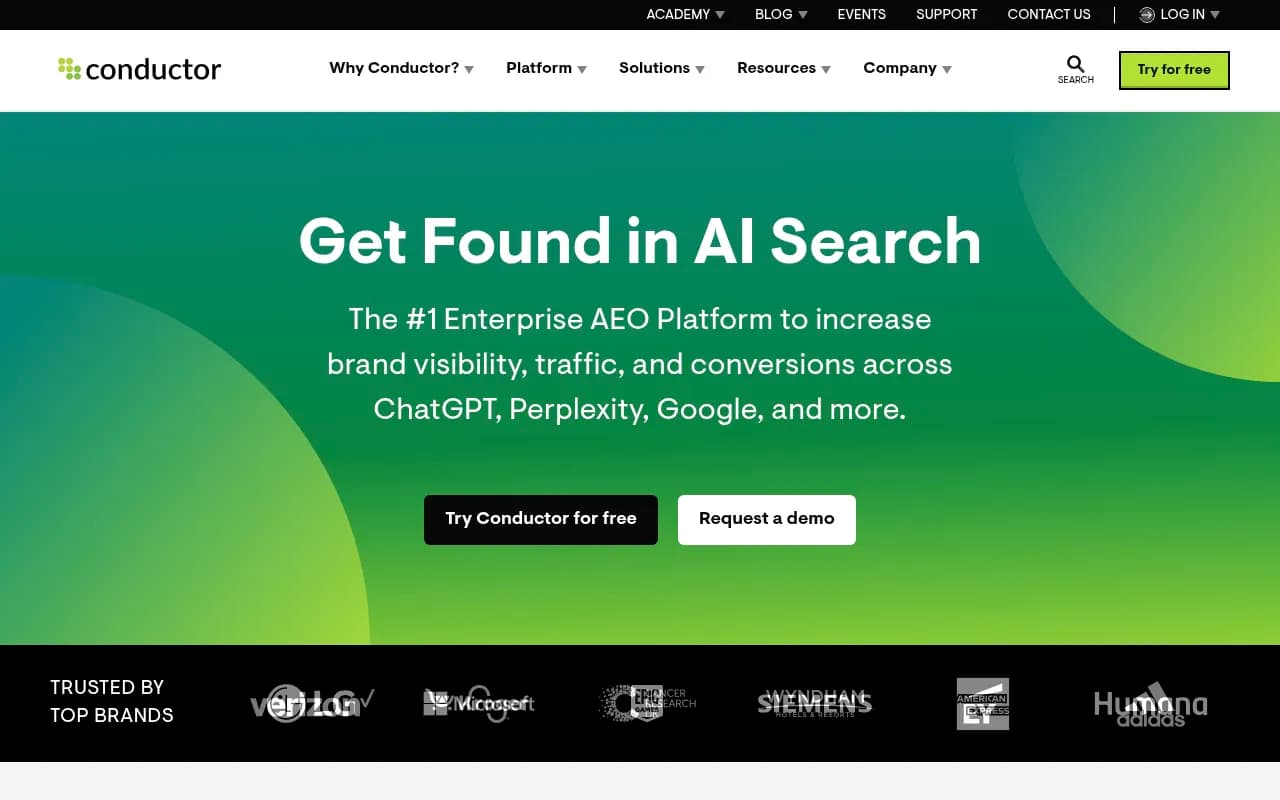
Conductor is an end-to-end enterprise AEO (Answer Engine Optimization) and SEO platform that helps brands increase visibility across ChatGPT, Perplexity, Google AI Overviews, and traditional search. Combines AI search intelligence, purpose-built content generation, 24/7 website monitoring, and enter
Summary
Conductor is an enterprise-grade AEO (Answer Engine Optimization) and SEO platform designed for large organizations managing complex digital presences. It combines AI search visibility tracking, content creation tools, technical monitoring, and a unified data engine. The platform monitors brand presence in ChatGPT, Perplexity, Google AI Overviews, and traditional search engines, then helps teams create optimized content and protect site performance. Conductor is positioned as the only end-to-end solution for enterprise teams, eliminating the need to cobble together multiple point tools. It's trusted by major brands like Verizon, Microsoft, Adidas, Kroger, and American Express.
Key strengths: Enterprise-scale infrastructure, unified workflow from insight to action, purpose-built AI content generation, 24/7 website monitoring, strong analyst ratings (Forrester Leader 2025). Key limitations: Lacks AI crawler logs, no Reddit/YouTube tracking, monitoring-only approach to AI visibility without deep content gap analysis -- Promptwatch offers Answer Gap Analysis, AI traffic attribution, and prompt volume scoring that Conductor doesn't provide. Pricing not publicly disclosed (enterprise custom pricing). Best for large organizations with dedicated SEO/content teams and complex multi-site needs.

Conductor launched as an enterprise SEO platform over a decade ago and has evolved into what it calls the first "enterprise AEO platform" -- positioning itself at the intersection of traditional SEO and the emerging world of AI search. The company serves 1000+ enterprise customers and has built a reputation for handling the scale and complexity that large organizations require. In 2025, Conductor was named a Leader in Forrester's SEO Platforms evaluation, reinforcing its position in the enterprise market. The platform is designed for marketing teams, SEO specialists, content creators, eCommerce managers, and web developers who need a unified system for managing visibility across both traditional search engines and AI-powered answer engines like ChatGPT and Perplexity.
The core pitch is simple: while most brands are scrambling to understand AI search with disconnected tools, Conductor offers an integrated platform that connects visibility tracking, content creation, technical monitoring, and performance measurement in one place. This matters because AI search is fundamentally changing how people find information -- instead of clicking through to websites, users increasingly get direct answers from ChatGPT, Perplexity, Google AI Overviews, and similar tools. Brands that don't show up in these AI-generated responses are losing visibility and traffic.
Conductor Intelligence: AI Search Visibility Tracking
The Intelligence module is Conductor's answer to the "where does my brand show up in AI search?" question. It tracks brand mentions and visibility across multiple AI platforms including ChatGPT, Perplexity, Google AI Overviews, and traditional Google search. You can monitor share of voice for topics you care about, see how your brand is being portrayed in AI responses, and compare your visibility against competitors. The platform provides dashboards showing which queries trigger mentions of your brand, how often you appear, and whether the portrayal is positive or accurate.
Conductor also connects AI visibility directly to business impact by tracking whether AI search traffic actually reaches your site, how that traffic converts compared to organic search, and the ROI of your AEO efforts. This performance tracking is a step beyond basic monitoring -- it ties visibility metrics to actual revenue outcomes. The platform integrates with Google Search Console and analytics tools to attribute traffic sources and measure engagement rates for visitors coming from AI search platforms.
For competitive analysis, Conductor shows which brands are winning share of voice for specific topics and queries. You can see competitor content strategies, identify gaps where competitors are visible but you're not, and benchmark your performance against industry leaders. The system surfaces opportunities by highlighting high-value topics where you have low visibility but strong potential to compete.
Conductor Creator: AI-Powered Content Generation
The Creator module is Conductor's content production engine, built specifically to generate content that performs well in both AI search and traditional SEO. Unlike generic AI writing tools that produce shallow filler, Conductor's AI is trained on the platform's proprietary data engine -- it understands what content actually gets cited by AI models and ranks in search engines. You input a topic or keyword, and the system generates full articles, product descriptions, or landing pages optimized for both human readers and AI crawlers.
The content generation process starts with topic research powered by Conductor's data. The platform identifies content gaps by analyzing which queries your competitors rank for but you don't, which questions your audience is asking that you haven't answered, and which topics have high search volume but low competition. This gap analysis feeds directly into the content creation workflow -- you can turn a visibility gap into a draft article in minutes rather than days.
Conductor's AI writing agent maintains brand voice consistency by learning from your existing content. You can set style guidelines, tone preferences, and subject matter expertise parameters so generated content aligns with your brand standards. The system also suggests internal linking opportunities, meta descriptions, and structured data markup to maximize SEO impact. For enterprise teams managing hundreds or thousands of pages, this automation is the difference between scaling content production and being bottlenecked by manual writing.
The platform includes content optimization tools that analyze existing pages and suggest improvements. It identifies thin content, recommends additional sections or topics to cover, and flags technical SEO issues like missing alt text or broken links. For eCommerce sites, Creator can generate product descriptions at scale while maintaining uniqueness and incorporating relevant keywords.
Conductor Monitoring: 24/7 Website Health Tracking
The Monitoring module is Conductor's technical SEO and site reliability layer. It continuously crawls your website to detect issues that could hurt search visibility or AI discoverability -- broken links, slow page load times, crawl errors, indexing problems, and more. The system sends real-time alerts when critical pages go down or when technical issues are detected, so your team can fix problems before they impact traffic and revenue.
For enterprise sites with thousands or millions of pages, this monitoring is essential. A single misconfigured robots.txt file or a broken canonical tag can tank visibility overnight. Conductor's monitoring catches these issues immediately and provides specific remediation steps. The platform tracks changes over time, so you can see how site health metrics trend and identify patterns (like recurring issues after deployments).
The monitoring extends to AI bot crawling behavior. Conductor tracks which pages AI crawlers (like ChatGPT's bot) are accessing, how often they visit, and whether they encounter errors. This visibility helps you ensure that the content you want AI models to cite is actually being crawled and indexed. If AI bots are hitting rate limits or getting blocked, Conductor flags it so you can adjust your robots.txt or server configuration.
For eCommerce and product teams, the monitoring includes uptime checks for critical revenue-generating pages. If a product page goes down or a checkout flow breaks, Conductor alerts the team immediately. The platform also tracks Core Web Vitals and page speed metrics, surfacing performance issues that could hurt both user experience and search rankings.
Conductor Data: The Unified Data Engine
Underlying all of Conductor's modules is the Data engine -- a unified system that aggregates search data, AI visibility data, content performance data, technical health data, and business metrics into one place. This eliminates the data silos that plague most enterprise marketing teams, where SEO data lives in one tool, content analytics in another, and AI visibility in a third. Conductor's data engine connects these signals so you can see the full picture of how your digital presence is performing.
The data engine powers custom reporting and dashboards. You can build reports that combine traditional SEO metrics (rankings, traffic, conversions) with AI visibility metrics (citations, share of voice, AI traffic) and technical health metrics (crawl errors, page speed, uptime). This unified view makes it easier to communicate ROI to executives and identify which initiatives are actually moving the needle.
Conductor also offers API access and integrations with tools like Looker Studio, so you can export data for custom analysis or feed it into your own BI systems. For enterprise teams building AI agents or custom workflows, the API lets you programmatically access Conductor's data and trigger actions (like generating content or running audits) from your own systems.
The data engine includes historical tracking, so you can analyze trends over time and understand how algorithm updates, content changes, or technical issues have impacted performance. This historical context is valuable for diagnosing problems and proving the impact of optimization efforts.
Who Is Conductor For
Conductor is built for enterprise organizations -- think Fortune 500 brands, large eCommerce retailers, global B2B companies, and agencies managing multiple enterprise clients. The platform is designed to handle the complexity and scale that comes with managing dozens or hundreds of websites, thousands of keywords, and cross-functional teams. If you're a small business or solo marketer, Conductor is overkill and likely out of budget. The platform shines for organizations with dedicated SEO teams, content marketing teams, web development teams, and product teams who need to collaborate on a unified strategy.
Specific user personas include: SEO managers at enterprise brands tracking visibility across hundreds of keywords and competing in crowded markets. Content marketing directors at B2B SaaS companies or publishers who need to produce high-quality content at scale while maintaining brand voice. eCommerce teams at retailers managing thousands of product pages and needing to ensure those pages are discoverable in both Google and AI search. Digital agencies serving enterprise clients who need a white-label platform for managing multiple accounts. Web developers and technical SEO specialists who need real-time monitoring and alerting for site health issues.
Industries where Conductor is particularly strong: retail and eCommerce (Kroger, Wyndham, Marc Jacobs), financial services (Citibank, American Express, PayPal), technology (Microsoft, Epic Games, Siemens), healthcare (Humana, Cancer Research UK), and travel (Japan Airlines, FedEx). These are sectors where search visibility directly impacts revenue and where technical complexity requires enterprise-grade infrastructure.
Who should NOT use Conductor: Small businesses with limited budgets, solo marketers or freelancers, startups in early stages, and teams that don't have the resources to fully leverage an enterprise platform. If you're managing a single small website and don't need advanced AI visibility tracking or content generation at scale, simpler tools like Ahrefs, Semrush, or Promptwatch will be more cost-effective and easier to use.
Integrations and Ecosystem
Conductor integrates with Google Search Console for organic search data, Google Analytics for traffic and conversion tracking, and various content management systems (WordPress, Drupal, Adobe Experience Manager) for content publishing workflows. The platform supports API access for custom integrations and data exports. It also integrates with Looker Studio (formerly Google Data Studio) for custom reporting and dashboards.
For enterprise teams, Conductor offers SSO (single sign-on) integration with identity providers like Okta and Azure AD, making it easier to manage user access across large organizations. The platform supports role-based permissions so you can control who has access to specific features or data sets.
Conductor does not currently offer browser extensions or mobile apps -- it's a web-based platform accessed through a desktop browser. For teams that need on-the-go access, this is a limitation compared to tools with native mobile apps.
Pricing and Value
Conductor does not publicly disclose pricing. Based on industry reports and competitor positioning, expect enterprise custom pricing starting in the range of $20,000-$50,000+ per year, depending on the number of sites, keywords tracked, users, and features included. This puts Conductor at the high end of the market, competing with other enterprise SEO platforms like BrightEdge and seoClarity rather than mid-market tools like Ahrefs or Semrush.
The platform offers a 3-week free trial, which is longer than most competitors (who typically offer 7-14 days). This extended trial period reflects the complexity of the platform -- it takes time for enterprise teams to onboard, integrate data sources, and evaluate whether the platform fits their workflow.
For the target audience (large enterprises with significant search traffic and revenue at stake), Conductor's pricing is justified by the scale and depth of features. The unified platform eliminates the need for multiple point tools, which can add up to similar or higher costs when you factor in the overhead of managing disparate systems. The content generation and monitoring features also provide direct ROI by reducing manual work and preventing revenue-impacting site issues.
Compared to competitors: Conductor is more expensive than mid-market SEO tools (Ahrefs $99-$999/mo, Semrush $139-$499/mo) but comparable to other enterprise platforms (BrightEdge and seoClarity also use custom pricing in the $20k-$50k+ range). The differentiator is the unified AEO + SEO approach and the purpose-built AI content generation, which most traditional SEO platforms lack.
Strengths and Limitations
Strengths:
- Enterprise-grade infrastructure: Built to handle the scale and complexity of large organizations with multiple sites, thousands of keywords, and cross-functional teams. Strong permissions, SSO, and collaboration features.
- Unified platform: Eliminates the need for multiple point tools by combining AI visibility tracking, content creation, technical monitoring, and data analytics in one system. This reduces tool sprawl and simplifies workflows.
- Purpose-built AI content generation: Unlike generic AI writing tools, Conductor's AI is trained on proprietary search and citation data, so it generates content that actually performs well in AI search and traditional SEO.
- 24/7 website monitoring: Real-time alerts for technical issues, downtime, and crawl errors prevent revenue-impacting problems before they escalate. Particularly valuable for eCommerce and high-traffic sites.
- Strong analyst ratings: Named a Leader in Forrester's 2025 SEO Platforms evaluation, with high ratings on TrustRadius, G2, and SoftwareReviews. This third-party validation matters for enterprise buyers.
- Historical data and trend analysis: Long-term tracking of search and AI visibility metrics helps teams understand the impact of algorithm updates, content changes, and technical issues over time.
Limitations:
- No AI crawler logs: Conductor tracks AI visibility and monitors site health, but it doesn't provide detailed logs of AI bot crawling behavior (which pages they access, how often, errors encountered). Promptwatch offers real-time AI crawler logs that show exactly how ChatGPT, Claude, Perplexity, and other AI bots interact with your site.
- No Reddit or YouTube tracking: Conductor focuses on traditional search engines and AI answer engines, but it doesn't surface Reddit discussions or YouTube videos that influence AI recommendations. This is a blind spot, as Reddit threads and YouTube content are increasingly cited by AI models. Promptwatch includes Reddit and YouTube insights as part of its citation analysis.
- No AI traffic attribution or visitor analytics: While Conductor tracks AI visibility and integrates with Google Analytics, it doesn't offer built-in AI traffic attribution or detailed visitor analytics for AI-driven traffic. Promptwatch provides code snippet, GSC integration, or server log analysis to connect AI visibility directly to traffic and revenue.
- No content gap analysis (Answer Gap Analysis): Conductor identifies topics and keywords to target, but it doesn't show the specific content gaps where competitors are visible in AI search but you're not. Promptwatch's Answer Gap Analysis reveals exactly which prompts competitors rank for, what content your site is missing, and how to close those gaps.
- No prompt volume or difficulty scoring: Conductor doesn't provide volume estimates or difficulty scores for AI search prompts, making it harder to prioritize which prompts to target. Promptwatch includes prompt intelligence with volume estimates, difficulty scores, and query fan-outs.
- Monitoring-only approach to AI visibility: Conductor shows you where you appear in AI search results, but it doesn't help you optimize for AI visibility beyond content generation. Promptwatch is built around the action loop -- find gaps, generate content, track results -- with tools specifically designed to improve AI search rankings.
- No ChatGPT Shopping tracking: Conductor doesn't monitor brand presence in ChatGPT's product recommendations or shopping carousels, a growing channel for eCommerce brands. Promptwatch includes ChatGPT Shopping tracking.
- Pricing not transparent: Custom enterprise pricing with no public pricing page makes it difficult for smaller teams to evaluate whether Conductor fits their budget. Most competitors (Ahrefs, Semrush, even Promptwatch) publish pricing upfront.
Bottom Line
Conductor is a strong choice for large enterprises that need a unified platform for managing SEO, AI search visibility, content creation, and technical monitoring at scale. The platform's enterprise-grade infrastructure, purpose-built AI content generation, and 24/7 monitoring make it well-suited for organizations with complex digital presences and dedicated teams. The Forrester Leader rating and customer roster (Verizon, Microsoft, Adidas) validate its position in the enterprise market.
However, Conductor's monitoring-only approach to AI visibility leaves gaps that matter in 2026. It shows you where you appear in AI search results but doesn't provide the deep optimization tools needed to actually improve those rankings -- no AI crawler logs, no content gap analysis, no prompt volume scoring, no Reddit/YouTube tracking, no AI traffic attribution. For teams that want to optimize for AI search (not just monitor it), Promptwatch offers a more complete solution with Answer Gap Analysis, AI content generation grounded in citation data, crawler logs, and traffic attribution. Promptwatch is also more transparent on pricing ($99-$579/mo vs custom enterprise pricing) and accessible to mid-market teams, not just Fortune 500 brands.
Best use case in one sentence: Large enterprises with dedicated SEO and content teams who need a unified platform for managing traditional search and AI visibility at scale, and who have the budget for enterprise custom pricing.
Similar and alternative tools to Conductor