Key takeaways
- Peec AI is built around custom prompt tracking -- you define the prompts, it monitors them daily across multiple LLMs, making it strong for agencies managing distinct client brands.
- LLMrefs takes a keyword-centric approach, mapping how AI models respond to query categories rather than individual prompts you specify.
- Neither tool is a full optimization platform -- both are primarily monitoring tools that show you data without helping you act on it.
- For agencies that need to go beyond monitoring to actually fix AI visibility gaps, a platform like Promptwatch covers the full cycle: gap analysis, content generation, and citation tracking.
- The right choice depends on whether your agency needs granular per-client prompt control (Peec AI) or broad query-landscape mapping (LLMrefs).
If you're running an agency in 2026 and trying to figure out how your clients show up in ChatGPT, Perplexity, or Google's AI Overviews, you've probably landed on Peec AI and LLMrefs as two of the more talked-about options. They both track AI visibility. They both surface data about brand mentions in LLM responses. But they're solving slightly different problems, and picking the wrong one means paying for data you won't actually use.
This guide breaks down exactly how each tool works, where each one shines, and which type of agency is better served by each approach.
How each tool approaches AI visibility
Peec AI: custom prompt tracking, daily
Peec AI's core idea is that you define the prompts that matter to your client, and the platform tracks those specific prompts across LLMs on a daily basis. So if your client sells project management software, you'd set up prompts like "best project management tool for remote teams" or "what software do agencies use for project tracking" -- and Peec AI tells you whether your client appears in the AI-generated answer, where they rank relative to competitors, and how that changes over time.
This is a deliberate choice. Rather than trying to cover every possible query, Peec AI bets that the prompts you choose -- mapped to the customer journey -- are more valuable than a massive static dataset of generic questions.

The platform starts at around €89/month for 25 prompts, with a €199/month tier for 100 prompts. It's positioned toward multi-brand agencies, and the per-prompt structure means you're paying for precision, not volume.
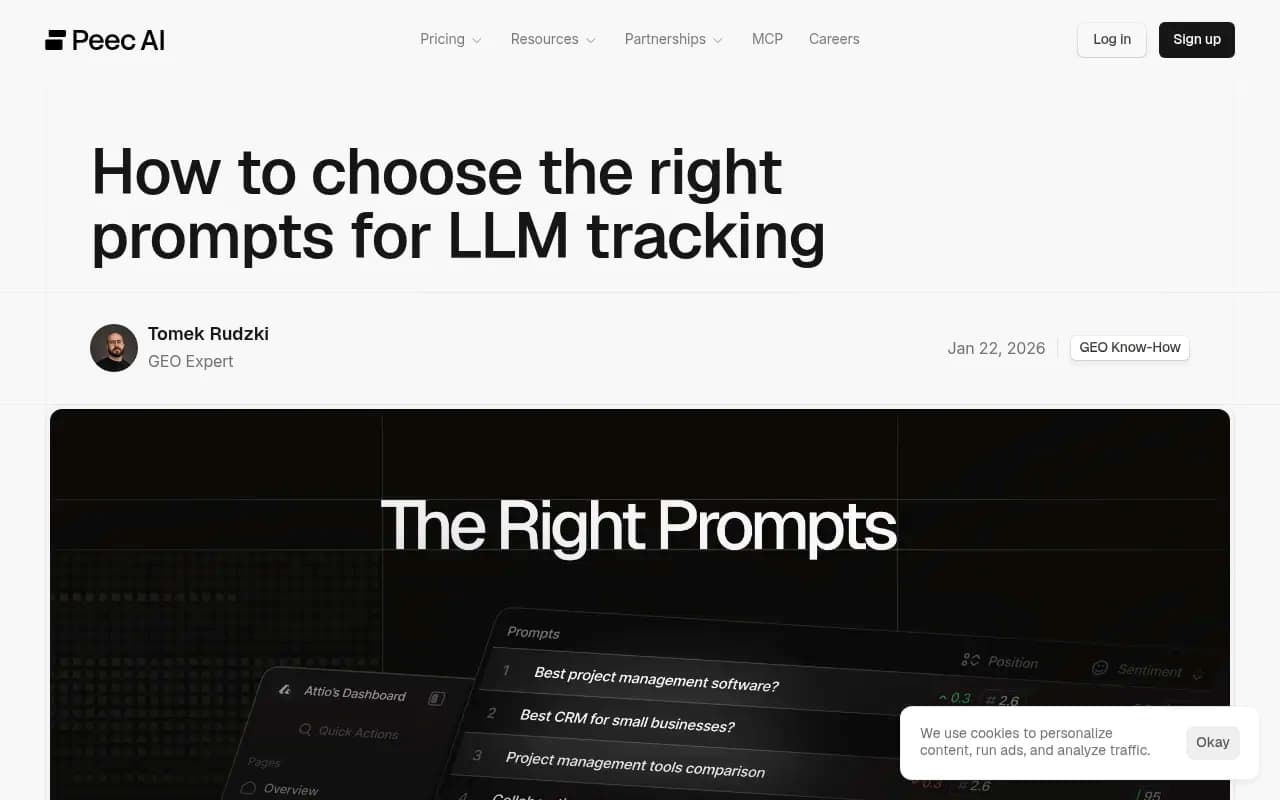
One thing worth noting: Peec AI has written extensively about prompt strategy, arguing that most teams make the mistake of only tracking "best [category]" prompts while missing awareness-stage queries and brand evaluation prompts. That's a real problem. If you're only watching the obvious high-volume prompts, you're blind to the positioning battles happening earlier in the funnel.
LLMrefs: keyword-level query mapping
LLMrefs takes a different angle. Instead of tracking individual prompts you specify, it focuses on keywords and query categories -- mapping how AI models respond to broader topic clusters. Think of it less like rank tracking and more like a topical visibility index.
This means LLMrefs can give you a wider view of where a brand sits across a topic landscape without requiring you to manually define every prompt. The tradeoff is granularity: you get breadth, but you lose the ability to track the specific conversational queries your clients' customers are actually typing.
For agencies managing clients with broad brand awareness goals -- where the question is "are we showing up in AI answers about this category at all?" -- LLMrefs' approach makes sense. For agencies doing detailed competitive positioning work, the lack of custom prompt control is a real limitation.
Where they overlap and where they diverge
Both tools monitor brand mentions across major AI platforms (ChatGPT, Perplexity, Gemini, Claude). Both give you some form of competitor comparison. And both are fundamentally monitoring tools -- they tell you what's happening, not what to do about it.
The divergence is in the unit of analysis:
- Peec AI's unit is the prompt -- a specific question a real user might ask
- LLMrefs' unit is the keyword or query category -- a topic cluster that aggregates across many possible phrasings
That difference has downstream effects on how you use the data. Prompt-level tracking maps naturally onto the customer journey. You can say "we're invisible at the consideration stage for this persona" because you've been tracking consideration-stage prompts. Keyword-level tracking is harder to map onto a funnel -- it's better for answering "are we a recognized player in this space?" than "why aren't we winning this specific decision moment?"
Feature comparison
| Feature | Peec AI | LLMrefs |
|---|---|---|
| Custom prompt tracking | Yes -- you define prompts | Limited -- keyword/category based |
| Update frequency | Daily | Varies |
| Multi-LLM coverage | Yes (ChatGPT, Perplexity, Gemini, Claude, others) | Yes |
| Competitor benchmarking | Yes | Yes |
| Multi-brand / multi-client | Yes -- agency-friendly | Yes |
| Customer journey mapping | Built into prompt strategy | Not a core feature |
| Content gap analysis | No | No |
| Content generation | No | No |
| AI crawler logs | No | No |
| Prompt volume / difficulty data | Limited | Limited |
| Pricing (entry) | ~€89/month (25 prompts) | Freemium available |
| Best for | Agencies needing per-client prompt control | Broad query landscape mapping |
The agency use case: where each tool fits
When Peec AI makes more sense
You're running a mid-size agency with 5-15 clients, each in different verticals. You need to show clients concrete data about their specific AI visibility -- not a generic category score, but "here's how you rank for the exact questions your buyers are asking." Peec AI's custom prompt setup lets you build a tailored tracking list per client, which makes client reporting much cleaner.
The daily update cadence also matters here. If a client launches a campaign or publishes new content, you can see the effect within 24 hours rather than waiting for a monthly refresh.
The prompt strategy framework Peec AI promotes -- covering awareness, consideration, evaluation, and purchase stages -- is genuinely useful for agencies that want to show clients where they're winning and where they're invisible in the funnel.
When LLMrefs makes more sense
You're doing initial research for a new client pitch or a competitive audit. You want to quickly understand the AI visibility landscape for a category without spending time manually building a prompt list. LLMrefs' keyword-level approach lets you get a broad read on who's dominating AI answers in a space before you've done the deeper work.
It's also useful for clients with simple, single-brand goals -- "just tell me if we're showing up in AI answers about [our category]" -- where the nuance of prompt-level tracking isn't needed yet.
The gap neither tool fills
Here's the honest limitation of both: they're monitoring tools. They show you data. They don't help you fix anything.
If Peec AI tells you your client is invisible for 12 out of 20 tracked prompts, your next step is... figuring out why, then figuring out what content to create, then creating it, then waiting to see if it helps. That whole workflow happens outside the tool.
Same with LLMrefs. The data is useful, but the action is on you.
For agencies that need to close that loop -- find the gaps, generate content that addresses them, then track whether citations improve -- a platform like Promptwatch is built specifically for that workflow.

Promptwatch's Answer Gap Analysis shows which prompts competitors are visible for that you're not. Its Content Agents then generate articles and briefs grounded in that prompt data. And page-level tracking shows when new content starts getting cited by AI models. That's a different product category from Peec AI or LLMrefs -- it's an optimization platform, not just a monitor.
Comparing the broader tool landscape
If you're evaluating beyond just these two, here's how several agency-relevant tools stack up:
| Tool | Approach | Custom prompts | Content help | Best agency use case |
|---|---|---|---|---|
| Peec AI | Prompt tracking | Yes | No | Per-client visibility tracking |
| LLMrefs | Keyword/query mapping | Limited | No | Category landscape audits |
| Promptwatch | Full GEO platform | Yes | Yes (Content Agents) | End-to-end AI visibility optimization |
| Otterly.AI | Basic monitoring | Yes | No | Quick-setup monitoring |
| SE Ranking | Traditional SEO + AI | Yes | Limited | Teams already in SE Ranking |
| Profound | Enterprise monitoring | Yes | No | Large brand visibility benchmarking |
| Scrunch AI | Enterprise segmentation | Yes | No | Complex multi-segment brands |

Practical advice for choosing
A few questions that cut through the noise:
How many clients are you managing, and how different are their verticals? If you have 10+ clients in different industries, Peec AI's custom prompt setup is worth the overhead. If you're mostly doing category-level audits or working in one vertical, LLMrefs' broader approach may be faster to get value from.
Do your clients care about funnel stage visibility? If you're reporting on where clients win at awareness vs. consideration vs. purchase, Peec AI's prompt-based approach maps to that story much more naturally.
Are you just monitoring, or do you need to act? Both tools are monitoring-only. If your agency's value proposition includes actually improving AI visibility -- not just reporting on it -- you'll hit the ceiling of both tools quickly. That's when a platform with content gap analysis and generation capabilities becomes necessary.
What's your budget structure? Peec AI charges per prompt, which scales predictably but can get expensive if you're tracking 50+ prompts per client. LLMrefs has a freemium entry point, which makes it easier to test before committing.
A note on prompt strategy regardless of tool
One thing Peec AI gets right in their published thinking: the prompts you track matter as much as the tool you use. Most teams default to tracking "best [category]" prompts and assume that covers it. But buyers ask different questions at different stages:
- Awareness: "what causes [problem]?" or "how do companies handle [challenge]?"
- Consideration: "what are the options for [solution category]?"
- Evaluation: "how does [Brand A] compare to [Brand B]?"
- Purchase: "is [Brand] worth it?" or "what do [Brand] customers say?"
If you're only tracking consideration-stage prompts, you're missing the awareness and evaluation battles where positioning actually gets set. This applies whether you're using Peec AI, LLMrefs, or any other tool.
Bottom line
Peec AI and LLMrefs are both legitimate tools for agencies getting started with AI visibility tracking. Peec AI gives you more control and maps better to client-specific reporting. LLMrefs gives you faster category-level coverage without the setup overhead.
Neither will tell you what to do with the data. If your agency is at the stage where you need to move from "tracking AI visibility" to "improving AI visibility," that's a different conversation -- and a different class of tool.
For agencies that want to start with monitoring and see where it goes, Peec AI is the stronger pick for multi-client, multi-vertical work. For quick audits and category research, LLMrefs earns its place in the toolkit.