Key takeaways
- Peec AI is a clean, affordable monitoring tool with flexible model selection and unlimited language/country tracking -- but it caps out at 100 prompts on the Pro plan and has no content creation features
- ZipTie focuses on deep analysis for AI search visibility, positioning itself as a more analytical alternative for teams that want to understand why they're appearing (or not)
- Neither tool closes the loop from monitoring to optimization -- they show you data but don't help you act on it
- If you're comparing these two specifically on budget, Peec AI has the clearer pricing structure; ZipTie is worth evaluating if you need richer diagnostic data
- Teams that need to actually improve their AI visibility -- not just track it -- should look at platforms that combine monitoring with content gap analysis and generation
The AI visibility tracking space has exploded. There are now dozens of tools claiming to tell you how your brand shows up in ChatGPT, Perplexity, Gemini, and the rest. Most of them do roughly the same thing: they run prompts, check if your brand appears in the response, and give you a score.
Peec AI and ZipTie both sit in this category. They're focused, relatively lean tools -- not the sprawling enterprise platforms like Profound or Goodie AI, and not the traditional SEO suites that bolted on AI tracking as an afterthought. That makes them worth comparing directly, because the question isn't "which is more feature-rich" -- it's "which one actually fits what you need."
Let's get into it.
What Peec AI does
Peec AI has built a reputation as the budget-friendly option in the GEO monitoring space, and that reputation is largely deserved. The interface is clean, setup is fast, and the core value proposition is simple: track how your brand appears across AI search engines without paying enterprise prices.
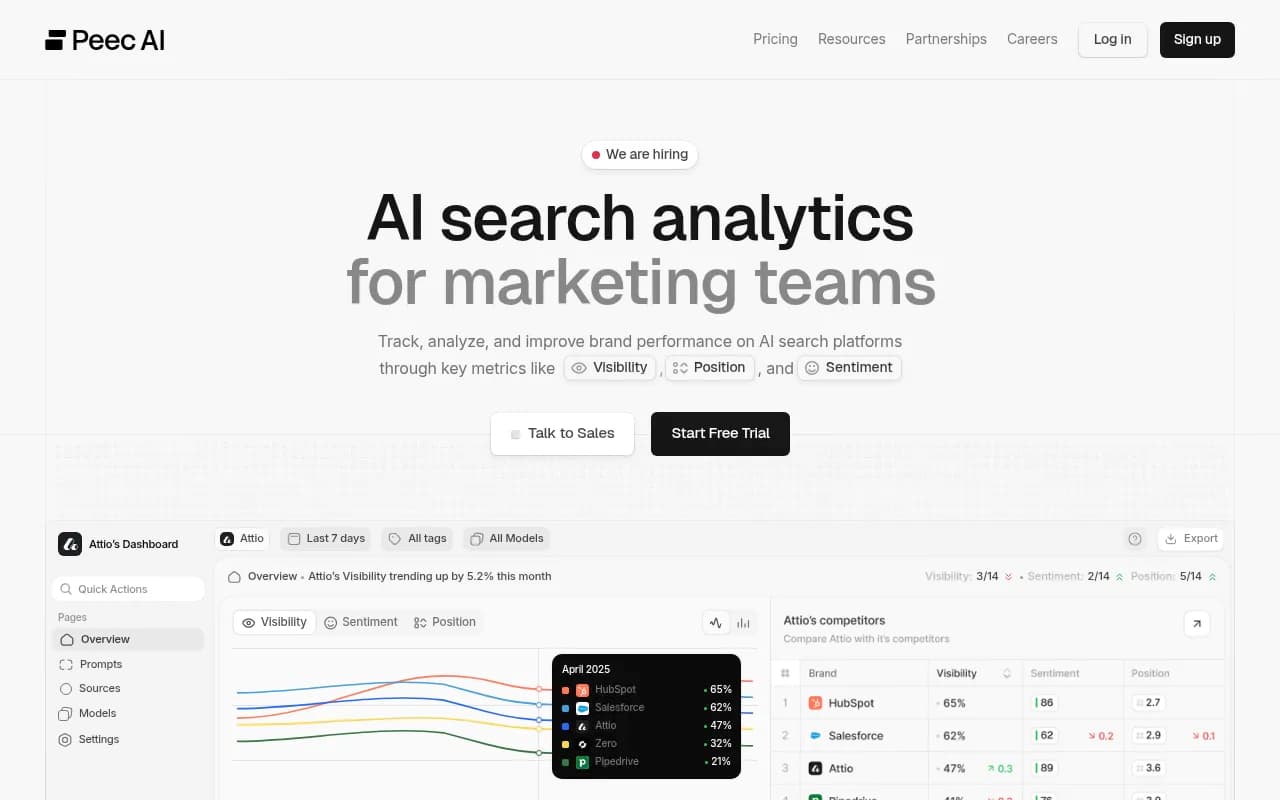
The standout feature is its model flexibility. You can pick which AI engines to monitor rather than being locked into a fixed bundle. The base Pro plan (€199/mo) covers ChatGPT, Perplexity, Google AI Overviews, and DeepSeek. Claude, Gemini, and Google AI Mode are available as Enterprise add-ons -- which is a bit frustrating if you want broad coverage without a custom contract.
A genuine differentiator: unlimited countries and languages at no extra cost. Most tools charge by region or lock certain markets behind higher tiers. Peec doesn't, which matters a lot for brands operating across multiple markets.
What Peec doesn't do is equally important to understand. There's no content creation tooling. No site audits. No shopping visibility tracking. No traditional SEO features. You get monitoring data and that's it. The Pro plan caps you at 100 prompts and 9,000 AI answers per month -- which is fine for a focused brand tracking use case, but limiting if you're trying to map a full content strategy against AI responses.
Peec AI pricing
- Starter: ~€85/mo (limited prompts, basic model coverage)
- Pro: €199/mo (100 prompts, 9,000 AI answers/mo, 4 base engines)
- Enterprise: Custom (adds Claude, Gemini, AI Mode)
What ZipTie does
ZipTie positions itself around deep analysis for AI search visibility. Where Peec leans into simplicity and affordability, ZipTie leans into diagnostic depth -- the idea being that knowing why you're visible (or invisible) is more valuable than just knowing whether you are.
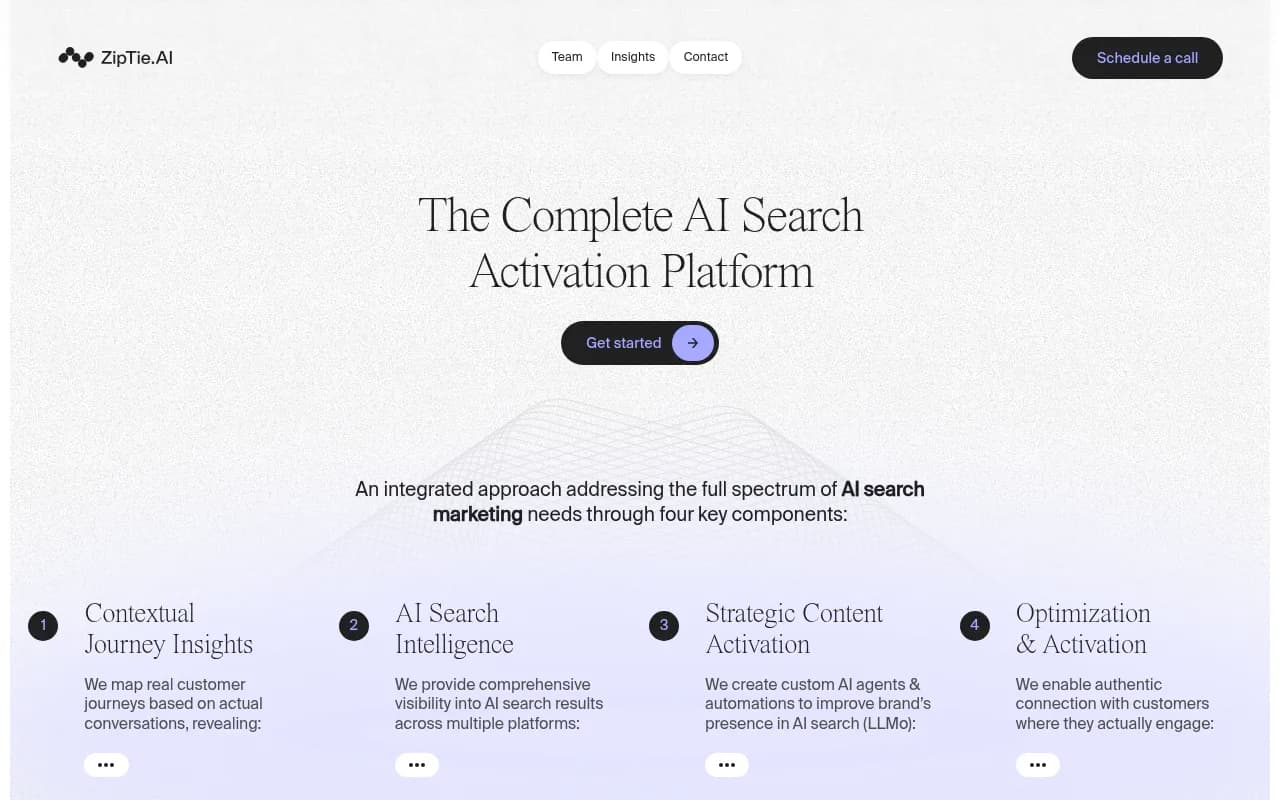
The platform tracks visibility across major AI engines and provides more granular breakdowns of citation patterns, response structures, and competitive positioning. It's aimed at teams that want to go beyond a visibility score and actually understand the mechanics of how AI models are constructing responses in their category.
Pricing for ZipTie is less publicly documented than Peec's, which is worth noting. If you're budget-conscious and need to compare costs quickly, Peec's transparent pricing is an advantage.
Head-to-head comparison
| Feature | Peec AI | ZipTie |
|---|---|---|
| AI models tracked | Up to 10 (4 base, rest Enterprise) | Multiple major LLMs |
| Prompt tracking | Up to 100/mo (Pro) | Varies by plan |
| Multi-language/region | Unlimited (no extra cost) | Available |
| Content creation tools | None | None |
| Site audit / crawl logs | None | None |
| Competitive analysis | Basic | More detailed |
| Pricing transparency | Clear public pricing | Less transparent |
| Starting price | ~€85/mo | Custom/contact |
| Best for | Budget-conscious brand monitoring | Deeper diagnostic analysis |
| Content gap analysis | No | No |
| Shopping visibility | No | No |
Both tools are monitoring-only. Neither helps you create content to fix the gaps they find.
Where Peec AI wins
Peec's pricing clarity is a real advantage. You know exactly what you're getting and what it costs, which matters when you're trying to justify a new tool to a finance team or a client.
The unlimited country and language tracking is genuinely useful and not something most competitors offer at this price point. If you're running campaigns across Europe, Latin America, or Asia-Pacific and need to see AI visibility data across those markets without paying per-region fees, Peec is hard to beat at its price.
It's also fast to set up. You're not configuring complex workflows or waiting for an onboarding call -- you connect your brand, define your prompts, and start seeing data.
The ceiling is real, though. A hundred prompts per month sounds like a lot until you realize that a thorough AI visibility strategy for a mid-sized brand might require tracking hundreds of question variants across multiple personas, markets, and intent types. At that point, Peec's Pro plan starts to feel tight.
Where ZipTie wins
ZipTie's strength is in analysis depth. If your team is trying to understand the structural reasons behind AI visibility patterns -- which sources AI models are pulling from, how competitors are being positioned in responses, what the response architecture looks like for your category -- ZipTie gives you more to work with.
This makes it a better fit for teams that are already past the "do we show up?" question and are asking "why does our competitor show up more than us, and what specifically would change that?"
The tradeoff is that ZipTie, like Peec, stops at the analysis layer. It can tell you what's happening but doesn't give you tools to fix it.
The gap both tools share
Here's the honest limitation of both Peec AI and ZipTie: they're trackers. Good ones, in their respective ways -- but trackers.
The workflow most marketing teams actually need looks like this:
- Find which prompts competitors are visible for that you're not
- Understand what content is missing from your site that would change that
- Create content specifically engineered to fill those gaps
- Track whether that content starts getting cited
Peec and ZipTie cover step one, partially. They don't touch steps two, three, or four.
This is fine if you already have a content team and a clear process for turning monitoring data into action. But for most teams, the data sits in a dashboard and doesn't translate into anything that actually moves visibility scores.
Platforms that close this loop -- like Promptwatch, which combines answer gap analysis, AI content generation, and page-level citation tracking -- are worth considering if you find yourself looking at Peec or ZipTie data and not knowing what to do with it.

Other tools worth considering alongside these two
If you're evaluating Peec AI and ZipTie, you're probably also looking at a few adjacent options. Here's how some of the other focused trackers in this space compare:

Otterly.AI starts at $29/mo and covers four base AI engines. It's the cheapest entry point in the category and works well for solo marketers or small teams that just want basic brand monitoring without committing to a larger platform.
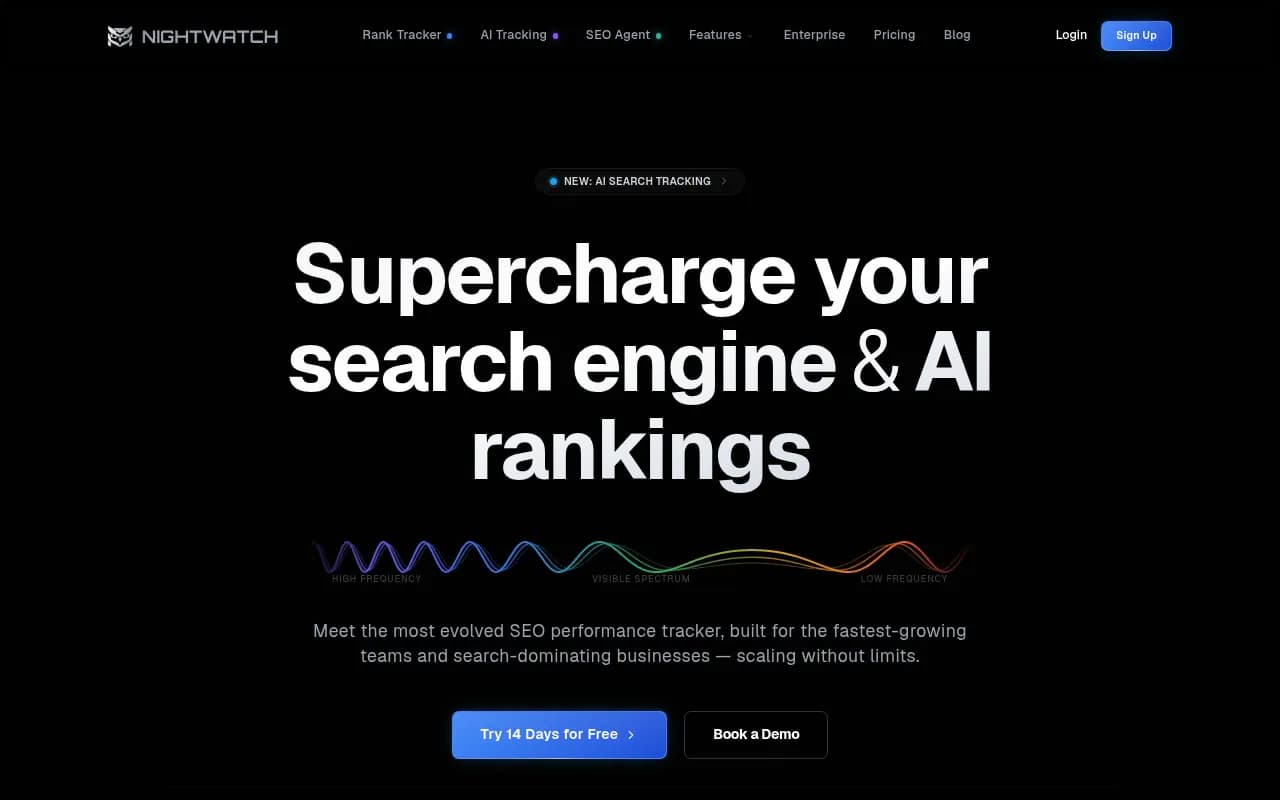
Nightwatch is interesting if you want traditional SEO rank tracking and AI visibility in one tool. The base plan starts at $32/mo with an AI add-on at $99/mo. It's not the deepest AI visibility tool, but the combination is useful if you're managing both channels.
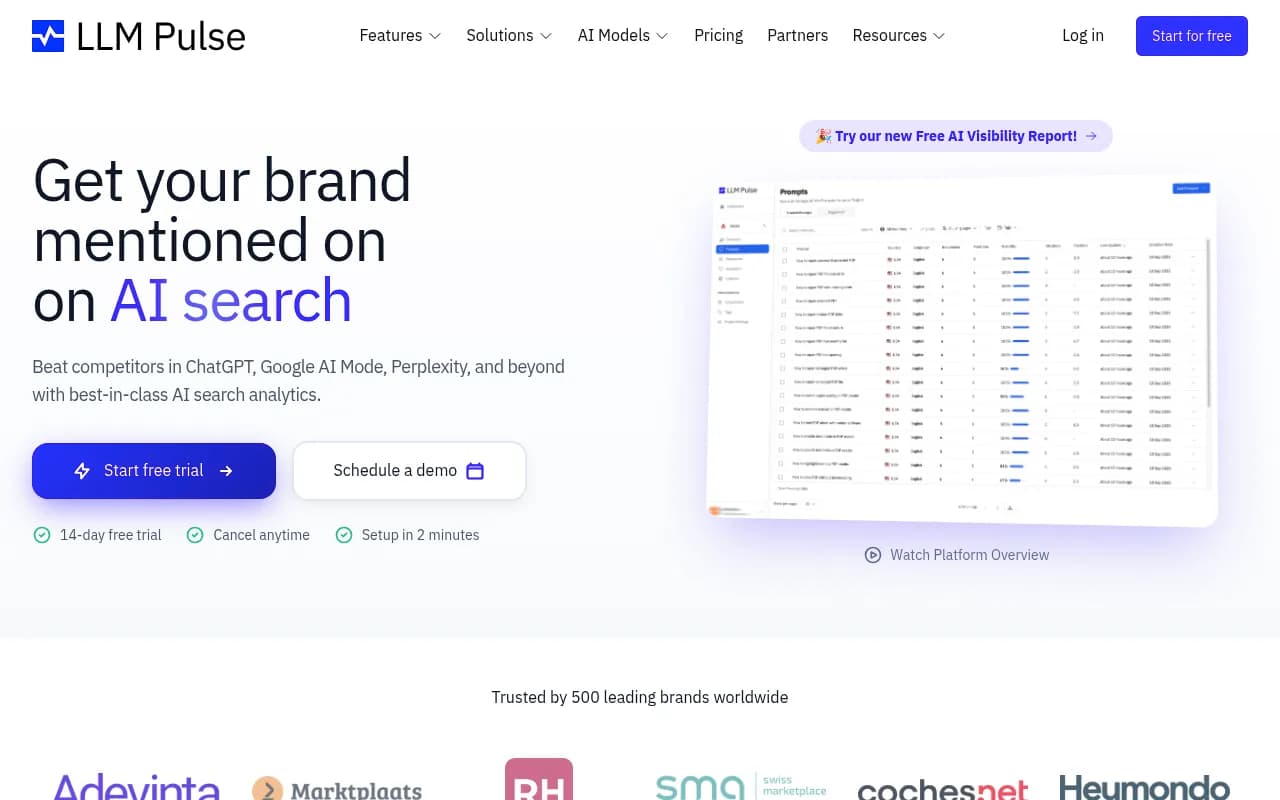
LLM Pulse tracks brand visibility across ChatGPT, Perplexity, and other major models. It's a simpler tool focused on share-of-voice metrics without a lot of configuration overhead.
Ahrefs Brand Radar takes a different architectural approach -- its prompts are derived from real search data (People Also Ask queries with actual search volume), not fabricated scenarios. That means the visibility scores reflect real user behavior rather than hypothetical queries. Paid plans start at $50/mo for 2,500 checks.
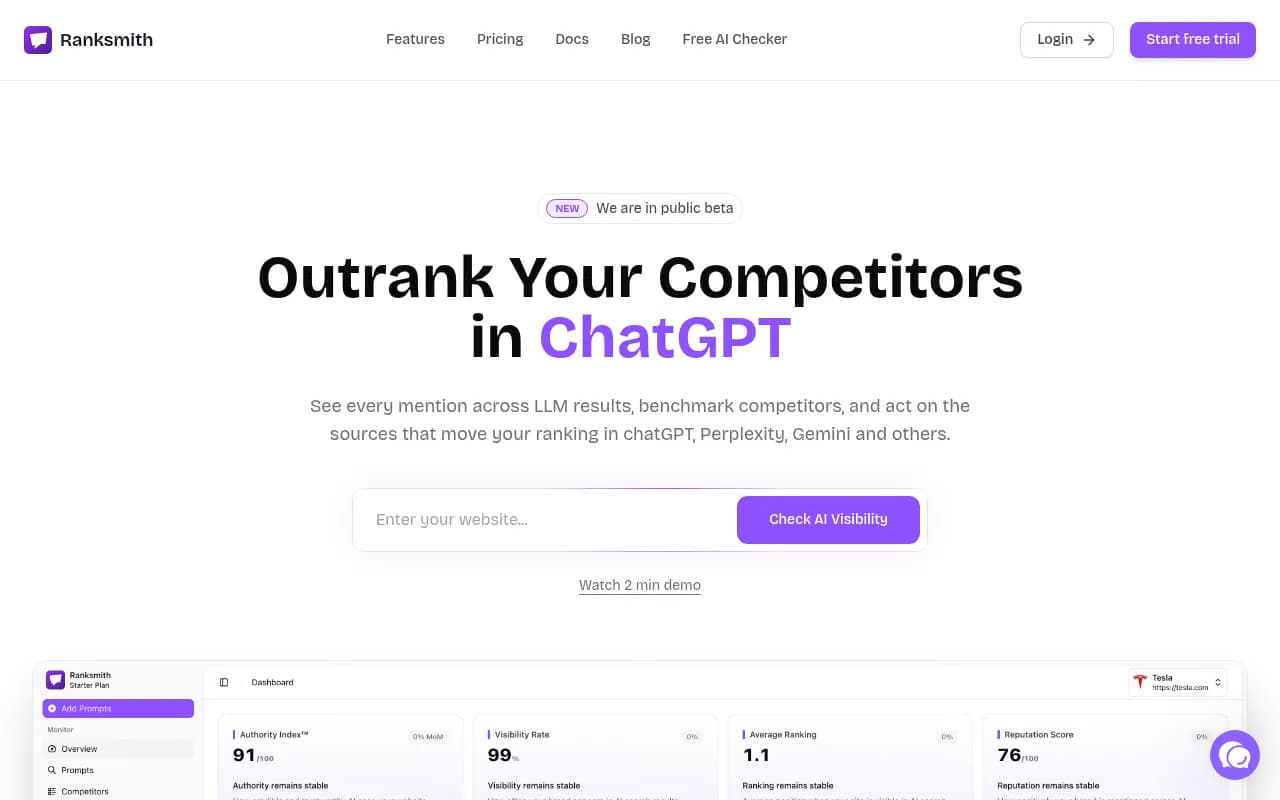
Ranksmith focuses on actionable AI search visibility insights -- it's worth a look if you want something that pushes you toward specific actions rather than just showing you a score.
Which one should you pick?
The honest answer depends on what you actually need.
Pick Peec AI if:
- You want clear, predictable pricing
- You operate across multiple countries and languages and don't want to pay per-market
- You need a fast setup with minimal configuration
- You're comfortable treating the monitoring data as an input to a separate content workflow
Pick ZipTie if:
- You need deeper diagnostic analysis of why visibility patterns look the way they do
- Your team is already past basic monitoring and wants to understand the mechanics of AI response construction in your category
- You're willing to have a sales conversation to understand pricing
Consider something else if:
- You need more than 100 prompts per month at a reasonable price
- You want content gap analysis and content generation built into the same platform
- You need crawler logs to understand how AI engines are actually reading your site
- You want to track ChatGPT Shopping or entity mentions
Both Peec and ZipTie are solid for what they are. The question is whether "what they are" is enough for where you are.
If you're finding that monitoring-only tools leave you with data but no clear path forward, that's a sign you've outgrown the tracker category and need a platform that helps you act on what you're seeing. The gap between "we know we're invisible" and "we've fixed it" is where most teams get stuck -- and it's worth picking tools that help you cross it.