Key takeaways
- Peec AI is a solid monitoring tool, but it lacks content generation, crawler logs, and the optimization features agencies need to actually move client metrics
- Before switching, export your historical prompt data and document your current reporting baselines so clients don't notice a gap
- The migration itself takes 1-2 weeks if you run platforms in parallel before cutting over
- Promptwatch is the strongest like-for-like replacement for agencies because it covers the full loop: tracking, gap analysis, and content generation in one place
- Timing matters -- switching mid-retainer is fine if you frame it as an upgrade, not a disruption
Why agencies outgrow Peec AI
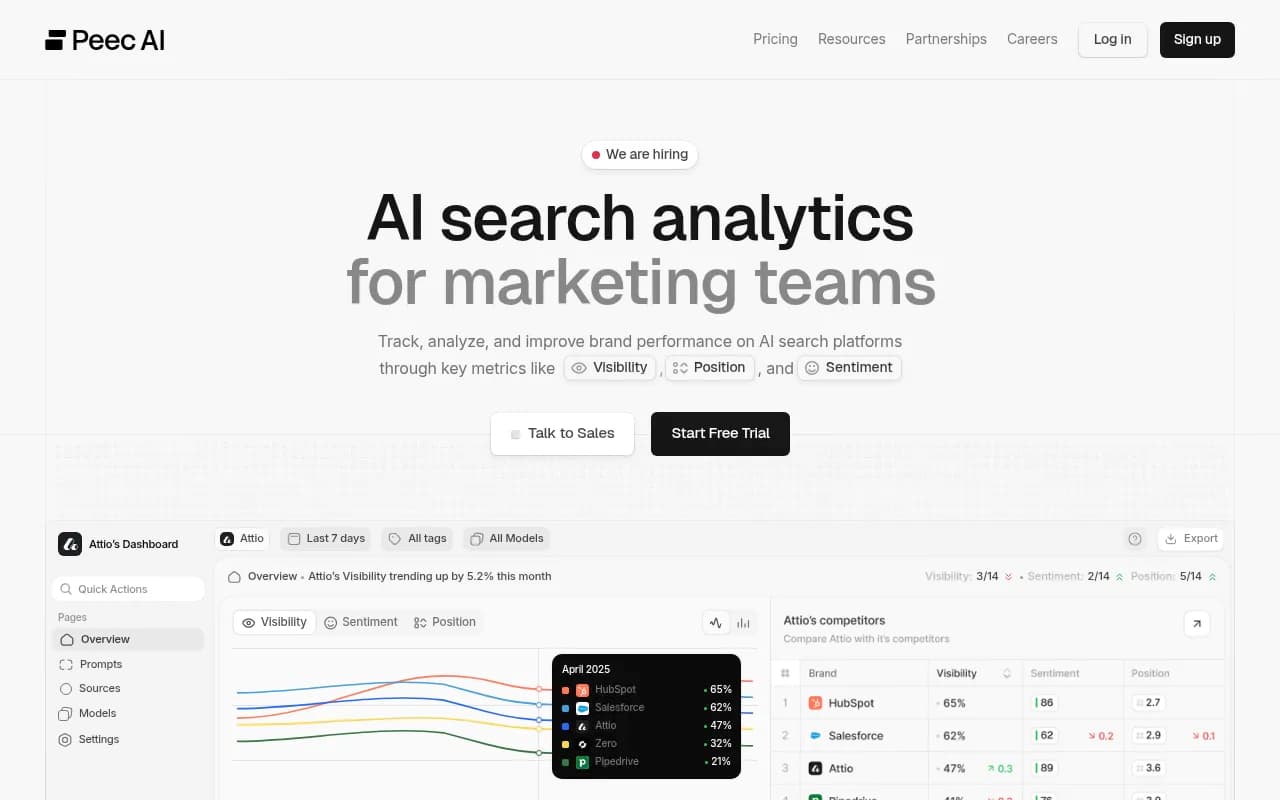
Peec AI does what it says on the tin. You set up prompts, it runs them across AI models, and you get visibility scores and brand mention data in a reasonably clean dashboard. For a solo consultant or a brand doing basic AI monitoring, that's enough.
For agencies, it tends to fall short in a few specific ways.
The first is scale. Peec AI's pricing tiers cap prompts at 50 (Starter, $95/month), 150 (Pro, $245/month), or 350 (Advanced, $495/month). If you're running 5 clients with 80 prompts each, you're already past the Pro tier on a single project basis. Multi-client management gets expensive fast.
The second is the action gap. Peec AI shows you visibility data. It doesn't help you do anything about it. There's no content gap analysis, no AI content generation, no crawler log data to diagnose why a client's pages aren't being cited. You get the "what" but not the "so what" or the "now what." That's a problem when clients are paying for results, not reports.
The third is reporting depth. Agencies need white-label exports, Looker Studio integrations, and the ability to show clients page-level citation data. Peec AI's integrations (GSC, GA, Looker) are locked to the Advanced plan at $495/month per project, which is a steep jump.
None of this makes Peec AI a bad tool. It just means it was built for a different use case than running a multi-client GEO retainer.
What to look for in a replacement
Before picking a platform, be honest about what your agency actually needs. Most agencies switching from Peec AI need at least four things:
Multi-client management at a reasonable price. You need to run multiple sites without paying enterprise rates for each one. Look for platforms that price by site count or offer agency tiers.
Content optimization, not just monitoring. The agencies winning GEO retainers in 2026 aren't just delivering dashboards. They're delivering content that improves AI visibility. That means you need a platform that can identify gaps and help fill them.
Crawler and citation intelligence. Knowing your client's brand was mentioned 47 times in ChatGPT responses is useful. Knowing which pages drove those citations, which pages AI crawlers are hitting but not citing, and why certain content isn't being picked up -- that's what lets you actually fix things.
Exportable, client-ready reporting. White-label reports or Looker Studio integration. Clients shouldn't see your tool's branding; they should see their data.
The migration process, step by step
Step 1: Export everything from Peec AI before you cancel
This sounds obvious but gets skipped. Before you do anything else, export:
- All tracked prompts (the exact wording matters -- you'll want to replicate these in your new platform)
- Historical visibility scores by prompt and by model
- Citation data and source URLs
- Any custom dashboards or reports you've built for clients
Peec AI's Advanced plan includes Looker Studio integration, so if you're on that tier, export your Looker dashboards too. These become your baseline documentation.
Keep a spreadsheet with each client's top 10-20 prompts, their current visibility scores across models, and the date you exported. This is your migration baseline.
Step 2: Run both platforms in parallel for 2-3 weeks
Don't cancel Peec AI the day you sign up for something new. Run them side by side for at least two weeks. This lets you:
- Verify that your new platform's prompt results are consistent with Peec AI's (they won't be identical -- different platforms query models differently -- but the directional story should match)
- Build up enough data history in the new platform before you cut over client reporting
- Catch any prompts you forgot to migrate
Two weeks is usually enough. Three weeks is safer if you have clients with monthly reporting cycles.
Step 3: Rebuild your prompt library in the new platform
When you migrate prompts, don't just copy-paste. This is a good moment to audit. Some prompts you've been tracking for months might be low-value. Others might need updating because your client's competitive landscape has shifted.
For each client, prioritize:
- Prompts where the client currently has zero or low visibility (highest upside)
- Prompts with high estimated volume (most impact if you win them)
- Prompts where competitors are consistently cited but your client isn't
If your new platform has prompt volume estimates or difficulty scoring, use that data to prioritize which prompts to track first.
Step 4: Set new baselines and document them
Once your new platform has 2-3 weeks of data, set formal baselines. Document the visibility score per prompt, per model, and per client. This becomes your "Day 1 on new platform" benchmark.
Why does this matter? Because when you show a client their visibility improved from 23% to 41% over three months, you need a clean starting point. If you're comparing Peec AI data to new platform data, the numbers won't be directly comparable. Set a fresh baseline and work forward from there.
Step 5: Update client reports and communicate the change
You don't need to make a big deal of this. A one-paragraph note in your next report is enough:
"We've migrated our AI visibility tracking to [new platform], which gives us deeper citation intelligence and content optimization capabilities. Your visibility scores are now tracked from [date] as a new baseline. The methodology is more granular than before, so direct comparisons to earlier numbers aren't meaningful -- but we'll show you clear progress from this starting point."
Clients who care about results will appreciate the transparency. Clients who care about the numbers will appreciate that you've set a clear baseline.
Which platform should you switch to?
Here's an honest comparison of the main options agencies consider when leaving Peec AI.
| Platform | Multi-site pricing | Content generation | Crawler logs | White-label / exports | Best for |
|---|---|---|---|---|---|
| Promptwatch | Yes (2-5 sites on paid plans) | Yes (Content Agents) | Yes | Looker Studio + API | Agencies wanting full optimization loop |
| Profound | Enterprise pricing | No | No | Yes | Enterprise brands, not agencies |
| Otterly.AI | Limited | No | No | Basic | Solo consultants, light monitoring |
| AthenaHQ | Yes | Partial | No | Yes | Teams wanting monitoring + some optimization |
| Scrunch | Yes | No | No | Yes | Agencies focused on reporting |
| Search Party | Agency-focused | No | No | Yes | Agencies wanting custom automation |
| Ahrefs Brand Radar | Per-seat Ahrefs pricing | No | No | Via Ahrefs | Teams already in the Ahrefs ecosystem |
The honest answer for most agencies is that Promptwatch is the closest thing to a complete replacement that also solves the action gap. It tracks the same models Peec AI tracks (ChatGPT, Perplexity, Claude, Gemini, Grok, DeepSeek, Copilot, Google AI Overviews, and more), but it also tells you why visibility is low and gives you tools to fix it.

The Professional plan ($249/month) covers 2 sites, 150 prompts, and 15 articles per month, plus crawler logs and state/city tracking. The Business plan ($579/month) covers 5 sites and 350 prompts. For agencies running more than 5 clients, custom agency pricing is available.
What makes the difference for agencies specifically is the Content Agents feature. Instead of delivering a report that says "your client is invisible for 60% of tracked prompts," you can deliver a report that says "here are the 8 articles we're publishing this month to close those gaps" -- and then show the citation data improving over the following weeks. That's a retainer clients renew.

AthenaHQ is worth a look if you want something between Peec AI and Promptwatch -- more optimization-oriented than pure monitoring tools, but less full-featured than Promptwatch's content generation capabilities.
Scrunch AI handles multi-client reporting well and has decent white-label options, making it a reasonable choice if your primary pain point with Peec AI is reporting rather than optimization.
Handling the "why are the numbers different?" conversation
This comes up. A client who's been seeing their Peec AI dashboard for six months will notice when the numbers change. Here's how to handle it.
First, acknowledge it proactively. Don't wait for them to ask. Put it in your migration note (see Step 5 above).
Second, explain the methodology difference briefly. Different platforms query AI models at different times, with different personas, and sometimes through different interfaces. User-facing AI responses can differ from API outputs. This is why visibility scores vary between tools -- it's not that one is right and one is wrong, they're measuring slightly different things.
Third, anchor them to trend, not absolute score. The number that matters is whether visibility is going up over time, not whether it's 34% or 41% on day one. Show them the trajectory.
If a client pushes back hard, offer to run a comparison report showing both platforms side-by-side for one month. In practice, the directional story is almost always consistent even when the absolute numbers differ.
Common mistakes agencies make during the switch
Canceling Peec AI too early. You lose historical context and risk a reporting gap. Keep it running until you have 3-4 weeks of data in the new platform.
Migrating prompts without auditing them. Bad prompts follow you to the new platform. Use the migration as a chance to clean up.
Not setting a formal baseline. Without a documented starting point in the new platform, you can't show progress. This is the single most important thing to get right.
Choosing a platform based on features you don't use. Enterprise platforms like Profound have impressive feature sets, but if you're running 3-10 client accounts, you'll pay for capabilities you don't need. Match the platform to your actual workflow.
Underestimating onboarding time. Most platforms take 1-2 weeks to get properly configured -- prompts set up, personas defined, competitors added, integrations connected. Factor this into your timeline before you tell clients anything has changed.
The bigger picture: what this switch is really about
Switching platforms is tactical. The strategic question underneath it is whether your agency is selling monitoring or optimization.
Monitoring is a commodity. There are now 40+ tools that track AI visibility, and the price pressure is real. If your retainer is "we watch your AI visibility scores and send you a monthly report," that's a service clients will eventually question.
Optimization is defensible. If your retainer is "we identify where you're invisible in AI search, create content to close those gaps, and show you the citation data improving month over month" -- that's a service with measurable ROI. Clients don't cancel that.
The platform you switch to should support the second model. That means content generation, gap analysis, and page-level citation tracking, not just a dashboard with visibility scores.
The migration itself is straightforward. The harder part is deciding what kind of agency you want to be on the other side of it.
Quick-reference migration checklist
- Export all prompts, visibility scores, and citation data from Peec AI
- Document client baselines (top prompts + current scores + export date)
- Sign up for new platform and run parallel for 2-3 weeks
- Audit and rebuild prompt library in new platform (don't just copy-paste)
- Set formal baselines in new platform once you have 2-3 weeks of data
- Update Looker Studio or reporting templates
- Send clients a one-paragraph migration note before your next report
- Cancel Peec AI only after parallel period is complete and baselines are set