Key takeaways
- Peec AI is a solid monitoring tool but caps out at 100 prompts/month on its Pro plan, lacks content generation, and puts Claude, Gemini, and AI Mode behind expensive enterprise add-ons
- Agencies specifically need multi-site management, white-label reporting, content optimization, and the ability to show clients measurable results -- not just dashboards
- Promptwatch is the only platform in this space rated "Leader" across all GEO categories, and the only one that closes the full loop: find gaps, create content, track results
- Tools like Otterly.AI and Peasy are cheaper but monitoring-only; Profound and Scrunch AI are stronger on enterprise features but priced accordingly
- The right choice depends on whether you need pure monitoring or an end-to-end optimization workflow
Peec AI does one thing well. It tracks how your brand shows up in AI-generated responses across ChatGPT, Perplexity, Google AI Overviews, and DeepSeek. The interface is clean. Unlimited countries and languages at no extra cost is genuinely useful. For a solo marketer who just wants a pulse on brand mentions, it's fine.
But agencies have different problems.
You're managing multiple clients, each wanting to know not just "are we being mentioned?" but "why aren't we being mentioned, and what do we do about it?" Peec's Pro plan caps you at 100 prompts and 9,000 AI answers per month. Claude, Gemini, and Google AI Mode are enterprise add-ons with custom pricing. There's no content creation tooling, no crawler logs, no site audits, and no way to connect visibility data to actual revenue.
That ceiling hits fast when you're running campaigns for five clients simultaneously.
This guide covers the best alternatives -- what each one actually does well, where it falls short, and which type of agency it fits.
What agencies actually need from a GEO platform
Before getting into specific tools, it's worth being clear about what separates an agency-grade GEO platform from a basic monitoring dashboard.
Monitoring tells you where you stand. Optimization tells you what to do next. Most tools in this space only do the first part.
For agencies, the must-haves are:
- Multi-site or multi-client management without paying per-seat for every client
- Enough prompt volume to cover multiple brands across multiple topics
- Content gap analysis that shows why a client isn't being cited
- Some form of content generation or brief creation to act on those gaps
- Reporting that clients can actually understand (white-label is a bonus)
- Coverage across the AI models clients actually ask about -- ChatGPT, Perplexity, Google AI Overviews, Claude, Gemini
Nice-to-haves that separate the serious platforms from the rest:
- AI crawler logs (which pages are being crawled, which are being cited)
- Prompt volume and difficulty scoring so you can prioritize
- Reddit and YouTube tracking (both heavily influence AI recommendations)
- Traffic attribution connecting AI visibility to actual site visits and revenue
With that framework in mind, here's how the main alternatives stack up.
The best Peec AI alternatives for agencies
Promptwatch
Promptwatch is the most complete GEO platform available right now, and the one most worth evaluating if you're running an agency that needs to show clients real results.

The core difference from Peec AI and most other tools: Promptwatch doesn't stop at monitoring. It runs a full optimization loop. Answer Gap Analysis shows exactly which prompts competitors are visible for that your client isn't -- not in vague terms, but the specific topics and questions AI models are already answering without citing your client's content. Content Agents then generate articles, listicles, and briefs grounded in that real prompt data, citation patterns, and competitor analysis. Then page-level tracking shows when those new pages get crawled, when they start getting cited, and which AI models are picking them up.
For agencies, the practical value is that you can walk into a client meeting with a clear story: here's where you're invisible, here's the content we created to fix it, here's the visibility improvement over the last 60 days.
The AI Crawler Logs feature is something most competitors don't have at all. You can see which AI crawlers (ChatGPT, Claude, Perplexity) are hitting your client's site, which pages they're reading, which ones they're ignoring, and what errors they're encountering. That's genuinely useful for diagnosing why a page isn't getting cited.
Coverage spans 10 AI models: ChatGPT, Perplexity, Google AI Overviews, Google AI Mode, Claude, Gemini, Meta/Llama, DeepSeek, Grok, and Mistral. Peec AI's base plan covers four.
Pricing starts at $99/mo for one site (Essential), $249/mo for two sites with crawler logs and city-level tracking (Professional), and $579/mo for five sites (Business). Agency and enterprise pricing is custom. There's a free trial.
The main caveat: if a client genuinely only needs basic mention monitoring and has no interest in content optimization, Promptwatch is more platform than they need. But for agencies trying to drive measurable outcomes, that's rarely the situation.
Otterly.AI
Otterly.AI sits at the affordable end of the market and is worth considering for smaller agencies or clients who are just starting to think about AI visibility.

It tracks brand mentions across ChatGPT, Perplexity, Google AI Overviews, and a handful of other models. The interface is clean and relatively easy to onboard clients onto. Pricing is accessible compared to most enterprise GEO tools.
The limitation is the same one that applies to Peec AI: it's monitoring-only. There's no content gap analysis, no content generation, no crawler logs, and no traffic attribution. You can see that your client isn't being cited, but the platform won't tell you why or what to do about it.
For agencies that just need to add "AI visibility tracking" to their reporting stack without a major investment, Otterly.AI is a reasonable starting point. For agencies that need to actually move the needle, you'll hit the ceiling quickly.
Profound
Profound positions itself as an enterprise AI visibility platform, and it earns that label. It covers a broad range of AI models, has solid competitive benchmarking, and is used by larger brands with dedicated analytics teams.
For agencies managing enterprise clients, Profound is worth evaluating. The data quality is strong, and the platform goes deeper than basic mention counting -- you get sentiment analysis, share-of-voice comparisons, and more granular breakdowns of how AI models are treating your brand.
The tradeoffs: pricing is on the higher end, and like most platforms in this space, it's primarily a monitoring and analysis tool rather than an optimization one. There's no content generation built in. You'll still need a separate workflow to act on what you find.
Scrunch AI
Scrunch AI is another enterprise-oriented option, focused on monitoring how AI assistants like ChatGPT and Claude represent your brand across different types of queries.
It's particularly strong on competitive analysis -- comparing how your brand is positioned versus competitors in AI responses, and tracking shifts over time. For agencies managing brands in competitive categories, that context is useful.
Similar to Profound, Scrunch AI is built around analysis rather than action. The monitoring is solid; the optimization workflow is something you build yourself on top of the data.
SE Ranking AI visibility
SE Ranking has been a reliable traditional SEO platform for years, and its AI visibility toolkit is a meaningful addition for agencies that already use it for rank tracking.
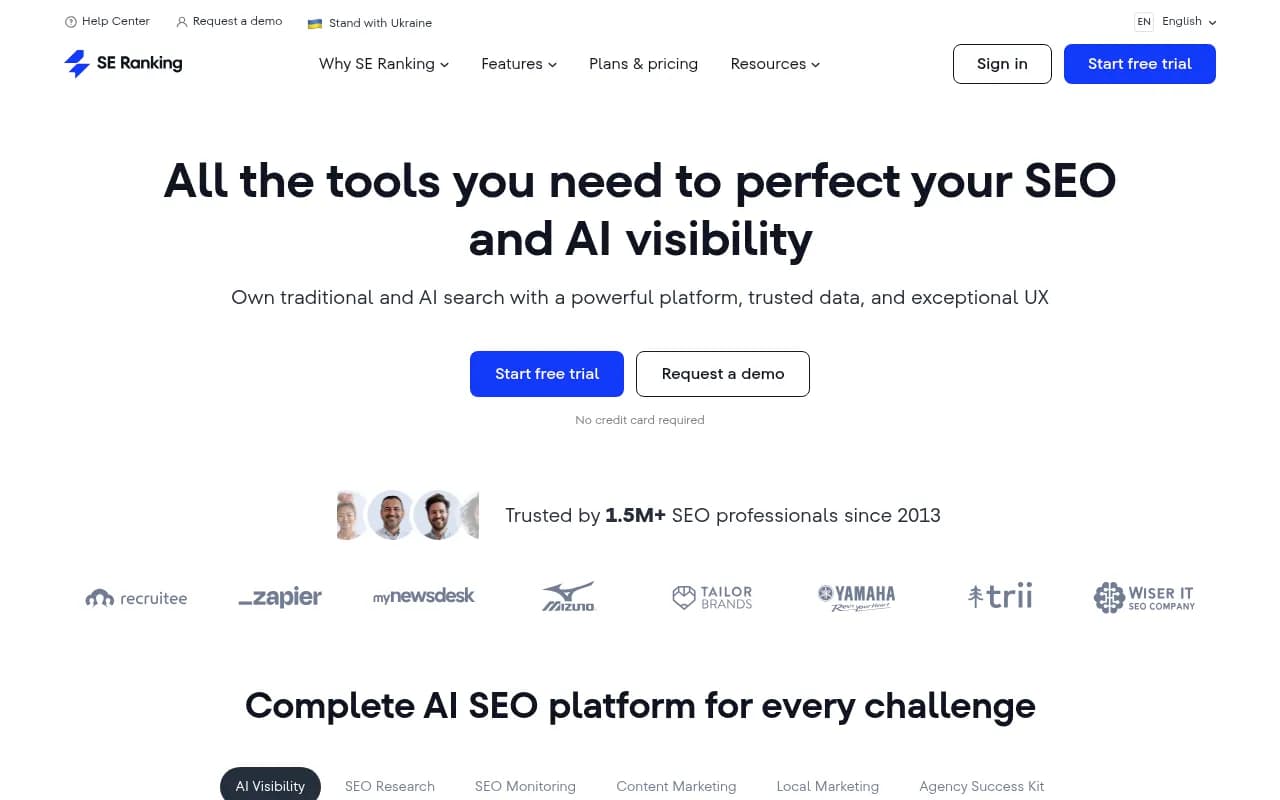
The appeal is consolidation: if you're already paying for SE Ranking's keyword tracking, site audits, and reporting, adding AI visibility monitoring to the same platform reduces tool sprawl. The AI visibility features track brand mentions across major LLMs and surface recommendations for content improvements.
It's not as deep as a dedicated GEO platform on the AI visibility side, but for agencies that want a single platform covering both traditional SEO and AI search, it's a practical choice.
Athena HQ
Athena HQ focuses specifically on AI search visibility tracking across 8+ AI search engines. It's clean, focused, and does the monitoring job well.
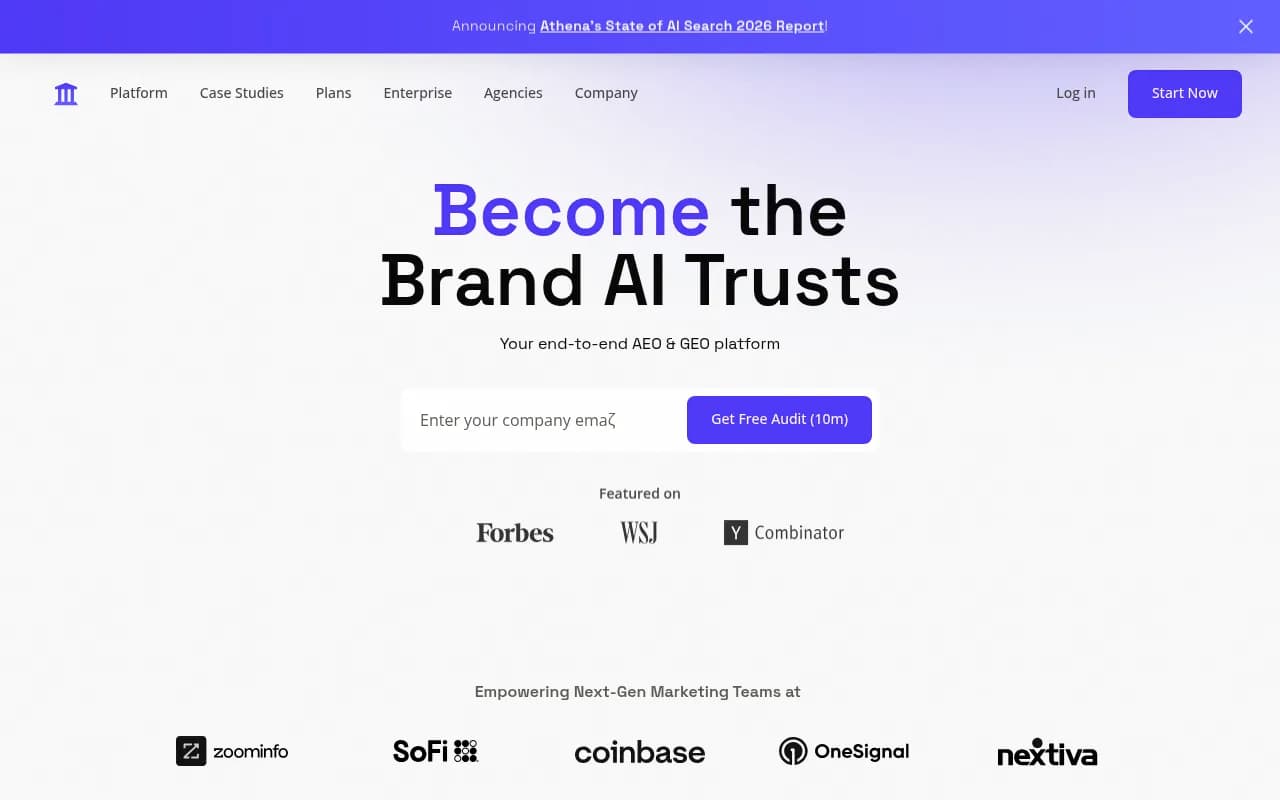
For agencies that want dedicated AI visibility tracking without the complexity of a full enterprise platform, Athena HQ is worth a look. The interface is straightforward, and it covers the major models clients care about.
The limitation is the same pattern: monitoring without optimization. There's no content generation, no crawler logs, and no gap analysis that tells you what content to create. You get the data; the strategy is up to you.
Peasy
Peasy is a newer, leaner tool focused on real-time AI search performance tracking. It's designed to be fast and accessible rather than comprehensive.
For smaller agencies or individual consultants who want a lightweight way to monitor AI visibility without committing to a full platform, Peasy is worth considering. It's not trying to be an enterprise solution, and that focus keeps it simple.
Not suitable for agencies that need multi-client management, content optimization, or deep competitive analysis.
Ahrefs Brand Radar
Ahrefs Brand Radar takes a different architectural approach from most tools in this space. Rather than constructing hypothetical prompts, it draws from real search data -- specifically "People Also Ask" queries with measurable search volume behind them.
That matters because visibility scores built on real queries are more meaningful than scores built on fabricated ones. Brand Radar monitors responses across six AI engines (ChatGPT, Perplexity, Gemini, Copilot, Google AI Overviews, and Google AI Mode) plus YouTube, TikTok, and Reddit.
For agencies that already use Ahrefs for traditional SEO and want to add AI visibility tracking in the same ecosystem, Brand Radar is a natural fit. It's not a full optimization platform, but the data quality is strong and the prompt methodology is more defensible than most competitors.
How the main alternatives compare
| Tool | AI models covered | Content generation | Crawler logs | Multi-site | Best for |
|---|---|---|---|---|---|
| Promptwatch | 10 | Yes (Content Agents) | Yes | Yes (from $579/mo) | Agencies needing full optimization loop |
| Peec AI | 4 base (+ enterprise add-ons) | No | No | Limited | Basic brand monitoring |
| Otterly.AI | 4-6 | No | No | Yes | Budget monitoring |
| Profound | 6+ | No | No | Yes | Enterprise monitoring |
| Scrunch AI | 6+ | No | No | Yes | Enterprise competitive analysis |
| SE Ranking | 5+ | Limited | No | Yes | Teams already using SE Ranking |
| Athena HQ | 8+ | No | No | Yes | Dedicated AI visibility tracking |
| Ahrefs Brand Radar | 6 + social | No | No | Yes | Data quality-focused teams |
| Peasy | 4-5 | No | No | Limited | Lightweight monitoring |
The monitoring-only problem
Something worth naming directly: most tools in this space are monitoring dashboards. They show you a visibility score, a list of mentions, and a competitive benchmark. That's useful context, but it doesn't tell you what to do next.
For agencies, "what to do next" is the entire job. Clients don't pay for dashboards; they pay for outcomes.
The gap between monitoring and optimization is where most GEO platforms fall short. You can see that your client has 12% AI visibility versus a competitor's 34%, but the platform won't tell you which specific topics are driving that gap, what content you'd need to create to close it, or whether the content you've already created is being crawled and cited.
That's the workflow Promptwatch is built around -- and it's the main reason it's worth evaluating seriously if you're running an agency that needs to deliver measurable results rather than just report on them.
Which tool should agencies actually use?
It depends on what you're trying to accomplish.
If you need a full optimization workflow -- gap analysis, content generation, crawler logs, traffic attribution, and multi-model tracking -- Promptwatch is the strongest option available. It's the only platform that covers the complete loop from "where are we invisible" to "here's the content we created" to "here's the visibility improvement."
If you're managing enterprise clients who primarily need competitive benchmarking and share-of-voice data, Profound or Scrunch AI are worth evaluating alongside Promptwatch.
If you're already deep in the Ahrefs ecosystem and want AI visibility tracking anchored in real search data, Brand Radar is a natural addition.
If budget is the primary constraint and a client just needs basic monitoring to get started, Otterly.AI or Peasy are reasonable entry points -- with the understanding that you'll need to build the optimization workflow yourself.
Peec AI itself isn't a bad tool. It's just built for a different use case than most agencies actually have. When clients start asking "what are you doing to improve our AI visibility, not just measure it," that's when the platform runs out of answers.
A note on the GEO market in 2026
The AI search visibility space has gotten crowded fast. There are now dozens of tools claiming to track LLM mentions, and the feature lists can look similar at a glance. The meaningful differences are in data quality, model coverage, and -- most importantly -- whether the platform helps you act on what you find.
Most tools in this space are still in the monitoring phase. A smaller number have started building optimization features. Fewer still have closed the full loop with content generation, crawler analytics, and traffic attribution.
That gap will close over time. For now, it's the clearest way to distinguish between tools that are genuinely useful for agencies and tools that are useful for reporting but not much else.
The agencies getting ahead in AI search right now aren't the ones with the best dashboards. They're the ones with a repeatable process for finding gaps, creating content that fills them, and tracking the results. The platform you choose should support that process, not just document where you currently stand.