Scrunch AI Review 2026
Scrunch AI is a generative engine optimization (GEO) platform that helps brands monitor and improve how they appear in AI-powered search results from ChatGPT, Perplexity, Claude, and other LLMs. Track citations, analyze competitor visibility, and understand which prompts surface your brand across mu
Key Takeaways
• Monitoring-focused platform -- Scrunch AI tracks brand visibility across AI search engines but lacks content generation, AI crawler logs, and traffic attribution that Promptwatch offers • Strong multi-model coverage -- Monitors responses from ChatGPT, Perplexity, Claude, Gemini, and other major LLMs with competitive benchmarking • Higher price point -- Starting at $250-300/month makes it one of the pricier GEO tools, especially for monitoring-only capabilities • Best for agencies -- Multi-brand workspace features and white-label reporting make it suitable for agencies managing multiple clients • Missing optimization tools -- No answer gap analysis, no AI content writer, no prompt volume data -- you see where you're invisible but get no help fixing it

Scrunch AI entered the generative engine optimization space in 2024 as one of the early platforms helping brands understand their visibility in AI-powered search results. As ChatGPT, Perplexity, Claude, and other large language models increasingly influence purchase decisions and brand discovery, Scrunch positions itself as a monitoring solution for tracking how often your brand gets cited in AI responses. The platform is built for marketing teams and agencies that need to prove AI visibility to stakeholders but don't necessarily need the optimization tools to improve it.
The target audience skews toward mid-market brands and digital agencies managing multiple client accounts. If you're a CMO trying to understand whether your $500K content investment is paying off in AI search, or an agency that needs to show clients their AI visibility metrics in monthly reports, Scrunch gives you the dashboard to do that. It's less suited for hands-on SEO teams or content creators who want to actively improve their AI rankings -- the platform shows you the data but doesn't help you act on it.
Citation Tracking Across AI Models Scrunch monitors your brand mentions across the major AI search engines -- ChatGPT, Perplexity, Claude, Gemini, and others. You input a set of prompts (questions your target audience might ask), and Scrunch runs them across these models to see if your brand appears in the responses. The citation tracking shows whether you're mentioned, in what context, and how prominently (first mention vs buried in a list). You can track specific product names, competitor brands, and category-level queries. The multi-model view is genuinely useful -- you might rank well in Perplexity but be invisible in ChatGPT, and Scrunch surfaces that gap. However, unlike Promptwatch, there's no prompt volume data or difficulty scoring, so you're guessing which queries actually matter to your business.
Competitor Benchmarking The competitive analysis feature lets you add rival brands and see how your AI visibility stacks up. Scrunch generates comparison charts showing share of voice across different AI models and prompt categories. You can see which competitors dominate specific query types and where you have opportunities to gain ground. The heatmap visualizations are clean and easy to present to executives. The limitation: it's purely descriptive. You see that Competitor X appears 3x more often than you do, but Scrunch doesn't tell you why or what content gaps you need to fill. Promptwatch's Answer Gap Analysis, by contrast, shows you the exact topics and angles competitors cover that you're missing.
Multi-Brand Workspace for Agencies Scrunch clearly designed this with agencies in mind. You can manage multiple client brands in one account, each with its own prompt sets, competitors, and tracking dashboards. The white-label reporting feature lets you export branded PDFs with client logos and custom messaging. For agencies billing $5K-10K/month retainers and needing to justify AI visibility work, this is genuinely valuable. The workspace switching is smooth, and permissions let you give clients view-only access to their own data. The catch: at $300-500/month per account, the economics only work if you're managing several clients and can spread the cost.
Prompt Management and Scheduling You build prompt libraries organized by category (product research, comparison queries, informational searches, etc.) and schedule how often Scrunch re-runs them. Daily tracking for high-priority prompts, weekly for broader monitoring. The prompt builder is straightforward -- you type the question, assign it to a category, and Scrunch handles the rest. What's missing: Scrunch doesn't suggest prompts based on your industry or show you what queries have high search volume. You're on your own to figure out which questions matter. Promptwatch's prompt intelligence shows volume estimates and query fan-outs (how one prompt branches into related sub-queries), which is critical for prioritizing what to track.
Reporting and Dashboards The main dashboard shows your visibility score (a proprietary metric based on citation frequency and prominence), trend lines over time, and breakdowns by AI model and prompt category. You can filter by date range, competitor, or specific products. The visualizations are polished and executive-friendly -- good for monthly stakeholder updates. Export options include CSV, PDF reports, and scheduled email digests. The reporting is Scrunch's strength. The weakness: it's all backward-looking. You see what happened but get no recommendations on what to do next. No content gap analysis, no suggestions for which pages to optimize, no guidance on which prompts to target.
Integrations and Data Sources Scrunch integrates with Google Search Console to pull in traditional SEO data alongside AI visibility metrics, which helps you see the full picture of organic performance. There's also a Looker Studio connector for building custom dashboards. API access is available on enterprise plans for teams that want to pipe Scrunch data into their own analytics stack. What's notably absent: no AI crawler log tracking (you can't see when ChatGPT or Claude's crawlers visit your site), no traffic attribution (you can't connect AI visibility to actual website visitors or conversions), and no Reddit or YouTube monitoring (two major sources that influence AI recommendations). Promptwatch offers all of these.
Who Is It For
Scrunch AI is built for two groups: brand marketing teams at mid-to-large companies who need to report on AI visibility to leadership, and digital agencies managing multiple client accounts. If you're a VP of Marketing at a B2B SaaS company with a $2M content budget and your CEO keeps asking "Are we showing up in ChatGPT?", Scrunch gives you the dashboard to answer that question with charts and trend lines. If you're an agency with 10-15 retainer clients and you need to show AI visibility as part of your monthly reporting, the multi-brand workspace and white-label PDFs justify the cost.
Scrunch is NOT for hands-on SEO teams, content strategists, or anyone who wants to actively improve their AI rankings. It's a monitoring tool, not an optimization platform. You'll see where you're invisible, but you're on your own to figure out why and what to do about it. If you're a lean startup or a solo consultant, the $300/month entry point is steep for what amounts to a reporting dashboard. And if you're managing a large enterprise site with hundreds of pages, the lack of page-level tracking and content gap analysis makes it hard to prioritize optimization work.
The ideal Scrunch customer is someone who already has a content team and SEO resources in place, and just needs the visibility data to prove ROI or guide strategy at a high level. If you need the tool to actually help you create content that ranks in AI search, look elsewhere.
Integrations & Ecosystem
Scrunch integrates with Google Search Console for traditional SEO data correlation, and offers a Looker Studio connector for custom reporting. API access is available on enterprise plans, though documentation is limited compared to more developer-focused platforms. There's no Slack integration for alerts, no Zapier support for workflow automation, and no browser extension for quick checks. The platform is web-only -- no mobile app. For agencies, the white-label reporting and multi-brand workspace are the key "integrations" that matter. For technical teams, the lack of webhook support or robust API docs is a limitation.
Pricing & Value
Scrunch has three pricing tiers. The Starter plan is $300/month and includes one brand, up to 100 prompts tracked, and basic reporting. The Professional plan is $500/month with three brands, 300 prompts, and white-label reporting. Enterprise pricing is custom and adds API access, dedicated support, and unlimited brands. All plans are billed monthly with no annual commitment required, which is flexible but means you're paying full price year-round.
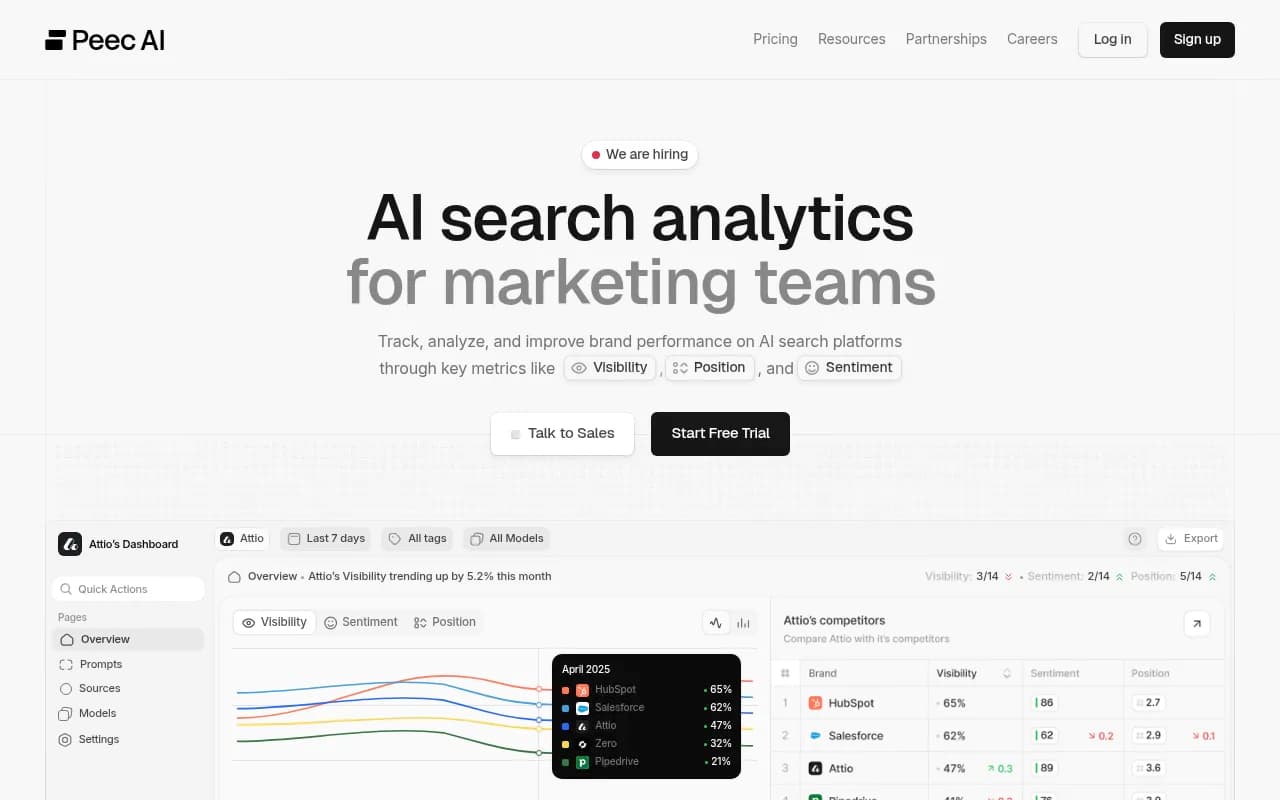
Compared to competitors, Scrunch is on the expensive end for what it offers. Promptwatch starts at $99/month with 50 prompts, crawler logs, and content generation tools -- significantly more capability for less money. Profound and AthenaHQ have similar pricing to Scrunch ($250-500/month) but include more optimization features. Otterly.AI and Peec.ai are cheaper ($99-200/month) but are also monitoring-only like Scrunch. The value proposition only makes sense if you're an agency spreading the cost across multiple clients or a large brand with budget to spare. For most teams, you're paying a premium for polished reporting without getting the optimization tools that actually move the needle.
Strengths & Limitations
Strengths: • Clean, executive-friendly dashboards that make AI visibility easy to understand and present • Multi-brand workspace and white-label reporting are genuinely useful for agencies • Solid multi-model coverage across ChatGPT, Perplexity, Claude, Gemini, and others • Google Search Console integration ties AI visibility to traditional SEO metrics • No annual contract lock-in -- monthly billing gives you flexibility
Limitations: • No content optimization tools -- Scrunch shows you where you're invisible but doesn't help you fix it. No answer gap analysis, no AI content writer, no recommendations on which pages to optimize. Promptwatch's content generation and gap analysis are critical for actually improving rankings. • No AI crawler logs -- You can't see when ChatGPT, Claude, or Perplexity crawlers visit your site, which makes it hard to diagnose indexing issues or understand how AI models discover your content. Promptwatch tracks this in real-time. • No traffic attribution -- Scrunch can't connect AI visibility to actual website visitors or revenue. You see citation counts but have no idea if they're driving business results. Promptwatch offers code snippet, GSC integration, and server log analysis for attribution. • No prompt intelligence -- No volume estimates, no difficulty scores, no query fan-outs. You're guessing which prompts matter instead of prioritizing based on data. • Missing Reddit and YouTube tracking -- Two major sources that influence AI recommendations, completely absent from Scrunch. Promptwatch monitors both. • High price for monitoring-only -- At $300-500/month, you're paying more than platforms that include optimization tools. The value only works for agencies or large brands with reporting-heavy needs.
Bottom Line
Scrunch AI is a solid monitoring platform for agencies and brand teams that need to report on AI visibility but don't need help optimizing it. If you're managing multiple client accounts and your main job is producing monthly reports with charts showing AI citation trends, Scrunch's multi-brand workspace and white-label PDFs justify the cost. The dashboards are polished, the competitor benchmarking is useful, and the multi-model coverage is comprehensive.
But if you're a hands-on marketer, SEO, or content team trying to actually improve your AI rankings, Scrunch leaves you stuck. You'll see where you're invisible, but you won't know why or what to do about it. For teams that want to close the loop -- find content gaps, generate optimized content, track crawler behavior, and measure traffic impact -- Promptwatch is the stronger choice at a lower price point. Best use case for Scrunch: agency reporting dashboards where the client just wants proof their brand is being tracked, not active optimization.
Similar and alternative tools to Scrunch AI