Key takeaways
- Traditional keyword rank tracking is no longer enough -- AI search engines like ChatGPT, Perplexity, and Gemini now drive meaningful traffic and require completely different optimization signals.
- ChatGPT cites branded domains 11.1 points more than Google does, meaning direct vendor websites have a real advantage over third-party publications in AI responses.
- The SEO tools that adapted best in 2025 moved beyond rank tracking to offer AI citation monitoring, content gap analysis, and crawler log visibility.
- Most tools still stop at monitoring. A smaller number now help you actually fix visibility gaps by generating content engineered to get cited.
- The smartest approach in 2026 is running traditional SEO and AI visibility optimization in parallel -- they share foundations but diverge sharply in what actually moves the needle.
The moment SEO professionals realized something had shifted
There's a post circulating that captures the mood well. Someone asked ChatGPT to recommend an SEO tool for a specific task. It listed five options. Three of them the person had never heard of.
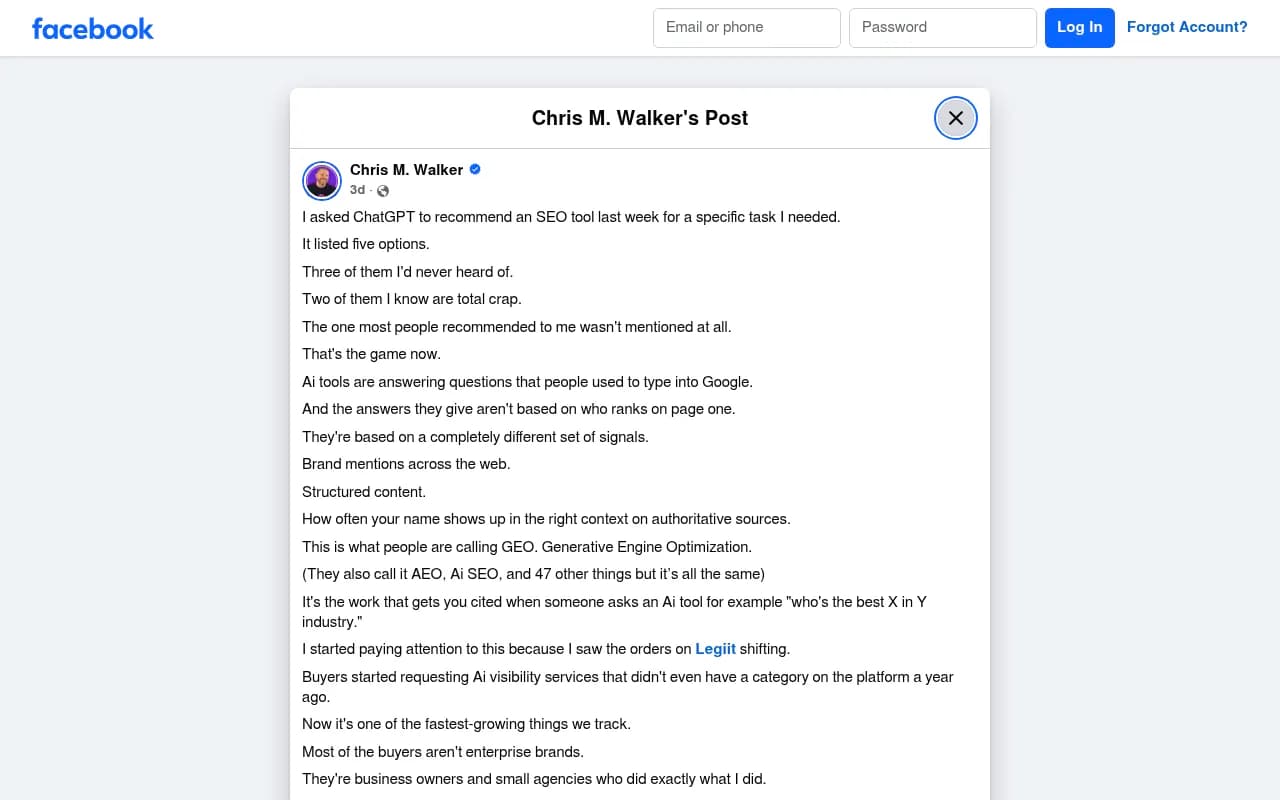
That's the new reality. ChatGPT, Perplexity, Claude, and Gemini are now recommending products, vendors, and services to hundreds of millions of people every week. And the brands showing up in those recommendations aren't necessarily the ones with the highest Google rankings.
For SEO professionals, this created an uncomfortable question: if a competitor is getting cited by ChatGPT but you're not, does your keyword ranking even matter?
The answer is nuanced. Traditional SEO still matters -- a lot. But 2025 was the year the industry had to genuinely reckon with a second optimization channel running in parallel. The tools that understood this early are now in a very different position than those that didn't.
What actually changed in AI search in 2025
Before getting into the tools, it's worth being precise about what shifted. AI search engines don't rank pages the way Google does. They synthesize answers from multiple sources and decide which sources to cite. The factors that drive those citation decisions are meaningfully different from traditional ranking signals.
A September 2025 analysis from Superprompt found that ChatGPT cites branded domains 11.1 points more than Google does -- favoring direct vendor websites over third-party industry publications. That's a significant inversion of what many SEO strategies were built around. Years of "earn coverage on authoritative third-party sites" advice still applies for Google, but ChatGPT is increasingly going straight to the source.
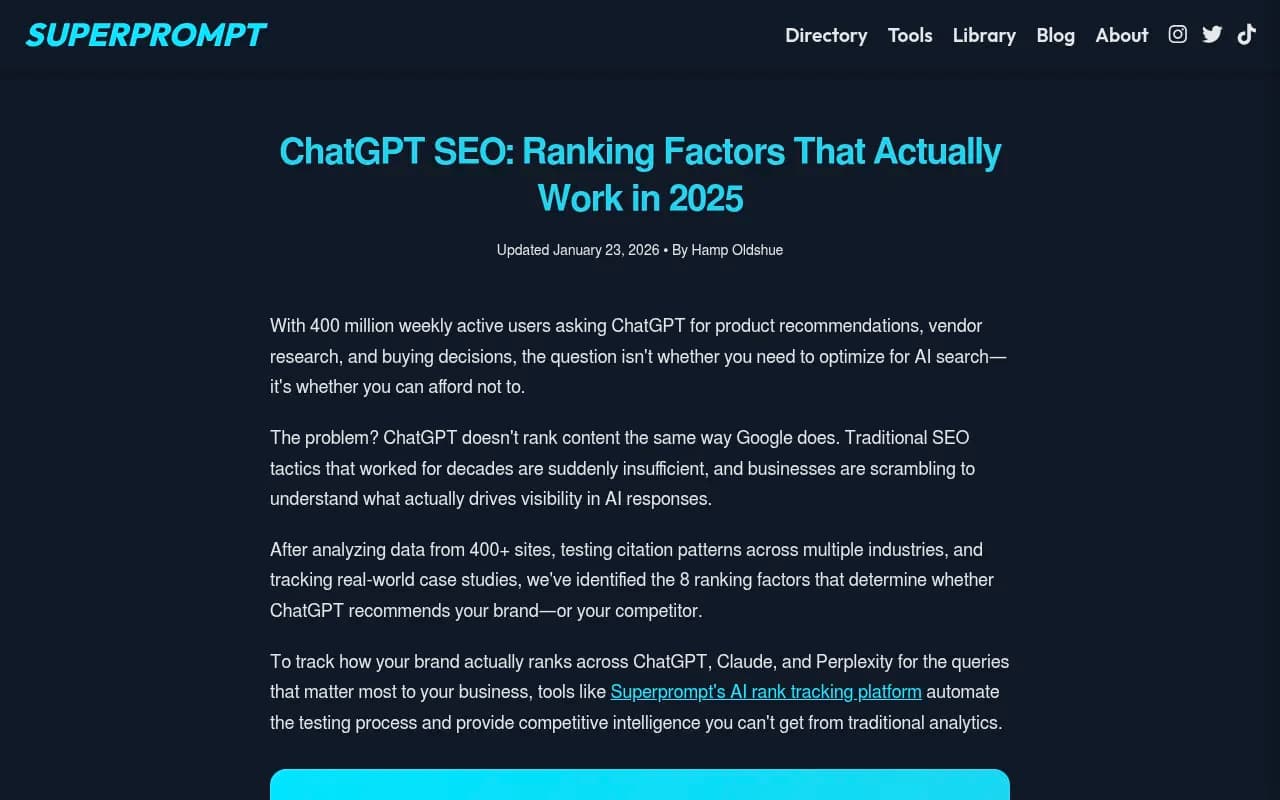
The same analysis broke down ChatGPT's citation weighting into three components: authority and credibility signals (40%), content quality and utility (35%), and platform-specific trust factors (25%). None of those map cleanly onto a traditional DA score or backlink count.
Meanwhile, AI models like ChatGPT with Browse enabled and Perplexity are actively crawling the web in real time. Which means there's now a meaningful question of whether AI crawlers can actually access and process your content -- something most SEO tools weren't built to answer.
How traditional SEO tools responded
The established players -- Semrush, Ahrefs, Moz -- had a real challenge. Their core products were built around Google. Keyword databases, backlink analysis, rank tracking: all of it was Google-centric by design.
Semrush was probably the fastest to respond among the legacy tools. They added AI Overview tracking and began surfacing data on how content performs in Google's AI-generated summaries. But the implementation uses fixed prompt sets, which limits how granular you can get with your own brand's specific queries.
Ahrefs launched Brand Radar, which monitors brand mentions across AI search engines. It's a genuine step forward from pure backlink analysis. The limitation is similar to Semrush's: fixed prompts, no AI traffic attribution to connect visibility to actual revenue.
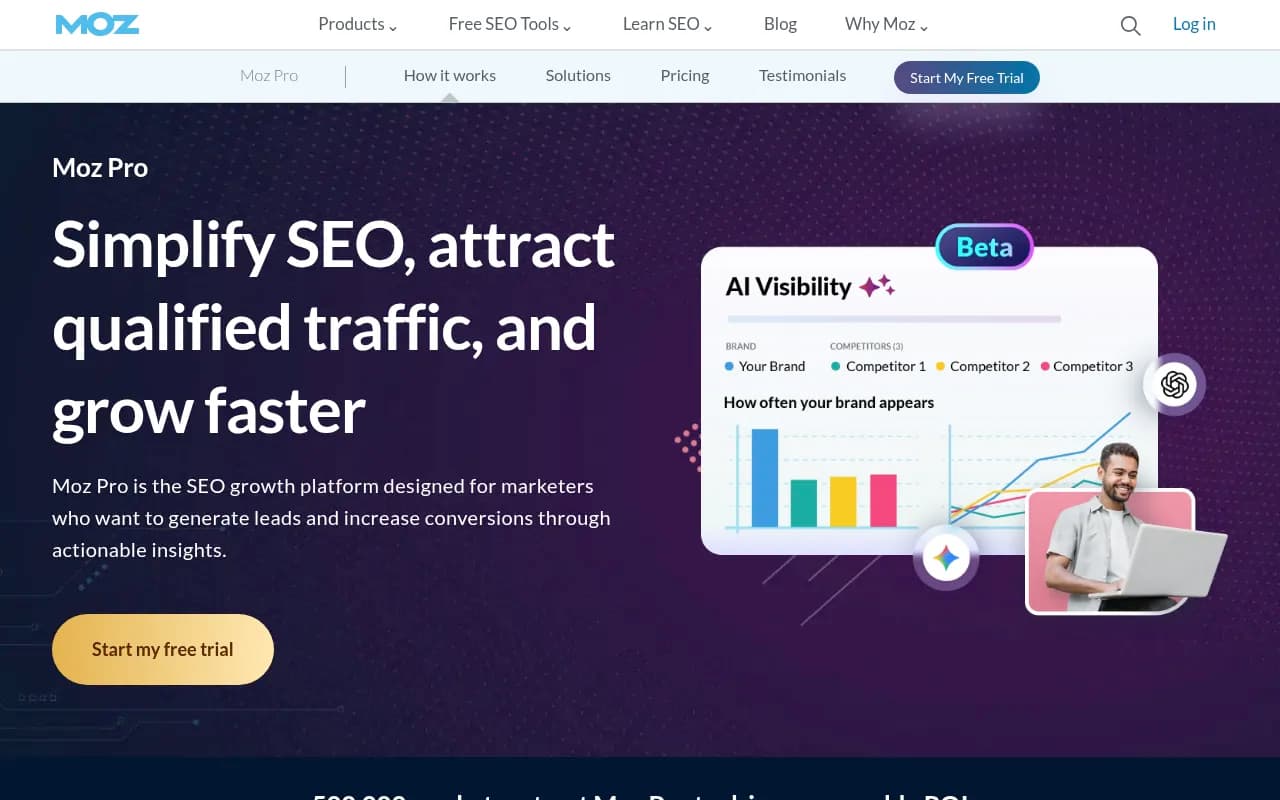
Moz has been slower to pivot. Their core product remains strong for traditional SEO, but AI search visibility is still largely absent from the platform.
The honest assessment: these tools are excellent for what they were built to do. If you're managing a traditional SEO program, they're still essential. But they weren't designed for AI visibility, and it shows.
The new category: purpose-built AI visibility platforms
The more interesting story is the category of tools that were built specifically for AI search -- either launched in 2024-2025 or significantly rebuilt around the new reality.
Monitoring-only tools
A large wave of tools launched to answer the basic question: "Is my brand showing up in ChatGPT and Perplexity?" These are monitoring dashboards that track brand mentions across AI models, show you sentiment, and give you a visibility score.
Tools like Otterly.AI, Peec AI, and Athena HQ fall into this category. They're useful for understanding your current position. The gap is that they stop there -- you see the problem but the tool doesn't help you fix it.


Platforms that go further
A smaller set of tools moved beyond monitoring to actually help with optimization. This is where the category gets genuinely interesting.
Promptwatch is the clearest example of a platform built around the full optimization loop rather than just tracking. It monitors visibility across 10 AI models (ChatGPT, Perplexity, Claude, Gemini, Grok, DeepSeek, Copilot, Meta AI, Mistral, and Google AI Overviews), but the more distinctive capabilities are what happen after you see the data.
The Answer Gap Analysis shows you exactly which prompts competitors are getting cited for that you're not -- the specific questions AI models are answering with your competitor's content instead of yours. Then a built-in AI writing agent generates content engineered to close those gaps, grounded in citation data from over 880 million analyzed citations. And AI Crawler Logs show you in real time which pages ChatGPT, Claude, and Perplexity are actually crawling, how often, and what errors they're hitting.
That last feature is something most tools lack entirely. You can have great content, but if AI crawlers are hitting errors on your site, they may never see it.

Profound takes a similar enterprise-focused approach, with strong brand tracking and competitive analysis. It's positioned at larger organizations and priced accordingly.
Scrunch AI and BrightEdge are worth mentioning for enterprise teams that need AI visibility layered into an existing SEO workflow.
Content optimization tools: the other half of the equation
Visibility in AI search isn't just about monitoring -- it's about having content that AI models want to cite. This is where content optimization tools became more important, not less, in 2025.
The core insight: AI models favor content that directly answers specific questions, demonstrates genuine expertise, and is structured in a way that's easy to extract and cite. That's different from the keyword-density and topical-coverage approach that dominated traditional SEO content.
Surfer SEO and Clearscope both adapted their content scoring to account for semantic coverage and question-answering structure. Neither is specifically built for AI citation optimization, but both help produce the kind of thorough, well-structured content that AI models tend to prefer.
MarketMuse goes deeper on content strategy -- it's particularly useful for identifying topical gaps across an entire site, which maps well onto the kind of comprehensive coverage AI models reward.
For agencies producing content at volume, Content at Scale and Jasper have both added features aimed at AI-optimized content production. The quality varies, but the direction is right.
Rank tracking: still necessary, but no longer sufficient
Here's the thing about traditional rank tracking tools: they're not obsolete. Google is still the dominant search engine by volume. Keyword rankings still drive the majority of organic traffic for most sites. The mistake would be abandoning traditional SEO in favor of AI visibility -- the smarter move is running both.
That said, the rank tracking tools that added AI visibility features are more useful than those that didn't.
SE Ranking added a dedicated AI visibility module that sits alongside traditional rank tracking. For teams that want a single platform covering both, it's a reasonable option.
Nightwatch and AccuRanker remain strong for pure rank tracking. Neither has made significant moves into AI visibility, but for teams with a separate AI monitoring tool, that's fine.
Google Search Console remains essential -- and free. It won't tell you anything about ChatGPT citations, but it's still the most reliable source of data on how Google actually sees your site.
How the major categories compare
Here's a practical breakdown of how the main tool types stack up across the capabilities that matter in 2026:
| Tool type | Traditional rank tracking | AI citation monitoring | Content gap analysis | AI content generation | Crawler log visibility |
|---|---|---|---|---|---|
| Legacy SEO (Semrush, Ahrefs) | Excellent | Basic | No | Limited | No |
| Monitoring-only AI tools (Otterly, Peec) | No | Good | No | No | No |
| Full-stack AI visibility (Promptwatch) | No | Excellent | Yes | Yes | Yes |
| Enterprise AI platforms (Profound, BrightEdge) | Limited | Good | Partial | No | No |
| Content optimization (Surfer, Clearscope) | No | No | Partial | Yes | No |
| Rank trackers (Nightwatch, AccuRanker) | Excellent | No | No | No | No |
The honest read: no single tool covers everything. Most teams in 2026 are running at least two platforms -- a traditional SEO tool for Google visibility and a dedicated AI visibility platform for everything else.
What the best-adapted tools have in common
Looking across the tools that genuinely moved the needle in 2025, a few patterns emerge.
They treat AI crawlers as a first-class concern. The ability to see which pages AI models are crawling, how often, and what errors they encounter is a capability that separates serious platforms from dashboards. If you don't know whether Perplexity can even read your content, citation tracking is almost meaningless.
They connect visibility to revenue. Showing a brand mention count is easy. Connecting that to actual traffic and conversions is hard. The platforms that built traffic attribution -- whether through a code snippet, GSC integration, or server log analysis -- are the ones that can justify their cost to a CFO.
They help you act, not just observe. The monitoring-only tools were useful in 2024 when the category was new and just understanding your position was valuable. In 2026, the bar is higher. Teams want to know what to do about the gaps they're seeing.
They prioritize prompts intelligently. Not all AI queries are equal. Tools that surface prompt volume estimates and difficulty scores let you focus on the queries that actually drive decisions -- rather than chasing every mention.
Practical recommendations by team type
If you're an in-house SEO team at a mid-size brand, the most practical setup is keeping your existing traditional SEO tool (Semrush or Ahrefs) for Google visibility and adding a dedicated AI visibility platform. Promptwatch's Professional plan at $249/month covers 2 sites and 150 prompts, which is enough for most single-brand teams to get real signal.
If you're a digital agency managing multiple clients, the calculus shifts. You need multi-site support, white-label reporting, and the ability to show clients concrete AI visibility improvements over time. Promptwatch's agency and enterprise tiers are built for this. Alternatively, AgencyAnalytics handles reporting aggregation well if you're pulling data from multiple sources.
If you're just starting out and budget is tight, SE Ranking gives you traditional rank tracking plus basic AI visibility in one platform. It's not as deep as a dedicated AI visibility tool, but it's a reasonable starting point.
If you're at an enterprise with serious brand protection concerns -- think Fortune 500, financial services, or any brand where AI misrepresentation is a real risk -- Profound AI or BrightEdge are worth evaluating, alongside Promptwatch for the content optimization layer.
The underlying shift that explains everything
The reason SEO tools had to adapt isn't just that a new traffic channel appeared. It's that the fundamental question changed.
Traditional SEO asked: "How do I rank for this keyword?"
AI search asks: "Why should an AI model trust my content enough to cite it in an answer?"
Those are different questions with different answers. The first is about technical signals, backlinks, and on-page optimization. The second is about genuine expertise, content structure, brand authority, and whether your site is even accessible to AI crawlers.
The tools that understood this distinction early -- and built products around the second question -- are the ones that matter most heading into 2026. The tools that added an "AI tab" to their existing dashboard without rethinking the underlying model are mostly just noise.
The good news: the foundations overlap. A site with strong technical SEO, genuine topical authority, and well-structured content is already in a better position for AI visibility than one without those things. You're not starting from scratch. You're extending what you've built -- with different tools, different metrics, and a different mental model for what "ranking" actually means.