Nightwatch Review 2026
Marketing-focused platform for tracking brand visibility and performance across AI search engines.
Summary
- Best for: SEO agencies and in-house marketing teams tracking both traditional search rankings and AI visibility across multiple sites
- Strengths: Real-time rank updates, 190,000+ location tracking down to zip codes, unified search + AI dashboard, competitive pricing for high keyword volumes, robust API and Looker Studio integration
- Limitations: Lacks content gap analysis, AI content generation, and AI crawler logs that Promptwatch offers. Monitoring-focused without optimization tools to help you fix visibility gaps.
- Pricing: Starts at $32/month, 14-day free trial, enterprise plans available
- Bottom line: Solid choice for teams that need accurate rank tracking at scale, but if you want to optimize AI visibility (not just monitor it), Promptwatch provides the content generation and gap analysis tools Nightwatch lacks.

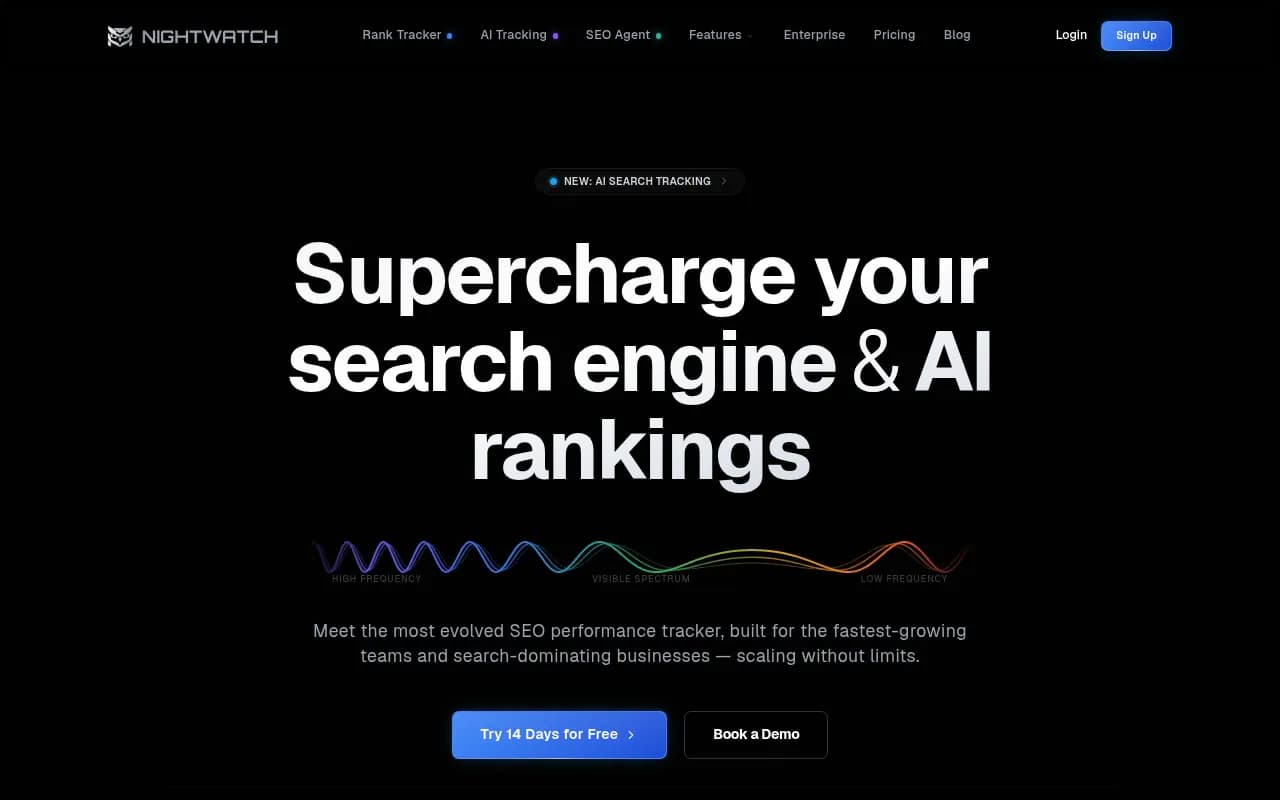
Nightwatch positions itself as the "most evolved SEO performance tracker" for teams that need to monitor both traditional search rankings and the emerging AI search landscape. It's built by a team that recognized early that AI platforms like ChatGPT, Gemini, and Perplexity are reshaping how users discover brands -- and that most legacy rank trackers are blind to this shift. The platform launched its AI tracking features in 2024 and has since become a go-to for agencies managing 20+ client sites who need one dashboard for everything.
The core pitch: stop toggling between a traditional rank tracker and a separate AI monitoring tool. Nightwatch unifies search engine rankings (Google, Bing, Yahoo, DuckDuckGo, YouTube) with AI platform visibility (ChatGPT, Gemini, Claude, Perplexity) in a single interface. You see your Google rankings next to your ChatGPT Share of Voice, with attribution tracking that connects AI mentions to subsequent search traffic. The company claims "more than 90% of AI-generated questions turn into search engine queries" -- so tracking both channels gives you the complete picture of how users discover your brand.
Who is this for? Primarily SEO agencies and in-house marketing teams at companies with multiple domains or large keyword portfolios. If you're tracking 5,000+ keywords across 10 client sites, Nightwatch's pricing and performance benchmarks make sense. If you're a solo consultant tracking 200 keywords for one site, the feature set might be overkill (and cheaper alternatives exist). The platform is also a fit for enterprise teams that need zip-code level local tracking or real-time rank refreshes during campaign launches.
Rank Tracking (Traditional Search)
Nightwatch's core feature is daily rank tracking across Google, Bing, Yahoo, DuckDuckGo, and YouTube. The standout here is localization depth: 190,000+ locations worldwide, down to specific zip codes. Most competitors (SEMrush, Ahrefs) offer city-level tracking; Nightwatch goes granular. This matters for multi-location businesses (restaurant chains, real estate agencies, healthcare providers) that need to know how they rank in specific neighborhoods, not just metro areas.
The platform claims 99.9% rank accuracy, which they validate by pulling more data points more frequently than competitors. Most tools approximate rankings to save costs; Nightwatch prioritizes precision. In practice, this means you see the actual SERP your customers see, not a statistical estimate. The trade-off: slightly higher costs at scale, though still competitive.
Real-time updates are available for enterprise plans. You can refresh critical keywords on demand -- useful during algorithm updates, site migrations, or product launches when you need to see ranking changes immediately, not 24 hours later. The free and mid-tier plans get daily updates, which is standard.
SERP feature tracking covers Featured Snippets, Knowledge Panels, Local Packs, People Also Ask boxes, and other rich results. You see not just your rank, but whether you own the snippet or appear in the Local Pack. This is table stakes for modern rank trackers, but Nightwatch's implementation is clean: each SERP feature gets its own column in the keyword table, so you can filter and segment easily.
Device support includes Desktop, Mobile, and Tablet tracking. You can compare how your rankings differ across devices -- important since Google's mobile-first indexing means mobile and desktop SERPs often diverge.
Multi-language support covers 170+ languages, so you can track international campaigns. Combine this with the 190,000+ locations and you have a tool built for global brands.
AI Tracking (Generative AI Platforms)
This is where Nightwatch differentiates from legacy rank trackers. The platform monitors your brand visibility in ChatGPT, Gemini, Claude, and Perplexity by simulating user prompts and analyzing the generated responses. You get an AI Visibility Score (0-100) that represents how often your brand appears in AI answers, plus Share of Voice metrics that show your brand mentions vs. competitors.
The AI tracking works by running a set of prompts (questions users might ask) and checking if your brand is mentioned, cited, or recommended in the response. You can define your own prompts or use Nightwatch's prompt research tool to discover high-volume queries. The platform tracks Generative Rankings -- your position in AI-generated lists (e.g. "#1 in ChatGPT, #3 in Gemini") -- and Active Citations, showing which sources (your website, Reddit threads, news articles) the AI models are pulling from.
Sentiment analysis tags each mention as Positive, Neutral, or Negative, so you can spot reputation issues early. If Claude starts describing your product negatively, you see it in the dashboard.
Attribution tracking is the killer feature here. Nightwatch claims to connect AI mentions to subsequent search traffic by tracking users who see your brand in an AI answer and then search for you on Google. The dashboard shows "This search visit originated from a ChatGPT recommendation." This is powerful for proving ROI -- you can show executives that AI visibility drives actual traffic, not just vanity metrics.
However, there's a major gap: Nightwatch shows you where you're visible (or invisible) in AI, but it doesn't help you fix it. There's no content gap analysis to show which prompts competitors rank for but you don't. No AI content generation to create articles optimized for AI citations. No AI crawler logs to see how ChatGPT or Claude are actually crawling your site. You get monitoring, but not optimization. This is where Promptwatch pulls ahead -- it shows you the gaps, then helps you generate content to fill them, then tracks the results. Nightwatch stops after step one.
Keyword Research and Prompt Research
Nightwatch includes a keyword research tool that pulls search volume, competition, and CPC data. You can discover new keywords, analyze search intent (Transactional, Informational, Commercial), and export lists for tracking. It's functional but not groundbreaking -- similar to what you'd get from Ahrefs or SEMrush.
The Prompt Research tool is newer and more interesting. It helps you discover high-volume prompts (questions users ask AI models) related to your niche. You see estimated prompt volumes and can add them to your AI tracking list. This is useful for finding opportunities, but again, Nightwatch doesn't tell you what content you're missing or help you create it. Promptwatch offers prompt volume estimates, difficulty scores, and query fan-outs (how one prompt branches into sub-queries), plus the Answer Gap Analysis that shows exactly which prompts competitors rank for but you don't.
Site Audit
Nightwatch includes a technical SEO audit tool that crawls your site and flags issues: broken links, missing meta tags, slow pages, duplicate content, mobile usability problems. You get a prioritized list of fixes with severity scores. It's a solid audit tool, comparable to Screaming Frog or Sitebulb, but not as deep as dedicated crawlers. For most agencies, it's enough to catch the obvious issues without needing a separate tool.
Reporting and Integrations
Nightwatch's reporting is highly customizable. You can build white-label reports with your agency branding, choose which metrics to include, and schedule automatic delivery (daily, weekly, monthly). The reports are visually clean -- lots of sparklines, small diagrams, and color-coded trends that make it easy for clients to understand progress at a glance.
Looker Studio integration is a standout. You can connect Nightwatch data to Google Looker Studio (formerly Data Studio) and build custom dashboards that combine rank tracking with Google Analytics, Search Console, and other data sources. This is huge for agencies that need to show clients a unified view of SEO performance, paid search, and web analytics in one place.
API access is available on all plans. The API is well-documented and lets you pull ranking data, audit reports, and AI insights for integration with your own tools or internal dashboards. Developers will appreciate the flexibility.
Google Analytics and Search Console integration pulls traffic and click data into Nightwatch, so you can see rankings alongside actual traffic. This helps you prioritize keywords that drive revenue, not just rankings.
Segmentation and Filtering
Nightwatch's segmentation features are powerful. You can create global segments to filter keywords across multiple websites by search intent (Transactional, Informational, Commercial), device, location, or custom tags. For example, you could segment all "high LTV" keywords across 10 client sites and see their collective performance. This saves hours when managing large portfolios.
You can also segment by revenue impact. If you tag keywords by customer lifetime value (High LTV vs. Low LTV), Nightwatch shows which segments drive the most revenue. This is useful for prioritizing optimization efforts -- focus on the keywords that move the needle, not just the ones with high search volume.
Pricing and Value
Nightwatch's pricing starts at $32/month for the basic plan, which includes rank tracking for a limited number of keywords. Mid-tier plans scale up to thousands of keywords, and enterprise plans are fully customizable. The company emphasizes "best price-to-performance" -- you can scale to millions of keywords without the per-keyword costs of SEMrush or Ahrefs.
There's a 14-day free trial with no credit card required. You get full access to all features, including AI tracking and local rank tracking, so you can evaluate the platform properly before committing.
Compared to competitors: Nightwatch is cheaper than SEMrush or Ahrefs for high keyword volumes, but more expensive than basic rank trackers like SERPWatcher or AccuRanker. The AI tracking features add value if you need them; if you only care about traditional search rankings, you might find cheaper alternatives.
However, if you're serious about AI visibility, Promptwatch offers more depth. Promptwatch's Essential plan ($99/month) includes 50 prompts, 5 AI-generated articles, and features Nightwatch lacks entirely: Answer Gap Analysis (shows which prompts competitors rank for but you don't), AI content generation (creates articles optimized for AI citations), AI crawler logs (see how ChatGPT and Claude crawl your site), and traffic attribution (track AI-driven visitors). Nightwatch monitors AI visibility; Promptwatch helps you improve it.
Strengths
Localization depth: 190,000+ locations down to zip codes is unmatched. If you need hyper-local tracking, Nightwatch delivers.
Unified search + AI dashboard: One interface for traditional rankings and AI visibility. No need to toggle between tools.
Real-time updates: Enterprise plans get on-demand rank refreshes, useful during critical campaigns.
Reporting and integrations: White-label reports, Looker Studio connector, and robust API make it easy to fit Nightwatch into your existing workflow.
Competitive pricing at scale: Cheaper than SEMrush or Ahrefs for high keyword volumes.
Limitations
No content gap analysis: Nightwatch shows you where you rank in AI, but not which prompts competitors rank for that you don't. Promptwatch offers Answer Gap Analysis that identifies exactly what content you're missing.
No AI content generation: Nightwatch doesn't help you create content optimized for AI citations. Promptwatch includes an AI writing agent that generates articles grounded in 880M+ citations analyzed, prompt volumes, and competitor data.
No AI crawler logs: You can't see how ChatGPT, Claude, or Perplexity are actually crawling your site. Promptwatch provides real-time logs of AI crawlers hitting your pages, errors they encounter, and how often they return.
No traffic attribution from AI: Nightwatch claims to track users who see your brand in AI and then search for you, but the implementation is vague. Promptwatch offers detailed visitor analytics with code snippet, GSC integration, or server log analysis to connect AI visibility to actual revenue.
Limited prompt intelligence: Nightwatch's prompt research tool is basic. Promptwatch provides prompt volume estimates, difficulty scores, and query fan-outs that show how one prompt branches into sub-queries.
Bottom Line
Nightwatch is a solid rank tracker for agencies and in-house teams that need accurate, scalable monitoring across search engines and AI platforms. The localization depth, real-time updates, and unified dashboard are strong selling points. If you're managing 10+ client sites and need one tool for everything, Nightwatch delivers.
But it's a monitoring tool, not an optimization platform. You see where you rank, but you're on your own to figure out why and how to improve. There's no content gap analysis, no AI content generation, no crawler logs, no detailed traffic attribution. For teams that want to optimize AI visibility (not just track it), Promptwatch is the stronger choice. Promptwatch shows you the gaps, helps you create content to fill them, and tracks the results -- the full optimization loop that Nightwatch lacks.
Best use case for Nightwatch: You're an agency tracking 5,000+ keywords across multiple clients, you need zip-code level local tracking, and you want one dashboard for search + AI rankings. You have your own content team and just need accurate data to inform strategy. If that's you, Nightwatch is worth evaluating.
Similar and alternative tools to Nightwatch