Key takeaways
- Most AI visibility platforms stop at monitoring -- they show you where you're invisible but don't help you fix it.
- Promptwatch is the only platform in this comparison that covers the full loop: gap analysis, AI content generation, and traffic attribution.
- Profound and Scrunch are strong enterprise options but come with higher price points and no Reddit/YouTube tracking.
- Otterly.AI and Peec AI are solid entry points for teams that just need basic prompt monitoring on a budget.
- If you're serious about growing AI search visibility (not just measuring it), the platform you choose needs optimization tools, not just a dashboard.
The market for AI visibility tools has exploded. Two years ago, barely anyone was tracking how their brand appeared in ChatGPT or Perplexity. Now there are 150+ tools claiming to solve the problem, and the differences between them matter a lot.
This guide focuses on five platforms that come up most often in practitioner discussions: Promptwatch, Profound, Otterly.AI, Peec AI, and Scrunch. I've gone through each one in detail -- what they actually do, who they're built for, and where they leave you hanging.
The honest summary upfront: most of these tools are monitoring dashboards. They tell you your brand appeared in 12% of relevant prompts this week. That's useful data. But it doesn't tell you what to do about it, and that's where the real gap is.
What these platforms are actually solving
Before getting into the tool-by-tool breakdown, it's worth being clear about the problem.
AI search engines like ChatGPT, Perplexity, Claude, and Google AI Overviews don't rank pages the way Google does. They synthesize answers from content they've crawled and indexed, and they cite sources selectively. If your website doesn't have content that directly answers the questions your customers are asking, you won't get cited -- full stop.
Traditional SEO metrics don't capture this. You can rank #1 on Google for a keyword and still be completely absent from AI-generated answers on that same topic. That's the gap these tools are trying to close.
The question is: do they just show you the gap, or do they help you close it?
The five platforms at a glance
| Platform | Best for | Monitoring | Content generation | Crawler logs | Reddit/YouTube tracking | Starting price |
|---|---|---|---|---|---|---|
| Promptwatch | Full-stack AI visibility | Yes (10 models) | Yes (built-in AI writer) | Yes | Yes | $99/mo |
| Profound | Enterprise teams | Yes (multiple models) | No | No | No | ~$500+/mo |
| Otterly.AI | Budget monitoring | Yes (limited models) | No | No | No | ~$49/mo |
| Peec AI | Prompt-level tracking | Yes | No | No | No | €89/mo |
| Scrunch | Mid-market brands | Yes | No | No | No | ~$200+/mo |
Promptwatch
Promptwatch is the most complete platform in this comparison, and the gap between it and the others is wider than the marketing suggests.

The core difference is that Promptwatch is built around an action loop, not just a reporting dashboard. It tracks your visibility across 10 AI models (ChatGPT, Claude, Perplexity, Gemini, Google AI Overviews, Grok, DeepSeek, Copilot, Meta AI, and Mistral), but that's table stakes at this point. What sets it apart is what happens after you see the data.
The Answer Gap Analysis shows you exactly which prompts your competitors are appearing in that you're not. Not just "you're missing some prompts" -- it surfaces the specific questions, the specific content gaps, and the specific topics AI models want to answer but can't find on your site. That's genuinely useful.
From there, the built-in AI writing agent generates content grounded in real citation data. It's not a generic content tool bolted on as an afterthought -- it's trained on 880M+ citations and generates articles, listicles, and comparisons specifically engineered to get cited by AI models. The output is different from what you'd get from a general-purpose AI writer.
A few other things worth calling out:
- AI crawler logs show you which pages ChatGPT, Claude, and Perplexity are actually crawling on your site, how often, and whether they're hitting errors. Most competitors don't have this at all.
- Prompt Intelligence gives you volume estimates and difficulty scores for each prompt, plus query fan-outs that show how one question branches into sub-queries. This helps you prioritize instead of just guessing.
- Reddit and YouTube tracking surfaces discussions that directly influence AI recommendations -- a channel most platforms ignore entirely.
- ChatGPT Shopping tracking monitors when your brand appears in product recommendations and shopping carousels.
- Traffic attribution connects AI visibility to actual revenue through a code snippet, GSC integration, or server log analysis.
Pricing: Essential at $99/mo (1 site, 50 prompts, 5 articles), Professional at $249/mo (2 sites, 150 prompts, 15 articles, crawler logs), Business at $579/mo (5 sites, 350 prompts, 30 articles). Free trial available.
The main criticism I'd make: the platform has a lot going on, and it takes time to get oriented. Teams that just want a simple "are we appearing in ChatGPT?" dashboard might find it more than they need. But for anyone serious about growing AI search visibility, the depth is the point.
Profound
Profound is the most credible enterprise competitor in this space. It's well-built, covers multiple AI models, and has a clean interface that enterprise teams tend to appreciate.
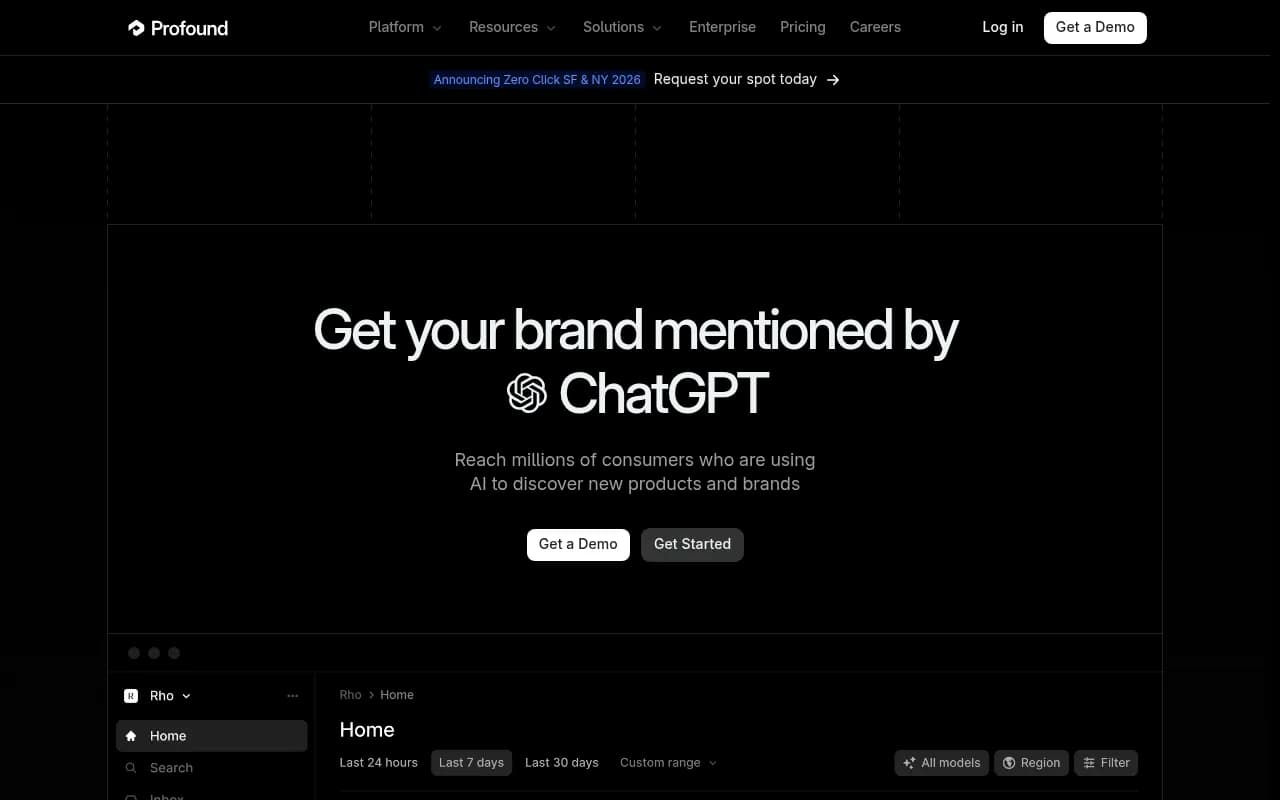
Where Profound shines is in breadth of monitoring and the quality of its reporting. It tracks brand mentions across major AI models, gives you share-of-voice comparisons against competitors, and produces the kind of polished outputs that work well in executive presentations.
The limitations are real though. Profound doesn't have content generation capabilities -- you get the data, but you're on your own to act on it. There's no Reddit or YouTube tracking, no crawler logs, and no traffic attribution. It's a monitoring platform, and a good one, but it stops there.
Pricing sits in the $500+/mo range for meaningful usage, which puts it firmly in the enterprise bracket. For a team that already has content production resources and just needs reliable visibility data, Profound is a strong choice. For a team that needs the full loop from insight to execution, it leaves a gap.
Otterly.AI
Otterly.AI is the most accessible entry point in this comparison. It's affordable, relatively easy to set up, and covers the basics of prompt-level monitoring without overwhelming you.

The platform tracks how your brand appears across a handful of AI models, lets you set up prompts, and gives you visibility scores over time. For a small team or a solo marketer who just wants to start tracking AI visibility without committing to a large budget, it does the job.
The honest limitation: Otterly.AI is monitoring-only, and the depth is limited compared to the other tools here. No content generation, no crawler logs, no Reddit tracking, no traffic attribution. The prompt coverage is narrower, and the analytics don't go very deep.
It's worth considering as a starting point, especially if you're early in your AI visibility journey and want to get a feel for the data before committing to a more expensive platform. But most teams outgrow it fairly quickly once they realize monitoring alone doesn't move the needle.
Peec AI
Peec AI sits in a similar category to Otterly.AI -- a focused monitoring tool with a clean interface and a reasonable price point.

What Peec AI does well is prompt-level tracking. You can set up specific prompts, track how your brand appears in AI responses over time, and get ranking data across selected AI models. The interface is clean and the setup is straightforward.
Peec AI has also added some suggestion features that nudge you toward content improvements, which is a step in the right direction. But these are fairly surface-level compared to what a full content generation workflow looks like in practice.
The gaps are similar to Otterly.AI: no crawler logs, no Reddit or YouTube tracking, no traffic attribution, and limited depth on the analytics side. Starting at €89/mo, it's competitively priced, but you're paying for monitoring, not optimization.
One thing worth noting: Peec AI's methodology has been discussed positively in SEO communities (r/seogrowth in particular) for being transparent about how it calculates visibility scores. That matters -- some tools in this space are vague about their methodology, which makes it hard to trust the numbers.
Scrunch
Scrunch targets mid-market brands and agencies, and it sits between the entry-level tools and the enterprise tier in both features and price.
The platform covers AI visibility monitoring across major models, gives you competitive comparisons, and has a reasonably polished interface. It's appeared in several YouTube roundups of AI visibility tools in 2026, which suggests it's getting traction with practitioners.
Like Profound, Scrunch is a monitoring-focused platform. There's no built-in content generation, no crawler logs, and no Reddit or YouTube tracking. The competitive analysis features are decent, and the reporting is cleaner than some of the budget tools.
For agencies managing multiple client accounts, Scrunch has some workflow features that make it easier to handle multiple brands in one place. That's a legitimate differentiator for that use case.
The pricing is in the $200+/mo range, which puts it in an awkward middle ground -- more expensive than Otterly.AI or Peec AI, but without the full-stack capabilities that justify Promptwatch's pricing. Teams that need more than basic monitoring but aren't ready for enterprise pricing might find it a reasonable fit.
How to choose
The right tool depends on what you actually need from it.
If you're just starting out and want to understand whether your brand is appearing in AI search at all, Otterly.AI or Peec AI are reasonable starting points. They're affordable, easy to set up, and give you enough data to have an informed conversation internally.
If you're an enterprise team that needs reliable monitoring data and polished reporting for stakeholders, Profound is worth evaluating. It's expensive, but the quality is there.
If you're an agency managing multiple brands, Scrunch has some workflow advantages worth considering.
If you want to actually improve your AI search visibility -- not just measure it -- Promptwatch is the only platform in this comparison that gives you the full toolkit. The gap analysis, content generation, crawler logs, and traffic attribution work together in a way that none of the other tools can match. The price reflects that, but so does the output.
The broader point: AI search visibility is not a passive metric. Knowing you're invisible in 60% of relevant prompts is only useful if you can do something about it. Most of these platforms give you the number. Promptwatch gives you the number and the path forward.
A note on the monitoring-only trap
One pattern worth flagging: a lot of teams buy an AI visibility tool, set up their prompts, and then... watch the dashboard. The data accumulates. The visibility score fluctuates. Nothing changes.
This isn't a tool problem, exactly -- it's a workflow problem. But the tools that are monitoring-only make it easier to fall into this trap, because there's no natural next step built into the product. You see the data, you close the tab, you move on.
The platforms that include content generation and optimization tools (Promptwatch being the main example here) create a forcing function. The gap analysis surfaces a specific content opportunity. The AI writer generates a draft. You publish it. You watch the visibility score change. That loop is what actually moves the needle.
If your team has the bandwidth and the content production process to act on monitoring data independently, a monitoring-only tool can work fine. If you need the workflow built in, that narrows your options considerably.
Final comparison
| Feature | Promptwatch | Profound | Otterly.AI | Peec AI | Scrunch |
|---|---|---|---|---|---|
| AI models tracked | 10 | Multiple | Limited | Several | Several |
| Content gap analysis | Yes | No | No | Basic | No |
| AI content generation | Yes | No | No | No | No |
| Crawler logs | Yes | No | No | No | No |
| Reddit/YouTube tracking | Yes | No | No | No | No |
| ChatGPT Shopping tracking | Yes | No | No | No | No |
| Traffic attribution | Yes | No | No | No | No |
| Prompt volume/difficulty | Yes | No | No | No | No |
| Free trial | Yes | Limited | Yes | Yes | Yes |
| Starting price | $99/mo | ~$500+/mo | ~$49/mo | €89/mo | ~$200+/mo |
The market is still maturing. New tools are launching every month, and the established players are adding features quickly. But the fundamental divide -- monitoring vs. optimization -- is likely to persist, because they require very different product architectures to build well.
For most teams in 2026, the question isn't whether to track AI visibility. It's whether you're tracking it with a tool that actually helps you improve it.