BrightEdge Review 2026
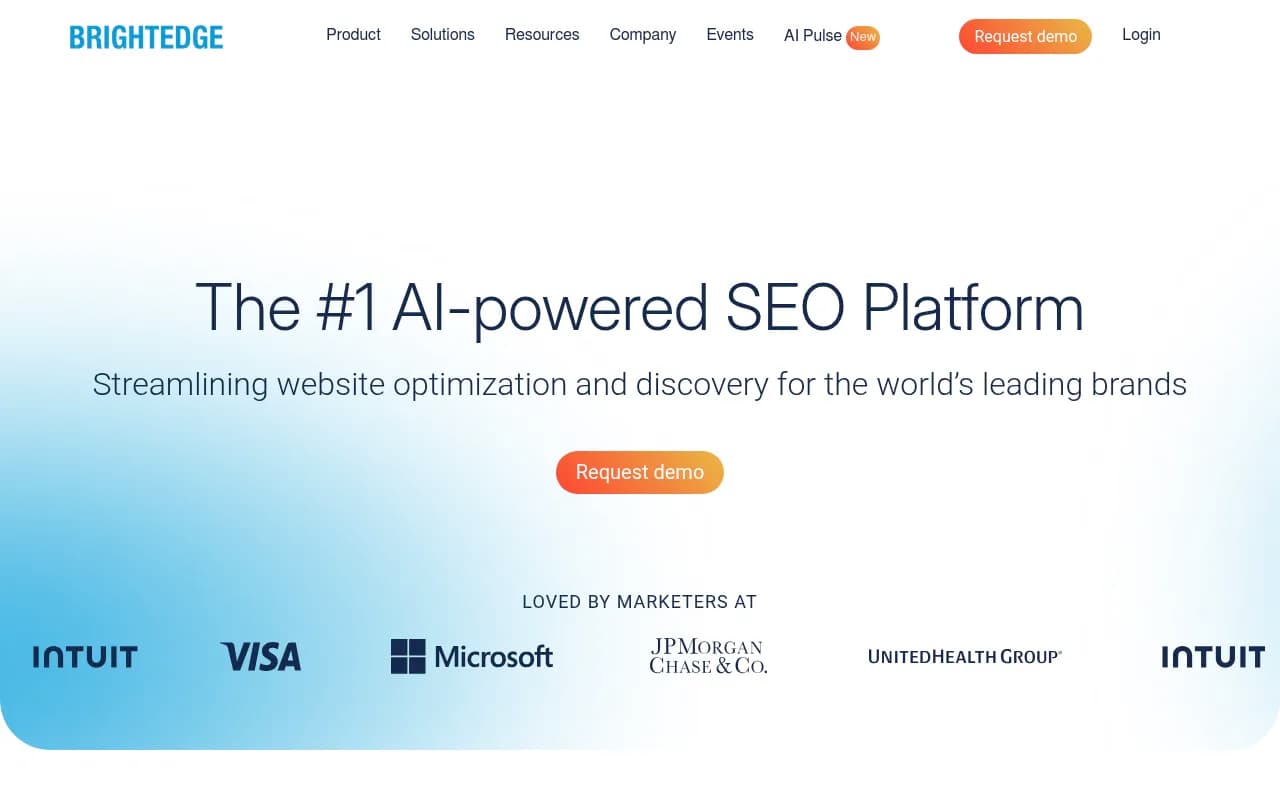
BrightEdge is an enterprise-grade SEO platform that combines proprietary keyword research (4B+ data points), AI-powered content optimization (Copilot/Autopilot), and visibility tracking across traditional search and AI engines. Built for large brands managing complex, multi-market SEO strategies wit
Summary
- Best for enterprise brands managing large-scale SEO across multiple markets, languages, and business units -- not built for small teams or solo marketers
- Proprietary Data Cube research engine with 4 billion data points and 10 years of historical ranking data -- deeper than most competitors but locked behind high pricing
- AI Copilot and Autopilot handle content suggestions and automated on-page optimizations, though the AI content generation is less comprehensive than dedicated GEO platforms like Promptwatch
- Lacks content gap analysis, AI crawler logs, and traffic attribution that Promptwatch offers -- BrightEdge focuses on traditional SEO with some AI visibility tracking, not full GEO optimization
- Custom enterprise pricing only -- no transparent pricing, no free tier, typically $10K-$50K+ annually depending on site size and features

BrightEdge is the incumbent enterprise SEO platform that's been around since 2007, serving Fortune 500 brands like IBM, Microsoft, and 3M. It's built for large marketing teams managing hundreds of thousands of pages across multiple countries and languages. The platform combines keyword research, rank tracking, content optimization, technical SEO audits, and reporting into one system. In 2024-2026, BrightEdge added AI features to stay relevant as search shifts toward LLMs -- but it's still fundamentally a traditional SEO platform with AI bolted on, not a GEO-first solution.
The core value proposition: replace spreadsheets and point solutions with one unified platform that your entire marketing org can use. SEO teams get deep research tools, content teams get optimization recommendations, web dev teams get technical audits, executives get executive dashboards. It's designed for companies where SEO is a strategic function with dedicated headcount and budget.
Data Cube X: The proprietary research engine
BrightEdge's biggest differentiator is Data Cube, their keyword research database. It tracks 4 billion keywords across 170+ countries with 10 years of historical ranking data. You can see how keyword volumes, difficulty scores, and SERP features have changed over time -- useful for spotting long-term trends and seasonal patterns. The data is more accurate than free tools like Google Keyword Planner because BrightEdge uses clickstream data from real users, not just Google's estimates.
Data Cube also tracks Amazon rankings, which is rare. If you're an e-commerce brand, you can see which keywords drive product visibility on Amazon and compare your rankings to competitors. Most SEO tools ignore Amazon entirely.
The downside: Data Cube is only available on higher-tier plans. If you're on the base plan, you get limited keyword research. And the interface feels dated compared to newer tools -- lots of tables and filters, not much visual storytelling.
AI Copilot and Autopilot: Automated optimizations
BrightEdge's AI features come in two flavors. Copilot is the assistant that surfaces insights and recommendations -- it scans your site, identifies optimization opportunities, and suggests specific changes (add this keyword to your title tag, fix this broken link, update this meta description). You review the suggestions and decide what to implement.
Autopilot is the fully automated version. You set rules (e.g. "automatically update meta descriptions for pages ranking 6-10 to include target keywords") and Autopilot makes the changes without human review. It connects to your CMS (WordPress, Adobe Experience Manager, Sitecore, etc.) and pushes updates directly. This is powerful for large sites where manual optimization doesn't scale -- you can optimize thousands of pages overnight.
The catch: Autopilot requires technical setup and CMS integration, which means dev resources. And the AI content generation is basic -- it rewrites existing content to include keywords, but it doesn't create net-new articles or analyze content gaps the way Promptwatch's AI writing agent does. BrightEdge assumes you already have content; it just optimizes what's there.
AI Catalyst: Visibility in AI search engines
In 2024, BrightEdge launched AI Catalyst to track brand visibility in AI-generated answers -- Google AI Overviews, ChatGPT, Perplexity, etc. You can see which queries trigger AI answers, whether your brand is mentioned, and how often you're cited vs competitors. This is BrightEdge's response to the GEO trend.
But AI Catalyst is a monitoring tool, not an optimization platform. It shows you where you're invisible in AI search, but it doesn't help you fix it. There's no content gap analysis to identify missing topics, no AI crawler logs to see how LLMs are indexing your site, no traffic attribution to measure actual visitors from AI engines. You get dashboards and reports, then you're on your own to figure out what to do next.
Compare this to Promptwatch, which is built around the action loop: find gaps (Answer Gap Analysis shows exactly which prompts competitors rank for but you don't), create content (AI writing agent generates articles grounded in 880M+ citations), track results (page-level citation tracking and traffic attribution). BrightEdge gives you step one; Promptwatch gives you all three.
Content optimization and recommendations
BrightEdge's ContentIQ module analyzes your existing pages and scores them on SEO factors -- keyword usage, readability, internal linking, meta tags, schema markup. You get a checklist of fixes for each page. The recommendations are solid but not groundbreaking -- they're the same best practices you'd find in any SEO audit tool.
The content briefs feature generates outlines for new content based on top-ranking pages for your target keyword. It pulls headings, questions, and related terms from competitors and packages them into a brief for your writers. This is useful for scaling content production, but the briefs are generic -- they don't account for your brand voice, product specifics, or strategic positioning. You still need a human editor to make the content good.
BrightEdge also has a content performance dashboard that shows which pages drive the most organic traffic, conversions, and revenue. You can filter by topic, author, publish date, or business unit. This is helpful for proving SEO ROI to executives, but it requires integrating BrightEdge with your analytics platform (Google Analytics, Adobe Analytics) and setting up conversion tracking.
Technical SEO audits and site health
The StoryBuilder module (yes, BrightEdge loves quirky product names) crawls your site and flags technical issues -- broken links, duplicate content, missing alt tags, slow page speed, mobile usability problems, crawl errors. You get a prioritized list of fixes with severity scores. The crawler is fast and accurate, and it integrates with Google Search Console to pull real crawl data from Googlebot.
BrightEdge also monitors Core Web Vitals and page experience signals, which are ranking factors in Google's algorithm. You can see which pages fail the thresholds and get recommendations for improving load times, interactivity, and visual stability. This is table stakes for any enterprise SEO tool in 2026.
One nice feature: BrightEdge tracks how technical issues impact rankings over time. If you fix a batch of broken links and see rankings improve two weeks later, BrightEdge connects the dots. This helps you prioritize fixes based on actual impact, not just theoretical best practices.
Local SEO and multi-location management
If you have physical stores or service locations, BrightEdge's Local module manages Google Business Profiles at scale. You can bulk-update business info (hours, phone numbers, descriptions), respond to reviews, and track local rankings for each location. The review management dashboard aggregates reviews from Google, Yelp, Facebook, and other platforms so you can respond without logging into multiple accounts.
BrightEdge also tracks local pack rankings (the map results that appear for "near me" queries) and shows which locations rank for which keywords. This is useful for franchise brands or retail chains that need to optimize hundreds of locations. But the local features are basic compared to dedicated local SEO tools like BrightLocal or Yext -- BrightEdge is a jack-of-all-trades, not a local specialist.
Reporting and dashboards
BrightEdge's reporting is built for executives who don't live in the weeds of SEO. You can create custom dashboards that show high-level metrics -- organic traffic, keyword rankings, conversions, revenue -- with trend lines and goal tracking. The dashboards are visual and easy to understand, which is important when you're presenting to a CMO or CFO who doesn't know what a meta description is.
You can also schedule automated reports that get emailed to stakeholders weekly or monthly. The reports are PDF or PowerPoint format, not interactive dashboards, which feels outdated in 2026. Most modern tools (including Promptwatch) offer live dashboards with drill-down capabilities.
BrightEdge integrates with Looker Studio (formerly Google Data Studio) if you want to build custom reports, but the integration is clunky -- you have to export data manually or use the API, which requires dev resources.
Integrations and ecosystem
BrightEdge integrates with major CMS platforms (WordPress, Drupal, Adobe Experience Manager, Sitecore), analytics tools (Google Analytics, Adobe Analytics), and marketing automation platforms (Marketo, HubSpot, Salesforce). The integrations are deep -- BrightEdge can push content updates directly to your CMS and pull conversion data from your analytics platform.
There's also an API for custom integrations, but the documentation is sparse and the API is rate-limited. If you're a large enterprise with dev resources, you can build custom workflows; if you're a smaller team, you're stuck with the out-of-the-box integrations.
No browser extension, no mobile app. BrightEdge is a web-based platform that you access through a browser. This is fine for desk work but limiting if you want to check rankings or respond to reviews on the go.
Who is it for
BrightEdge is built for enterprise brands with complex SEO needs. Think: Fortune 500 companies, global e-commerce sites, multi-brand conglomerates, large publishers. You need at least one full-time SEO manager to get value from the platform -- it's not a tool you can hand to a junior marketer and expect them to figure it out.
Specific personas: SEO directors managing 10+ person teams, digital marketing VPs reporting to the C-suite, e-commerce brands with 50K+ product pages, global companies managing SEO in 20+ countries. If you're a SaaS startup with 50 blog posts or a local business with one location, BrightEdge is overkill.
Industries where BrightEdge shines: retail, travel, financial services, healthcare, B2B tech. These are verticals with large websites, regulatory constraints, and complex stakeholder structures -- exactly the environment BrightEdge is designed for.
Who should NOT use BrightEdge: small businesses, solopreneurs, agencies managing 5-10 client sites, anyone who needs transparent pricing or a free trial. BrightEdge doesn't publish pricing and requires a sales call to even see a demo. If you're not ready to spend $10K+ per year, look elsewhere.
Pricing and value
BrightEdge doesn't publish pricing. You have to request a demo and go through a sales process. Based on third-party reports and user reviews, pricing starts around $10K-$15K per year for the base plan and goes up to $50K-$100K+ for enterprise plans with Data Cube, Autopilot, and multi-site support.
There's no free trial, no freemium tier, no month-to-month option. You're signing an annual contract. This is standard for enterprise software, but it's a barrier for smaller teams who want to test the platform before committing.
Is it good value? If you're a large brand with a dedicated SEO team and a six-figure SEO budget, yes. BrightEdge consolidates multiple tools into one platform, which saves money and reduces complexity. But if you're a mid-market company or a growing startup, the ROI is questionable -- you can get 80% of the functionality from cheaper tools like Semrush, Ahrefs, or Promptwatch for a fraction of the cost.
Strengths
- Data Cube research engine with 4 billion keywords and 10 years of historical data -- unmatched depth for enterprise keyword research
- Autopilot automated optimizations can scale changes across thousands of pages without manual work
- Amazon ranking tracking is rare and valuable for e-commerce brands
- Enterprise integrations with major CMS, analytics, and marketing automation platforms
- Executive reporting that translates SEO metrics into business outcomes (traffic, revenue, conversions)
- Dedicated customer success team that acts as an extension of your marketing org
Limitations
- AI Catalyst is monitoring-only -- it shows you where you're invisible in AI search but doesn't help you fix it. No content gap analysis, no AI crawler logs, no traffic attribution like Promptwatch offers.
- AI content generation is basic -- it optimizes existing content but doesn't create net-new articles or analyze what's missing from your site.
- No transparent pricing -- you have to go through a sales process to even see a quote, which is frustrating for smaller teams.
- Steep learning curve -- the platform is powerful but complex, with a dated interface that feels like enterprise software from 2015.
- Overkill for small teams -- if you're not managing 10K+ pages or operating in multiple countries, you're paying for features you won't use.
- Lacks Reddit and YouTube tracking that influence AI recommendations -- a gap that Promptwatch fills.
Bottom line
BrightEdge is the enterprise SEO platform for large brands that need a unified system for keyword research, content optimization, technical audits, and executive reporting. It's powerful, comprehensive, and backed by a strong customer success team. But it's expensive, complex, and built for a specific buyer -- Fortune 500 marketing orgs with dedicated SEO headcount and six-figure budgets.
If you're a mid-market company or a growing startup looking to optimize for AI search, Promptwatch is the better choice. It's built around the action loop (find gaps, create content, track results) that BrightEdge's AI Catalyst lacks, and it costs a fraction of the price. BrightEdge is a monitoring and optimization platform for traditional SEO with some AI visibility tracking; Promptwatch is a GEO-first platform that helps you actually rank in ChatGPT, Perplexity, and other AI engines.
Best use case in one sentence: Large enterprise brands managing 50K+ pages across multiple markets who need a single platform to unify SEO strategy, automate optimizations, and report results to the C-suite.
Tags:
Similar and alternative tools to BrightEdge