Key takeaways
- Most AI visibility platforms only monitor -- they show you data but leave you to figure out what to do with it. Enterprise teams should prioritize platforms that close the loop from gap identification to content creation to traffic attribution.
- Security, data residency, and multi-user access controls are non-negotiable for enterprise procurement. Many vendors skip these details in demos -- you have to ask directly.
- Prompt coverage, model breadth, and update frequency matter more than dashboard aesthetics. A beautiful UI tracking three AI models is less useful than a less polished tool tracking ten.
- Watch for vendors who can't show you real citation data, can't demonstrate content generation grounded in actual AI responses, or can't explain how their platform connects visibility to revenue.
- The procurement process should include a structured pilot with defined success criteria before any multi-year commitment.
Buying software for an enterprise team is already painful. Buying a category of software that barely existed two years ago, where half the vendors are still figuring out what they actually do, is a different kind of painful.
AI visibility platforms -- tools that track and improve how your brand appears in ChatGPT, Perplexity, Claude, Gemini, and other AI search engines -- are now a real budget line item for marketing and SEO teams at serious companies. But the market is messy. There are monitoring dashboards being sold as optimization platforms, tools built for solo consultants being pitched to enterprise procurement teams, and a lot of vendor claims that don't survive a 30-minute demo.
This guide is designed to help enterprise teams cut through that noise. It covers what to look for, what to ask, and what should make you walk away.
What enterprise teams actually need from an AI visibility platform
Before you open a single RFP, it helps to be clear about what you're buying. There are roughly three tiers of capability in this market right now:
Monitoring only: The platform tracks brand mentions across AI models, shows you visibility scores, and maybe lets you compare against competitors. You get data. What you do with it is your problem.
Monitoring plus gap analysis: The platform shows you where competitors are visible and you're not, surfaces the specific prompts and topics you're missing, and gives you some direction on what content to create.
Full optimization loop: The platform does all of the above, then helps you create content engineered to get cited by AI models, tracks whether that content is actually working, and connects visibility improvements to real traffic and revenue.
For a small agency or a solo SEO consultant, tier one might be fine. For an enterprise team with multiple sites, multiple markets, and real accountability for results, you need tier three. The problem is that most vendors in this space are tier one or tier two, but they present themselves as tier three in demos.
The questions below are designed to expose that gap.
The procurement checklist
Before you get into vendor-specific questions, run through this checklist to establish your baseline requirements. Any platform that can't check these boxes shouldn't make it to a demo.
Coverage requirements
- Tracks at least 8-10 AI models (ChatGPT, Perplexity, Claude, Gemini, Google AI Overviews, Grok, DeepSeek, Copilot, Meta AI, Mistral)
- Supports multi-language and multi-region monitoring
- Allows custom persona configuration (so you can simulate how your actual customers prompt)
- Tracks prompt volumes and difficulty scores, not just presence/absence
- Monitors at the page level, not just the domain level
Data and infrastructure requirements
- Processes real AI model responses (not simulated or cached)
- Updates frequently enough to catch meaningful changes (daily or near-daily for high-priority prompts)
- Has AI crawler log access (shows which pages AI bots are actually reading on your site)
- Provides citation source analysis (which URLs, Reddit threads, YouTube videos are being cited)
Optimization requirements
- Includes content gap analysis tied to real prompt data
- Has built-in content generation grounded in citation data, not generic AI writing
- Tracks whether new content improves visibility scores over time
- Connects visibility to traffic via GSC integration, code snippet, or server log analysis
Enterprise requirements
- Multi-user access with role-based permissions
- SSO / SAML support
- SOC 2 Type II certification (or equivalent)
- Data residency options
- API access and/or Looker Studio integration
- Dedicated onboarding and support SLA
Commercial requirements
- Transparent pricing tied to prompts, sites, and users -- not vague "contact us" for everything
- Clear contract terms with defined data ownership
- Pilot or trial option before multi-year commitment
20 questions to ask every vendor
These questions work across any AI visibility platform evaluation. Some will reveal capability gaps. Others will reveal whether the vendor actually understands enterprise needs or is just scaling up a tool built for smaller teams.
Questions about data quality and methodology
1. How do you generate the AI responses you track?
You want to hear that they're querying real AI models in real time (or near-real time), not relying on cached responses or synthetic simulations. Ask how often prompts are refreshed and whether the refresh rate varies by tier.
2. How do you calculate visibility scores?
Visibility scores are only useful if you understand what they measure. Ask whether the score reflects mention frequency, sentiment, position in the response, or some combination. A vendor who can't explain their scoring methodology clearly is a vendor whose data you can't trust.
3. How many citations have you analyzed, and how does that data inform your recommendations?
Volume of historical data matters. A platform that has processed hundreds of millions of citations has a fundamentally different signal quality than one that launched six months ago. Ask specifically how citation data feeds into content recommendations.
4. Can you show me which specific pages on a competitor's site are being cited, and why?
This is a concrete test of citation depth. If the vendor can only show you domain-level data ("competitor X is mentioned a lot"), that's monitoring. If they can show you the exact URL, the prompt it appeared in, and the model that cited it, that's useful intelligence.
5. How do you handle AI model updates and changes in response behavior?
AI models change constantly. Ask how the platform detects and adapts to changes in how models respond, and how quickly they update their tracking methodology when a major model release changes response patterns.
Questions about optimization capabilities
6. Walk me through what happens after I identify a content gap.
This is the most important question on this list. A monitoring-only platform will say something like "you can see which prompts you're missing and create content to address them." An optimization platform will show you a workflow: here's the gap, here's the content brief generated from real citation data, here's the article the AI writing agent produced, here's how we track whether it gets cited. The difference is stark.
7. How is your content generation different from just using ChatGPT?
Generic AI writing won't get you cited by AI models. Ask whether their content generation is grounded in actual citation data, prompt volumes, competitor analysis, and persona targeting. If the answer is vague, the content output will be generic.
8. How do you connect visibility improvements to actual traffic and revenue?
This is where a lot of platforms fall apart. Ask specifically: do you offer a JavaScript snippet, GSC integration, or server log analysis to attribute AI-driven traffic? Can I see which visibility improvements led to measurable clicks? If they can't answer this, you have a reporting tool, not an optimization platform.
9. Can you show me a real example of a brand that improved their AI visibility using your platform, with before/after data?
Case studies in sales decks are one thing. Ask for a live walkthrough of a real customer's data (anonymized if needed) showing the gap analysis, the content created, and the visibility improvement. If they can't produce this, be skeptical.
10. Do you track Reddit, YouTube, and other third-party sources that AI models cite?
AI models don't only cite brand websites. They cite Reddit threads, YouTube videos, industry publications, and forums. A platform that only tracks your own domain is missing a significant part of the picture. Ask whether they surface these third-party citation sources and whether they give you any guidance on how to influence them.
Questions about enterprise readiness
11. What does your multi-user access model look like, and how do you handle role-based permissions?
Enterprise teams have multiple stakeholders: SEO leads, content managers, brand managers, agency partners. Ask whether different users can have different access levels, whether you can restrict certain data to certain roles, and whether there's an audit log.
12. Do you support SSO, and which identity providers?
This is a standard enterprise requirement. If the answer is "it's on our roadmap," that's a no for most procurement teams.
13. What are your data residency options?
For brands operating in the EU, this matters a lot. Ask where data is stored, whether you can choose a region, and whether they're GDPR compliant. Get this in writing.
14. What's your uptime SLA, and can you share historical uptime data?
Ask for actual numbers, not "we take reliability seriously." 99.9% uptime is table stakes. Ask what happens when there's an outage and whether you get service credits.
15. What does onboarding look like for a team our size?
For enterprise accounts, onboarding should include dedicated support, not just a help center. Ask how long it typically takes to get fully set up, whether there's a dedicated customer success manager, and what the support SLA is for critical issues.
Questions about pricing and commercial terms
16. How does pricing scale as we add sites, prompts, and users?
AI visibility platform pricing varies wildly. Some charge per prompt, some per site, some per user. Ask for a clear breakdown of what happens to your bill as you scale, and whether there are overage charges.
17. Who owns the data we generate on your platform?
This should be in the contract, but ask anyway. Your prompt data, your visibility scores, your content -- make sure you retain ownership and can export everything if you leave.
18. What's your policy on using customer data to train your models?
Some platforms use customer data to improve their AI features. That may or may not be acceptable depending on your legal team's position. Ask directly and get the answer in writing.
19. Can we run a structured pilot before committing to an annual contract?
Any vendor confident in their product should offer a trial or pilot period. Define success criteria upfront -- specific visibility improvements, content pieces created, traffic attribution established -- and hold the vendor to them.
20. What does your roadmap look like for the next 12 months?
This market is moving fast. Ask what's coming, and specifically ask about any AI models they're planning to add, any new optimization features, and whether they're investing in enterprise-specific capabilities.
Red flags to watch for
Some of these will come up during demos. Others you'll only catch if you push.
The demo shows dashboards but never shows outcomes
If a vendor spends 45 minutes showing you beautiful charts and never once shows you a piece of content that was created, published, and then tracked for AI citation improvement, you're looking at a monitoring tool. That's fine if monitoring is all you need. It's not fine if you're paying enterprise prices for an "optimization platform."
Vague answers about data methodology
"We use proprietary AI technology to track your visibility" is not an answer. If a vendor can't explain clearly how they query AI models, how often, and how they calculate their scores, you can't evaluate the quality of their data.
No answer to the traffic attribution question
A platform that can't connect visibility to traffic is a platform that can't prove ROI. This is the single biggest gap in the current market. Most tools will show you that your visibility score went up. Very few can show you that this led to actual clicks, sessions, or conversions.
Pricing that only makes sense for small teams
Some platforms have pricing structures that work fine at $99/month for a single site but become incoherent at enterprise scale. If the vendor can't give you a clear number for 10 sites, 500 prompts, and 20 users, that's a sign the platform wasn't designed for enterprise use.
"We track all the major AI models" with no specifics
Ask them to name the models. Ask when they added each one. Ask how they handle models that don't have public APIs. The specifics matter.
No case studies with actual data
Marketing claims are easy. Ask for a real customer example with before/after visibility data. If the vendor says "we can't share customer data," ask if they can show you an anonymized version. If they still can't produce anything concrete, that's a problem.
Heavy reliance on IT for basic configuration
If updating a prompt list or adjusting a competitor set requires a support ticket or IT involvement, the platform wasn't built for marketing teams. Enterprise AI visibility tools should be configurable by the people who use them.
How the leading platforms compare
Here's a quick comparison of the main capability dimensions to evaluate across platforms. Use this as a framework when scoring vendors during your evaluation.
| Capability | Monitoring-only tools | Mid-tier platforms | Full optimization platforms |
|---|---|---|---|
| AI model coverage | 3-5 models | 5-8 models | 10+ models |
| Prompt volume data | No | Sometimes | Yes |
| Content gap analysis | No | Basic | Detailed, actionable |
| Built-in content generation | No | No | Yes, grounded in citation data |
| AI crawler logs | No | Rare | Yes |
| Reddit/YouTube citation tracking | No | No | Yes |
| Traffic attribution | No | No | Yes (GSC, snippet, server logs) |
| Page-level tracking | No | Sometimes | Yes |
| Multi-language/region | Sometimes | Sometimes | Yes |
| Enterprise SSO/RBAC | Rarely | Sometimes | Yes |
| API access | Rarely | Sometimes | Yes |
For enterprise teams that need the full optimization loop, Promptwatch is one of the few platforms that covers all of these dimensions. It tracks 10+ AI models, includes AI crawler logs, surfaces Reddit and YouTube citations, has built-in content generation grounded in 880M+ analyzed citations, and connects visibility to traffic via GSC integration, a code snippet, or server log analysis.

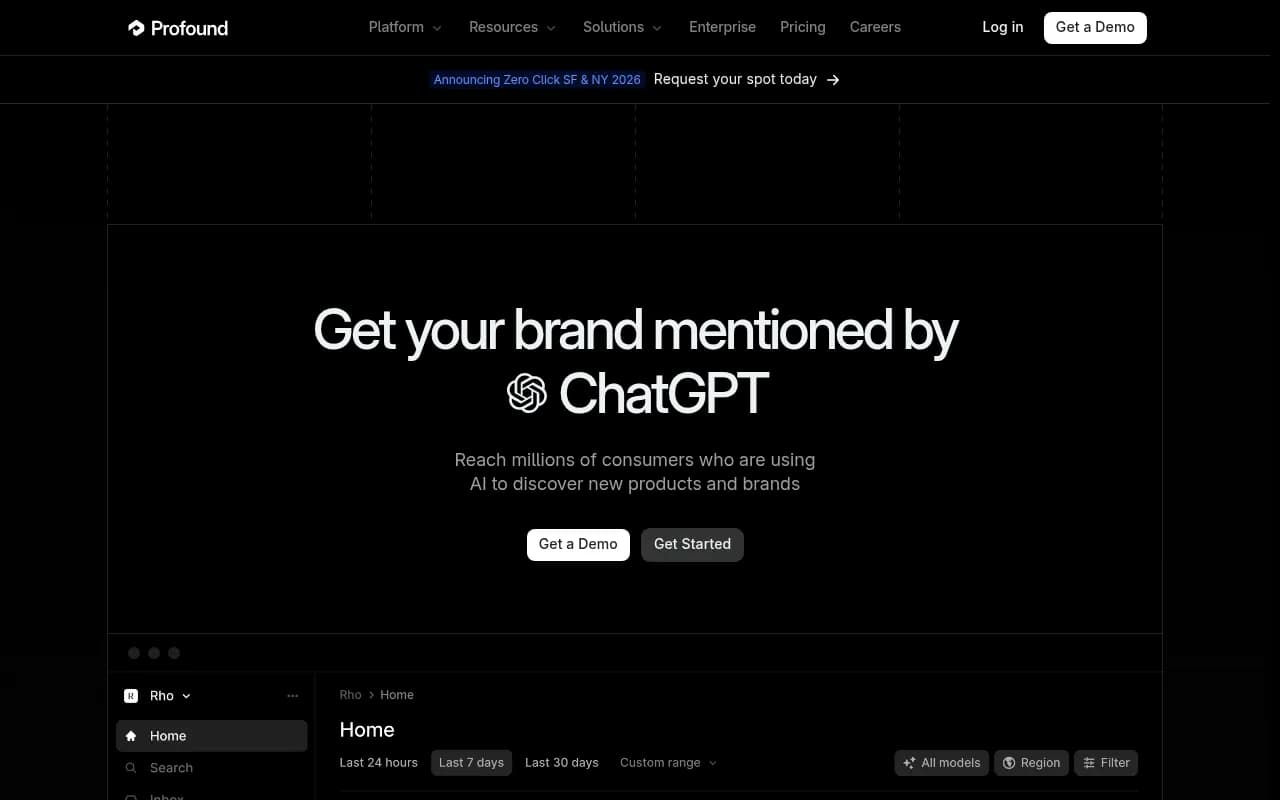
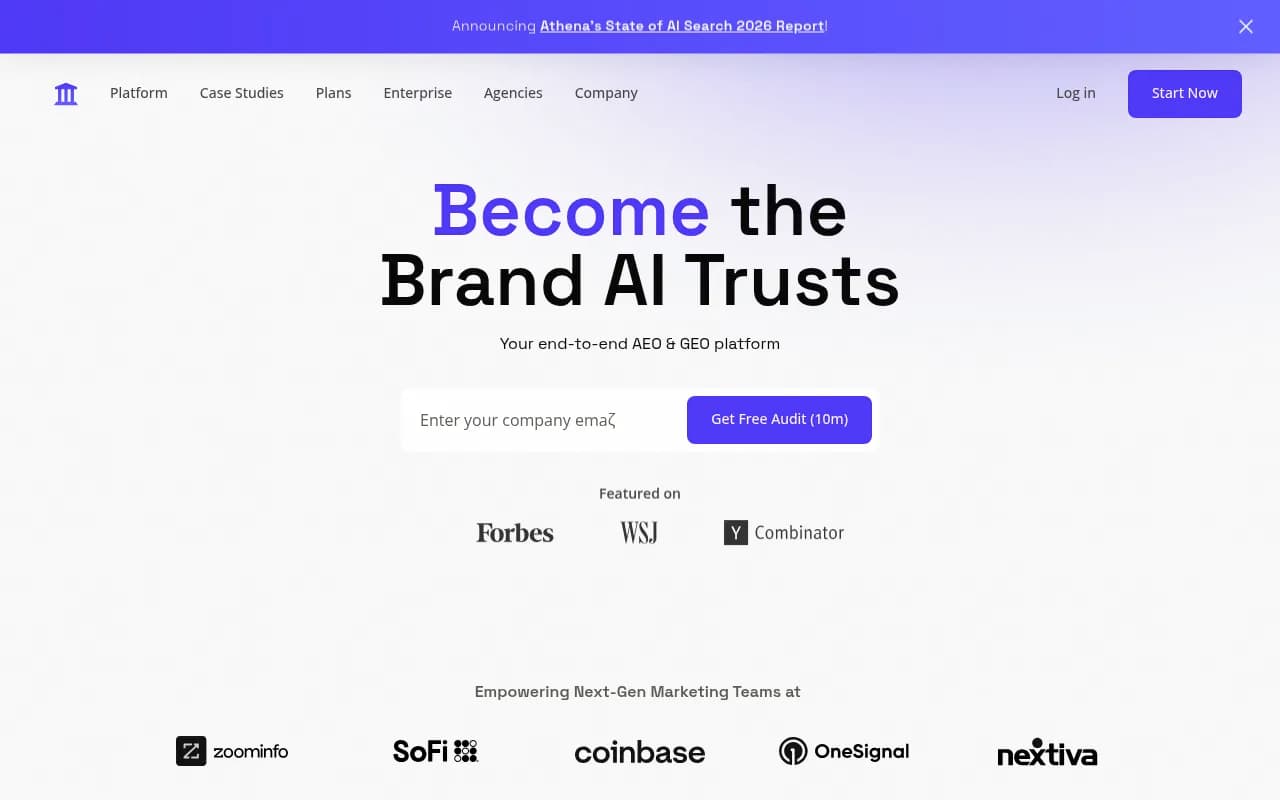
For teams that are earlier in their evaluation and want to explore a range of options, here are some other platforms worth including in your shortlist:

Structuring your pilot
Once you've narrowed to two or three vendors, run a structured pilot rather than going straight to a contract. Here's how to set it up:
Define success criteria before you start. Agree with the vendor on what "success" looks like at the end of the pilot. This might be: identifying 20 high-value content gaps, publishing 5 pieces of content, and seeing measurable visibility improvement on at least 3 prompts within 60 days.
Use real prompts, not vendor-provided ones. Some vendors will offer to set up your account with a curated prompt list. That's fine as a starting point, but make sure you're also testing with prompts you've identified yourself -- the ones that actually matter to your business.
Test the content generation end-to-end. Don't just look at the content brief. Have the platform generate a full article, publish it, and track whether it gets cited. This is the only real test of whether the optimization loop works.
Involve your actual users. The SEO lead, the content manager, the brand manager -- get them using the platform during the pilot, not just watching a demo. Usability issues that don't show up in a 30-minute demo will show up in week two of a pilot.
Ask for a mid-pilot check-in. A vendor who is confident in their product will welcome this. Use it to surface any issues early and see how responsive the team is.
What to include in your RFP
If your procurement process requires a formal RFP, here's a condensed list of what to include beyond the standard vendor information:
- Methodology documentation: how AI model queries are executed, how often, and how scores are calculated
- Security documentation: SOC 2 report, data residency options, GDPR compliance statement
- Integration documentation: API specs, GSC integration details, Looker Studio connector
- Pricing model: full breakdown for your specific use case (sites, prompts, users, regions)
- Reference customers: two or three enterprise customers in a similar industry willing to speak
- SLA documentation: uptime commitment, support response times, escalation process
- Data ownership and portability: what happens to your data if you leave
The answers to these requests will tell you a lot. A vendor who can produce all of this quickly and clearly has built an enterprise-grade product. A vendor who hedges, delays, or redirects to a sales call for every question has not.
Final thoughts
The AI visibility market is real, the stakes are real, and the quality gap between platforms is significant. Enterprise teams that invest in the right platform now -- one that goes beyond monitoring to actually help them create content that gets cited and track whether it's working -- will have a meaningful advantage over competitors who are still watching dashboards and wondering what to do next.
The questions and checklist in this guide won't guarantee you pick the right vendor. But they'll make it much harder for the wrong vendor to slip through.