Key takeaways
- Writesonic is primarily an AI writing and SEO content tool that added GEO features -- it's not a purpose-built AI visibility platform.
- Its GEO dashboard tracks brand mentions across some AI engines, but lacks the depth of dedicated platforms: no crawler logs, limited prompt intelligence, no Reddit/YouTube citation tracking, and no content gap analysis.
- At $249/month for the Professional plan, you're paying enterprise-adjacent prices for monitoring features that specialized tools handle better.
- Teams that need both AI content generation and basic AI visibility tracking in one place may find it useful. Teams serious about GEO will likely outgrow it quickly.
- If AI search visibility is a core priority, purpose-built platforms offer significantly more actionable data.
What Writesonic actually is (and isn't)
Writesonic started as an AI writing assistant. Blog posts, landing pages, ad copy -- it was one of the earlier tools to make AI-generated drafts feel usable for marketing teams. That's still the core of what it does.
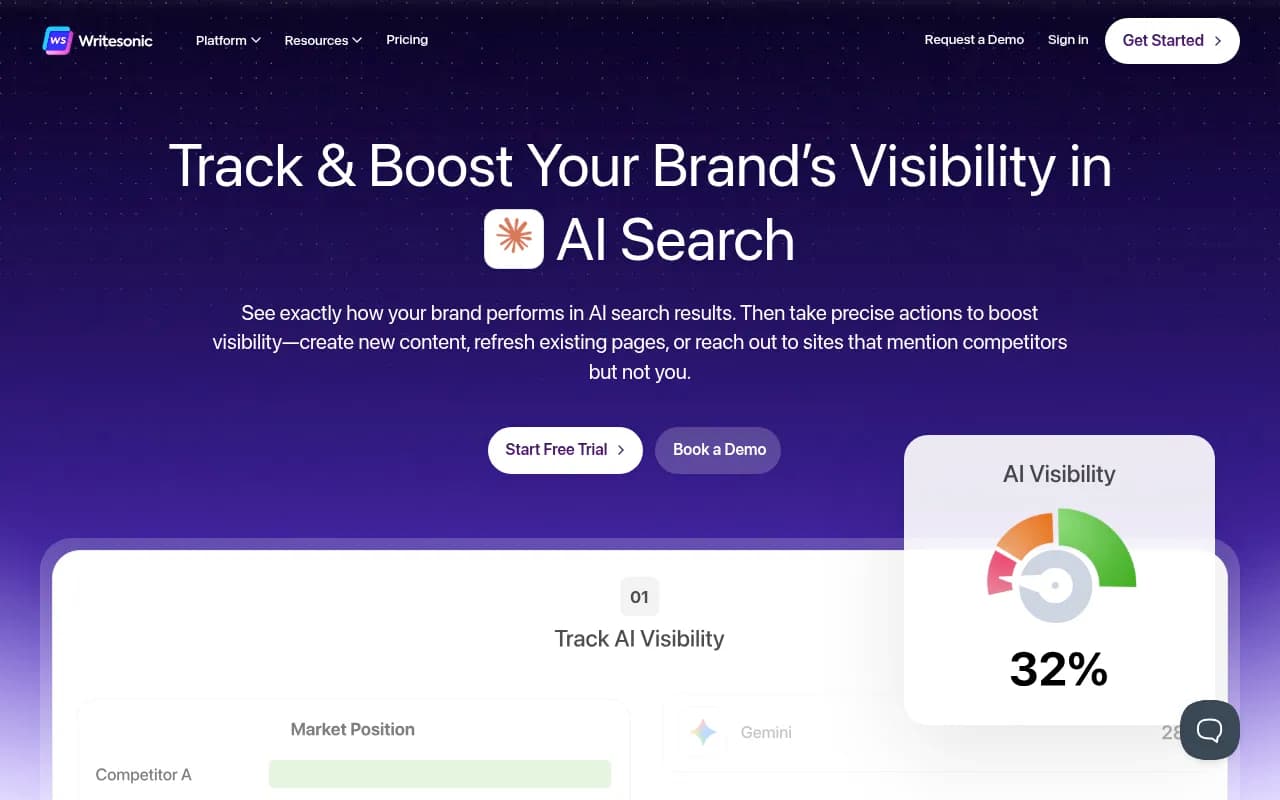
The GEO features came later. Writesonic added an "AI Visibility" dashboard that tracks how often your brand appears in responses from AI engines like ChatGPT, Perplexity, and Gemini. It shows brand mentions, sentiment, and some suggestions for improving your presence.
The question worth asking in 2026 is: does bolting GEO tracking onto a writing tool produce something genuinely useful, or does it produce something that's mediocre at both?
The honest answer is somewhere in between -- but closer to the latter for anyone who takes AI visibility seriously.
What the GEO features actually do
Writesonic's AI visibility suite monitors a set of prompts you configure and checks whether your brand appears in the responses. You get a visibility score, sentiment breakdown (positive, neutral, negative), and some competitor comparison data.
There are also "suggested actions" -- recommendations for what content to create or optimize to improve your AI search presence. This is the most interesting part of the feature set, and it's where Writesonic tries to differentiate itself from pure monitoring tools.
The writing integration makes some sense here: if the platform tells you to create a comparison article, you can theoretically start drafting it in the same tool. That workflow is genuinely appealing on paper.
In practice, the suggestions tend to be fairly generic. They're not grounded in citation data -- the platform doesn't analyze which specific pages, Reddit threads, or external sources AI models are actually pulling from when they answer queries in your space. So the recommendations feel more like educated guesses than data-backed priorities.
Where it falls short for serious GEO work
After 90 days on the Professional plan (documented by practitioners at Analyze AI), the gaps become clearer:
No AI crawler logs. You can't see which AI crawlers are hitting your site, which pages they're reading, or whether they're encountering errors. This is foundational for understanding how AI engines discover and index your content. Most dedicated GEO platforms have this; Writesonic doesn't.
Limited prompt intelligence. Writesonic doesn't give you volume estimates or difficulty scores for prompts, and there's no concept of query fan-outs -- the way a single prompt branches into related sub-queries. Without this, you're essentially guessing which prompts are worth targeting.
No Reddit or YouTube tracking. A significant chunk of what AI models cite comes from Reddit discussions and YouTube content. Writesonic's visibility dashboard doesn't surface these sources, so you're missing a major piece of the citation picture.
No traffic attribution. You can see your visibility score go up, but you can't connect that to actual website traffic or revenue. There's no code snippet, no Google Search Console integration, no server log analysis. The loop never closes.
Fixed or limited model coverage. The platform's AI engine coverage is narrower than dedicated tools, and the prompt monitoring cadence is slower than what you'd get from a purpose-built tracker.
The pricing problem
Writesonic's Professional plan sits at $249/month. That's the same price bracket as dedicated AI visibility platforms that do significantly more on the GEO side.
For $249/month, you're getting a writing tool with GEO features tacked on. If you already have a writing workflow you're happy with, you're essentially paying for a monitoring dashboard that lacks the depth of alternatives. If you need the writing features too, the value calculation changes -- but you'd still want to weigh it against using a dedicated writing tool plus a dedicated GEO platform.
How it compares to dedicated alternatives
Here's a direct comparison across the features that matter most for AI visibility work:
| Feature | Writesonic | Promptwatch | Profound | Otterly.AI |
|---|---|---|---|---|
| AI brand monitoring | Yes | Yes | Yes | Yes |
| Prompt volume/difficulty | No | Yes | Partial | No |
| AI crawler logs | No | Yes | No | No |
| Content gap analysis | Basic | Yes | Yes | No |
| AI content generation | Yes | Yes | No | No |
| Reddit/YouTube tracking | No | Yes | No | No |
| Traffic attribution | No | Yes | No | No |
| ChatGPT Shopping tracking | No | Yes | No | No |
| Price (mid tier) | $249/mo | $249/mo | Higher | Lower |
| Models tracked | Limited | 10+ | Multiple | Limited |
The pattern is clear: Writesonic is competitive on content generation but lags on the GEO depth that actually helps you act on visibility data.
Promptwatch sits at the same price point but covers the full loop -- monitoring, gap analysis, content generation grounded in citation data, crawler logs, and traffic attribution. The difference is that Promptwatch was built around GEO from the start, not retrofitted onto a writing tool.

For pure monitoring at a lower price, tools like Otterly.AI or Peec AI cover the basics without the writing overhead.


For enterprise-grade visibility with deep analytics, Profound is the more established option, though it comes at a higher price and without content generation.
Who Writesonic actually works for
Despite the gaps, there are real use cases where Writesonic makes sense:
Small teams doing both writing and basic GEO. If you're a one- or two-person marketing team that needs AI writing assistance and wants some visibility into how your brand appears in AI search -- without the complexity of running multiple specialized tools -- Writesonic is a reasonable starting point. You won't get deep GEO intelligence, but you'll get something.
Teams already using Writesonic for content. If you're already paying for the platform and the GEO dashboard is included in your plan, it's worth using. The monitoring data is better than nothing, and the content suggestions, even if generic, can prompt useful thinking.
Early-stage GEO programs. If your organization is just starting to think about AI visibility and you want to see what the data looks like before committing to a dedicated platform, Writesonic's dashboard gives you a low-friction introduction to the concept.
Where it stops working is when GEO becomes a serious channel -- when you need to know exactly which prompts competitors are winning, which content gaps are costing you citations, and how AI crawler behavior on your site is affecting your visibility. At that point, you need a purpose-built tool.
The writing features, briefly
Since Writesonic is fundamentally a writing tool, it's worth noting that the AI writing side is genuinely solid. The long-form article generation, content briefs, and SEO optimization features are competitive with tools like Jasper and Copy.ai. The Surfer SEO-style content scoring helps writers hit keyword targets.

If you're evaluating Writesonic purely as a writing tool with some GEO features as a bonus, the calculus is more favorable. The writing quality is good, the interface is clean, and the SEO integration is useful for traditional search.
The issue is that Writesonic markets itself as an AI visibility platform, and on that dimension, the product doesn't match the positioning.
What to look for in a real GEO platform
If Writesonic's limitations push you toward a dedicated tool, here's what actually matters:
Prompt intelligence with volume data. You need to know which prompts are worth targeting -- not just whether you appear in them, but how often people ask them and how hard they are to win.
Citation source analysis. Knowing that AI models cite your competitors isn't enough. You need to know which specific pages, forums, and external sources they're pulling from so you can create content that competes directly.
Crawler log access. Understanding how AI crawlers interact with your site -- which pages they read, how often they return, what errors they hit -- is the technical foundation of GEO. Without it, you're optimizing blind.
Traffic attribution. Visibility scores are vanity metrics unless you can connect them to actual traffic and revenue. Look for tools that offer GSC integration, code snippet tracking, or server log analysis.
Content gap analysis. The most valuable GEO insight is knowing which prompts your competitors appear in that you don't -- and understanding what content you'd need to create to close those gaps.
Tools like Rankability and SearchAtlas have made progress on the content optimization side:

And for teams that want the full action loop -- find gaps, generate content, track results -- the combination of deep monitoring with built-in content generation is what separates optimization platforms from monitoring dashboards.
The verdict
Writesonic is a good AI writing tool that added GEO features. It's not a GEO platform that happens to include writing.
That distinction matters because the two things require fundamentally different architectures. A writing tool optimized for drafting speed and SEO scoring isn't built to ingest AI crawler logs, analyze citation patterns across Reddit and YouTube, or run prompt fan-out analysis. Writesonic didn't build those things because they weren't in the original product vision.
If you're a content team that wants AI writing assistance and a basic visibility dashboard in one place, Writesonic is a reasonable choice. If you're serious about GEO as a growth channel in 2026, you'll want a platform built around that problem from the ground up -- one that closes the loop between finding visibility gaps and actually fixing them.
The $249/month price point makes the comparison unavoidable. At that price, you should be getting more than a monitoring dashboard with generic content suggestions.