Content at Scale Review 2026
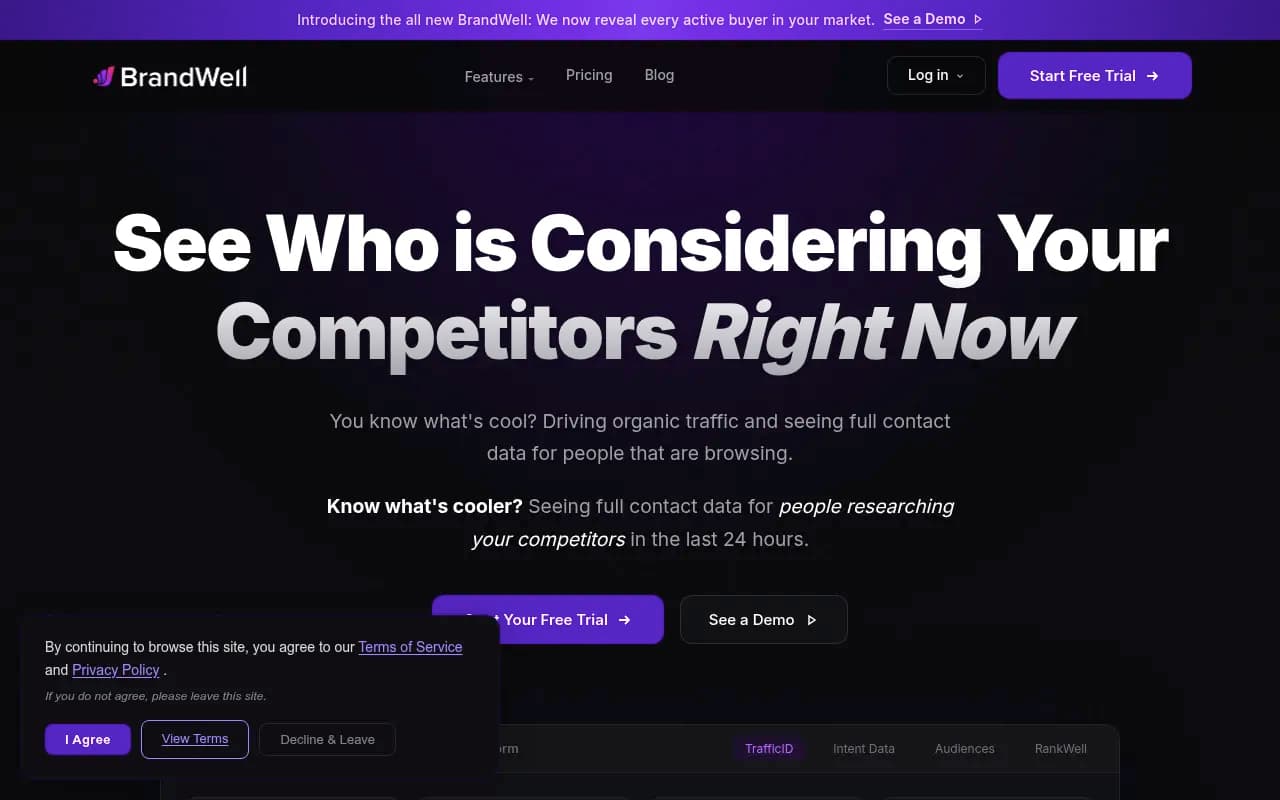
BrandWell (formerly Content at Scale) combines AI-powered SEO content creation with B2B intent data, visitor identification, and ABM tools. Tracks 5B+ daily visits to reveal competitor researchers and active buyers for marketing teams and agencies.
Key takeaways
- BrandWell (the rebrand of Content at Scale) has evolved well beyond an AI writing tool -- it now combines SEO content generation with B2B intent data, visitor identification, and account-based marketing in one platform
- The RankWell content engine is genuinely strong: 12-factor SEO scoring, brand voice calibration trained on your own published content, and programmatic SEO at scale
- The intent data and TrafficID features are the newer, more ambitious additions -- identifying anonymous site visitors and competitor researchers with full contact data is a bold claim that deserves scrutiny
- AIMEE, the platform's AI marketing agent, handles a wide range of tasks but is still maturing as a unified orchestration layer
- Pricing has shifted significantly with the rebrand and is not fully transparent on the main site; older pricing references ($39-$1,199/mo) may no longer reflect current plans
- For teams that want pure AI search visibility and GEO optimization, this tool doesn't cover that space -- platforms like Promptwatch are built specifically for tracking and improving brand presence in ChatGPT, Perplexity, and other AI search engines
Content at Scale launched around 2022 as one of the early AI writing tools specifically designed for long-form SEO content. The pitch was simple and compelling: produce full-length, research-backed blog posts at a fraction of the time and cost of human writers, with enough quality to actually rank. It found a real audience among content agencies, affiliate publishers, and in-house SEO teams who needed volume without sacrificing too much on quality.
By 2025-2026, the company had rebranded to BrandWell and made a significant strategic pivot. The product is no longer just an AI content writer -- it's positioning itself as an "intent-led GTM platform." That means it now combines the original RankWell content engine with TrafficID (anonymous visitor identification), competitor intent data, stakeholder audience building, and an AI marketing agent called AIMEE. It's a substantial expansion, and whether it holds together as a coherent product depends heavily on what you actually need.
The target audience has shifted accordingly. The original Content at Scale was squarely aimed at SEO professionals, content agencies, and affiliate publishers. BrandWell now also targets B2B marketing and revenue operations teams who want to identify and surround active buyers with content and ads. That's a wider net, and it creates some tension in the product experience -- the two halves (content creation and intent data) feel like they're still finding their integration story.
Key features
RankWell content engine
This is the original core of the product and still its strongest component. RankWell generates long-form SEO articles with a 12-factor scoring system that grades content before it publishes. The factors include keyword placement in title, headers, meta description, and first paragraph; URL slug optimization; word count; internal and external links; and secondary keyword usage. Each article gets a score out of 100, and the system won't recommend publishing until it hits a threshold.
The brand voice calibration is a standout feature. You train it on your existing published content -- the system claims to analyze up to 847 articles -- and it scores new content across dimensions like sentence structure, vocabulary match, tone consistency, and formality. Getting a 94% overall voice match on generated content is a meaningful claim for teams that have spent years building a recognizable editorial identity.
Programmatic SEO support lets you feed in CSVs, APIs, or product feeds to generate thousands of unique pages. The drip-publishing feature is designed to avoid Google's sandbox effect by spacing out publication rather than dumping hundreds of pages at once.
The Weekly 5
A weekly digest of your five highest-impact ranking opportunities -- pages currently sitting just outside page one that need specific edits to move up. Each recommendation includes the current position, target position, search volume, difficulty score, and a specific action (e.g., "Add 2 expert quotes + update statistics section"). This is a practical, actionable format that cuts through the noise of a full SEO audit. It's closer to a coaching tool than a data dump.
TrafficID and visitor identification
BrandWell claims to identify anonymous website visitors with full contact data -- names, emails, job titles, company info -- even if they never fill out a form. This is powered through data partnerships tracking over 5 billion visits per day. The system identifies not just your own site visitors but also people actively researching your competitors across 35,000+ intent topics, updated daily.
This is the most ambitious and also the most legally sensitive part of the platform. Visitor identification tools in general operate in a gray area around privacy regulations (GDPR, CCPA), and the quality of the contact data varies significantly across vendors in this space. The claims here are bold -- "full contact data, not just IP addresses" -- and worth verifying with a trial before committing.
Intent data and competitor signals
The intent data layer surfaces professionals who are actively evaluating solutions in your category -- reading reviews, comparing tools, researching vendors. The 35,000+ topic database is searchable, and you can see average daily profile counts for any topic before you buy. This is a useful pre-purchase signal.
The competitor site visitor identification is the headline feature: BrandWell claims to show you who is actively browsing your competitors' websites. If accurate, this is genuinely valuable for B2B sales and marketing teams. The practical question is data freshness and match rate, which the platform doesn't fully disclose publicly.
Stakeholder audience mapping and ABM
Once visitors and intent signals are identified, BrandWell maps them to the full buying committee at their companies -- VP, CFO, CMO, and other budget holders. It then syncs these audiences to Meta, Google Ads, and LinkedIn for targeted advertising. The demo shows a company like "Acme Corp" with 6 of 8 decision makers identified, their visit history, and their current buying stage (Awareness, Research, Decision, Negotiation).
This is a genuine account-based marketing workflow, not just a data export. The integration with ad platforms means you can act on the data without leaving the platform or manually uploading lists.
AIMEE AI marketing agent
AIMEE is described as having 20+ specialized skills and 70+ internal tools. In practice, it functions as an AI assistant that can write articles, build stakeholder audiences, generate ad creative, run competitive analysis, and execute content gap strategies. The "Weekly 5" is surfaced through AIMEE's analysis.
The conversational interface shown in the demo is impressive on paper -- you ask AIMEE to draft 23 articles targeting competitor content gaps, and it schedules them across content clusters with CTAs and formatting. Whether the actual output quality matches the demo is the real question, and it varies by use case.
12-factor SEO scoring
Worth calling out separately because it's more granular than most AI writing tools offer. The scoring covers: word count, media inclusion, keyword in title, keyword in headers, meta description, internal/external links, keyword in first paragraph, URL slug, title length, priority keywords, keyword usage density, and secondary keywords. Each factor is graded individually, giving writers a clear checklist rather than a vague quality score.
Who is it for
The original Content at Scale audience -- SEO agencies, affiliate publishers, and content-heavy brands -- is still well served by the RankWell side of the platform. If you're running a site like Hawaii-Guide.com (cited as a customer with 15M+ annual visitors) or a healthcare content operation like NextCare, the content engine is mature and capable. Teams producing 20-100+ articles per month who need consistent brand voice and SEO optimization without a full editorial staff will find real value here.
The newer BrandWell positioning targets B2B marketing and revenue operations teams at companies with active sales cycles. Think SaaS companies with 50-500 employees, where the marketing team is trying to identify and influence buyers before they ever raise their hand. If your sales cycle involves multiple stakeholders and you're running account-based marketing programs, the intent data and audience sync features are directly relevant.
The platform is less suited to individual bloggers or small businesses with limited ad budgets -- the intent data and ABM features require meaningful ad spend to activate, and the pricing reflects an enterprise-adjacent positioning. Solo content creators who just want an AI writing assistant would be better served by simpler, cheaper tools.
Companies in highly regulated industries (healthcare, finance, legal) should approach the visitor identification features carefully. The contact data sourcing and privacy compliance claims need independent verification before you build a marketing workflow around them.
Integrations and ecosystem
BrandWell integrates with a solid set of platforms:
- CMS integrations: WordPress, Shopify, Webflow, Squarespace -- direct publishing from the platform
- CRM and marketing: HubSpot, GoHighLevel
- Ad platforms: Meta Ads, Google Ads, LinkedIn Ads (for audience syncing)
- Data inputs: CSV uploads, API feeds, product feeds for programmatic SEO
The platform has its own API for data ingestion (feeding product data into programmatic SEO workflows), though a full developer API for external integrations isn't prominently documented. There's no mention of a Zapier integration or native Slack notifications, which would be useful for alerting sales teams when high-intent accounts are identified.
A browser extension isn't listed as a feature. Mobile app support isn't mentioned either -- this is primarily a web platform.
Pricing and value
Pricing is genuinely unclear from the current website, which is a frustration. The site redirects to BrandWell branding and doesn't display a clear pricing page in the scraped content. Historical references suggest Content at Scale started at $39/month and scaled to $1,199+/month for high-volume content production. Capterra lists a starting price of $250 flat rate, which may reflect a newer tier structure.
Given the platform now bundles intent data, visitor identification, and ABM tools alongside content generation, pricing has almost certainly increased from the original Content at Scale tiers. Intent data platforms in this space (like Bombora, G2 Buyer Intent, or ZoomInfo) typically run $1,000-$3,000+/month for comparable data access. If BrandWell is bundling this at a lower price point, it's either a significant value play or the data quality is more limited than enterprise alternatives.
A 7-day free trial is available, which is the right way to evaluate the visitor identification claims before committing.
Strengths and limitations
What it does well:
- The RankWell content engine is mature and genuinely useful for high-volume SEO content production. The 12-factor scoring and brand voice calibration are more sophisticated than most AI writing tools.
- Combining content creation with intent data in one platform is a real workflow advantage -- you can identify what topics competitors rank for, generate content to compete, and track who's researching those topics.
- The Weekly 5 feature is a practical, low-noise way to surface actionable SEO improvements without drowning in data.
- Programmatic SEO with drip publishing is a thoughtful feature that shows real understanding of how Google responds to content floods.
- The ABM audience sync to Meta, Google, and LinkedIn is a direct action path from data to advertising, which most intent data tools don't provide natively.
Honest limitations:
- The visitor identification and competitor traffic claims are extraordinary and require independent verification. Privacy compliance (GDPR, CCPA) is a real concern for any team using these features with European or California-based audiences.
- Pricing transparency is poor. The rebrand to BrandWell has created confusion about what plans exist and what they cost, which makes it hard to evaluate value before starting a trial.
- The two halves of the platform -- content creation and intent data/ABM -- feel like they're still being integrated. The AIMEE agent is the connective tissue, but it's not clear how seamlessly the workflows actually connect in practice versus in the demo.
- No coverage of AI search visibility. If you want to know how your brand appears in ChatGPT, Perplexity, or Google AI Overviews, BrandWell doesn't address that. This is a growing gap as AI search becomes a primary discovery channel.
Bottom line
BrandWell is a genuinely ambitious product that has grown well beyond its AI writing tool origins. For B2B marketing teams running account-based programs who also need serious content production capabilities, the combination of intent data, visitor identification, and RankWell's content engine is a compelling bundle -- if the data quality holds up under real-world testing.
For teams whose primary concern is traditional SEO content at scale, the RankWell engine remains one of the more capable tools in the market, with brand voice calibration and programmatic SEO features that outpace simpler AI writers. The best use case is a B2B SaaS or services company that needs both high-volume SEO content and account-level intent signals to feed a sales and advertising workflow.
Frequently asked questions
What is BrandWell (formerly Content at Scale)?
How much does BrandWell cost?
What is TrafficID and how does it work?
What is RankWell?
Who is BrandWell best suited for?
Does BrandWell track AI search visibility in tools like ChatGPT or Perplexity?
Similar and alternative tools to Content at Scale