Uberall Review 2026
Uberall is a multi-location marketing platform for brands managing dozens to thousands of physical locations, handling listings, reviews, local pages, social posting, and now AI search visibility through its GEO Studio product. Built for enterprise retail, QSR, hospitality, and EV charging brands, i
Key takeaways
- Uberall centralizes listings, reviews, local pages, and social posting for multi-location brands managing anywhere from 20 to thousands of physical locations.
- Its newer GEO Studio product tracks AI search visibility (ChatGPT, Gemini, Perplexity) at the location level, but it's monitoring-and-content-generation focused rather than a full agentic optimization stack. It lacks the AI crawler logs, traffic attribution, Reddit/YouTube citation tracking, and ChatGPT Shopping monitoring that Promptwatch offers, and covers fewer AI models (3-9 depending on tier vs. Promptwatch's 10+).
- G2 reviewers rate it 4.4/5 and Capterra reviewers rate it 4.6/5, praising ease of use and support, but a smaller sample of Trustpilot reviews (2.3/5) raises real concerns about AI suggestion accuracy and overstated directory reach.
- Core plan pricing isn't published; you have to talk to sales. GEO Studio pricing is transparent, starting at $109/month.
- Best suited to enterprise and mid-market multi-location brands in retail, QSR, hospitality, financial services, and EV charging, not solo-location businesses or brands whose primary need is deep AI-optimization tooling.
What Uberall actually is
Uberall started in Berlin in 2013 as a business listings management tool and has spent over a decade bolting on adjacent capabilities: reviews, local pages, social posting, analytics, and, as of December 2025, a dedicated AI search product called GEO Studio built in partnership with AthenaHQ. The company now says it powers 1.4 million-plus business locations for roughly 1,800 customers and partners, and it has absorbed several smaller companies along the way, including MomentFeed, SweetIQ Analytics, Navads, and Spotistic. A $115 million funding round tied to the MomentFeed acquisition pushed cumulative funding into the $115M-$164M range depending on the source you trust.
The pitch is simple: if you run 50, 500, or 5,000 locations, you can't manually keep every Google Business Profile, Apple Maps listing, Yelp page, and Facebook location page accurate and synced. Uberall gives you one dashboard to push updates everywhere at once, respond to reviews in bulk with AI-assisted replies, publish local social content per location, and, increasingly, try to make sure AI assistants recommend your locations too.
This is not a tool built for a single-location coffee shop or a freelancer managing one client's Google profile. It's built for operations and marketing teams juggling franchise networks, retail chains, bank branches, or EV charging networks where consistency at scale is the whole problem.
Key features
-
Listings management: Push business information (hours, address, phone, photos, attributes) to 150+ directories from one place, including Google, Apple Business Connect, Yelp, TripAdvisor, and voice search platforms. Duplicate suppression is included to clean up conflicting listings that hurt local rankings. In practice, several reviewers note that actual live distribution can fall short of what's advertised, with one agency reviewer on Trustpilot claiming they saw roughly 40 directories actually live versus a sales claim of 100+.
-
GEO Studio: Uberall's answer to AI search visibility, tracking how brands appear in ChatGPT, Gemini, and Perplexity answers at the location level. The Starter tier ($109/mo) tracks 3 answer engines with 50 prompts and weekly/monthly checks; Scale ($449/mo) bumps that to 5 engines, 150 prompts, and daily tracking with location-level breakdowns; Enterprise adds 9 engines and custom tracking frequency. It generates AI-readable content (FAQs, local pages, posts) and auto-publishes it. This is a genuinely useful add for multi-location brands worried about AI discovery, but it monitors fewer models than dedicated GEO platforms and doesn't include crawler-log analytics or AI-driven traffic attribution back to the website.
-
Review management: Aggregates reviews from Google, Yelp, Facebook, and other sources into one inbox, with AI-generated bulk reply suggestions and sentiment analysis (the latter gated behind the Reviews Plus add-on). Several reviewers specifically call out the AI bulk-reply feature as a genuine time-saver, with one noting it references the reviewer's actual name and content rather than generic boilerplate.
-
Local pages and store locator: Auto-generated, SEO/GEO-optimized landing pages per location with built-in calls to action for directions, bookings, and reviews. Positioned as both a conversion tool and an AI-discoverability tool, since these pages are the content AI systems can cite.
-
Local social: AI-generated, brand-compliant social posts pushed to Facebook, Instagram, LinkedIn, Google, and Apple per location, with templates so individual store managers aren't starting from scratch each time.
-
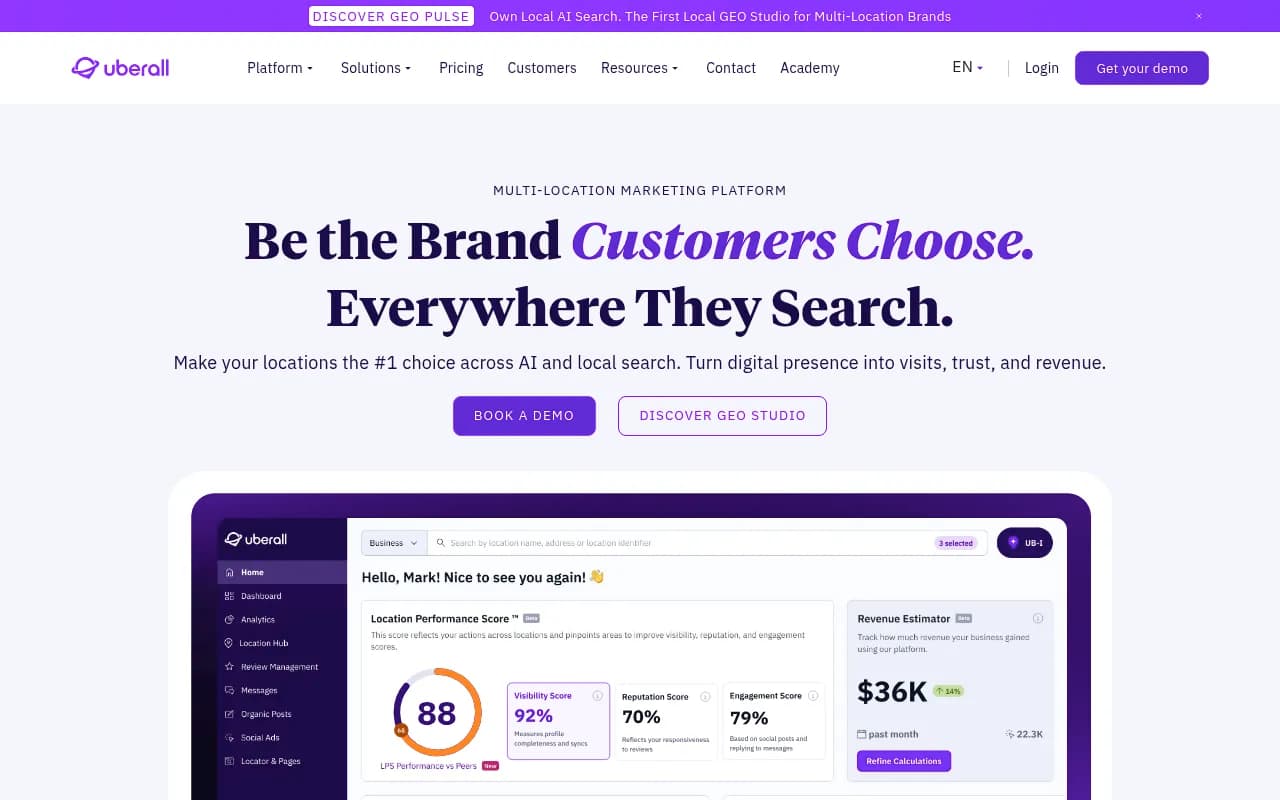
UB-I: Uberall's agentic AI layer, described as an always-on agent that monitors locations and prioritizes actions rather than just reporting data. UB-I 2 launched in November 2025 as an upgrade. It's a genuinely differentiated idea for the local-marketing space, though it's a much narrower scope of automation than what a dedicated GEO platform's content agents handle across the entire AI-visibility funnel.
-
Analytics: Visibility, reputation, conversion, and engagement metrics per location, plus a Revenue Estimator that tries to tie local marketing activity to actual revenue impact. Competitor benchmarking is included in some tiers.
-
Integrations: 50+ integrations claimed, including Shopify, Zendesk, Tableau, Salesforce, Google BigQuery, Google Ads, Canva, and Semrush shown on the homepage. GEO Studio specifically connects to Google Analytics 4, Google Search Console, Google Ads, Shopify, Webflow, Wix, Framer, WordPress, and Looker Studio. There's also an open-source MCP server on GitHub for programmatic API access.
Who is it for
Uberall makes the most sense for marketing and operations teams at multi-location brands with at least 20-30 physical locations, and it scales cleanly up to enterprise networks with thousands. Franchise-heavy brands like KFC, Burger King, and Pizza Hut use it precisely because local marketing decisions need to happen at both the corporate and franchisee level simultaneously. Retailers like Menkind and Douglas use it to keep hundreds of store listings consistent without a large dedicated team. EV charging network operators (EVgo, Powerdot, Ionity are referenced customers) are a growing niche, since charging station data changes frequently and accuracy directly affects whether drivers can find a working charger.
Real estate and property services firms like Cushman & Wakefield and REMAX use it for office-listing consistency across regions, and financial services brands like Arvest Bank and insurance companies like LVM Versicherung use it to manage branch-level digital presence and customer messaging.
Who shouldn't use it: single-location businesses, agencies managing a handful of small clients where a simpler tool would do, and any brand whose primary goal is deep, best-in-class AI search optimization rather than
Tags:
Frequently asked questions
What is Uberall used for?
How much does Uberall cost?
Is Uberall good for small businesses?
How does Uberall's GEO Studio compare to Promptwatch?
What are Uberall's biggest weaknesses?
What integrations does Uberall support?
Similar and alternative tools to Uberall