Trakkr.ai Review 2026
Trakkr.ai monitors how AI models like ChatGPT, Claude, Gemini, and Perplexity mention your brand. Track visibility scores, discover citation sources, analyze competitor rankings, and optimize your content to win AI recommendations. Includes automated site optimization, AI traffic attribution, and ac
Summary
- Monitoring-only platform -- Trakkr shows you visibility scores and citation sources but lacks content generation, AI crawler logs, and traffic attribution that Promptwatch offers
- Covers 8 AI models including ChatGPT, Claude, Perplexity, Gemini, Grok, Meta AI, and more -- tracks brand mentions and competitor rankings across each
- Best for brand teams and agencies who want to monitor AI visibility without building optimization workflows themselves
- Pricing starts at $79/mo for 50 queries and basic tracking -- free plan available with 5 queries
- Missing key optimization features like Answer Gap Analysis, AI content generation, prompt volume scoring, and Reddit/YouTube tracking that competitors like Promptwatch provide

Trakkr.ai is an AI brand visibility monitoring platform built for marketing teams, agencies, and startups who want to understand how AI models like ChatGPT, Claude, Perplexity, and Gemini mention their brand. It tracks visibility scores across 8 AI platforms, surfaces the sources AI models cite when recommending brands, and provides competitor benchmarking. The platform launched in response to the shift toward AI-driven search -- Gartner research cited on their site claims 25% of buyers now ask AI before making purchase decisions.
The core pitch: when buyers ask ChatGPT or Perplexity for product recommendations, AI surfaces just 3-5 brands per query. There's no second page. If you're not in that shortlist, you're invisible. Trakkr helps you monitor whether you're making the cut.
The platform is aimed at brand managers, SEO teams, and digital agencies who need visibility into how AI models perceive their brand. It's particularly relevant for SaaS companies, e-commerce brands, and service businesses where AI recommendations directly influence buying decisions. The tool positions itself as more accessible than enterprise GEO platforms (no sales calls, transparent pricing) but more comprehensive than basic monitoring dashboards.
Visibility Tracking Across AI Models
Trakkr monitors 8 AI platforms: ChatGPT, Claude, Perplexity, Gemini, Grok, Meta AI, and two others not specified on the site. For each platform, it tracks three core metrics: overall visibility score (0-100), total brand mentions, and competitive ranking (your position vs competitors for specific queries). The dashboard shows 14-day trend lines so you can see if visibility is improving or declining.
The platform lets you define custom queries relevant to your business -- e.g. "best CRM for small teams" or "top project management tools for agencies." Trakkr then monitors how often your brand appears in AI responses to those queries, what position you hold, and which competitors are mentioned alongside you. This is more targeted than generic brand monitoring because you're tracking the exact prompts your potential customers are likely to use.
One useful feature: the "By Model" breakdown shows visibility scores per AI platform. You might rank #1 on ChatGPT but be invisible on Perplexity. This helps you prioritize where to focus optimization efforts. However, Trakkr doesn't provide prompt volume estimates or difficulty scoring, so you're guessing which queries are actually worth targeting.
Citation Source Discovery
When AI models mention your brand, Trakkr surfaces the sources they're citing -- review sites like G2 or Capterra, Reddit threads, news articles, social media posts. The dashboard categorizes these into Reviews (43%), Social (24%), News (20%), and Other (13%) based on the example screenshot. You can see the top sources by citation count and drill into specific URLs.
This is valuable for understanding your citation footprint. If AI models are pulling from outdated reviews or negative Reddit threads, you know where to focus reputation management. If competitors are getting cited from authoritative sources you're missing, you can target those channels.
The limitation: Trakkr shows you the sources but doesn't help you create content to earn more citations. It's diagnostic, not prescriptive. You're left to figure out the optimization strategy yourself. Competitors like Promptwatch go further by analyzing content gaps and generating articles designed to get cited by AI models.
Competitor Intelligence
Trakkr maps your visibility against competitors for each tracked query. You can see who ranks #1, #2, #3 for prompts like "best analytics platform for SaaS" and how your position changes over time. The platform claims to have mapped 929,876 competitors across all tracked brands.
The competitor view helps you identify where you're losing ground. If a competitor suddenly jumps ahead on a key query, you can investigate what changed -- did they publish new content, earn press coverage, or get featured on a major review site? The dashboard doesn't surface these insights automatically; you have to dig.
What's missing: Trakkr doesn't show you the specific content or pages competitors have that you lack. There's no Answer Gap Analysis to reveal which topics or angles AI models want but can't find on your site. You're monitoring the scoreboard without a playbook for how to win.
Automated Site Optimization (Prism)
Trakkr includes a feature called Prism that "enhances how crawlers see your pages, no code required." Based on the screenshot, it adds schema markup, FAQ structure, clear citations, and expert bylines to improve your site's AI readability. The dashboard shows an "AI Score" (0-100) and tracks crawler activity from Gemini, GPTBot, Claude, and Perplexity.
This is useful for technical optimization -- making sure AI crawlers can parse your content properly. The "52 citations this week" metric suggests Prism is actively serving optimized versions of your pages to AI crawlers. However, the site doesn't explain how Prism works under the hood or whether it's a proxy layer, JavaScript injection, or something else.
The crawler activity log shows which AI models are hitting your site and which pages they're reading. This is helpful for understanding indexing patterns, but it's not as detailed as full AI crawler logs that show errors, response times, and crawl frequency over time. Promptwatch offers real-time crawler logs with error tracking and indexing diagnostics that Trakkr lacks.
AI Traffic Attribution
Trakkr connects to Google Analytics 4 to track visitors referred by AI platforms. The dashboard shows sessions from ChatGPT, Perplexity, Claude, and Gemini, plus revenue attributed to AI-referred visitors. The example screenshot shows $12,847 in monthly revenue from AI traffic, with ChatGPT driving $6,841.
This is valuable for proving ROI. If you're investing in AI visibility optimization, you need to know whether it's actually driving conversions. The 2-minute GA4 integration is straightforward -- no code changes required.
The limitation: Trakkr's traffic attribution relies on referrer data from Google Analytics. This works for direct clicks from AI platforms but misses indirect influence (e.g. someone sees your brand in ChatGPT, then searches for you on Google). More sophisticated attribution models (like Promptwatch's visitor analytics with code snippet or server log analysis) capture a fuller picture of AI's impact on your funnel.
Reporting and Alerts
The Growth plan includes executive summary reports and shared dashboards. You can export data to CSV or Google Sheets. The platform offers automated alerts (3 on Growth, unlimited on Scale) for visibility changes, new competitor mentions, or citation spikes.
The Scale plan ($399/mo) adds white-label reports for agencies, a multi-client dashboard, and API access. This is useful for agencies managing AI visibility for multiple clients, though the pricing is steep compared to monitoring-only competitors like Otterly.AI or Peec.ai.
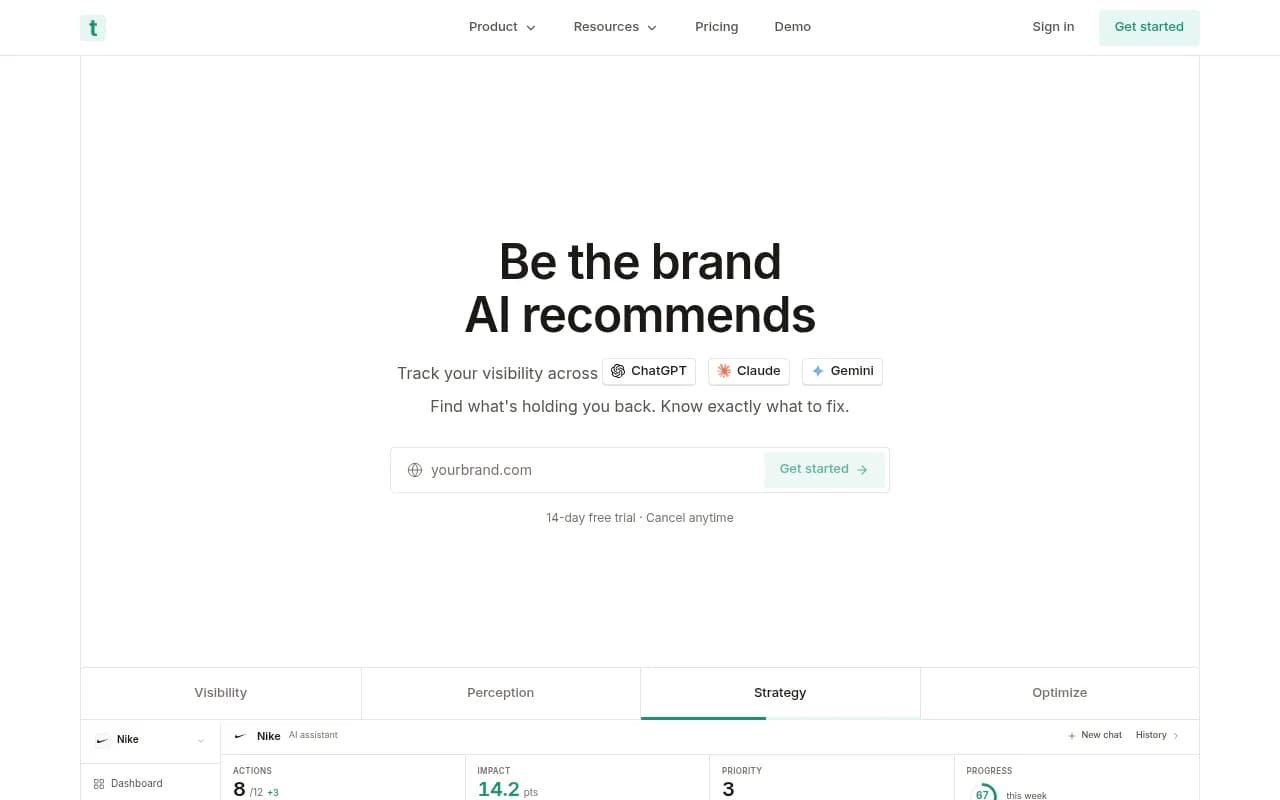
What's missing: Trakkr doesn't provide content recommendations, gap analysis reports, or optimization roadmaps. The "Priority Actions" feature shown in the hero section ("Update product descriptions +5.2", "Build Wikipedia presence +4.8") looks promising, but it's unclear how detailed or actionable these suggestions are in practice. The site doesn't explain the methodology behind impact forecasts.
Who Is Trakkr For
Trakkr is best suited for brand managers and marketing teams at SaaS companies, e-commerce brands, and service businesses where AI recommendations directly influence buying decisions. If you're selling project management software, CRM tools, meal kits, or mattresses -- categories where buyers frequently ask AI for recommendations -- Trakkr helps you monitor whether you're showing up.
It's also useful for digital agencies managing AI visibility for multiple clients. The Scale plan's white-label reports and multi-brand dashboard are built for this use case. However, agencies that want to actively optimize client visibility (not just monitor it) will find Trakkr limited. There's no content generation, no gap analysis, no prompt intelligence to prioritize high-value queries.
Startups and small teams on tight budgets can start with the free plan (1 brand, 5 queries) to get a baseline understanding of their AI visibility. The $79/mo Growth plan is affordable for most businesses, though you're capped at 50 queries. If you need to track more prompts or multiple brands, you're jumping to $399/mo.
Who should NOT use Trakkr: Teams that want an optimization platform, not just a monitoring dashboard. If you need help identifying content gaps, generating AI-optimized articles, or understanding which prompts are worth targeting, Trakkr won't get you there. Promptwatch is the stronger choice for teams that want to take action, not just watch numbers.
Integrations and Ecosystem
Trakkr integrates with Google Analytics 4 for traffic attribution. The Scale plan includes API access for custom integrations, though the API documentation isn't publicly available on the site. There's no mention of integrations with content management systems, SEO tools, or marketing automation platforms.
The platform doesn't offer browser extensions or mobile apps. Everything happens in the web dashboard. Data export is available via CSV or Google Sheets, which is useful for pulling visibility data into custom reports or BI tools.
Compared to competitors, Trakkr's ecosystem is minimal. There's no Looker Studio integration, no Slack alerts, no Zapier connector. If you want to build custom workflows around AI visibility data, you're limited to the API (Scale plan only) or manual CSV exports.
Pricing and Value
Trakkr offers three plans:
- Free: 1 brand, 5 queries, daily visibility updates, competitor intelligence. Good for testing the platform but too limited for serious monitoring.
- Growth ($79/mo): 50 queries, all 8 AI models, citation tracking, perception analysis, executive reports, shared dashboards, automated site optimization (Prism), data export, 3 automated alerts. This is the core plan for most users.
- Scale ($399/mo): 10 brands, 50 queries each, full historical data, white-label reports, API access, unlimited alerts, agency dashboard, priority support. Built for agencies and enterprises managing multiple brands.
Annual billing saves 17%. All paid plans include a 14-day free trial.
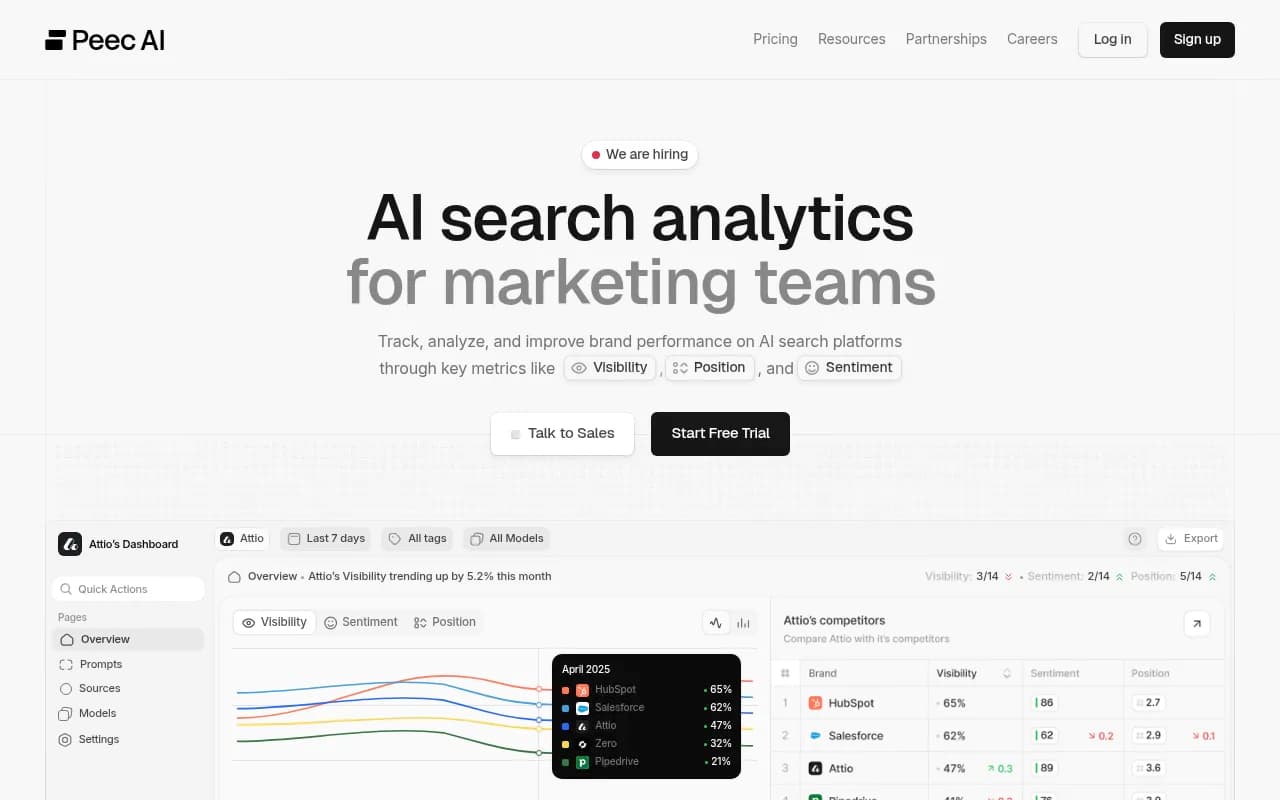
How does this compare to competitors? Trakkr's $79/mo Growth plan is cheaper than Promptwatch's Essential plan ($99/mo), but Promptwatch includes content generation, AI crawler logs, and Answer Gap Analysis that Trakkr lacks. Otterly.AI and Peec.ai are monitoring-only tools in a similar price range, but they don't offer automated site optimization or traffic attribution.
The value proposition depends on what you need. If you just want to monitor AI visibility and don't need optimization tools, Trakkr is reasonably priced. If you want to actively improve your AI rankings, you'll need to supplement Trakkr with content creation and SEO tools -- or switch to a platform like Promptwatch that handles the full optimization loop.
Strengths
- Multi-model coverage: Tracks 8 AI platforms including ChatGPT, Claude, Perplexity, Gemini, Grok, and Meta AI. Most competitors focus on 3-5 models.
- Citation source discovery: Shows exactly which URLs AI models cite when mentioning your brand. Useful for reputation management and identifying content gaps.
- AI traffic attribution: GA4 integration tracks revenue from AI-referred visitors. Proves ROI for AI visibility efforts.
- Automated site optimization (Prism): Adds schema markup and FAQ structure to improve AI crawler readability without code changes.
- Transparent pricing: No sales calls, no "contact us" gates. Clear pricing tiers with 14-day free trial.
- Competitor benchmarking: See your ranking vs competitors for each tracked query.
Limitations
- Monitoring-only platform: Trakkr shows you visibility scores and citation sources but doesn't help you optimize. Missing content generation, Answer Gap Analysis, and prompt intelligence that Promptwatch provides.
- No AI crawler logs: The crawler activity view is basic -- just recent page hits. No error tracking, crawl frequency analysis, or indexing diagnostics.
- No Reddit or YouTube tracking: Trakkr doesn't surface Reddit discussions or YouTube videos that influence AI recommendations. These channels are critical for brand perception but ignored by Trakkr.
- No prompt volume or difficulty scoring: You're tracking queries blindly without knowing which prompts are high-value or winnable. Promptwatch provides volume estimates and difficulty scores to prioritize optimization efforts.
- Limited query capacity: 50 queries on Growth, 500 total on Scale (10 brands × 50 each). If you need to track hundreds of prompts for a single brand, you're out of luck.
- No ChatGPT Shopping tracking: Trakkr doesn't monitor when your brand appears in ChatGPT's product recommendations or shopping carousels.
- Vague "Priority Actions" feature: The hero section shows impact forecasts and optimization suggestions, but the site doesn't explain how these are generated or how actionable they are in practice.
Bottom Line
Trakkr.ai is a solid monitoring tool for brands that want to track AI visibility across multiple platforms. The citation source discovery, competitor benchmarking, and AI traffic attribution are useful features. The $79/mo Growth plan is affordable for most businesses, and the automated site optimization (Prism) adds some technical value.
However, Trakkr is a dashboard, not an optimization platform. It shows you where you're losing but doesn't help you win. If you need content gap analysis, AI-optimized content generation, or prompt intelligence to prioritize high-value queries, Promptwatch is the stronger choice. Promptwatch closes the optimization loop -- find gaps, generate content, track results -- while Trakkr stops at step one.
Best use case: Brand managers at SaaS or e-commerce companies who want to monitor AI visibility and prove ROI with traffic attribution, but plan to handle content optimization separately.
Tags:
Similar and alternative tools to Trakkr.ai