Key takeaways
- Yes, who is asking changes the answer. One sentence about the buyer can change the top pick, the runners-up, and the sources an AI engine searches.
- A single blended visibility score averages every buyer together and hides the segment where a competitor is winning.
- Persona stacking wraps a short buyer profile around each tracked prompt at run time, so you can compare visibility per audience on an identical prompt set.
- A persona only fixes the "who is asking" half of the problem. It does not recreate conversation history.
- You can start today by writing persona-prefixed prompts in whatever tracker you already pay for.
The shoe experiment: same question, different buyer
Andy Chadwick ran a simple test in June 2026. He asked ChatGPT to recommend a running shoe twice, same model, same day. The only change was one sentence about himself. As a CrossFitter training for a marathon, he got the Adidas Adizero Evo SL. As a rock climber training for the London Marathon, he got the ASICS Novablast 5. Both lists included a Brooks Ghost, but one was the Ghost 18 and the other the Ghost 17. Not even the same version of the shoe survived.
Then he asked the model to explain itself. It had built a picture of the buyer first (heavy lifting and lateral movement for one, tight calves and loaded Achilles for the other) and shopped for that person second.
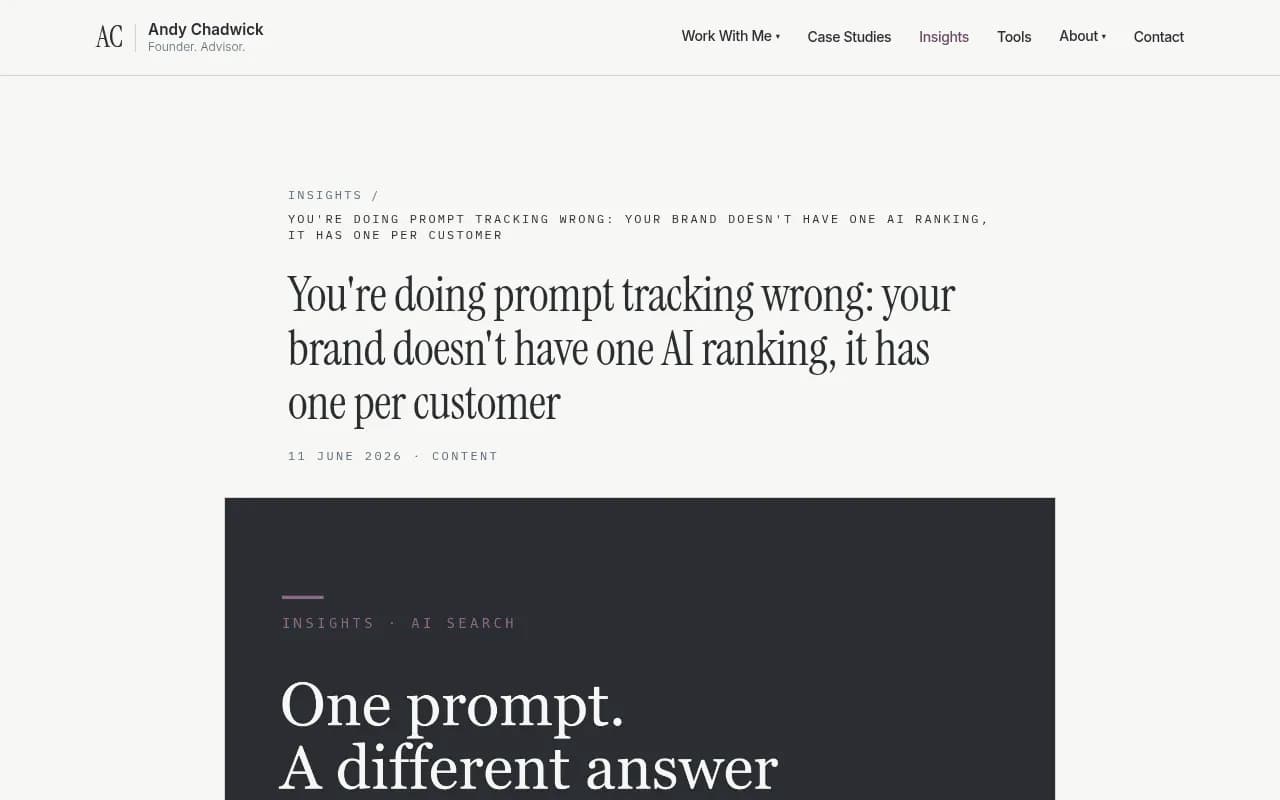
That is one anecdote about shoes. The useful question for a marketer is whether it holds for brands in your category, and whether you are measuring it.
What the research says
A team at Unusual.ai published a paper called Persona Conditioning of Brand Recommendations (arXiv 2605.30207). They are a vendor in this space, which is worth knowing, but the method is published in full. They wrote 10 buyer personas from four attributes (industry, company size, job role, location), stuck each one on the front of a buying question, and ran 8 questions across B2B software and consumer categories against OpenAI and Anthropic models.
Two findings stand out, as summarized in Chadwick's write-up:
- Mid-market brands got rebuilt almost entirely. Up to 75% of their recommendations changed when the persona changed.
- Change the persona and the overlap between recommendation lists drops by another third.
The practical reading: if you are well known in your niche but not a household name, the AI's answer about your category depends heavily on who is asking. Household names are more stable. Everyone else lives or dies by the segment.
I would treat the exact percentages with some caution. It is one paper, from a vendor, on a limited question set. The direction, though, matches what you see when you try it yourself in ten minutes.
Why a single prompt tells you less than you think
Promptwatch Data gives useful context on how much variance one tracked prompt already hides. In its report on unique domains per ChatGPT response (Sep 28 to Oct 4, 2026), 47.6% of responses cited 10 or more different domains, and only 6% cited 3 or fewer. For organic prompts with no brand named, 52.5% cited 10 or more domains. Brand-specific prompts were narrower, with 40.7% citing 5 or fewer.
That report does not measure persona effects. My own inference is that crowded organic answers leave the most room for a persona prefix to reshuffle which sources and brands show up, while brand-specific answers draw on fewer sources and probably move less. Promptwatch's own advice from that report is to measure across many organic prompts, not just one.
There is a second mechanism. The persona text is part of the prompt, so it can change the web searches ChatGPT generates. Promptwatch's ChatGPT query fanout data shows fanouts averaging about 2.15 searches per response in early December 2025 and falling to roughly 1.84 by early March 2026, with average query length dropping from about 117 characters to the high 80s. The report does not test persona effects either. But shorter, fewer searches means the framing you supply carries more weight in what gets retrieved. Treat that as a hypothesis to test, not a finding.
What persona stacking is
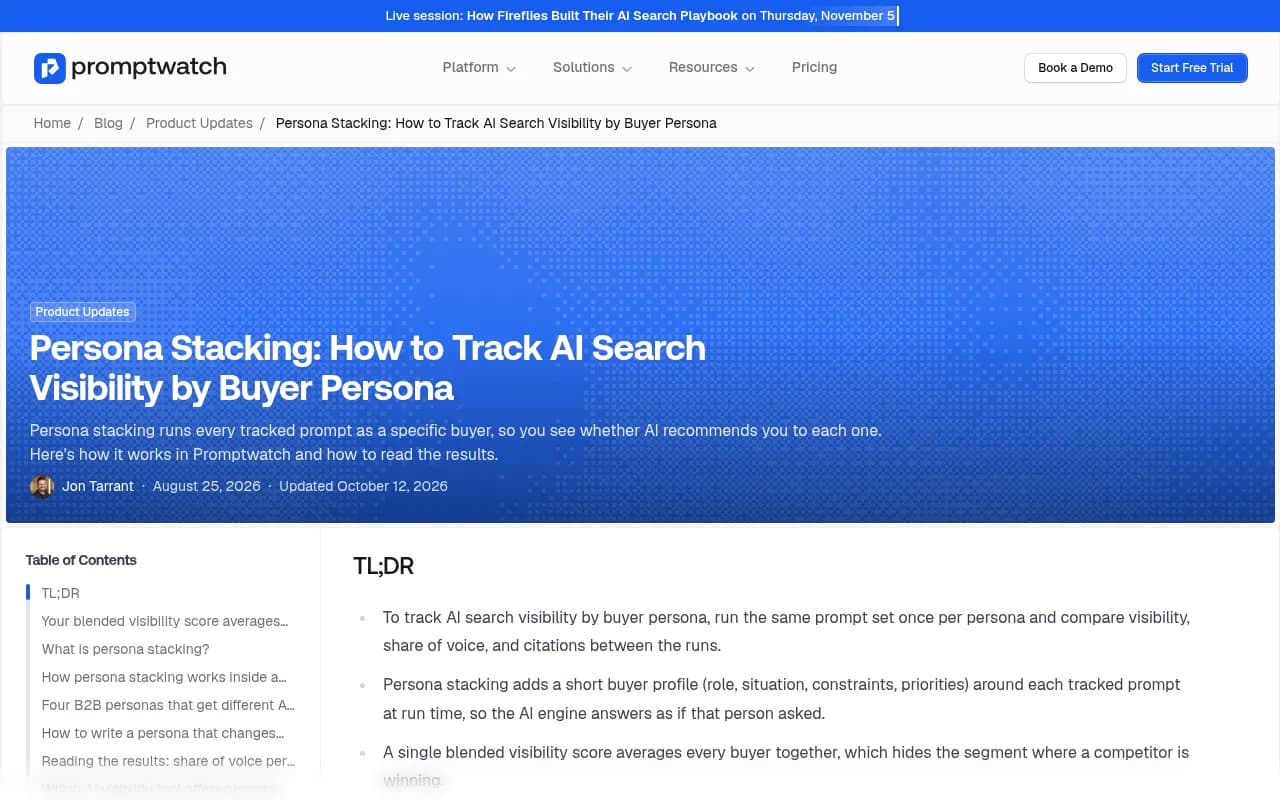
Persona stacking is a prompt-tracking method where a written buyer profile is added around each tracked prompt at run time, so the AI engine answers as that buyer. The prompt text stays identical. Only the context about who is asking changes.
That distinction matters in practice. You could write "best CRM for a CFO at a 200-person company" as a separate prompt, but then your prompts drift apart. People edit one copy and forget the others, and the comparison stops being clean. With stacking, one prompt set runs once per persona, and any difference in the result comes from the persona alone.
Promptwatch shipped Persona Stacking on August 25, 2026, as a monitor setting. Each response gets tagged with the persona that asked it, so a score change traces back to a specific buyer.
Promptwatch is the tool I would look at first for this, since the persona tag follows the response through visibility, share of voice, and citation reports.

Four B2B personas that get different answers
A technical evaluator and a CFO can type the same question into ChatGPT and leave with different shortlists. Here is a starting set for B2B software, adapted from Promptwatch's persona guide.
| Persona | What they ask AI | What the engine weighs | Content that tends to earn the citation |
|---|---|---|---|
| Technical evaluator | API rate limits, SOC 2, self-hosting, migration effort | Documentation depth, integration specifics, security proof | Docs, API references, security pages, GitHub |
| Department head | Pricing tiers, seat limits, time-to-value | Clear pricing, onboarding speed, peer adoption | Pricing pages, comparison pages, case studies |
| Economic buyer | Total cost of ownership, vendor stability, acquisition risk | Funding, customer base, contract terms | Funding news, analyst coverage, review sites |
| First-time evaluator | Basic category questions ("what is X", "do I need X") | Category leaders and plain explanations | Explainers, glossaries, listicles |
Notice that each row points to a different content asset. A brand with excellent docs and a vague pricing page will win with the first persona and lose with the second. A blended score would show "decent" and tell you nothing.
How to write a persona that changes the answer
A persona that does not change the answer is useless. A persona that is too elaborate creates a different problem.
What to include
Keep it to a short buyer profile covering role, situation, constraints, and priorities. For example:
I'm a head of operations at a 150-person logistics company in Germany. We have a small IT team and need something we can roll out in a month. Budget is tight and we must be GDPR compliant.
That has a role, a size, a location, a constraint, and a priority. Each of those gives the model something to weigh.
Keep it a little underbaked
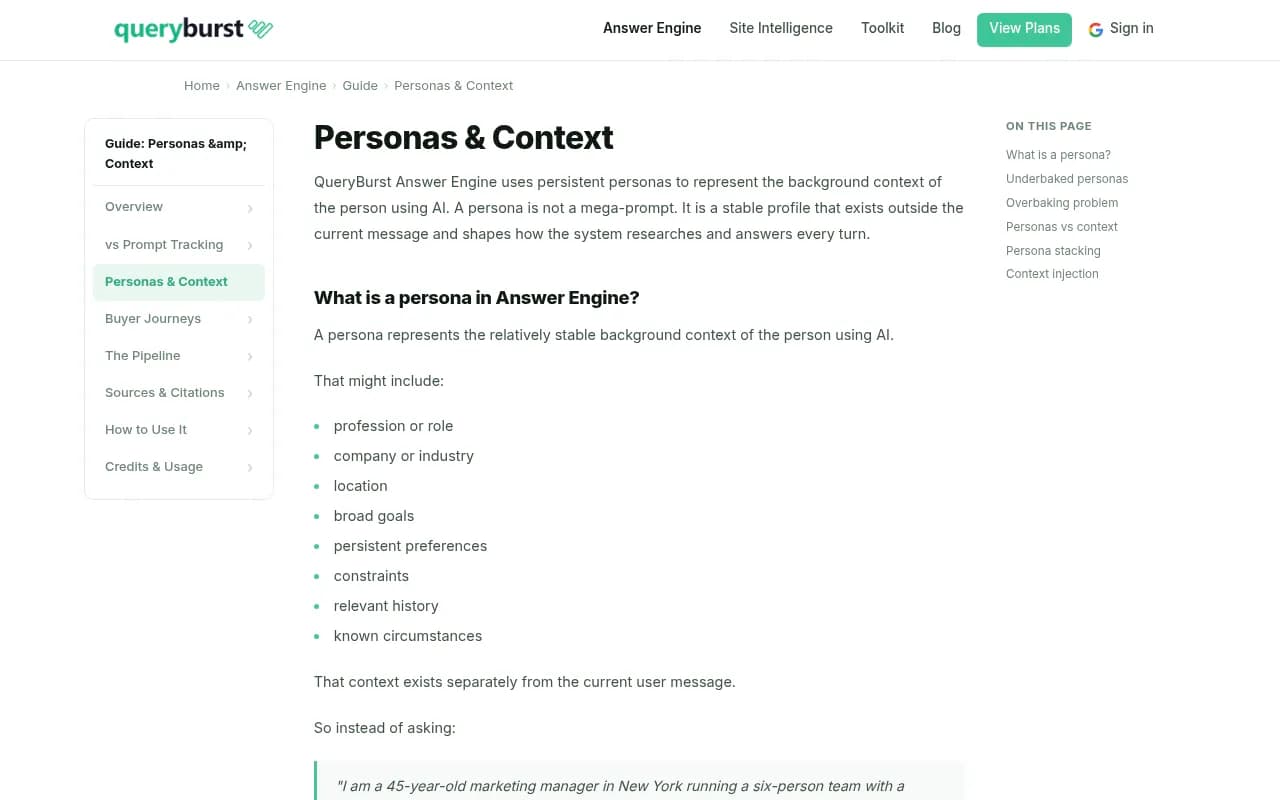
QueryBurst makes a point I agree with: a good persona should be slightly underbaked. It describes who the buyer is and the stable context they bring. It should not contain what has been recommended, what they ruled out, or which objection came up three turns later. Their rule of thumb is that if you need a new persona every time the context changes, your persona is doing the job of the journey.
The marathon runner example shows the failure mode. Add injury history, current shoe rotation, stack height preference, carbon plate attitude, and budget, and every small change needs a new persona. You end up with dozens, none of them comparable.
Where good inputs come from
Do not invent personas in a meeting room. Pull them from sales call notes, support tickets, CRM fields, and the questions prospects actually ask. A stakeholder who writes his own prompts usually asks only about things already on his website, and personas written the same way inherit that bias.
Persona stacking versus real context
Here is the honest limit. A persona is a written description. It is not an account with months of memory behind it. Chadwick makes this point about synthetic personas, and QueryBurst makes a related one: persona context and conversation context are different things.
Adding a persona gives each question a richer starting condition. It does not turn independent questions into a conversation. It does not capture what the AI told the buyer earlier, which products entered the shortlist, what they rejected, or which path through the decision they are following.
So persona stacking answers "who is asking?" and not much else. For most teams that is still a big step up from anonymous tracking. Just do not claim it simulates a buyer journey.
How to run a persona test, step by step
- Pick 20 to 50 organic prompts that matter for revenue. Skip brand-specific ones for the first pass, since they have fewer sources and probably move less.
- Write three to five personas using the structure above. Resist writing ten.
- Run the full prompt set once per persona, plus once with no persona as your baseline.
- Compare visibility, share of voice, position, and citations per persona against the baseline.
- Find the persona where you drop most, then check which competitors replace you and which sources get cited.
- Ask the model why. Run the buying question as that persona and have it explain its picks, as Chadwick did. The reasoning often names the exact criterion you fail.
- Fix the content gap, then rerun and see whether the number moved.
Run each condition several times. Answers vary from run to run even without a persona, so one run per persona is anecdote, not data.
Tool options for persona-based tracking
You do not need to wait for a feature. The prompts are yours to write, so persona-prefixed prompts work in whatever tracker you already pay for. The cost is just the prompt slots, and the downside is the drift problem described earlier. Native persona support removes that.
| Approach | How it works | Strength | Limitation |
|---|---|---|---|
| Persona-prefixed prompts in any tracker | Copy each prompt once per persona by hand | No new tool, no extra cost beyond prompt slots | Copies drift apart, no persona tag on responses |
| Native persona stacking | Persona set as a monitor setting, wrapped around each prompt at run time | Clean comparison, responses tagged by persona | Needs a platform that supports it |
| Manual ChatGPT testing | Open a chat, state the persona, ask the question | Fast, good for finding the reasoning | Not repeatable at scale |
Promptwatch has persona stacking natively, along with personas as a tracking dimension next to prompt volumes, difficulty, topics, and query fan-outs. Chatoptic also pitches persona-based prompt tracking, framed around seeing how AI answers change depending on who is asking. I have not verified its pricing or feature depth, so check it directly before comparing.
For the manual route, plain ChatGPT works well for exploration:
If you already use another monitoring tool, these are worth a look for the prefixed-prompt workaround:



More options are listed in the GEO software directory at bestgeosoftware.com and the AI rank tracker directory at ai-rank-tools.com.
Reading the results without fooling yourself
A few rules keep the analysis honest.
- Compare against a no-persona baseline. A persona that lowers your visibility only matters relative to the anonymous run.
- Look at the gap between personas, not the absolute score. A 30-point spread between the technical evaluator and the economic buyer is the finding.
- Check citations, not just mentions. If you are mentioned but never cited for the economic buyer, the problem is probably missing third-party coverage like analyst pieces and review sites.
- Do not over-segment. Five personas with enough runs beat fifteen with one run each.
- Remember that mid-market brands see the most movement. If you are a category giant, expect a smaller persona effect.
What to do once you find a losing persona
The fix is usually a content or sourcing problem tied to what that persona weighs. If the economic buyer never sees you, look at funding news, analyst coverage, and review sites. If the department head skips you, tighten pricing and comparison pages. If the technical evaluator picks a competitor, check docs depth and security pages.
It also helps to check whether AI crawlers can actually read the pages you are counting on. Persona tracking tells you where you lose. It does not tell you why a page is not being cited, which is where crawler logs and site audits come in.
Does it matter for your business?
It depends on how different your buyers are. If one person researches and buys, persona stacking adds little. If an engineer, a department head, and a CFO each ask AI different things, it matters a lot. The same goes for consumer categories with distinct segments, like the runner example.
If you are weighing whether to build this capability in-house or hire help, an agency like 1001 SEO Media can set up persona-segmented tracking as part of a wider AI search program. That is optional. The core method works with a spreadsheet and the prompts you already have.
Bottom line
Who asks changes the answer, and a single anonymous score hides it. Write three to five short, slightly underbaked personas, run your existing prompt set once per persona plus a baseline, and look for the segment where a competitor beats you. Then fix the content that persona relies on and rerun. For a wider view of how AI sources behave, the Promptwatch Data hub is a good place to keep checking.