Key takeaways
- A national visibility score can look healthy while half your stores are invisible in AI answers. Location-level tracking is the real requirement for store brands.
- Yext Scout and Uberall GEO Studio are built for hundreds or thousands of locations, but both come with suite lock-in and quote-based pricing.
- Promptwatch tracks AI answers from exact coordinates (20 m to 5 km radius) and also covers crawler logs, citations and content fixes. Most trackers stop at monitoring.
- ChatGPT's retail citations lean on product pages and third-party listing and review sites, so audit those, not just your own domain.
- Verify pricing and true geo-targeting (city or ZIP prompts versus brand-level only) with each vendor before you sign.
Why location-level tracking matters for retail
Most AI visibility trackers answer one question: how does my brand show up nationally? That is fine for a SaaS company. It is a poor fit for a retailer with 200 stores, because shoppers do not ask ChatGPT "best running shoe store." They ask "where can I try on running shoes near me" or "best hardware store in Leeds." The answer depends on where they are standing.
That creates three problems a national score hides:
- Some locations get named constantly and others never appear.
- Nearby competitors differ store to store, so share of voice is local.
- The sources AI trusts for a store (maps data, review sites, listings) are different from the ones it trusts for your brand.
So the shortlist below is filtered for one thing: can the platform tell you how a specific location performs, or at least answer prompts as if asked from that place?
What to look for in a location-aware platform
Before comparing vendors, decide which of these you actually need.
- Geo-targeted prompts. Does the tool run prompts as if from a city, ZIP code or exact coordinates? Or does it only tag results by brand? This is the single most important check, and many vendor pages are vague about it.
- Per-location reporting. A map, a table, or an export that breaks down visibility by store.
- Local competitor sets. Who shows up next to you in that area, not nationally.
- Source and citation data. Which listing, review and marketplace sites feed the answers for each location.
- A path to fixing things. Tracking that never produces a to-do list leaves a regional marketer with a dashboard and no budget to act.
- Scale and price. A tool built for 10,000 locations is wasted on 12 stores, and the reverse is also true.
Platform comparison
| Platform | Location approach | Best for | Pricing |
|---|---|---|---|
| Promptwatch | Monitors pinned to exact coordinates, plus country and state/city tracking | Retail teams that want tracking and fixes in one place | From $95/mo; local targeting on Business ($579/mo) and Agency Scale |
| Yext Scout | Location-level "Win Rate" and a map of per-location visibility | Enterprises with hundreds to thousands of locations | Quote-based |
| Uberall GEO Studio | Multi-location visibility across nine models | Brands already using Uberall for listings | Add-on, confirm with vendor |
| Semrush AI Visibility | Multi-location tracking on higher tiers | Teams already paying for Semrush | Public tiers from $199/mo |
| Profound, Scrunch, AthenaHQ | Brand and prompt-level monitoring | Specialist GEO dashboards | Quote-led |
| Otterly.AI, Peec AI | Prompt tracking, lighter on geography | Smaller budgets, simple monitoring | Verify with vendor |
Treat the pricing column as a starting point. I could verify Promptwatch's public tiers, but the others vary by source, and several third-party figures conflict.
The platforms, one by one
Promptwatch
Promptwatch is the one I would put first for retailers who want to act on the data, not just look at it. You pin a monitor to exact coordinates, either by searching a place or dropping a pin with an accuracy radius from 20 m to 5 km, and ChatGPT, Google AI Overviews and Google AI Mode answer as if asked from that spot. That is the closest thing on this list to a real "near me" test. State and city tracking sits on the Business plan, and local targeting is also available through the API and MCP server.

The rest of the stack matters for retail more than you might expect. Store pages are often thin, slow, or blocked from crawlers by a CDN rule nobody remembers. IP-verified AI crawler logs show whether GPTBot and friends can read your location pages at all, and the weekly site audit catches broken links and orphaned store pages. Citation analytics then show which listing and review sites AI is pulling from. When there is a gap, the Action Board turns it into a prioritized task, and the Content Agent can draft and publish pages to WordPress, Webflow or Framer.
A few honest caveats. The full local targeting requires Business ($579/mo) or an Agency plan, so a 3-store operator may find it more than they need. And Promptwatch is not a Google Business Profile editor or a classic map-pack rank tracker. It tells you what AI says, and helps you fix your content, not your listings.
Yext Scout
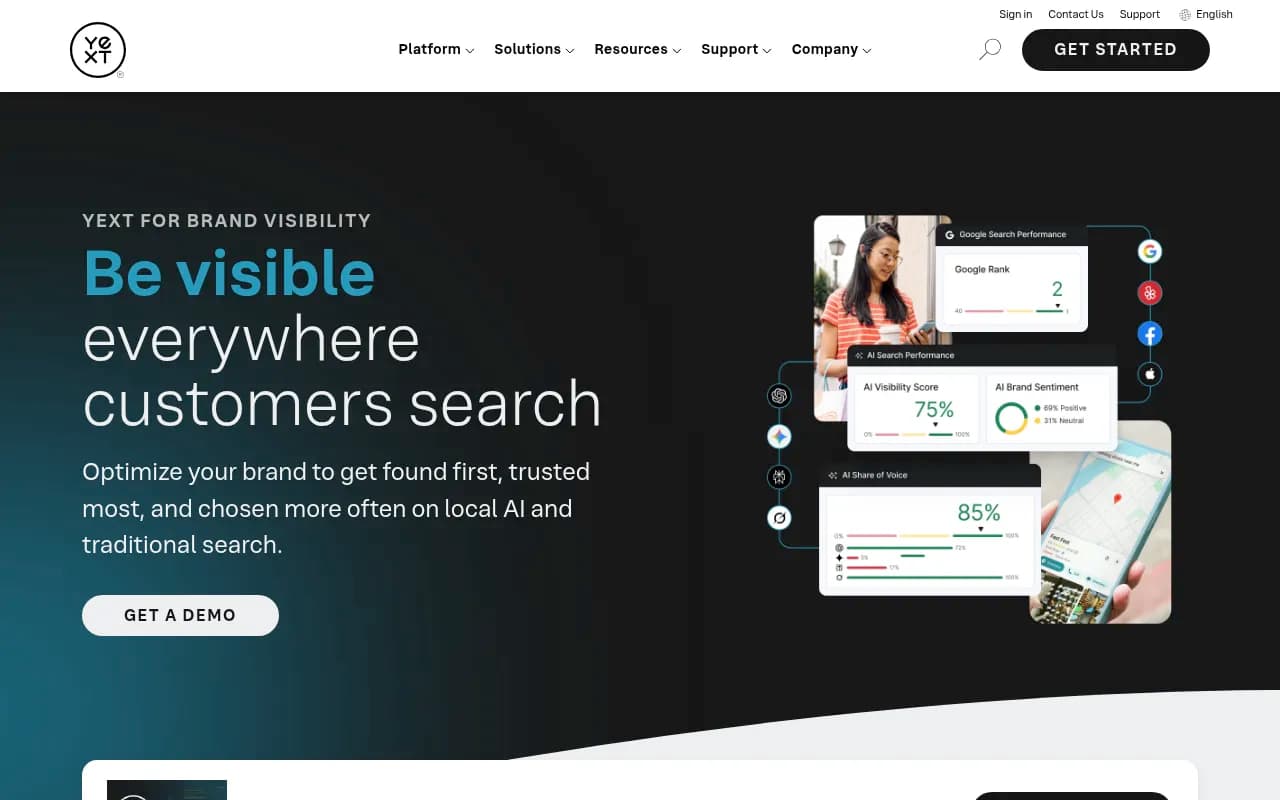
Yext's platform page describes Scout as an AI search visibility agent covering 12M+ locations, with 150 visibility metrics and 20 competitors per scan. Its signature feature is a map with colored hexagons showing how visible each location is in high-intent searches across engines like ChatGPT, Gemini, Claude and Perplexity. It pairs brand-level share of voice with a location-level "Win Rate."
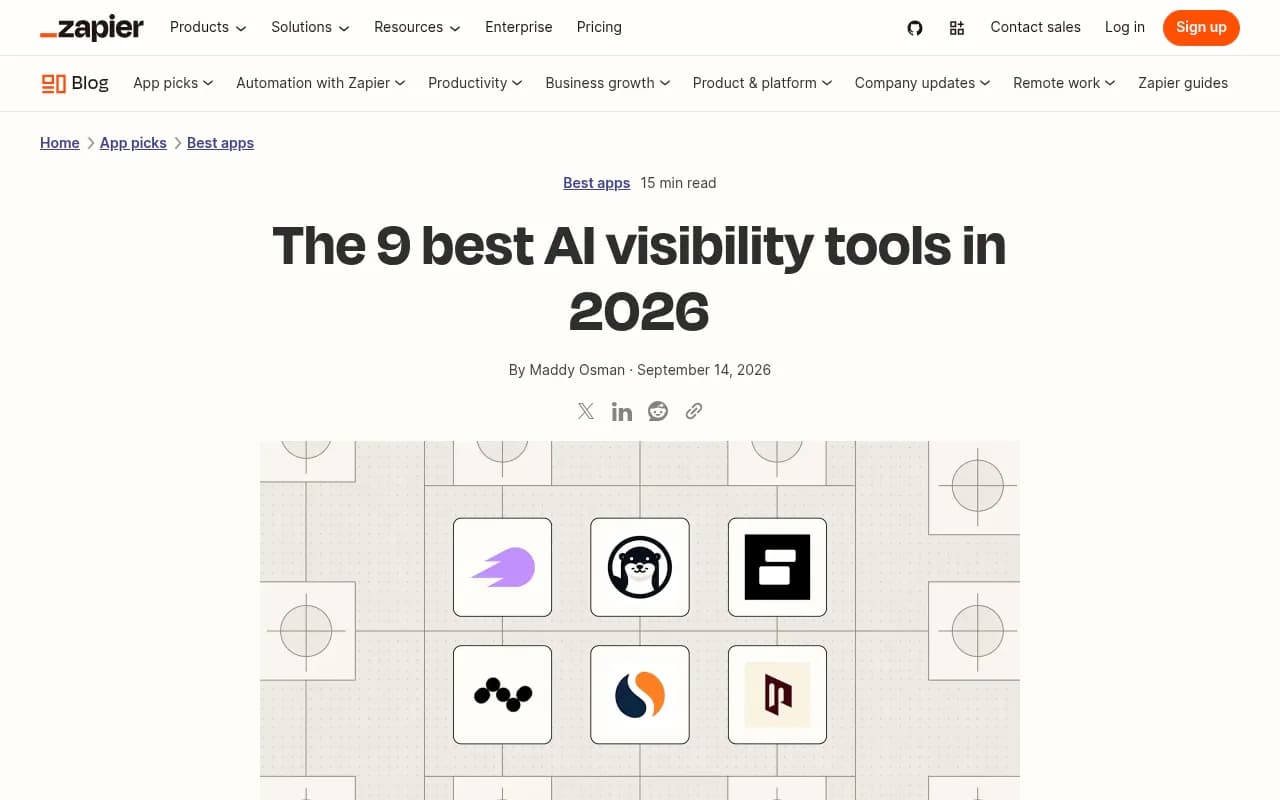
The catch, noted in Zapier's September 2026 review, is that Scout's recommended actions run through agents that need the rest of the Yext platform. If you are not already a Yext customer, you are buying a suite. Pricing is custom; Zapier cites third-party estimates of $199/month or more, but a YouTube review says there is no flat self-serve price, so I would not trust that figure. It is also aimed at enterprises. A brand with a dozen stores may be too local for it.
Uberall GEO Studio
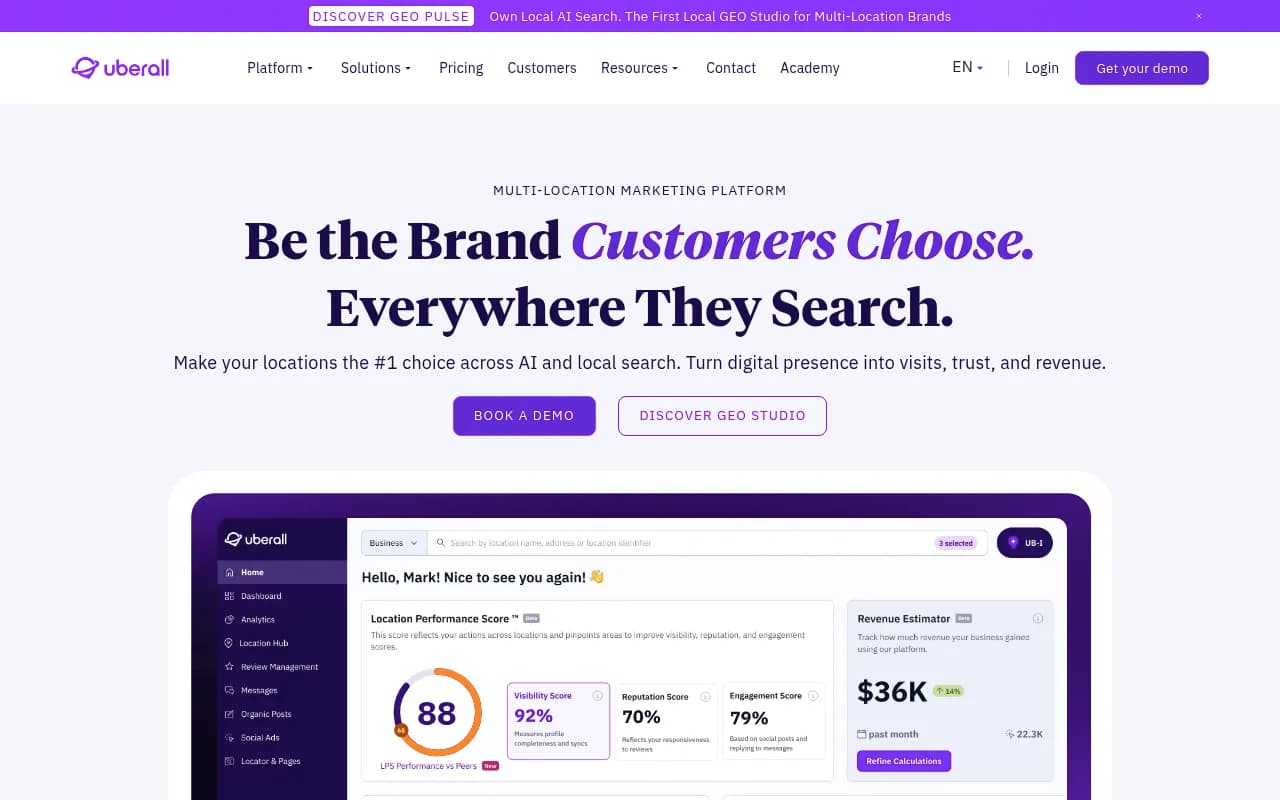
Uberall's competing product is GEO Studio. According to Yext's own comparison page, it lists nine models, share of voice, brand traits, a source breakdown including Reddit, TikTok and YouTube, and hallucination detection, and is sold as an add-on. That is Yext's characterization of a competitor, so confirm the packaging with Uberall directly. If you already run store listings through Uberall, this is the natural first demo.
Semrush AI Visibility Toolkit
Semrush is the practical choice when you already pay for the suite. One roundup lists Starter at $199/mo with 50 prompts a day and Pro+ at $299/mo with 100 prompts a day and multi-location tracking mentioned. That source is low authority and has a typo or two (its FAQ says 2027), so check the Semrush pricing page. The limitation is the usual one for suites: fixed prompt sets and shallower AI-specific data than a dedicated platform.
Specialist trackers: Profound, Scrunch, AthenaHQ, Otterly, Peec
These are solid monitoring products, and most are quote-led. I could not confirm that any of them support true city or ZIP-level prompts, as opposed to brand-level tracking, so ask that question first on every call. Profound and Scrunch tend to sit at the higher price end. Otterly.AI and Peec AI are cheaper prompt trackers, which makes them reasonable for a small retailer that only needs a rough read.





Listings and reputation tools worth pairing
AI answers about stores lean on listing and review data, so a tracker alone is not enough. Birdeye, Synup, BrightLocal and Chatmeter cover listings, reviews and local SEO for multi-location brands. They do not replace an AI visibility platform, but they fix the inputs.
What AI actually cites for retail queries
This is where I would spend your first week, because it changes where the work goes. In Promptwatch Data's report on ChatGPT content types (Sep 28 to Oct 4, 2026), product pages were the most cited type at 22.4% of classified citations, followed by landing pages at 16.8% and listicles at 13.6%. For commercial prompts, product pages rose to 26.0% and landing pages to 20.6%. Reviews were small overall (1.7%) but climbed to 5.6% for branded prompts.
The closest multi-location analogue is the automotive citation report for August 2026. Marketplaces like Autotrader (5%) and Cars.com (4.6%) outranked every manufacturer; Chevrolet.com was the top car brand at 2.62%. Marketplaces and listings held 14.65% of citations, reviews and research sites 12.62%, and manufacturer sites 7.92%. Dealerships as a group, along with community, news and finance sites, held just 2.12%. Still, one dealer group reached the top 31 at 0.28%, which shows that specific local pages can get cited.
The lesson for retail is uncomfortable. Your own domain is only part of the story. If third-party listing, marketplace and review sites feed the answers about your stores, you need accurate profiles there, and you need location-specific content on your own site.
Social is a separate wrinkle. Promptwatch Data's October 2026 social citations report found ChatGPT got only 0.46% of its citations from social platforms between Sep 28 and Oct 4, while Google AI Overviews got 12.2%. A store brand with a strong Instagram or TikTok presence may therefore look different across engines. For wider context on who cites what, the Promptwatch Data hub is worth bookmarking.
How to run a location-level audit
You can start without buying anything.
- Pick five to ten representative stores: flagship, mid-size, rural, and a few underperformers.
- Write 10 prompts per store. Mix "best [category] store in [city]", "where to buy [product] near [neighborhood]", and branded queries like "is [your brand] in [city] any good."
- Run them in ChatGPT and Google's AI surfaces, ideally from the actual location or through a tool that simulates it.
- Record whether the store is named, which competitors appear, and which sources are cited.
- Compare the cited sources to your listings. Missing hours, stale inventory, thin review counts and a missing location page are the usual culprits.
- Fix the inputs, then rerun after a few weeks.
Manual checks do not scale past about 20 stores, which is when a platform pays for itself. A free option for spot checks is the free AI Visibility Report at Promptwatch, and the AI rank tracking directory at ai-rank-tools.com lists lower-cost trackers if you want to compare more options.
Which platform should you pick?
- 500+ locations and already on Yext: Scout. The agents are worth it only if you use the broader platform.
- Already on Uberall for listings: Ask for a GEO Studio demo and confirm the add-on pricing.
- Mid-sized retailer, 10 to 300 stores, wanting to fix things as well as measure them: Promptwatch, on Business for coordinate-level targeting.
- Semrush shop with modest needs: Start with the AI Visibility Toolkit and see whether 50 to 100 prompts a day covers your stores.
- A handful of stores and a tight budget: A lighter tracker like Otterly or Peec, plus a manual audit.
If you want more options in the category, the GEO software directory at bestgeosoftware.com is a decent place to browse.
Questions to ask every vendor
- Can prompts run from a specific city, ZIP code or coordinates, or is results tagging brand-level only?
- How many locations and prompts are included, and what happens when you exceed them?
- Which AI interfaces are tracked: the real user interface or API outputs? They can differ.
- Do you get citation sources per location?
- Is the pricing public, and what is bundled versus add-on?
- Can you export per-location data to your own reporting?
The answers separate platforms that track stores from platforms that track a logo. Start with the geo-targeting question, because everything else depends on it.
Bottom line
For store brands, the best AI visibility platform is the one that can show you a specific location's answer and tell you why it looks that way. Yext Scout and Uberall suit very large footprints with existing suites. Promptwatch fits teams that want coordinate-level tracking tied to crawler data, citations and content fixes. Everything else is a reasonable monitor if you accept that it may only see your brand nationally. Confirm pricing on each vendor's site, then run the five-store audit before you commit.