Key takeaways
- A weekly discovery agent reads your visibility, crawler, citation and search data on a schedule and proposes a short list of actions. The value is in the evidence attached to each one, not in the list itself.
- A good suggestion names the data it came from, the page or prompt it affects, the content type, and a way to check whether it worked.
- Agents get things wrong quietly. In CXL's build, 17 of 22 test runs failed and 9 of those failures were silent, only caught on manual review.
- Vet every suggestion with a short yes/no checklist covering evidence, freshness, effort, reversibility and measurability.
- Keep a human at the start (which sources count), the middle (the scoring framework) and the end (approve or decline).
What a weekly discovery agent actually is
The idea is simple. Instead of an analyst opening six dashboards on Monday and wondering what to do, an agent does the digging overnight. It looks at where your brand appears in AI answers, which pages AI crawlers visited, what got cited, what Search Console says, and then writes up a few things worth doing.
There are two flavors. One is a research agent that monitors outside sources for new tactics (what other people say works). The other investigates your own data and says what to fix on your site. Both produce the same output: suggestions. And suggestions are cheap. The hard part is telling a good one from a plausible one.
One product example: Promptwatch runs a Discovery agent on its Action Board that investigates your data weekly and suggests up to five evidence-backed actions per run, with a digest email every Monday. Five is a deliberate number. A list of fifty is a list nobody finishes.

Other tools in the same neighborhood describe themselves as agentic or execution-oriented, such as Gradial GEO (detects visibility gaps and publishes the fix), Temso AI (visibility with built-in execution) and ReachLLM (daily tracking wired to execution workflows). I have not tested them against each other, so treat the catalog blurbs as starting points, not verdicts. For a broader list, the GEO software directory at bestgeosoftware.com is a decent place to browse.


What an evidence-backed suggestion looks like
Compare two suggestions an agent might produce.
Suggestion A: "Add more statistics to your content to improve AI visibility."
Suggestion B: "Your pricing comparison page was crawled by ChatGPT-User eleven times this week and cited in none of the tracked responses, while two competitor pages were cited for the same prompts. The page has no numbers in its first 300 words. Add a sourced comparison table and refresh the headings so they read like short queries."
A is true in a general sense. The Princeton, Georgia Tech, IIT Delhi and Allen AI paper (KDD 2024) found that adding statistics gave a +37 to +41% improvement on Position-Adjusted Word Count, and keyword stuffing did nothing, per the Radiant Elephant review. But A is a platitude. It points at no page, no prompt, no baseline.
B is something you can act on and check. It has five parts worth looking for every time:
- The observation, tied to specific data (crawl counts, citations, prompts)
- The target: a named URL, prompt or topic
- The reason, in terms of a mechanism you can inspect
- The proposed change, small enough to describe in a sentence
- A way to tell whether it worked, and by when
If an agent suggestion is missing the observation or the target, it is generic advice dressed up as analysis. Reject it or send it back.
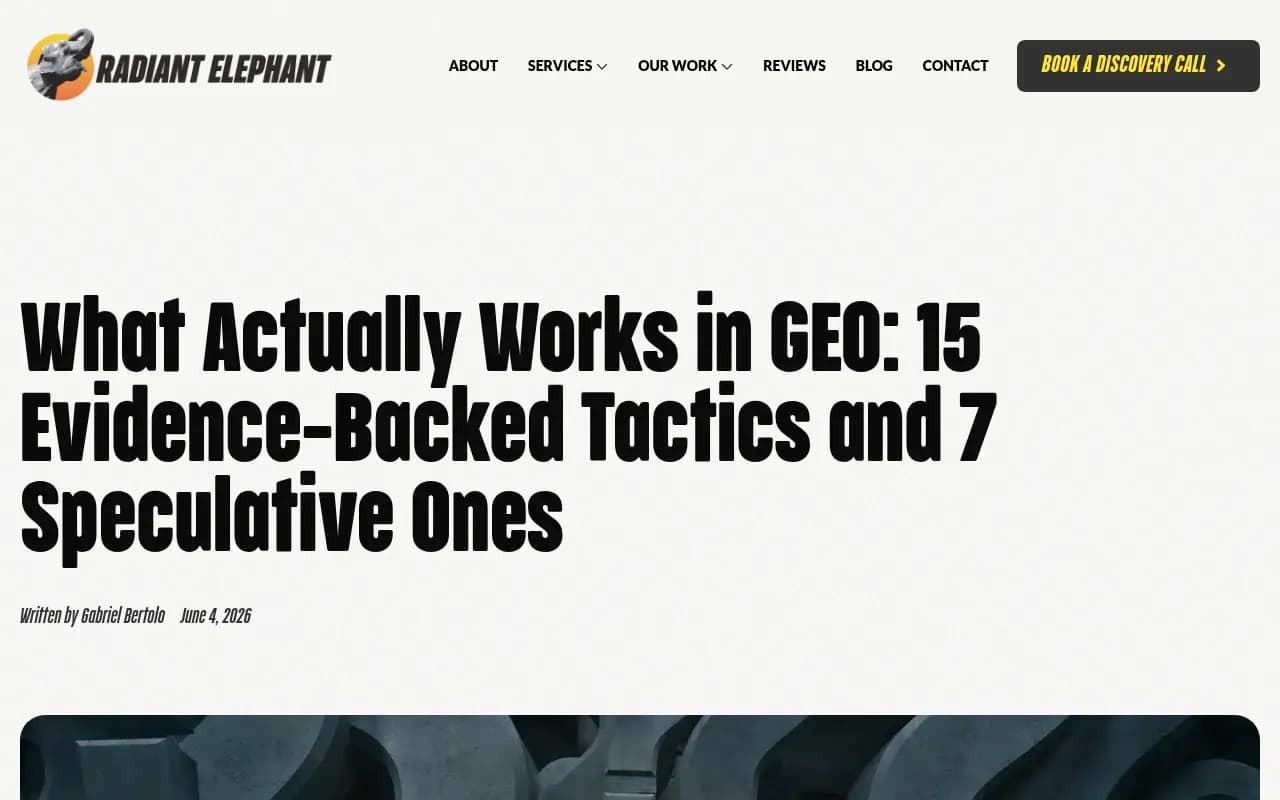
That review is worth reading before you trust any agent's tactic library, because it splits claims into what has peer-reviewed or large-sample support and what is speculation. It also calls the GEO measurement landscape immature and unreliable, which is the right amount of suspicion to carry into a weekly review.
Where suggestions come from, and why that matters
Every suggestion traces back to one of a few inputs. Knowing which one tells you how much to trust it.
| Input | Example suggestion | Main risk |
|---|---|---|
| Crawler logs | Page is fetched by AI bots but never cited | Spoofed bots if logs are not verified |
| Citation data | Competitor page wins prompts you target | Small sample for low-volume prompts |
| Search Console and Bing data | Page ranks in Google but is invisible in AI answers | Rankings and AI citations do not move together |
| External research | Add expert quotes and inline citations | Study may not match your niche |
| Site audit | Orphaned page, missing sitemap entry | Fixing it may not move citations at all |
Suggestions grounded in your own first-party data (crawls, citations, your pages) are usually easier to test than ones imported from general research. Research-derived tactics need an extra step: does the finding hold for your industry and for the model that matters to you?
A worked example: CXL's three-agent research engine
CXL published a useful build log of a weekly research agent, made with n8n and Claude Code after a July 2026 workshop. It is the most honest account I found of what these systems are like to build.
The design has three agents. An extraction agent pulls tactics from a curated list of trusted sources. A validation agent scores each tactic against a framework a human wrote. A reference scout suggests new authors and sources. n8n handles the scheduled, repeatable steps and Claude Code handles the judgment work, such as turning a validated tactic into an experiment brief.

Three details stuck with me.
First, humans sit at three points: the seed list up front, the validation framework in the middle, and a Slack message at the end where every suggested tactic and source needs a yes or no. The agent never publishes its own opinion as fact.
Second, the failure rate. About two days of building and 22 test runs, 17 failed, and 9 of those failures were silent. The output just looked slightly off. If you are running an agent whose suggestions you never spot-check, assume some of them are in that category.
Third, volume. The engine logged 58 tactics in two weeks, more than a team can act on. So the bottleneck moves from finding ideas to choosing between them.
Vetting checklist: eight yes/no questions
CXL chose PXL over ICE for prioritizing, because ICE scores are all opinion and tend to reward whoever pitches an idea most confidently. They adapted PXL into eight binary questions. I find them useful for vetting agent output too, since an agent pitches everything confidently.
- Does it fit your existing strategy, and can it scale?
- Is there credible evidence, meaning multiple studies or a real sample size?
- Has more than one source seen it working in the wild?
- Can it be implemented in under a day?
- Does it need minimal engineering?
- Is it easy to roll back?
- Can success be measured within two to four weeks with clear KPIs?
- Can the impact be isolated from other changes?
Score each as 0 or 1 and add them up. A suggestion with 7 or 8 goes into this week's work. A 3 waits or dies. The point is not precision, it is forcing a conversation about evidence before someone gets excited.
The question I would add for self-data suggestions: does the agent show you the underlying rows? If it says a page has no citations, you should be able to click through to the prompts and responses. A claim you cannot trace is a claim you cannot vet.
Check freshness against content type
Many suggestions boil down to "refresh this page." Whether that is worth doing depends heavily on what kind of page it is.
Promptwatch Data tracked every page ChatGPT cited on July 6, 2026 for 90 days, and the decay differed a lot by type (ChatGPT content half-life report):
| Content type | Still cited after 30 days | Still cited after 60 days | Notes |
|---|---|---|---|
| Landing pages | 78% | 69% | Only crossed 50% loss in the final week of the window |
| Docs | 76% | 67% | Same pattern as landing pages |
| Comparisons | 72% | 63% | Slow decay |
| Listicles | n/a | 60% | Slow decay |
| Product pages, reviews, how-tos | n/a | 55% | Half-life of 74 to 77 days |
| News | n/a | 41% | Half the pages gone after 36 days |
So a suggestion that says "update this quarterly" is sensible for a how-to and wasteful for a landing page that is still cited at day 60. For news, quarterly is far too slow. A good agent states which content type a freshness action applies to. If yours does not, ask.
Check the suggestion against current model behavior
AI search behavior moves in steps, and tactics age with it. Promptwatch's ChatGPT query fanouts report shows average searches per response falling from 2.15 in early December to about 1.84 by early March, then 1.0 per response in April after a gap in the data. Average query length dropped from about 117 characters to roughly 53 over the same stretch.
One caution on reading that page: its intro says a single prompt can trigger 3 to 8 or more searches, which does not square with the 1.0 to 2.15 averages. I would not quote both without knowing how each is defined. For vetting purposes the takeaway is simpler. If a suggestion rests on how ChatGPT decomposes queries, ask when that behavior was observed. A heading-to-keyword mapping built last quarter may be stale, and the report itself recommends re-auditing after major ChatGPT updates.
A related example: on August 8, 2026 ChatGPT started using the site: operator at scale, going from about 0.4% to about 17% of fanout queries overnight (report). Any suggestion written before that date and relying on old fanout patterns deserves a second look.
Watch the source landscape too
Some suggestions assume a channel works that has recently changed. Reddit is the clearest case. Promptwatch Data shows reddit.com's share of ChatGPT citations falling from about 4% to about 0.5% on August 14, 2026, while AI Overviews and AI Mode declined more gradually (report). For the week of Sep 28 to Oct 4, 2026, ChatGPT drew 0.46% of its citations from social platforms versus 12.2% for Google AI Overviews (social citations report).
So "post more on Reddit" can be good advice for AI Overviews and weak advice for ChatGPT. A well-formed suggestion says which engine it targets.
A weekly review routine that takes 45 minutes
Here is how I would run it.
- Read the list. Delete anything with no target page or prompt.
- For each survivor, open the evidence. Confirm the numbers exist and the sample is not tiny.
- Tag the engine and content type it applies to.
- Score it with the eight questions.
- Pick two or three. Record the baseline metric and the date you will look again, two to four weeks out.
- Decline the rest with a reason. Declines are data: if the agent keeps proposing something you keep rejecting, tell it.
Step six matters more than it looks. Agent suggestions improve when the feedback loop exists, and the CXL setup treats every yes or no as an input.
Tools that help with each step
| Job | Tool types | Examples from the catalog |
|---|---|---|
| Evidence on citations and crawls | AI visibility platform with crawler logs | Promptwatch, Profound |
| Search-side check | Search data per page | Google Search Console |
| Technical check | Crawler and audit | Screaming Frog SEO Spider |
| Building your own agent | Workflow automation | n8n, Zapier, Make |

If you are comparing AI visibility trackers before picking one, the AI rank tracking directory at ai-rank-tools.com lists many of them. Monitoring-only tools can tell you that you are invisible. Whether they can tell you why, with crawl and citation evidence, is the thing to check.
Red flags in agent output
- Suggestions with no URL, prompt or competitor attached
- Round numbers of improvement promised ("expect a 40% lift") with no source
- The same tactic every week regardless of your data
- Keyword stuffing advice. The GEO paper found it did nothing.
- Confidence with no caveats about sample size
- No way to see which data produced the suggestion
Orr Consulting makes a similar point about GEO agencies: anyone promising meaningful citation gains faster than roughly three to six months should show prior evidence. The same skepticism applies to a tool that promises week-one wins.
Measuring whether a suggestion worked
The loop only closes if you check. For each accepted action, write down the metric (citations of that page, crawl-to-citation rate, AI-referred visits), the baseline, and the date. Change one thing at a time where you can. CXL's last PXL question, can the impact be isolated, is the one teams skip and regret.
Expect noise. With the measurement landscape still unreliable, one week of movement is rarely proof. Two or three consistent weeks, on the page you changed and not on control pages, is closer.
Bottom line
A weekly discovery agent is only as good as the review you run on its output. Demand a named target, a visible data trail, a content type and engine, and a measurement date. Score with yes/no questions, keep humans at the start and end of the pipeline, and expect some suggestions to be quietly wrong. Pick two actions each week, finish them, and check back in a month.