Key takeaways
- Peec AI lets you pick a country for each prompt. City and neighbourhood details go inside the prompt text, which is not the same as tracking from a specific place.
- There are three real approaches to local AI tracking: country setting plus city wording in prompts, residential-IP city targeting, and coordinate-based sampling.
- Local Falcon samples the same prompt across a grid of points (9 to 441). Promptwatch pins a monitor to exact coordinates with a 20 m to 5 km accuracy radius, and also covers crawler logs, traffic and content.
- Listing platforms like Yext, BrightLocal and Uberall manage business data across locations. They are not substitutes for AI answer tracking, but they feed it.
- Costs scale differently. Peec prices by prompt, Local Falcon by credits per map pin, so grid size matters a lot.
Why Peec AI feels limited for local brands
Peec AI is a solid prompt tracker. It starts at $95/mo for 50 prompts, includes unlimited users, languages and competitors, and lists a "Local GEO" feature on its pricing page. I could not verify what that feature does beyond its name, so check it in a demo before you rely on it.

The part that matters for local teams is how location works. According to a community thread on r/aeotips (unverified, and I couldn't load it), the documented location setting picks a country, and you write the city or neighbourhood into the prompt itself. That is a workable trick. "Best dentist in Leeds" will pull Leeds-flavoured answers. But it isn't the same as asking from a spot in Leeds, and the answer you see can differ from what a person standing there sees.
The Radarkit comparison, which is vendor-authored and biased, describes Peec as best for citation analysis, brand perception and claim checking, not geo-grid work. That matches what I would expect.
Two more limits for multi-location brands: the lower plans cap you at 1 to 3 countries and let you choose only 3 models. Multi-country starts at Advanced ($495/mo), and the full model list is Enterprise only.
Three ways tools handle location
This is the distinction that makes shopping easier. Most tools fall into one of these.
City words in prompts
You set a country and write "near me" or a city name into each prompt. Cheap, simple, and good enough for a brand with five cities. It breaks down when you have 80 locations or care about neighbourhood differences.
It does fit how ChatGPT searches, though. Promptwatch Data's ChatGPT query fanouts report shows ChatGPT averaged about 2.15 web searches per response in early December 2025, easing to about 1.84 by early March 2026, and the average fanout query got shorter over the same period. Fewer, shorter searches mean a city name in the query carries more weight. The report is not location-specific, so treat that as inference, not proof.
Residential IP, city-level targeting
The tool runs queries through IP addresses in a given city or state, so the AI answers as if asked from there. RadarKit does this, with coverage across 50+ countries, though city and state targeting sits in its Enterprise tier according to its own site.
Coordinate-based tracking
You drop a pin or define a grid and the tool asks from those exact points. Local Falcon and Promptwatch both do this, in different ways.
Comparison table
| Tool | Location method | Starting price | Best for |
|---|---|---|---|
| Peec AI | Country setting, city in prompt text | $95/mo | Citation and brand perception tracking |
| Local Falcon | Geo-grid, 9 to 441 points | $24.99/mo (credits) | Neighbourhood-level maps of AI and map pack visibility |
| Promptwatch | Monitors pinned to exact coordinates, 20 m to 5 km radius | $579/mo (Business) | Local tracking tied to traffic, crawlers and content |
| RadarKit | Residential IP, city/state in Enterprise | $29/mo | Local recommendation analysis |
| Yext | Listings and location data management | Custom | Keeping business data consistent across many locations |
| BrightLocal | Local SEO and listings | Not verified | Agencies running local SEO |
Pricing for Yext, BrightLocal, Otterly and Profound is not verified here. Confirm on their sites.
The alternatives in detail
Local Falcon
Local Falcon is the purest option for geographic sampling. It runs the same prompt from every point on a grid over a city, neighbourhood or service area, across ChatGPT, Gemini, Google AI Overviews, Google AI Mode, Grok and the Local Map Pack. It reports Share of AI Voice next to Share of Local Voice. You can trace a custom outline instead of a square, and it has an API, MCP server, Looker Studio connector and white-label reports.
The sampling logic is sensible. AI answers vary from run to run and place to place, so one data point tells you little. Many points give you a mention rate you can believe.
The catch is pricing. One credit equals one map pin. A 5x5 scan costs 25 credits, a 9x9 scan costs 81. Plans run from Starter at $24.99 (7,500 credits) to Premium at $199.99 (63,150), with extra credits at $0.05 each. Cost scales with grid size x keywords x locations x frequency, competitor scans burn credits too, and monthly credits expire. The pricing page suggests weekly or bi-weekly scans and about 10 keywords to start. A 20-location brand scanning 10 keywords on 9x9 grids weekly will burn through a Premium plan quickly. Do the math before you commit.
Local Falcon is a sampler, though. It doesn't tell you whether AI crawlers can read your location pages or whether any of this brings customers.
Promptwatch
Promptwatch handles location by pinning a monitor to exact coordinates. You search a place or drop a pin, set an accuracy radius between 20 m and 5 km, and ChatGPT, Google AI Overviews and Google AI Mode answer as if asked from that spot. It is built for "near me" queries from stores, offices, franchises and multi-location brands, and it is also available through the REST API and MCP. State and city tracking starts on Business, and coordinate targeting is on Business, Agency Scale and Enterprise.

Where it differs from a pure sampler is everything around the tracking. IP-verified crawler logs show whether AI bots actually reach your location pages and hit errors. Visitor analytics attribute traffic and conversions from AI platforms. The Action Board turns gaps into a prioritised to-do list, and the Content Agent can draft and publish pages to WordPress, Webflow or Framer. For a brand with many locations, that loop from "we're missing in this city" to "here's the page that fixes it" is the useful bit.
It also tracks real user interfaces rather than APIs only, which matters because Promptwatch notes user-facing answers can differ from API outputs. Business is $579/mo with 350 prompts and 5 projects. Agencies can look at Kick-off ($199/mo), Growth ($399/mo) or Scale ($799/mo), which include city-level tracking; local coordinate targeting on the agency side is Scale. Verify at promptwatch.com/pricing.
Honest trade-off: it isn't a dense grid heatmap like Local Falcon. If your question is "which blocks of the city do we vanish from," Local Falcon draws that picture more directly. If your question is "why are we missing and what do we do about it," Promptwatch covers more of the work.
RadarKit
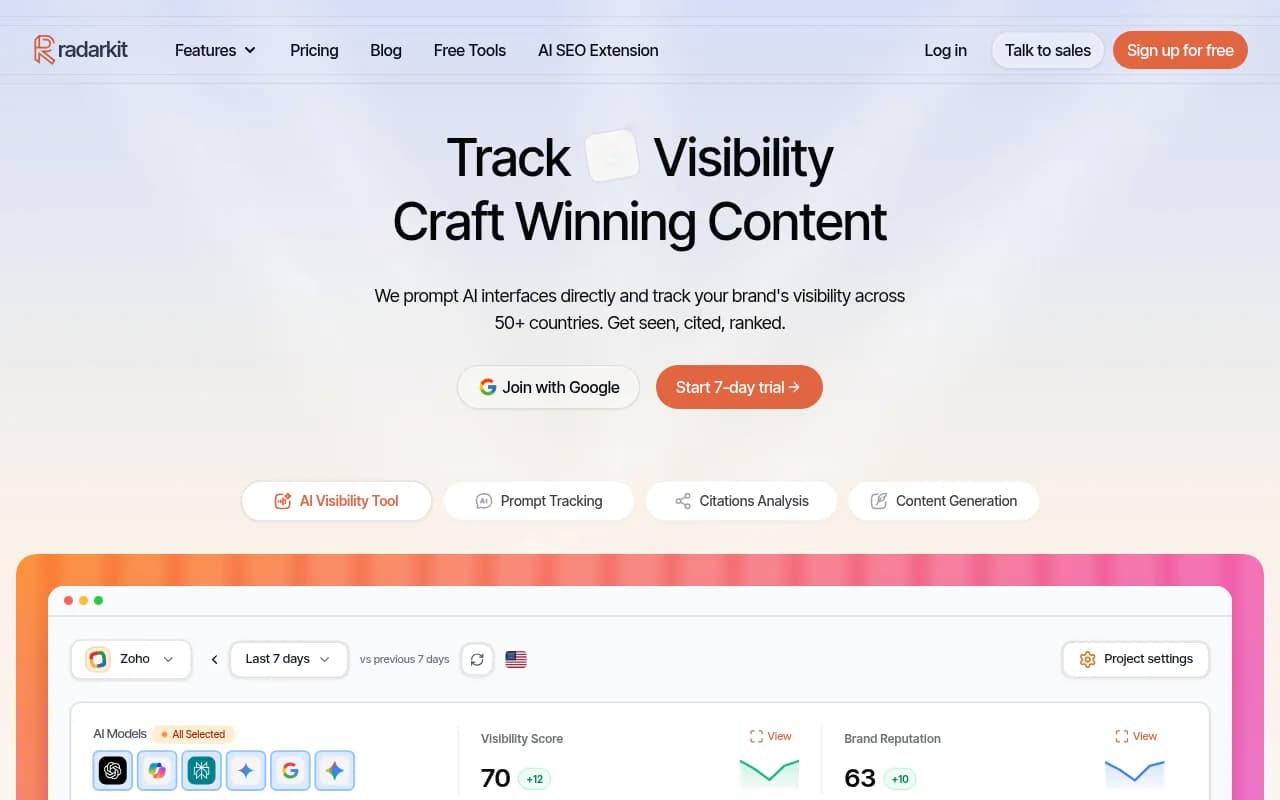
RadarKit starts at $29/month and tracks appearance rate, answer positions and competing businesses, using residential IPs across 50+ countries. City and state targeting is in Enterprise. It is cheap to start, which is appealing, but the Radarkit comparison I relied on is its own marketing, so run a trial before believing the positioning.
Yext, Uberall, Synup and Chatmeter
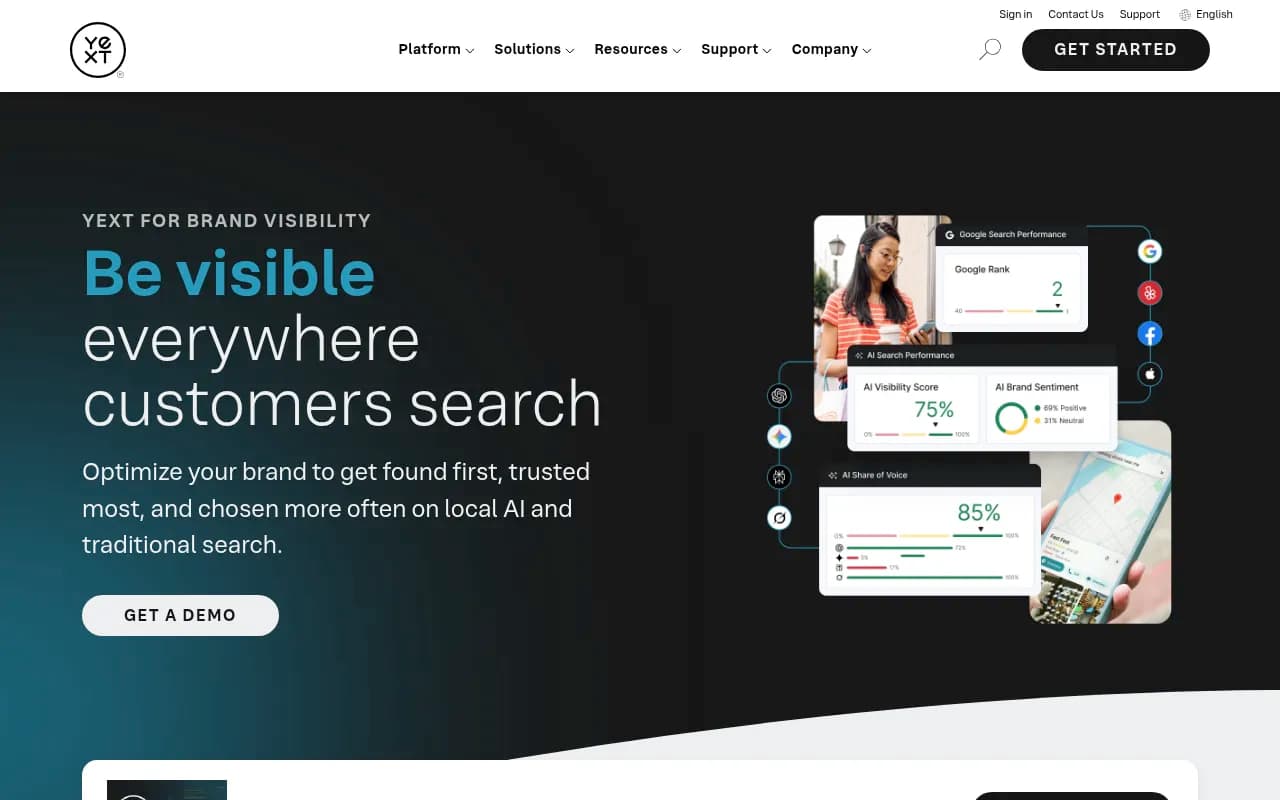
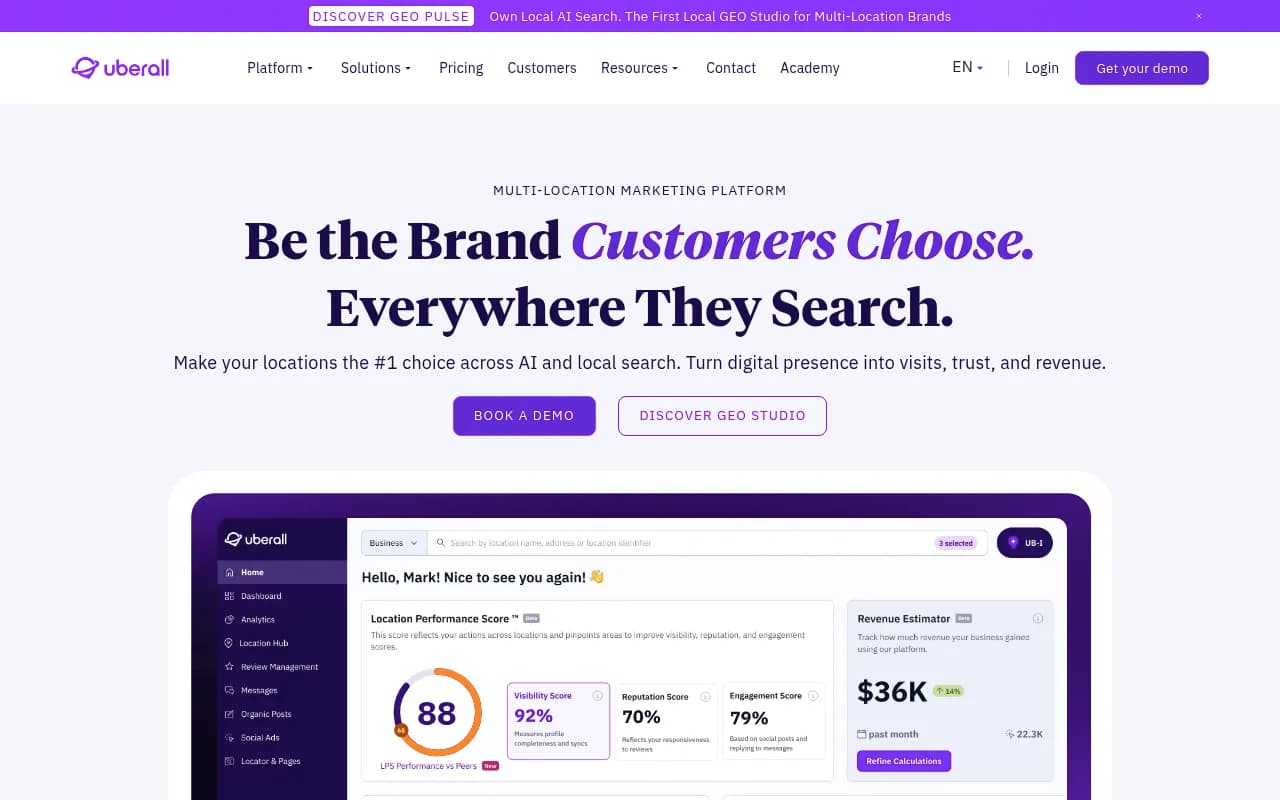
These are listing and location data platforms. They keep names, addresses, hours and reviews consistent across many locations, which AI models pull from. They don't replace an AI answer tracker, but for a 300-location chain the data hygiene may matter more than the dashboard.
BrightLocal and Birdeye
BrightLocal is a long-standing local SEO platform for agencies, and Birdeye covers reputation and marketing for multi-location businesses. Both are useful next to an AI tracker. Neither is a coordinate-level AI visibility tool as far as I could verify.
Otterly, Profound and general trackers
[tool:otterly-ai] is positioned for daily monitoring and page-level diagnostics, and [tool:profound] for enterprise research and regional reporting. I could not verify their city-level targeting, so ask for specifics. For other local-leaning options in our catalog, see Tibly and Semrush.

To browse more, the GEO software directory at bestgeosoftware.com and the AI rank tracking directory at ai-rank-tools.com list many more.
How to choose
- Count your locations. Under ten, Peec-style prompts with city names may do the job. Over fifty, you need either coordinates or a listings platform.
- Decide what question you're answering. Spatial coverage points to Local Falcon. Cause and fix points to Promptwatch. Data consistency points to Yext or Uberall.
- Model the cost. Local Falcon credits scale with grid size. Peec scales with prompts. Promptwatch scales with plan tier.
- Test with one location. Run the same five prompts in two tools for two weeks and compare to what a real person sees on a phone in that city.
A practical setup
Many multi-location brands end up with two layers. One tool for AI answer tracking by location, and one for listings. Keep prompts written like short search queries with the city or neighbourhood in them, tag them by location, and track branded and non-branded variants separately. Then check whether the location pages are being crawled at all. Missing from an answer is often a crawl or content problem, not a ranking problem.
If you want an agency to run this, 1001 SEO Media handles local SEO and AI search work, and uses Promptwatch for AI visibility.
Bottom line
Peec AI is fine for country-level tracking with city wording in prompts. If you need real geographic precision, move to coordinate-based tools: Local Falcon for grid sampling, Promptwatch when you also want crawler data, traffic and content actions attached to each location. Add Yext or a similar platform if your location data is a mess.