Synup Review 2026
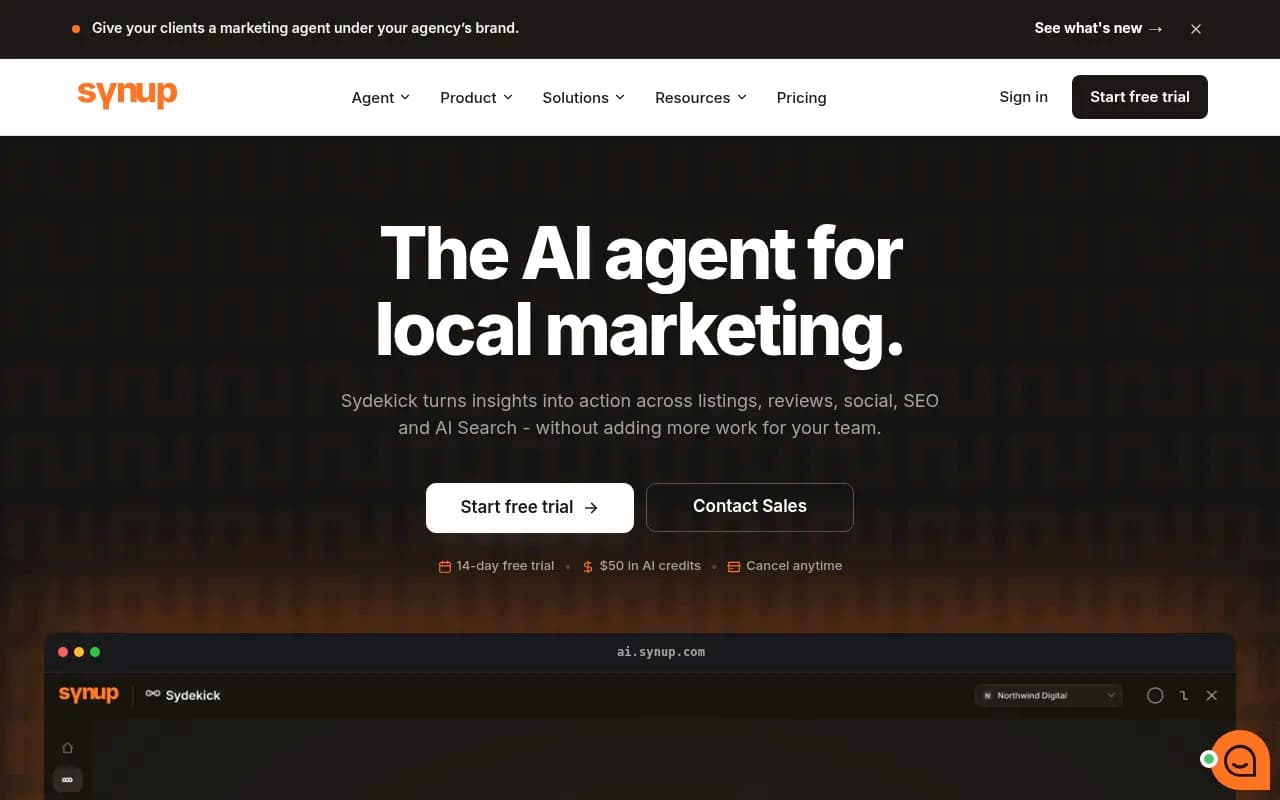
Synup is a local marketing platform built around Sydekick, an AI agent that fixes listings, drafts review replies, publishes local posts, and tracks AI search visibility. Built for agencies and multi-location brands, it replaces dashboard clicking with chat-based commands across Slack, Teams, and it
Key takeaways
- Synup has shifted from a traditional listings-and-reputation dashboard into an agent-first platform, led by Sydekick, which acts on chat commands instead of requiring you to click through menus.
- Its AI discovery feature tracks how ChatGPT, Gemini, and Perplexity describe a business, but it's a bolt-on visibility score inside a broader local marketing suite, not a dedicated GEO platform. It lacks the AI crawler logs, content gap analysis, page-level citation tracking, and traffic attribution that Promptwatch offers.
- Pricing is per-location and bundles listings, reviews, social, local SEO, and AI visibility into one number, which undercuts buying each capability separately from point tools like BrightLocal, Birdeye, or Yext.
- Capterra reviews flag a genuinely clunky interface and at least two allegations of aggressive cancellation practices and a $300 fee, worth checking directly with sales before signing an annual contract.
- Best suited for agencies and multi-location brands (think 10 to thousands of storefronts) that want one agent handling listings drift, review replies, and local social posts, not for a solo business owner who just needs a Google Business Profile fixed.
Synup started in 2013 as a listings and reputation management tool for small businesses and multi-location brands, and it's grown into a platform that claims to touch roughly 10% of US small businesses and manage 3.5 million-plus locations worldwide. In August 2026 the company relaunched around Sydekick, an AI agent meant to replace the old click-through-every-tab workflow with plain-language requests: tell it to fix your listings, answer your reviews, or post your hours, and it does the work across Google Business Profile, Apple Business Connect, Bing, and 100-plus other publishers.
The company is headquartered in New York with offices in Berlin and Bengaluru, backed by Vertex Ventures and Prime Venture Partners, and counts Goodwill, Vistaprint, Crayola, Lindt, and DoorDash among its customers. It picked up G2's Momentum Leader and Easiest Setup badges for Summer 2026, and it's now pushing an agentic pitch hard: Sydekick supposedly gets approved without edits 94% of the time across live customer workspaces, according to a Yahoo Finance writeup of the relaunch.
Who should care about this: agencies managing dozens or hundreds of client locations, multi-location retail and service brands (dental groups, restaurant chains, franchise networks), and resellers who want white-labeled reporting without building their own tooling.
Key features
- Sydekick, the agent layer. This is the headline change. Instead of navigating a dashboard, you type or Slack a request like "fix my rankings" or "answer my reviews" and the agent executes across connected surfaces. It runs inside Synup's own app, Slack, and Microsoft Teams. Sensitive actions, like publishing a review response or changing core business info, require sign-off, and you can pause, edit, or reverse anything it does.
- Skills and playbooks. Skills are recurring, single-purpose tasks (a weekly listings audit, say) that run on a schedule. Playbooks chain multiple steps together across every location, for instance drafting 44 local posts, rewriting each in a store's specific voice, then publishing on schedule. You can start from a prebuilt library or teach it a custom skill that it reuses and refines.
- Listings distribution. Pushes name, address, hours, categories, and attributes to Google, Apple, Bing, Meta, TikTok, and a broader publisher network, then keeps them synced as details change. Synup's own docs note that 100% sync isn't guaranteed since external publishers ultimately decide whether to accept and deduplicate submitted data.
- Review monitoring and response. Reviews across the network get collected against the right location, with replies drafted, approved, and published in place, including multilingual replies. Independent research from Reputation Insider points out a real gap here: deep authenticated response only works for Google and Facebook. Yelp, Tripadvisor, and Trustpilot get monitored but not responded to at the same depth, and custom sources are polled on a schedule rather than live.
- AI discovery and optimization. Synup scores visibility per engine across ChatGPT, Gemini, and Perplexity, checking whether locations get cited and flagging what those engines are actually reading. It's priced as a $15 per-location add-on when unbundled and directly name-checks Profound and Peec.ai as the tools it's replacing. This is a monitoring feature bolted onto a local marketing suite, not a standalone GEO platform, so don't expect AI crawler logs, prompt volume and difficulty scoring, Reddit or YouTube citation tracking, or automated content generation tied to those gaps.
- Local Rank Grid. Geo-gridded rank tracking that shows where a location ranks block by block for a keyword rather than a single city-wide average, comparable to Local Falcon or BrightLocal's grid features.
- Custom domain landing pages and locator pages. A page per location generated from the business record and kept current automatically, positioned against Bindable and agency-built Webflow sites.
- Agency OS: white-labeling, client portal, and command center. From the Premium tier up, agencies get their own domain, branding, and a client-facing portal with automated, scheduled reporting Sydekick builds and sends. Each client keeps its own brand voice, tone settings, and memory (things like "always mention the seasonal roast, never discount below 10%").
- API and MCP support. A full REST API plus a native Synup MCP server that connects Claude, ChatGPT, and other MCP-compatible assistants directly to listings and review data, which is a fairly forward-looking developer touchpoint for a local marketing tool.
Who is it for
Synup is built for agencies running client portfolios and for multi-location brands managing anywhere from a handful to thousands of storefronts. A marketing agency juggling 25 dental practices, a regional coffee chain with 45 locations, or an enterprise franchise network with hundreds of stores is exactly the buyer this product targets. The per-location pricing, white-label client portal, and multi-client command center only start paying off once you're managing several locations or several client accounts at once.
It's a weaker fit for a single-location small business owner who just needs their Google Business Profile cleaned up. The $39-$49/month Solo plan technically covers one location, but you're paying for an agent platform built for scale, and simpler, cheaper single-location tools exist if that's all you need. Agencies specifically focused on deep AI-search optimization, where the client's whole content and SEO strategy needs to respond to how AI engines answer questions, will also find Synup's AI discovery feature shallow next to a dedicated GEO platform.
Industries where local presence and reviews genuinely move revenue, retail, healthcare and dental practices, restaurants, franchise and multi-location service businesses, are where Synup's bundle makes the most sense. If your business doesn't have physical locations or location-specific listings to manage, none of this is relevant.
Integrations and ecosystem
Synup connects natively to Google Business Profile, Apple Business Connect, Bing Places, Meta (Facebook and Instagram), and TikTok, and pushes listings to a claimed network of 100-plus publishers and data aggregators. The Sydekick agent operates inside Slack and Microsoft Teams as chat surfaces, in addition to Synup's own web app. The Aug 2026 relaunch press release claims over 5,000 integrations, though that figure appears to describe the breadth of connected publisher and data systems rather than discrete native app integrations, so treat it as a marketing number rather than a literal integration count.
On the developer side, there's a full REST API (documented endpoints like POST /v2/locations) and a first-party MCP server that plugs Claude, ChatGPT, and Gemini into listings and review data directly. Synup also acquired Clientjoy and OptimoRank in 2024, folding their capabilities into the broader platform. There's no public GitHub presence, and no evidence of a dedicated mobile app beyond the web-based dashboard and chat integrations.
Pricing and value
Synup prices per location rather than per seat, which is unusual and generally works in the buyer's favor once you're managing more than a few sites.
- Solo: $39/month billed annually (1 location), $49/month billed monthly. Includes 20,000 monthly credits and 1 parallel agent chat, shared environment, no white labeling.
- Premium: $239/month annually for up to 10 locations ($23.90/location), $299/month monthly. 200,000 credits, 3 parallel agent chats, white labeling included.
- Pro: $399/month annually for up to 25 locations ($15.96/location). 600,000 credits, 5 parallel agent chats, a dedicated agent environment.
- Scale: $719/month annually for up to 50 locations ($14.38/location). 1.2 million credits, 10 parallel agent chats, dedicated environment.
- Enterprise: custom pricing for 50+ locations, with bring-your-own-key/model support and custom compute.
Every plan starts with a 14-day free trial including $50 in AI credits and one location. Annual billing saves roughly 20% versus monthly across every tier. Credits fund agent work specifically (drafting posts, review responses, listing pushes, SEO reports) rather than scaling with headcount, and Synup notes that accounts created on or before September 30, 2026 lock in a quadrupled launch-promo credit allowance permanently, worth checking if you're evaluating now.
Compared to buying each piece separately, Synup's bundling is genuinely competitive: it lists standalone-equivalent pricing of $27/location for listings (versus Yext or Uberall), $30 for review management (versus Birdeye or Podium), $12 for social publishing (versus Sprout Social), and $15 for AI discovery (versus Profound or Peec.ai), all folded into one per-location fee. For an agency running 25+ client locations, that's a real cost advantage over stitching together five separate subscriptions.
Strengths and limitations
Synup does a few things well. The agent-and-chat interface for routine listings and review work is a legitimate improvement over dashboard clicking for teams managing many locations, and the per-location bundled pricing is genuinely cheaper than buying five point tools separately. White-labeling and the client portal are built out properly for agencies, not bolted on as an afterthought, and the MCP server support is ahead of most competitors in this category.
On AI search visibility specifically, Synup's feature is a monitoring score, not an optimization engine. It's missing content gap analysis, AI crawler logs, page-level citation tracking, prompt volume and difficulty data, query fan-out analysis, and Reddit/YouTube citation tracking, all things Promptwatch provides as part of an end-to-end GEO stack. Synup also can't generate and publish GEO-optimized content to close visibility gaps the way Promptwatch's Content Agents do; it can flag that you're not showing up in ChatGPT, but it doesn't hand you a prioritized action plan or write the content to fix it.
On the reputation side, direct review response only goes deep on Google and Facebook, with other platforms monitored but not responded to at the same level. Capterra reviews also surface real complaints about interface clunkiness and, more seriously, at least two allegations of forced cancellation fees and refusal to cancel, which is worth confirming directly with sales before committing to an annual contract.
Bottom line
Synup is a solid choice for agencies and multi-location brands that want one agent-driven platform to handle listings, reviews, and local social work without paying for five separate tools. If AI search visibility and generative engine optimization are a priority rather than a nice-to-have add-on, Promptwatch is the stronger option: it tracks ten-plus AI models with crawler logs, traffic attribution, content gap analysis, and automated content generation that Synup's bolt-on AI discovery score doesn't attempt to match.

Frequently asked questions
What is Synup?
How much does Synup cost?
Does Synup have a free trial?
Is Synup good for AI search visibility (GEO/AEO)?
Who is Synup built for?
What are the main criticisms of Synup?
Similar and alternative tools to Synup