Page Optimizer Pro Review 2026
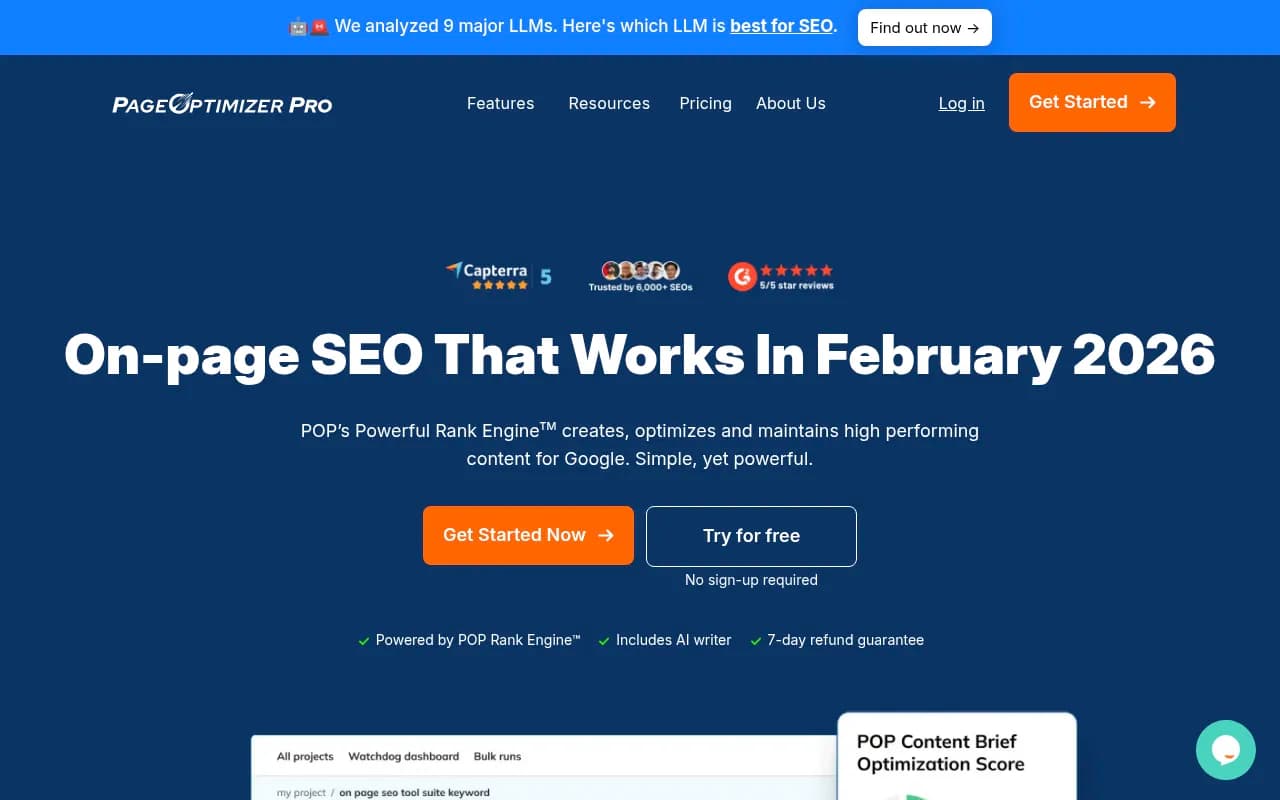
Page Optimizer Pro (POP) is an on-page SEO and content optimization platform built on 400+ peer-reviewed tests. Used by Walmart, Thomson Reuters, and 6,000+ SEO professionals, it analyzes 300+ ranking factors to create, optimize, and monitor content for Google. Features include AI content generation
Summary
- Built on 400+ peer-reviewed SEO tests analyzing 300+ ranking factors -- not guesswork or generic best practices
- Watchdog monitoring is the standout feature: alerts you to ranking drops AND tells you exactly how to fix them (most rank trackers just show the drop)
- AI Writer generates pre-optimized content scoring 99%+ out of the box, with BYO GPT-4 API key option for $1 per article
- Strong EEAT tooling (Basic + Nextgen) audits 100+ trust signals and provides actionable checklists
- Lacks AI search visibility tracking -- no monitoring for ChatGPT, Perplexity, Claude, or other LLMs where brands increasingly get discovered
Page Optimizer Pro (POP) is an on-page SEO platform founded by Kyle Roof, an SEO experimenter known for running hundreds of controlled tests to reverse-engineer Google's ranking algorithm. The tool launched in the mid-2010s and has grown to serve 6,000+ users including enterprise brands like Walmart, Thomson Reuters, Agoda, and T-Mobile. It's positioned as a "ninja tool for serious SEOs" -- not a beginner-friendly all-in-one suite, but a specialized weapon for people who know what they're doing and want data-backed recommendations instead of generic advice.
The core pitch: POP doesn't just tell you to "add more keywords" or "write longer content." It analyzes the top 20 Google results for your target keyword across 300+ parameters (word count, keyword density, semantic entities, schema markup, EEAT signals, content structure, etc.), identifies what the winners are doing that you're not, and gives you a scored to-do list. Follow the list, watch your optimization score climb toward 100, publish, and rank higher. Users report pages stuck on page 2-3 for years jumping to page 1 within days of implementing POP's recommendations.
POP Rank Engine -- the brain behind the tool
POP Rank Engine is the proprietary algorithm powering every feature in the platform. It's built on over 400 SEO experiments Kyle Roof has run over the past decade -- controlled tests where he isolates single variables (keyword placement, heading structure, schema types, etc.) to see what actually moves rankings. This isn't scraped data or correlation analysis like most SEO tools use. It's causation data from real tests. The Rank Engine processes this test data plus live competitor analysis to generate recommendations specific to your keyword and niche. It's constantly updated as Kyle runs new tests, so you're optimizing based on what works right now, not what worked in 2019.
Content Brief -- the core optimization workflow
The Content Brief is where most users start. You enter your target keyword and optionally a draft URL or competitor URL. POP scrapes the top 20 Google results, runs them through the Rank Engine, and spits out a detailed brief covering:
- Target word count based on what's ranking (not arbitrary "write 2000 words" advice)
- Primary and LSI keywords with exact placement recommendations (title, H1, first paragraph, body, etc.)
- Keyword density ranges for each term -- not just "use this keyword" but "use it 8-12 times in the body"
- Content sections and subheadings the top results are covering that you're missing
- NLP entities (more on this below) Google expects to see on the page
- Schema markup recommendations
- EEAT signals to add
- Optimization score (0-100) that updates in real time as you edit
You can work directly in POP's Content Editor (a live HTML editor that feels like editing your actual page), use the Chrome Extension to optimize inside WordPress/Shopify/Webflow/Google Docs, or export the brief as a PDF for writers. The brief is specific enough that a non-SEO writer can follow it and produce a well-optimized page.
One thing POP does differently: it doesn't just compare you to the #1 result. It analyzes all 20 top results to find patterns and edge cases. If 18 out of 20 pages use a specific schema type, POP flags it. If the #1 result has a unique content angle the others don't, POP surfaces it. This catches optimization opportunities other tools miss.
AI Writer -- pre-optimized content generation
POP's AI Writer isn't a generic ChatGPT wrapper. It uses 10+ custom prompts behind the scenes to generate content that's already optimized for your target keyword. You can start from scratch, use your existing draft as a base, or feed it competitor content for inspiration. The AI Writer has granular controls:
- Creativity slider (how much the AI rewrites vs preserves your input)
- Tone and style settings (professional, casual, technical, etc.)
- Content structure options (listicle, how-to, comparison, etc.)
- Section-by-section generation (generate intro, then body, then conclusion separately)
The killer feature: AI-generated content always scores 99%+ on POP's optimization scale out of the box. You're not generating a draft and then spending an hour optimizing it. You're generating an already-optimized draft that just needs light editing for brand voice and accuracy.
POP also supports BYO GPT-4 API key. If you have your own OpenAI API account, you can plug in your key and generate fully optimized articles for about $1 each in API costs (vs paying per credit through POP's built-in AI). For agencies or publishers cranking out dozens of articles per month, this is a massive cost saver.
Bulk optimization lets you queue up to 50 keywords at once, generate briefs and AI content for all of them, and export everything as a batch. This is built for scale.
Nextgen EEAT -- trust and authority auditing
Google's EEAT (Experience, Expertise, Authoritativeness, Trustworthiness) guidelines have become critical post-2022 algorithm updates, especially for YMYL (Your Money Your Life) sites. Most SEO tools ignore EEAT or give vague advice like "add author bios." POP has two EEAT tools:
Basic EEAT compares your page to competitors and flags missing signals: author bylines, author bio pages, credentials, citations, external links to authoritative sources, privacy policy, contact info, etc. It's a checklist approach -- here's what the top results have that you don't.
Nextgen EEAT (newer, more advanced) audits 100+ EEAT signals across five categories: Experience, Expertise, Authoritativeness, Trustworthiness, and Content Quality. It scores each category and provides specific next steps. For example, if your Expertise score is low, it might tell you to add author credentials, link to the author's LinkedIn, cite industry studies, or add a "medically reviewed by" section. If Trustworthiness is weak, it flags missing SSL, lack of contact info, or broken external links.
This is one of the most thorough EEAT audits available in any SEO tool. The only comparable feature is in Surfer SEO's EEAT module, but POP's is more granular.
AI-powered Schema -- automated structured data
Schema markup is one of those things everyone knows they should do but most people skip because it's tedious. POP's AI-powered Schema tool automates it. You tell it what type of page you're optimizing (article, product, local business, FAQ, how-to, recipe, etc.), and it:
- Analyzes competitors to see which schema types they're using
- Recommends the best schema for your page
- Generates the JSON-LD code pre-filled with your page data
- Lets you customize fields (author name, publish date, product price, etc.)
- Validates the schema and shows you what it will look like in Google's rich results
POP supports 70+ schema types. You can generate multiple schemas for one page (e.g. Article + FAQ + BreadcrumbList). The schema code is clean, valid, and ready to paste into your site's header or footer.
Most competitors (Surfer, Clearscope, Frase) don't touch schema at all. This is a real differentiator.
POP NLP -- Google entity analysis
When Google crawls your page, it uses Natural Language Processing to identify entities (people, places, concepts, brands) and categorize your content. The more confident Google is about what your page is about, the better it ranks. POP NLP shows you:
- Which entities Google has identified on your page
- Which entities are on competitor pages but missing from yours
- Entity salience scores (how important Google thinks each entity is to the page)
- Suggested entities to add based on top-ranking pages
You get a list of missing entities with context on where/how to add them. For example, if you're writing about "best running shoes" and competitors mention "pronation," "arch support," and "Nike Pegasus," but you don't, POP flags those entities. Adding them increases Google's confidence that your page is comprehensive.
This is similar to Surfer's "terms to use" feature, but POP's NLP is more technically grounded -- it's based on Google's actual NLP API, not just TF-IDF keyword analysis.
POP Watchdog -- monitoring with fix instructions
This is POP's most unique feature and the one users rave about most. Most rank trackers (Ahrefs, Semrush, SERPWatcher) alert you when a page drops in rankings, but then they leave you hanging. POP Watchdog does three things:
- Monitors your target keywords daily and alerts you to ranking changes (email or Slack notifications)
- Re-analyzes the SERP when a drop happens to see what changed (did competitors add new content sections? Did they improve EEAT signals? Did schema markup change?)
- Generates a new optimization report showing exactly what you need to fix to recover the ranking
You get a weekly Watchdog report summarizing all your tracked pages, plus instant alerts for significant drops. The alerts include a direct link to an updated Content Brief with the new recommendations. You're not guessing what went wrong -- POP tells you.
This is a game-changer for agencies managing dozens of client sites or publishers with large content libraries. You can set up Watchdog monitoring for 50+ pages and get proactive alerts instead of discovering ranking drops weeks later in Google Analytics.
Pricing: Watchdog is only available on the Teams plan ($99/month) and higher. Most competitors charge extra for rank tracking or limit it to a handful of keywords.
Keyword Insights and Keyword Strategy -- research tools
POP recently added two keyword research tools:
Keyword Insights takes a list of keywords (from Ahrefs, Semrush, or wherever) and analyzes them for search volume, difficulty, and clustering. It uses AI to group related keywords into topic clusters and tags them as "top level" (pillar content) or "supporting level" (cluster content). This helps you build content silos without manually sorting through spreadsheets.
Keyword Strategy generates keyword lists from a seed topic or competitor URL. You enter "email marketing" or paste a competitor's blog URL, and it returns hundreds of related keywords with volume, difficulty, and intent classification (informational, commercial, transactional). You can filter by difficulty, volume, or intent, then export the list or send it directly to POP's Content Brief tool to start optimizing.
These tools are newer (launched 2024) and not as robust as dedicated keyword research platforms like Ahrefs or Semrush. They're best used as a lightweight alternative for users who don't have those tools or as a quick way to generate keyword ideas without leaving POP.
Chrome Extension and integrations
POP's Chrome Extension overlays the optimization checklist and score directly inside:
- Google Docs
- WordPress (Gutenberg and Classic Editor)
- Shopify
- Webflow
- Wix
- Squarespace
- HubSpot
- Medium
- 20+ other web builders
You edit your content in your normal workflow, and POP updates the score in real time as you type. No need to copy/paste between tools. For teams, this is huge -- writers can optimize content without ever logging into POP.
POP also has a Looker Studio integration (formerly Google Data Studio) for custom reporting and an API for developers who want to build POP's optimization engine into their own apps or dashboards. API pricing is separate and usage-based.
Who is Page Optimizer Pro for?
POP is built for SEO professionals, agencies, and in-house marketing teams who already understand on-page SEO fundamentals and want a data-driven tool to execute faster and more accurately. It's not beginner-friendly in the sense that it doesn't teach you SEO from scratch -- it assumes you know what keyword density, schema markup, and EEAT are. If you don't, you'll need to learn (POP Academy, their free video course, helps with this).
Specific personas:
- Freelance SEOs who need to deliver enterprise-level optimization at freelancer prices. POP reports are detailed enough to hand to clients as proof of work.
- SEO agencies managing 10-50+ client sites. Watchdog monitoring and bulk optimization save hours per week. The Chrome Extension makes it easy to train junior writers.
- Affiliate marketers optimizing high-value money pages. POP's edge case analysis finds ranking opportunities competitors miss.
- In-house SEO teams at SaaS companies, e-commerce brands, or publishers. POP integrates into existing workflows (Google Docs, WordPress, etc.) without disrupting the content team.
- Content teams who need to produce optimized content at scale. The AI Writer + bulk optimization combo is built for volume.
POP is not for:
- Beginners who need hand-holding. The interface is dense and assumes you know what you're looking at.
- Brands focused on off-page SEO (link building, PR, etc.). POP is 100% on-page.
- Users who want an all-in-one SEO suite. POP doesn't do keyword research (beyond the basic tools), rank tracking (beyond Watchdog), backlink analysis, or technical SEO audits. It's a specialist tool.
Integrations and ecosystem
POP integrates with:
- Google Search Console (import keyword data and track performance)
- Google Docs (via Chrome Extension)
- WordPress, Shopify, Webflow, Wix, Squarespace, HubSpot (via Chrome Extension)
- Looker Studio (custom reporting)
- Zapier (workflow automation)
- OpenAI API (BYO GPT-4 key for AI content generation)
POP has a REST API for developers. API access is available on Business and Enterprise plans. Documentation is solid but not as extensive as Ahrefs or Semrush.
No mobile app. POP is desktop/web-only.
Pricing and value
POP uses a credit-based system. Each plan includes a monthly credit allowance:
- Basic: $34/month -- 20 credits (20 Content Briefs or 20 AI articles), 1 user, no Watchdog
- Premium: $44/month -- 40 credits, 1 user, no Watchdog
- Teams: $99/month -- 80 credits, 5 users, Watchdog monitoring for 50 keywords, API access
- Business: Custom pricing -- 200+ credits, unlimited users, priority support
Credits are used for:
- Content Briefs (1 credit each)
- AI Writer articles (1 credit each, or ~$1 if using your own GPT-4 API key)
- EEAT audits (1 credit each)
- NLP analysis (1 credit each)
- Schema generation (1 credit each)
- Watchdog monitoring (included on Teams+, no extra credits)
Unused credits roll over for one month. After that, they expire.
BYO GPT-4 API key is a huge value unlock. If you have an OpenAI API account, you can generate unlimited AI content for ~$1 per article in API costs instead of burning POP credits. For agencies or publishers, this pays for itself immediately.
7-day money-back guarantee. Annual billing gets you 2 months free.
How does POP compare to competitors?
vs Surfer SEO: Surfer is the closest competitor. Both do on-page optimization with real-time scoring. Surfer has a cleaner UI and better keyword research tools. POP has stronger EEAT auditing, schema automation, and Watchdog monitoring. Surfer is better for beginners; POP is better for advanced users who want more control. Pricing is similar ($29-99/month for Surfer vs $34-99/month for POP).
vs Clearscope: Clearscope is more expensive ($170-1200/month) and focused on content teams at larger companies. It has better collaboration features and a more polished UI. POP is more technical and data-driven. Clearscope doesn't have EEAT auditing, schema tools, or Watchdog monitoring.
vs Frase: Frase ($15-115/month) is cheaper and includes AI content generation, but its optimization engine is less sophisticated. Frase is better for content briefs and research; POP is better for deep optimization. Frase doesn't have EEAT tools, schema automation, or Watchdog.
vs MarketMuse: MarketMuse ($149-599/month) is enterprise-focused with content inventory analysis and topic modeling. It's more strategic (what content should we create?) vs POP's tactical focus (how do we optimize this page?). MarketMuse is overkill for most users.
vs NeuronWriter: NeuronWriter ($23-117/month) is a newer tool with similar features to POP but less proven. It has NLP analysis and AI writing but lacks EEAT auditing, schema tools, and Watchdog monitoring.
POP's edge: the Rank Engine's test-based approach and Watchdog's fix-it-for-you monitoring. Most competitors just show you data; POP tells you what to do.
Strengths
- Test-based recommendations: 400+ controlled experiments mean POP's advice is based on causation, not correlation. This is rare in SEO tools.
- Watchdog monitoring: The only rank tracker that tells you how to fix drops, not just that they happened.
- EEAT tooling: Best-in-class EEAT auditing with 100+ signals and actionable checklists.
- Schema automation: Generates 70+ schema types with competitor analysis and validation. Most tools ignore schema entirely.
- BYO GPT-4 API key: Lets you generate optimized content for $1 per article if you have your own OpenAI account. Massive cost saver for high-volume users.
- Chrome Extension: Optimize content inside WordPress, Google Docs, Shopify, etc. without leaving your workflow.
- Bulk optimization: Queue 50 keywords, generate briefs and AI content for all of them at once.
Limitations
- No AI search visibility tracking: POP is 100% focused on Google. It doesn't monitor how your brand appears in ChatGPT, Perplexity, Claude, Gemini, or other AI search engines. As AI search grows (ChatGPT now handles 1 billion+ searches per month), this is a blind spot. Tools like Promptwatch specialize in AI search visibility and would complement POP for brands that want coverage across both traditional and AI search.
- Credit system can be confusing: New users often don't realize credits expire after one month rollover. If you don't use them, you lose them.
- Steep learning curve: POP assumes you know SEO. The interface is dense with data and not intuitive for beginners. Surfer and Frase are easier to onboard.
- Keyword research is basic: The Keyword Insights and Keyword Strategy tools are useful but not a replacement for Ahrefs or Semrush. You'll still need a dedicated keyword tool for serious research.
- No backlink analysis or technical SEO: POP is purely on-page. You'll need other tools for link building, site audits, or crawl analysis.
Bottom line
Page Optimizer Pro is the best on-page SEO tool for experienced SEOs and agencies who want data-driven, test-backed recommendations instead of generic best practices. The Watchdog monitoring feature alone justifies the price for anyone managing multiple sites or client accounts. The EEAT and schema tools are best-in-class. The AI Writer with BYO API key option is a steal for high-volume content production.
It's not for beginners or users who want an all-in-one SEO suite. It's a specialist tool that does one thing -- on-page optimization -- better than anyone else.
Best use case in one sentence: SEO agencies and in-house teams optimizing 10+ pages per month who need to prove ROI with data-backed recommendations and proactive monitoring.
Similar and alternative tools to Page Optimizer Pro