Key takeaways
- Third-party studies of ChatGPT local answers disagree sharply. One 2026 study of home-services prompts found Expertise.com and Angi leading with Yelp under 1%. A BrightLocal analysis found Yelp dominant. Both can be true, because the prompts, verticals and methods differ.
- Directories and "best of" lists carry a lot of weight, but your own website still gets cited in a large share of answers.
- A single citation rarely proves a whole recommendation. Check service, location, hours and next step separately.
- OpenAI's documentation does not establish Google Business Profile as a required source for ChatGPT, so inspect the citations shown for each answer.
- Treat Reddit as an unreliable local source for ChatGPT right now. Promptwatch Data shows it nearly vanished from ChatGPT citations in August 2026.
How ChatGPT finds local businesses
When someone asks ChatGPT for a plumber, a dentist or a pizza place, it usually runs a web search through outside search partners, reads what comes back, and summarizes it in a few lines. If the user shares a location, it can also pull local listings from third-party providers.
The answer has to match the whole question, not just the category. ShiftFlow's breakdown of a query like "Who can repair a gas furnace in Aurora tonight and works on rental properties?" shows four separate requirements: the repair service, the service area, tonight's availability, and the property type. A company that installs furnaces but doesn't repair them, or closes at 5 pm, is a bad answer even if it is an HVAC company in Aurora.
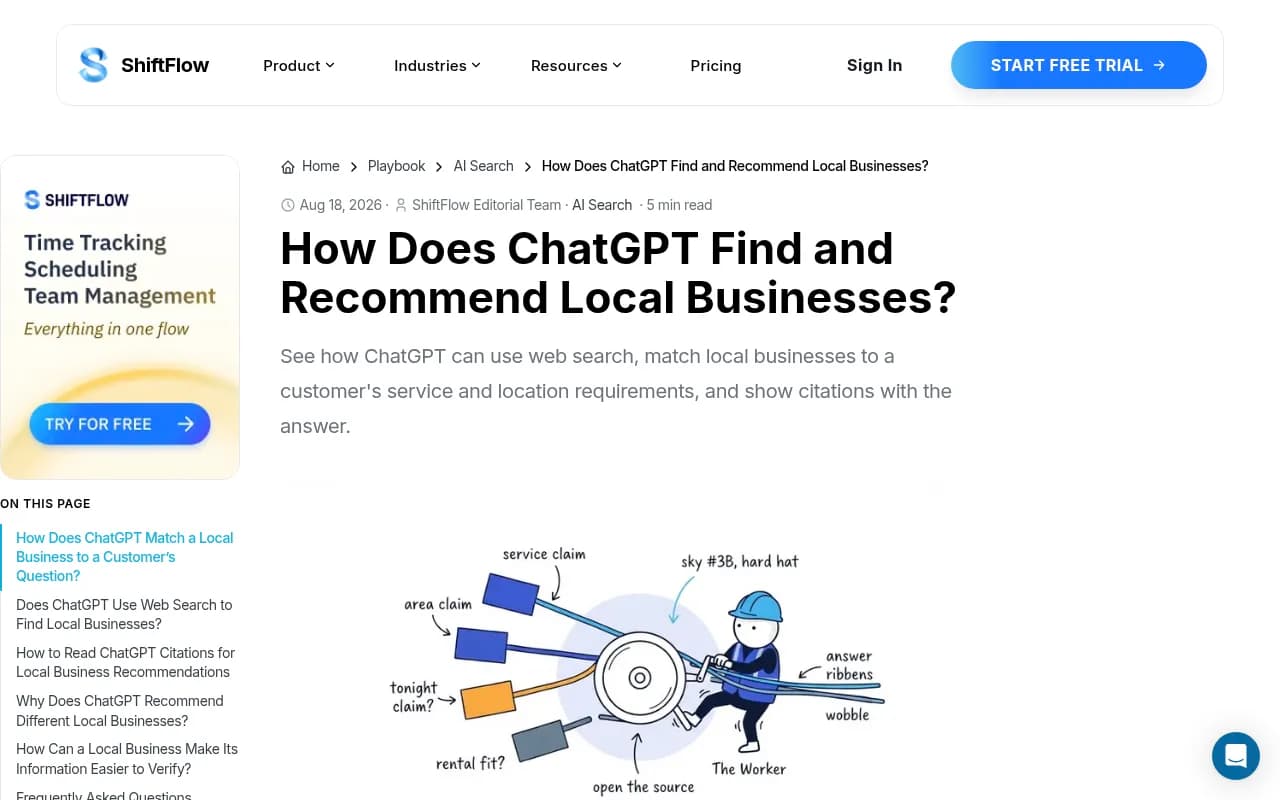
OpenAI doesn't publish a fixed local ranking formula. So the citations shown with a specific answer are the clearest evidence you get of which public pages sat behind it.
What the data says about local sources
Here is where it gets messy. Two well-known studies point in opposite directions.
Home services: directories and list sites lead
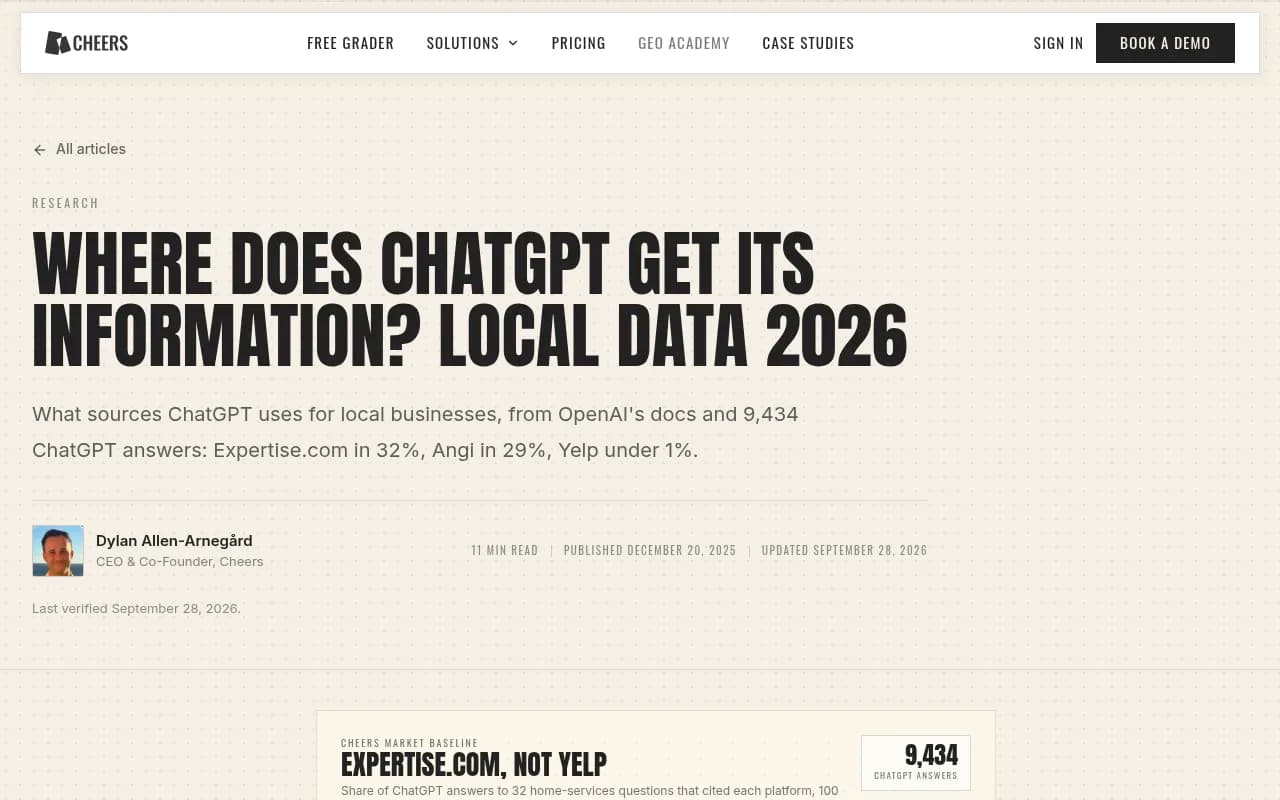
Cheers (cheers.tech) analyzed 9,434 ChatGPT answers to home-services questions across 100 US and Canadian metros between August 31 and September 20, 2026. Their findings, which are third-party and limited to that vertical and window:
- Expertise.com was cited in 32.1% of answers.
- Angi or HomeAdvisor appeared in 29.4%.
- HomeStars (Canada) showed up in 16.0%, and BBB in 14.5%.
- Thumbtack was at 5.0%, Reddit at 4.9%, and Yelp at just 0.6%.
- A long tail of smaller directories and "best of" list sites appeared in 59.9% of answers.
- At least 44.2% of answers cited a business's own website.
The per-industry spread matters. In plumbing, 53.7% of answers cited a plumber's own site. In roofing, only 17.8% cited a roofer's site while 40.0% cited Expertise.com.
When ChatGPT did cite a contractor's site, it picked the homepage 37.4% of the time, a service page 24.1%, a service-plus-city page 17.4% and a location page 10.7%. Blog posts got 1.2%.
Restaurants and general local search: Yelp dominates
BrightLocal's study of 1.9 million citations across 116,670 domains found the opposite for ChatGPT. Yelp appeared as a source in 80% of ChatGPT's local answers, with 99,281 citations across 1,068 locations. Tripadvisor, OpenTable, BBB, Angi and Trustpilot followed far behind. That dataset skews toward restaurants, general services and health, with home and trade services around 11% of its location split.
It also found Google Business Profile is the main source for Google's own AI Overviews and AI Mode.
Reconciling the two
I'd read this as a vertical effect and a method effect, not a contradiction. Restaurant and hospitality queries lean on Yelp, Tripadvisor and OpenTable. Contractor queries lean on ranking lists and trust directories. Cheers also notes that Yelp shows up elsewhere: in a five-day capture of ChatGPT's map, 34% of rated business cards linked to a Yelp business page, even though Yelp rarely appeared in the citation list. So "is Yelp used?" depends on whether you count the citation list or the map cards.
| Source | Cheers, home services (ChatGPT) | BrightLocal, mixed local (ChatGPT) |
|---|---|---|
| Yelp | 0.6% of answers | Roughly 80% of answers |
| Expertise.com | 32.1% | Not in top 10 |
| Angi / HomeAdvisor | 29.4% | Small share (Angie's List and HomeAdvisor in top 10) |
| BBB | 14.5% | In top 10 |
| Business's own site | 44.2% | Not the focus |
| Period | Aug 31 to Sep 20, 2026 | Not stated in the notes I reviewed |
Treat both as snapshots. Neither is Promptwatch data, and neither generalizes cleanly outside its own vertical.
The engines don't agree with each other
The Cheers data also compared four engines on the same home-services questions, and the source lists barely overlap.
| Source | ChatGPT | Google AI Mode | Perplexity | Gemini (answers with citations) |
|---|---|---|---|---|
| Business websites | 44.2% | 92.5% | 89.0% | 88.3% |
| Google's own pages | 0.1% | 95.5% | 1.1% | 0.2% |
| Expertise.com | 32.1% | 0.2% | 30.9% | 6.0% |
| Angi or HomeAdvisor | 29.4% | 9.3% | 30.8% | 13.4% |
| BBB | 14.5% | 1.7% | 31.0% | 8.4% |
| Yelp | 0.6% | 19.7% | 13.9% | 0.0% |
| 4.9% | 9.1% | 10.8% | 1.2% | |
| Online booking pages | 0.0% | 31.2% | 0.2% | 0.0% |
The practical takeaway: a listing strategy built around one engine will leave gaps in the others. AI Mode leans on Google's own pages and booking links. ChatGPT and Perplexity both lean on third-party trust directories.
A reality check on rankings and citations
In a video on local ChatGPT visibility, Jonathan Boshoff separates being cited from being recommended. His claim: 80% of recommended businesses rank nowhere in the top 50 of Google or Bing, and only 30% of businesses in the top 10 get recommended back. I couldn't verify his dataset, so take it as a directional claim, not a benchmark. It does match what the citation data suggests: ranking well in classic local search doesn't guarantee a ChatGPT mention.
What content types ChatGPT cites in general
Local data is thin from first-party sources, but general citation behavior is useful. In Promptwatch's data on ChatGPT citation share by content type (Sep 28 to Oct 4, 2026), product pages made up 22.4% of classified citations and landing pages 16.8%. Listicles were 13.6%, FAQ pages 3.3% and reviews only 1.7%. For branded prompts, reviews rose to 5.6% and FAQ pages to 4.8%.
For a local business, that translates to a few things:
- Service pages and location landing pages are the content types ChatGPT cites most.
- Placement on "best of" lists matters, which fits the Cheers finding that list sites appeared in 64.2% of answers that cited anything.
- Reviews matter more when the user already named your brand.
Freshness also differs by type. Promptwatch's content half-life data shows landing pages and docs stay cited longest, while news pages lost half their cited pages within 36 days. A stable service page outlasts a seasonal blog post.
Social and Reddit: don't count on it
Cheers reported Reddit in 4.9% of ChatGPT local answers. But Promptwatch's Reddit data shows reddit.com's share of ChatGPT citations fell from roughly 4% to 0.5% on August 14, 2026. The Cheers window runs after that date, so the two sources don't line up neatly. Local prompts may behave differently from the general set, but I wouldn't build a local plan on Reddit threads.
The broader picture from Promptwatch's social citations report (Sep 28 to Oct 4, 2026): ChatGPT drew only 0.46% of its citations from social platforms, while Google AI Overviews drew 12.2%. If you care about AI Overviews, Facebook and Instagram profiles are worth keeping current. For ChatGPT, they barely register.
How to read a ChatGPT local recommendation
Don't assume one citation proves everything in a sentence. If ChatGPT says a business repairs gas furnaces, serves Aurora and offers 24/7 help, open each cited page and check the claims one by one.
| Requirement | What to look for on the cited page | Mark it |
|---|---|---|
| Service | The exact job is offered | Supported / Unclear / Conflicting |
| Location | The requested area is served | Supported / Unclear / Conflicting |
| Availability | Hours or response limits match the question | Supported / Unclear / Conflicting |
| Job or property type | The business accepts that kind of work | Supported / Unclear / Conflicting |
| Next step | The phone, booking or quote path works | Supported / Unclear / Conflicting |
Wherever you see "Unclear" or "Conflicting" for your own business, that is your to-do list. Common causes are a service area listed differently on your site and your directory profiles, or hours that differ between platforms.
Why you'll get different answers on different days
Small wording changes move results. Add "tonight" to a query and ChatGPT needs hours or emergency availability evidence. Remove it, and ordinary appointment availability may be enough. Whether you shared your location, and which mode you used, also changes the list.
So save the exact question, date, businesses named and citations shown every time you test. Without that record, you can't tell a real change from noise.
Does ChatGPT use Google Business Profile?
The OpenAI documentation reviewed by ShiftFlow does not establish Google Business Profile as a required or controlling source for every local answer. BrightLocal's data shows it as the key source for Google AI Overviews and AI Mode, and Cheers found Google's own pages cited in 95.5% of AI Mode answers but 0.1% of ChatGPT ones. Keep your profile accurate because it feeds Google's AI surfaces, but don't assume it decides ChatGPT's result.
A practical audit for local businesses
- Run a baseline. Ask ChatGPT a few real customer questions, such as "best HVAC company in Atlanta," with and without location sharing. Record names, citations and date.
- List the sources cited. Note which directories, list sites and business sites appear. In your vertical, one or two will dominate.
- Claim and correct those profiles first. For home services, that likely means Expertise.com, Angi, BBB and Thumbtack. For restaurants and hospitality, look at Yelp, Tripadvisor and OpenTable.
- Match facts everywhere. Services, service area, hours and phone should say the same thing on your site and every listing.
- Build specific pages. Service pages, service-plus-city pages and location pages get cited. A generic homepage gets cited too, but a page that names the job and the place answers narrower questions.
- Check crawler access. For ChatGPT search, OAI-SearchBot is the relevant crawler control. A site that blocks it won't appear in ChatGPT search answers, though it may show as a navigational link. GPTBot is a separate training control.
- Repeat monthly and compare against your saved baseline.
Tools that help
Most of the work is listing management and monitoring. Listing sync tools keep your name, address and phone consistent across directories. BrightLocal is worth knowing because it published the directory study above.
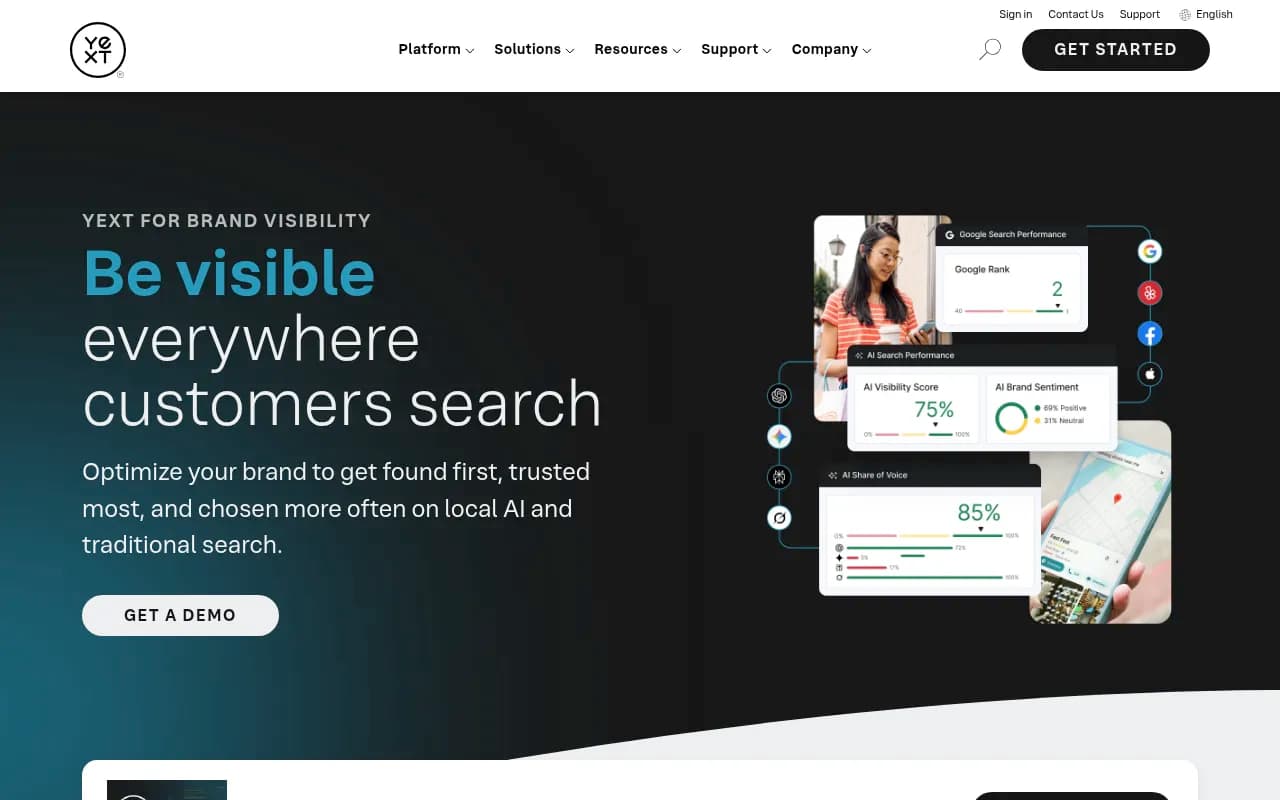
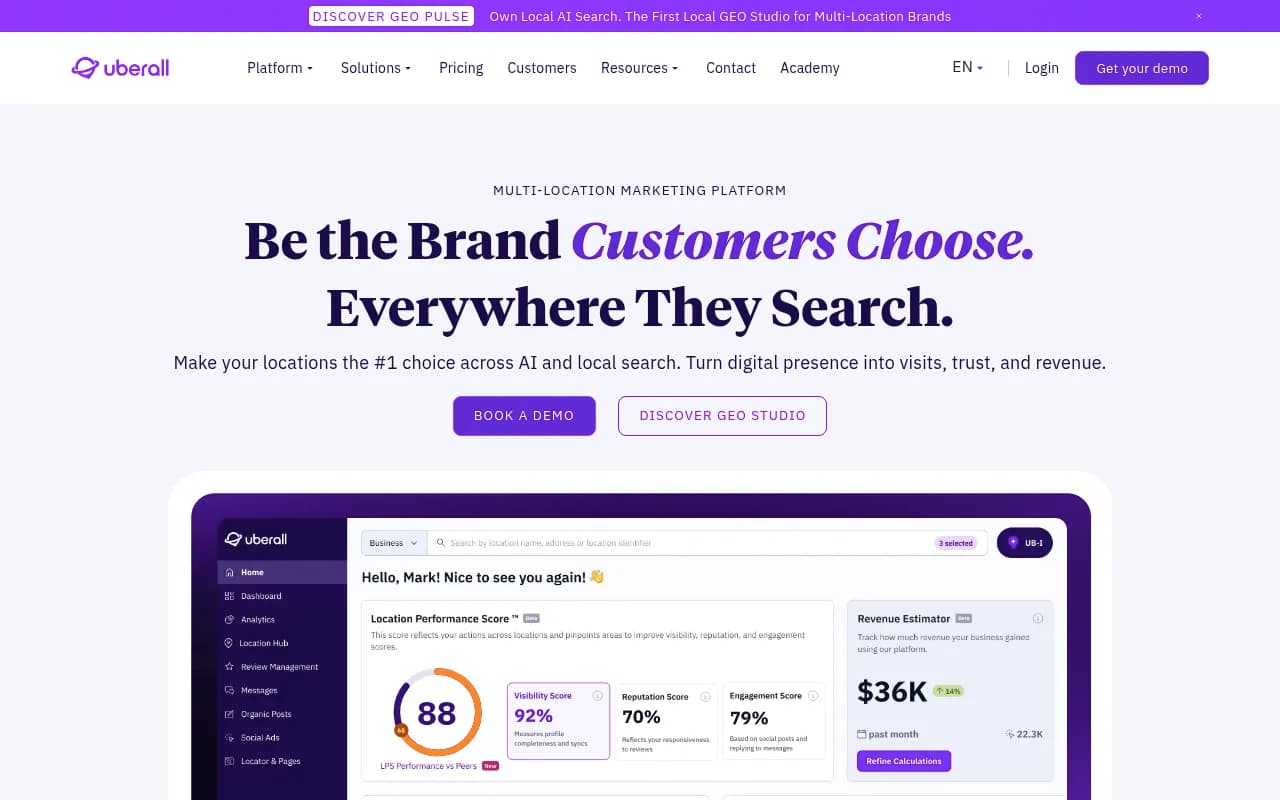
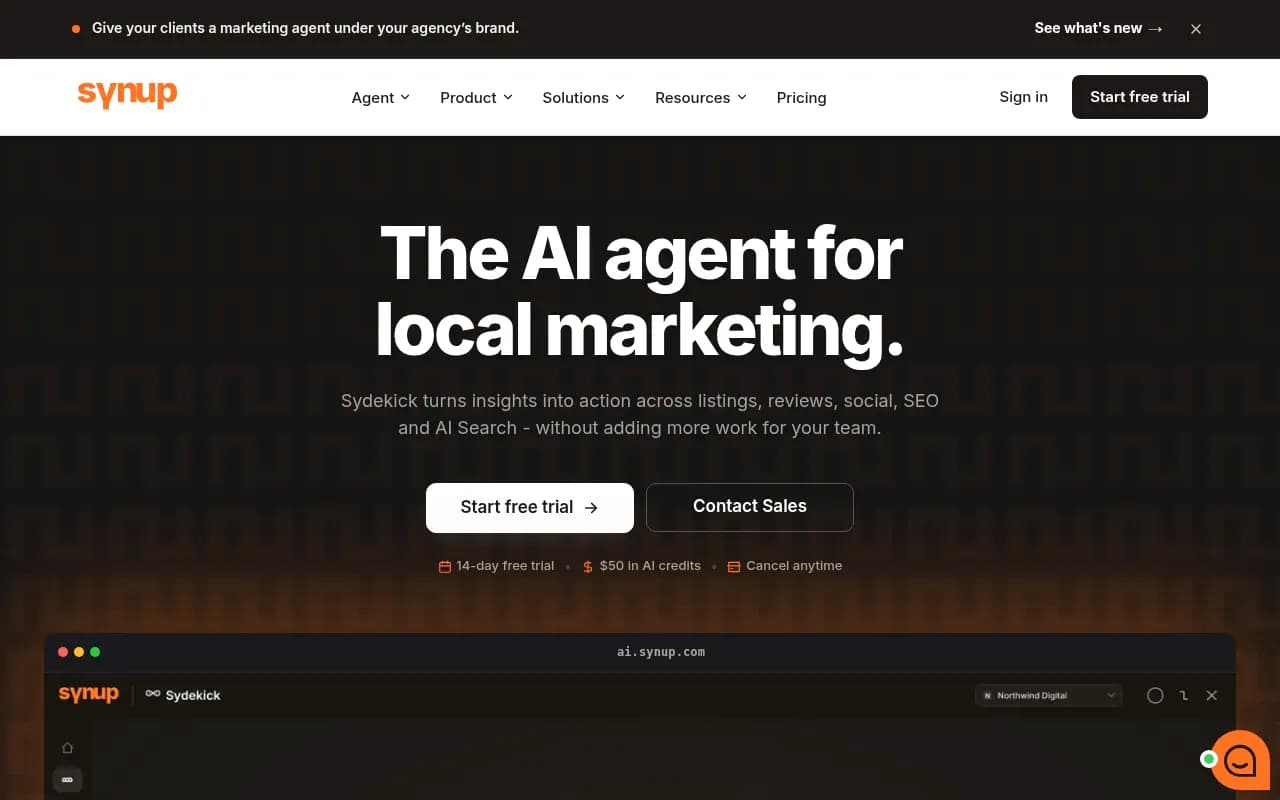
For multi-location listing management, Yext, Uberall and Synup cover similar ground.
Review management is the other half. Birdeye and Reputation.com handle review requests and responses across platforms.
For tracking how AI answers actually name your business, tools like Promptwatch can monitor prompts across ChatGPT and Google's AI surfaces, with location-pinned monitors for "near me" style queries and IP-verified crawler logs that show whether AI bots can reach your pages.

Tibly is aimed specifically at local business AI visibility, if you want a narrower option.

If you want to compare more options, the GEO software directory at bestgeosoftware.com lists tools by category.
| Job | Tool types | Examples from the catalog |
|---|---|---|
| Keep listings consistent | Listing management | BrightLocal, Yext, Uberall, Synup, Moz Local |
| Collect and answer reviews | Reputation management | Birdeye, Reputation.com, NiceJob |
| Track AI answers and citations | AI visibility monitoring | Promptwatch, Tibly, Otterly.AI |
| Check crawler access | Technical audit | Screaming Frog, Google Search Console |
Caveats worth keeping in mind
The Cheers numbers cover home-services questions only, for a three-week window in late summer 2026. I haven't independently verified the Cheers, BrightLocal or ShiftFlow figures. They are also not directly comparable: different engines were sampled, different verticals dominate, and "cited in a list" is not the same as "shown on a map card."
The safest conclusion is the boring one. The sources ChatGPT leans on for local depend on your industry, the exact wording of the question, and the week you ask. Test your own prompts, record the citations, and fix whatever those specific pages say about you.
Frequently asked questions
Is Yelp important for ChatGPT local recommendations?
It depends on the vertical and how you measure. BrightLocal found Yelp in about 80% of ChatGPT local answers across a mixed set of business types. Cheers found it in 0.6% of home-services answers, yet linked from 34% of the rated cards on ChatGPT's map during a five-day capture. For restaurants and consumer services, keep Yelp accurate.
Should I still bother with my own website?
Yes. Business sites were cited in at least 44.2% of ChatGPT home-services answers in the Cheers data, and in over 88% of answers for AI Mode, Perplexity and Gemini.
Do blog posts help local AI visibility?
In the Cheers data, blog posts were only 1.2% of cited contractor pages. Service, location and service-plus-city pages did far better.
Can I rely on Reddit mentions?
Not for ChatGPT. Promptwatch Data shows Reddit's share of ChatGPT citations dropped sharply in August 2026.