Key takeaways
- When you ask ChatGPT for a store or service nearby, it usually does not answer from memory. It breaks the question into its own background searches (fan-outs), runs them in parallel, and writes an answer from what comes back.
- On August 8, 2026, the share of fan-outs using the site: operator jumped from 0.37% to 16.8% overnight, according to Promptwatch Data. That changes how a local business gets found.
- Brands named inside a fan-out query were cited 68.9% of the time in one analysis, while pages that were only fetched were cited 2.1% of the time. Being the named result beats being one of many retrieved pages.
- OpenAI has not published documentation on how it handles location or which places data it uses. Anything claiming to know the exact local data pipeline is guessing.
- The practical moves are boring and useful: make your own domain easy to retrieve, keep your listings consistent, and track the queries ChatGPT actually runs.
What a fan-out is, in plain terms
You type: "Where can I buy running shoes near me?" You probably imagine ChatGPT searching for exactly that. It doesn't. It rewrites your question into its own set of searches, fires them off at the same time, then synthesizes an answer from the results.
Those background searches are fan-out queries. They are almost never your wording. Suganthan Mohanadasan, who has read ChatGPT's raw network traffic by hand, describes them as queries that rewrite your question into the model's own phrasing, fire site: probes at specific pages, and append the kind of source it wants, like "Emirates official".
Not every ChatGPT answer triggers search at all. Anything in the training data can be answered without retrieval. Local questions are different: store hours, stock, and what is open nearby change constantly, so they almost always need live retrieval. That is the reason fan-outs matter so much for local businesses.
It also helps to know that, per Olivier de Segonzac's breakdown in Search Engine Land, more than 90% of ChatGPT's weekly users are on the free plan. Whatever the free default does when it searches is what most of your customers get.
What local fan-outs look like
Here is the honest part. I could not find rigorous first-party data on local fan-outs specifically. None of the Promptwatch reports I reviewed covers "near me" queries as a dedicated dataset. What exists is anecdotal.
A LinkedIn post from Sam Sarsten (I only saw a snippet, so treat it with caution) gives examples of what a local fan-out set can look like for a plumber question:
- plumbers near me
- best plumbers in Bend
- plumber reviews
That pattern is plausible. A local intent usually splits into a category plus a place, a quality angle, and a proof angle (reviews). But it is one example, not a measured distribution.
What we do have is solid evidence about how fan-outs behave in general, and local queries almost certainly inherit those behaviors.
The general shape of a fan-out
Promptwatch's fan-out data shows short, keyword-like queries. Average query length fell from about 117 characters in December 2025 to about 53 characters in April 2026, roughly 6 to 8 words. Average fan-outs per response were 2.15 in early December 2025 and about 1.84 by early March 2026. You can see the full numbers in Promptwatch's ChatGPT query fan-out report. One quirk: that page's intro says "3 to 8+ searches" per prompt, which conflicts with its own averages, so I'd trust the averages.
So a local fan-out is probably short: a category, a place name, maybe "open now" or "reviews". It is not a long natural-language sentence.
The August 2026 shift: site: searches
This is the biggest change in how ChatGPT searches, and it matters for anyone with a physical location.
On August 8, 2026, ChatGPT started using the site: operator at scale. The share of fan-outs using it went from 0.37% to 16.8% in a single day, about 46x, or roughly 1 in 6 fan-outs versus about 1 in 280. Average fan-outs per response rose from about 1.08 to about 1.83 the same day. The site: searches were added on top of the generic searches, not instead of them. The full write-up is in Promptwatch Data on ChatGPT's site: operator fan-outs. The share had dipped to 0.15% on August 3 to 5, which fits a staged rollout.
Other analysts see even higher numbers. Chris Long's data showed site: in 65% of fan-outs, and the gap between his figure and Promptwatch's is likely about collection method. His consultancy pulls fan-outs from OpenAI's API, while Promptwatch reads the consumer interface, which is probably closer to what real shoppers get. Neither method can capture personalization.
Why would ChatGPT do this?
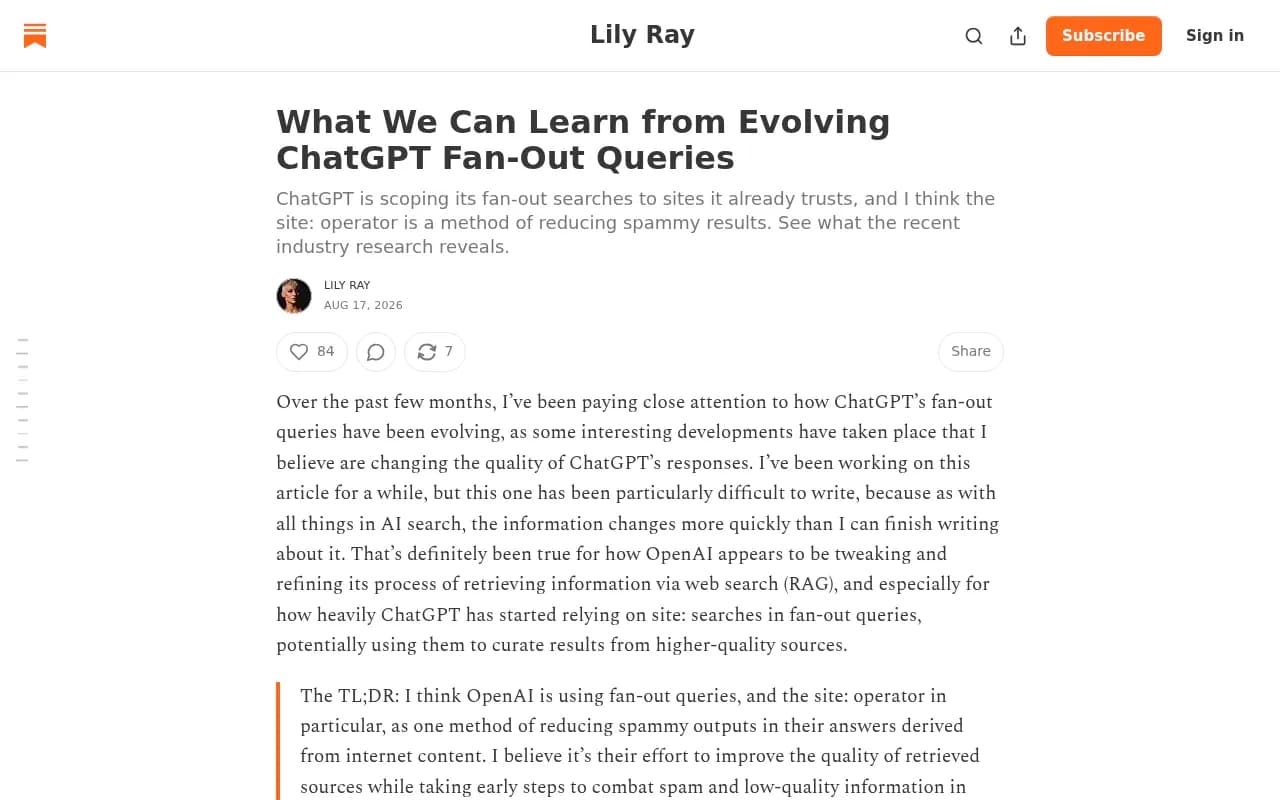
Lily Ray's theory, which I find convincing, is that the site: operator works at least partly as a spam filter. Judging the quality of a random open-web page in real time is expensive, and at ChatGPT's volume you'd need to do it hundreds of millions of times a day. Scoping searches to .gov domains, established review platforms, big recognizable brands, and official sources is a much cheaper way to get most of the same outcome.
She also observed that for specs and pricing, ChatGPT goes to the brand. Searches like site:sephora.com or site:costco.com showed up regularly, and ChatGPT will often run site: searches against well-established brands in a space even when you didn't name them in your prompt. It also adds the word "official" to hunt for the authoritative source.
For a store near you, translate that: if a shopper asks about a chain or a known local brand, expect probes like site:yourstore.com locations or yourstore official hours. If your site cannot answer that cleanly, the model moves on to someone else's.
Why being named in the fan-out matters
Suganthan's network-traffic work found that ChatGPT decides before it searches. Brands named in the fan-out were cited 68.9% of the time. Pages that were only fetched were cited 2.1% of the time, and just 110 of 3,554 retrieved pages, about 3.1%, made it into an answer.
Seer Interactive's Wil Reynolds makes the same point from a brand angle. If ChatGPT generates a fan-out containing your brand name, you are not competing in the results, you are the result. He suggests adding a KPI: what is my visibility in fan-outs? His team also found that running the same prompt 30 times produces noisy results, and the signal appears only when you stack runs.
For a local business, this has a blunt implication. A shopper who already knows your name is likely to trigger a fan-out that includes it. A shopper who asks "best bakery in Leeds" triggers generic searches, and you are one retrieved page among many that mostly won't be cited.
What we don't know about local
I'd rather be upfront than invent a tidy pipeline. These points are unconfirmed:
- How ChatGPT determines your location (IP address, precise device location, a stated city in the prompt).
- Which maps or places data providers it pulls from.
- Whether it uses Google Business Profile, Yelp, Bing Places, or something else as a source.
- Whether local answers get a dedicated local-pack style UI beyond text.
A June 2025 agency post from eSasson claims ChatGPT local answers show Google star ratings, review counts, photos, contact details and hours, and says to apply standard local SEO: consistent name, address and phone, categories, reviews, and a complete Google Business Profile. It gives no OpenAI primary source and could be stale. Another small-business guide claims Google holds 85 to 90% of local searches while ChatGPT has about 5%, but the source is low quality and I couldn't verify it. A BrightLocal 2026 survey is quoted in a social post as saying 45% of US consumers used ChatGPT for local recommendations. I only saw a snippet, so verify it before repeating it.
The cautious reading: local SEO fundamentals probably still help, because they make your business legible to whatever search backends ChatGPT queries. But don't treat any specific claim about the data source as fact.
What the citation data says about sources
Promptwatch has industry reports that hint at which types of sites win when ChatGPT recommends places and products. None is a local study, but they are the closest evidence.
- For travel prompts, Skyscanner, Going, and Tripadvisor lead citations, and booking and search sites earn more than half (Sep 28 to Oct 4, 2026). See the travel citation report.
- For automotive prompts in August 2026, marketplaces like Autotrader and Cars.com outrank every car brand, with Chevrolet the top manufacturer site. See the automotive citation report.
- Product pages are the most cited content type in ChatGPT at 22.4% of citations (Sep 28 to Oct 4, 2026), followed by landing pages and listicles, per the content type report.
Read together: for places and products, aggregators and marketplaces are strong, and product and landing pages on the brand's own site get cited. A store that has a clear, indexable page for each location and product category fits that pattern.
One more caution. Reddit's share of ChatGPT citations collapsed from roughly 4% to 0.5% on August 14, 2026, per Promptwatch Data. If your local reputation strategy leaned on Reddit threads, that route to ChatGPT mostly closed.
How to prepare a local business
Treat your own domain as a retrieval surface
Promptwatch's advice after the site: shift is blunt. A site:yourdomain.com topic query can only return pages that search engines have indexed. Thin category pages, broken internal search, and unindexed pages cost you answers. Fan-out keyword mappings built before August 8 are stale.
In practice, for a store:
- Give every location its own indexable page with address, hours, services, and phone in plain HTML.
- Make product and category pages specific enough to answer a sub-question like "does [store] stock X".
- Check that pages are in the sitemap and not orphaned. A crawler like Screaming Frog SEO Spider will surface orphaned pages and broken links quickly.
Make it obvious that you are the official source
ChatGPT appends "official" to queries to avoid unverifiable third-party pages. Lily Ray suggests revisiting whether "Official Site" belongs in your homepage title or meta description, especially if you share a name with other businesses. For a franchise or a common name, a clear location and brand identity in titles is cheap insurance.
Keep listings consistent
Since the actual local data providers are unconfirmed, the safe move is consistency everywhere a search engine might look. Listing and reputation tools such as BrightLocal, Yext, Synup, and Moz Local exist for this. I wouldn't claim any of them feeds ChatGPT directly. They keep your name, address, phone, and hours aligned across directories that search engines read.
Write headings that read like the queries
Fan-outs are short, around 6 to 8 words. Put the entity and category first in titles and H2s, and build focused pages for sub-questions such as pricing, hours, services, and comparisons.
Use Bing's grounding query data
Seer's Wil Reynolds points to Bing Webmaster Tools as a source of fan-out or grounding queries. It is free and shows what queries are matching your pages. Pair it with Google Search Console to see which pages rank but never get cited.
Tools for watching fan-outs
You can do this by hand. DevTools in a browser exposes the raw JSON, but it takes an afternoon per answer. Suganthan built a free Chrome extension, FanoutFox, that reads a finished ChatGPT answer and lists the searches it ran, the pages it fetched, and who it cited. It stays in your browser and reads undocumented fields, so it breaks when OpenAI changes formats. The Promptwatch GEO Inspector extension does something similar, showing fan-outs and fetched versus cited sources locally.
For ongoing tracking, a platform is more practical than spot checks, since single runs are noisy. Promptwatch tracks prompts across the real ChatGPT interface, shows query fan-outs, and can pin a monitor to exact coordinates so ChatGPT and Google's AI surfaces answer as if asked from that spot. That is useful for "near me" testing across store locations, and it is available on its Business and higher plans.

| Approach | Best for | Limits |
|---|---|---|
| Manual DevTools reading | One-off teardowns | Slow, fragile |
| FanoutFox (free extension) | Quick look at one ChatGPT answer | ChatGPT only, breaks on format changes |
| Promptwatch | Ongoing monitoring, location-pinned prompts, fan-outs, crawler logs | Local targeting needs Business tier or above |
| Bing Webmaster Tools | Free grounding query data for your site | Bing only |
| Local listing tools (BrightLocal, Yext, Synup) | Consistent listings across directories | No proven direct link to ChatGPT |
If you want more options in this category, the GEO software directory at bestgeosoftware.com lists a wide range of trackers.
A simple local fan-out audit
Here is a routine you can run in an afternoon.
- Pick five prompts a nearby customer would ask, with your city or neighborhood in them.
- Run each several times, since single runs are noisy, and capture the fan-outs.
- Note which queries are site: probes and which domains they target.
- Check whether your domain appears in any fan-out, and whether your pages were fetched, cited, or ignored.
- For every site: probe against a competitor, look at what their page answers that yours doesn't.
- Fix the gaps, then rerun in two weeks.
Keep expectations modest. The mechanism changed overnight in August, and ChatGPT's format changes often enough that FanoutFox's author shipped two breaking-change fixes in 48 hours. Whatever you learn is a snapshot.
The bottom line
Local fan-outs are short, parallel searches, and since August 8, 2026 a sizable share of them are scoped to specific domains. That rewards businesses with an indexable, official, clearly labelled web presence and a brand people already search for. It punishes thin location pages and reliance on third-party listicles. What remains genuinely unknown is the location logic and the places data behind it, so test your own prompts and watch the fan-outs instead of trusting anyone's confident diagram of the pipeline.