Key takeaways
- ChatGPT answers vary for several reasons at once: randomness, memory, model routing, and location. City is only one of the levers, and it is hard to isolate.
- Location is applied at the server and search layer, usually from a coarse IP-based estimate. The model itself does not see your IP address.
- A same-prompt test from three countries returned three different emergency numbers, each correct for its country. City-level differences for brand recommendations are plausible but not well measured publicly.
- Your brand's presence in a city is a probability, not a rank. Measure mention rate across many prompts and locations, not one screenshot.
- Local brands should track by city, publish location-specific content, and get mentioned on the third-party sources AI retrieves for local queries.
The short answer
Yes, ChatGPT can give different answers depending on where the question comes from. For some questions the effect is obvious. For brand recommendations in a specific city, it is murkier, and I want to be upfront about that, because a lot of marketing content on this topic states more than anyone has actually measured.
Here is what we know, what we are inferring, and what you can do about it.
Why two people get different answers to the same question
Location is only one of several variables. If you are testing from two cities and seeing different brands, you may be seeing the other variables rather than geography.
Randomness is built in
ChatGPT does not look up a stored answer. It generates each response token by token, with a randomness setting baked in. Similarweb's explainer puts it well: a single answer about your brand is one draw from a distribution of possible answers, not a verdict.
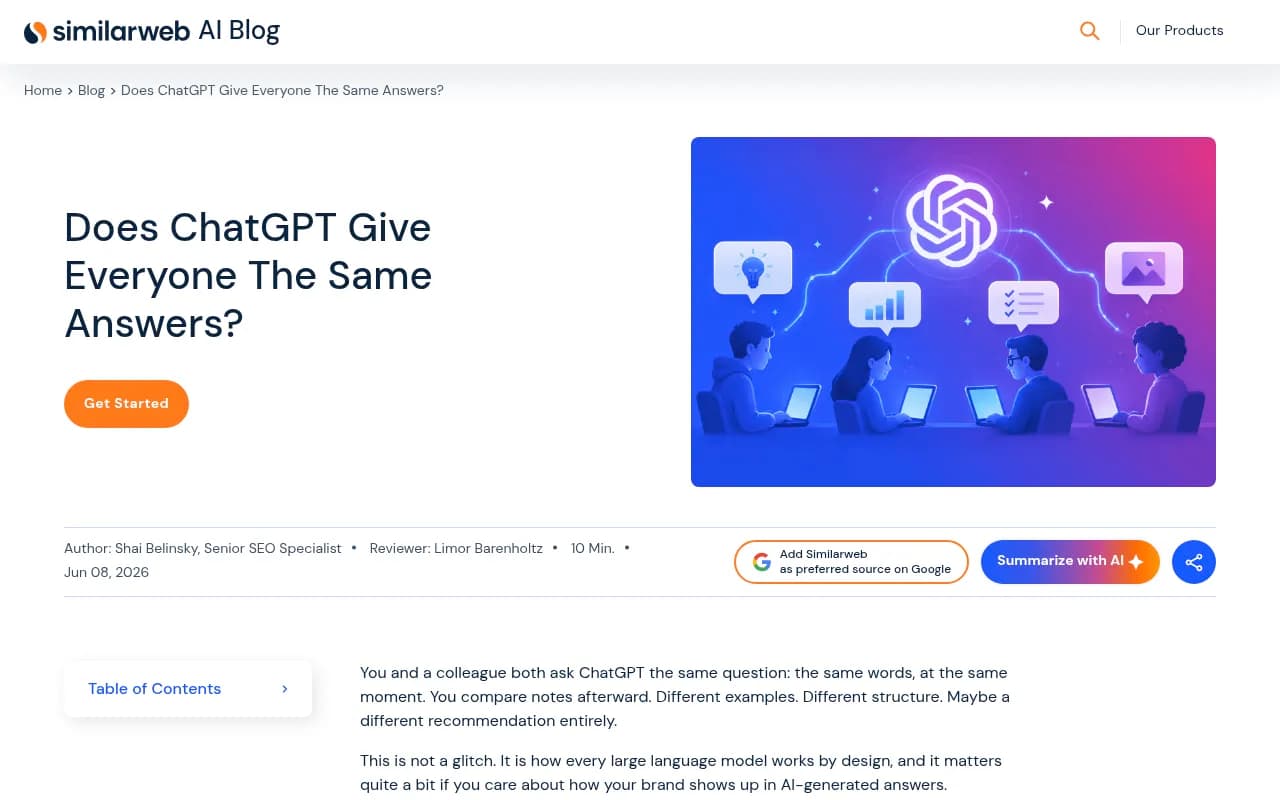
Run the same prompt twice from the same chair and you can get two different shortlists. That alone can look like a "city effect" if you only test once per city.
Memory and conversation history
A logged-in user with saved memories gets a differently framed answer than someone with a clean slate. Someone who has told ChatGPT they work in healthcare, or that they prefer budget options, will see that colour the recommendations.
Model routing
Different users can be routed to different models. A casual question may go to a fast model, while a complex research-style prompt may trigger a thinking model that pulls in more sources and surfaces a different set of brands. Two people, same words, different model.
Ads and account tier
Free-tier users may see ads next to answers, which changes the context around your brand mention and the competitive set on the page.
Location
And then there is where the request comes from. This is the one we care about here.
How ChatGPT actually uses location
The mechanics matter, because they tell you what you can and cannot influence.
According to a third-party explainer from ip-trackers.com, ChatGPT uses a coarse, IP-derived location estimate to localize web search results and some answers. The same source says the model does not receive your IP in plain text; location is applied at the server and search layer. That is a secondary source, and I could not find official OpenAI documentation that spells this out, so treat the details as likely rather than confirmed.
A few practical implications follow:
- IP geolocation is imprecise. It may place a user near their city, a local exchange, or a metro area, not at a street address.
- A VPN changes the apparent location immediately, which is why VPN-based testing works at all.
- ChatGPT has introduced optional precise location sharing for "near me" results, according to a vendor blog post. I could not verify the details or dates, so check OpenAI's help pages before building a process around it.
- Users have been surprised that ChatGPT knew where they were. A community thread from February 2025 shows exactly that reaction.
One caveat. An older OpenAI community thread from 2024 includes a reply saying there were no differences as far as the poster knew. That was a user's guess, not an official statement, and it predates the more search-heavy behaviour ChatGPT has now.
A clean example: the same prompt from three countries
The best public evidence I found comes from Massive, a proxy provider. They sent one prompt, "What number should I call in an emergency?", to ChatGPT from three countries on October 10, 2026.
| Asked from | What ChatGPT answered |
|---|---|
| United States | 911 for medical, fire, and police |
| Brazil | 190 for police, 192 for an ambulance, 193 for the fire department |
| Japan | 119 for an ambulance or fire, 110 for police |
Each answer was right for its country. A coffee-price question showed the same pattern, with dollars in the US answer, reais added for Brazil, and yen for Japan. The full write-up from Massive is worth a read.
The authors are careful about the limits, and so should we be. One run per country shows the effect exists, not how often it happens. And this is a question with one correct answer per place. It tells you very little about whether a Seattle user and a Portland user see different restaurant brands.
What about city-level brand recommendations?
Here is where I have to be honest. I found no primary study measuring how much brand recommendations overlap between cities. Promptwatch's published research covers ChatGPT query fanouts and other citation behaviour, but it does not measure geographic variation directly, so I will not pin a city-level number on anyone.
Still, the mechanism is easy to reason about. ChatGPT builds answers by running web searches (fanouts) and reading what comes back. If the search layer adds a city or "near me" intent, or localizes results by IP, the retrieved sources change, and so does the shortlist. Promptwatch's data also shows how fast that retrieval layer can shift: on August 8, 2026, ChatGPT started using the site: operator at scale, jumping from about 0.4% to about 17% of fanout queries, with searches per response nearly doubling. Retrieval behaviour changes overnight, which is a good reason to monitor continuously.
One unverified number is floating around. A Neil Patel video snippet claims Google puts multi-location brands in the top three about 36% of the time while ChatGPT recommends them 1.2% of the time. I only saw the snippet, with no methodology, so I would not repeat it in a deck. The direction (local brands struggle in AI answers) is plausible. The numbers are not established.
What the SparkToro walkthrough gets right for local brands
Rand Fishkin's SparkToro whiteboard on getting into LLM answers uses a locally flavoured example: fine dining in Seattle. His argument is that the currency of LLMs is mentions, meaning words that appear near other words across sources, not links. Canlis shows up first because it is synonymous with Seattle fine dining across the web.
His suggested process is worth stealing for any city-specific effort:
- Find the places on the web that talk about your category in your city.
- Make sure your brand is mentioned in those places, through PR, outreach, and content.
- Set up alerts for the category plus the city so you catch new opportunities.
Note that this advice is about training-data-style mentions. Modern ChatGPT also retrieves live pages, so the same sources matter twice: once for what the model absorbed, and again for what it fetches at answer time.
What this means for your brand
Your visibility is a probability, per place
Similarweb frames it as a mention rate rather than a rank. I agree. In Google you can say you are position 3 for a keyword in Denver. In ChatGPT, you appear in some share of responses, and that share can differ by city, phrasing, user, and day.
So stop asking "do we show up?" and start asking "in what percentage of relevant prompts do we show up, in each market we care about?"
A single screenshot is nearly worthless
Your CEO searching "best [category] near me" and seeing your brand proves very little. Same for the opposite. You need many prompts, repeated runs, and several locations before you can trust a pattern.
Multi-location brands have the biggest exposure
A franchise or chain with 40 locations is effectively 40 local competitions. The brand that wins in Austin may be invisible in Columbus, and your national average hides that.
How to measure city-level AI visibility
You have three realistic options, from scrappy to systematic.
Manual testing with VPNs or proxies
Use a VPN or location-specific proxy, open a fresh logged-out session, and run your prompt set several times per city. It is free-ish and it teaches you a lot. It does not scale past a handful of cities, and logged-out sessions differ from what real users see.
Purpose-built tracking tools
Some AI visibility platforms let you set the location a prompt is run from. Promptwatch supports country tracking on every paid plan, state and city tracking from the Business plan, and local targeting pinned to exact coordinates (accuracy radius from 20 m to 5 km), so ChatGPT, Google AI Overviews, and Google AI Mode answer as if asked from that spot. It also runs daily and reads the real interfaces rather than only APIs, which matters because user-facing answers can differ from API outputs.

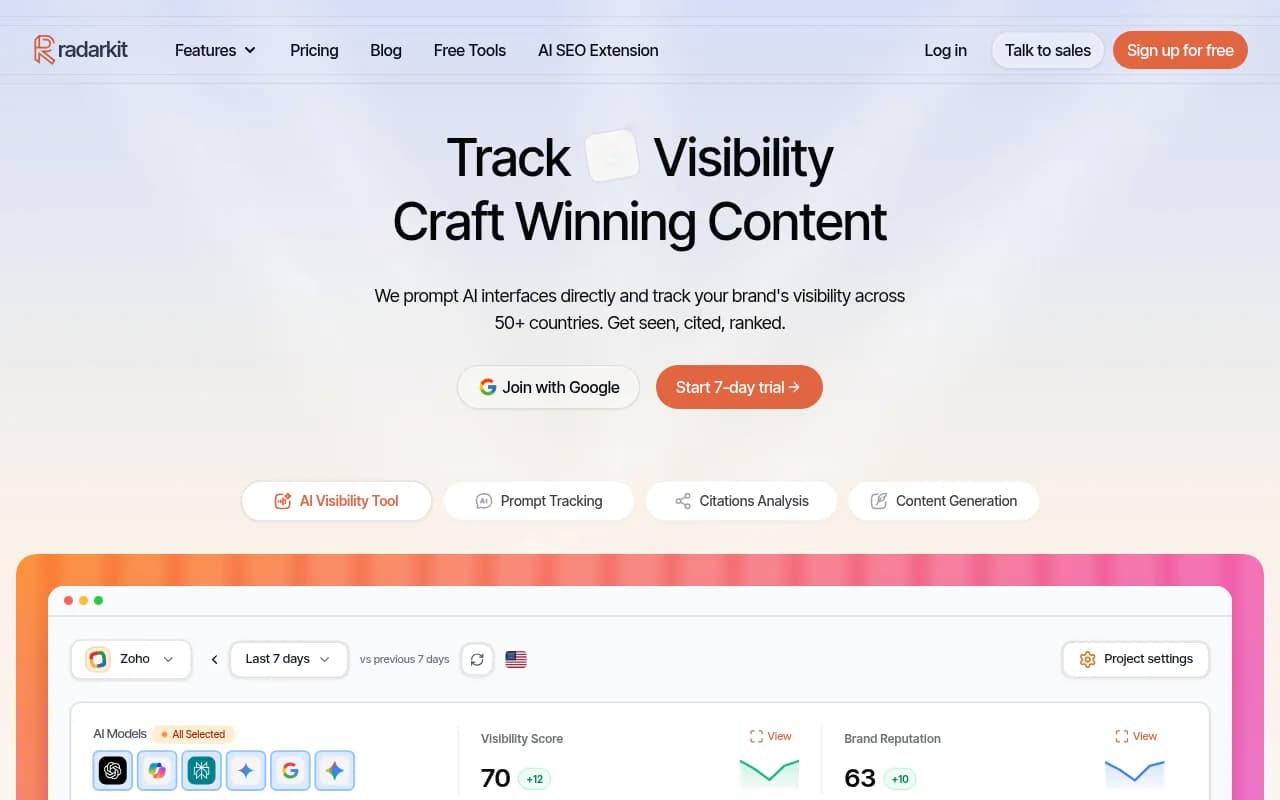
RadarKit's "Local Radar" demo (posted October 24, 2026) takes a similar approach: browser sessions using IP locations in target cities, tracking ChatGPT, Google AI Mode, and AI Overviews, with an appearance rate per listing and the cited sources such as Google Maps and Yelp. I found no pricing.
Other trackers in the category, such as [tool:otterly-ai] and [tool:peec-ai], are mainly monitoring tools. Check each one's documentation for city-level options before you buy, since I did not verify location support for them.
| Approach | Location precision | Scale | Best for |
|---|---|---|---|
| Manual VPN testing | City, if the VPN is good | A few prompts and cities | Early exploration |
| Promptwatch | Country, state, city, exact coordinates (Business plan and up) | Daily runs, many prompts | Multi-location brands, agencies |
| RadarKit Local Radar | City-level IP locations | Per-listing appearance rate | Local listings tracking |
| Single ChatGPT screenshot | Wherever you happen to be | One data point | Not recommended |
For more options, the directory at bestgeosoftware.com lists GEO platforms you can compare.
Pair AI tracking with local listing tools
Local AI answers lean on the same sources local search does: map listings, review sites, and directories. Tools like [tool:yext], [tool:brightlocal], and [tool:birdeye] manage listings and reviews across locations. They do not tell you what ChatGPT says, but they keep the underlying data consistent.
What to do about it
1. Build a prompt set that mirrors real local intent
Include city names ("best accountant in Leeds"), neighbourhoods, and "near me" phrasing. Vary wording, since fanout queries are often short and keyword-like. Promptwatch's fanout data suggests writing headings that read like searches, with the entity and category first.
2. Make location pages worth citing
Create a real page per location or city with specifics: services, hours, staff, local pricing, and local proof. Landing pages and docs tend to stay cited longest, according to Promptwatch's content half-life data (pages cited on July 6, 2026, tracked for 90 days). News-style content decays much faster, losing half its pages within 36 days.
3. Check your pages are crawlable and indexed
Site-scoped searches can only surface what search engines have indexed from your domain. If your location pages are blocked or thin, they are not in the running. Promptwatch's AI crawler traffic report shows how much verified crawler activity is out there, and its crawler logs show which of your pages AI bots actually read.
4. Get mentioned where AI looks
Follow the SparkToro playbook: local press, city guides, industry roundups, and review platforms. Do not count on Reddit to carry you. Promptwatch's data shows reddit.com's share of ChatGPT citations fell from about 4% to 0.5% on August 14, 2026, and ChatGPT drew only 0.46% of its citations from social platforms in the week of Sep 28 to Oct 4, 2026, versus 12.2% for Google AI Overviews, per the social media citations report. Your channel mix may need to differ by AI engine.
5. Remember that mid-authority sites win
Promptwatch's domain rank data shows sites with DR 46-75 earned almost half of ChatGPT citations in August 2026, while DR 91-100 fell to about 3%. A strong local publisher or niche directory can matter more than a giant national outlet.
6. Watch the sources, not just the mentions
For any city where you are missing, look at which pages ChatGPT cites. If it keeps citing a local "best of" list that omits you, that is your outreach target. Industry matters too: for travel prompts, booking and search sites earn more than half of ChatGPT citations (Sep 28 to Oct 4, 2026), and for automotive in August 2026, marketplaces like Autotrader and Cars.com outrank every car brand. Local visibility often means winning on aggregators, not your own site.
Common mistakes
- Treating one city's test as the national picture.
- Testing while logged in, with memory switched on, then assuming customers see the same thing.
- Running a prompt once and calling it a result.
- Assuming every AI engine localizes the same way. Google's AI surfaces are deeply tied to Google's local data; ChatGPT works differently.
- Reporting city-level statistics from vendor blogs without checking methodology.
FAQ
Does ChatGPT know my city?
Often, yes, through a coarse IP-based estimate applied at the search layer. It may be off by a metro area, and a VPN changes it.
Can I set my location in ChatGPT?
Third-party sources say there is no editable location setting, though optional precise location sharing for "near me" results has reportedly been added. Verify in OpenAI's help pages.
Should I optimise separately for each city?
If you operate in several markets, yes, at least for tracking. Content and mentions need local specificity to be retrieved for local prompts.
Is there a reliable benchmark for how different cities are?
Not that I could find. No primary study measures overlap in brand answers between cities. Build your own baseline.
Bottom line
Location clearly changes some ChatGPT answers, and the emergency-number test proves it. For brand recommendations by city, the mechanism is sound but the public measurement is thin. Treat your visibility as a rate per market, track it across many prompts and locations, and put your effort into pages and third-party mentions that local queries retrieve. If you want a starting point, run 20 city-specific prompts five times each from two cities this week and compare the mention rates.