Key takeaways
- A single national ChatGPT visibility score averages strong markets and invisible ones into one comfortable number.
- ChatGPT answers "nearest store" questions using what has been written about a specific address and city, not just the national brand.
- Tracking needs a prompt set per city or region, run with the right location context, and read store by store.
- Fixing local gaps usually means consistent listings, reviews, local pages and third-party mentions, not more national content.
- Treat any single prompt as noise. Measure across many prompts per market and track position and description, not only mentions.
The problem with one national number
Imagine your dashboard says your retail brand appears in 42% of tracked ChatGPT answers. Good. Your boss is happy. Then a regional manager in Leeds, Phoenix or Lyon asks why nobody walks in saying "ChatGPT sent me," and you look at the city level and find you show up almost nowhere there.
That is the averaging problem. Yext makes the same point: national metrics give a broad view but hide variation across regions and store locations, and a few high-performing markets can mask weak ones. A trade-press piece on the same theme put it bluntly: brand-level AI visibility scores can hide poorly performing individual locations, and a single score can look healthy while the stores where customers actually search lose out.
Retail makes this worse than most categories. Shoppers ask location-shaped questions all the time: where can I buy this today, which shop near me has it in stock, best running shoe store in Brooklyn. A national prompt like "best running shoe brands" tells you almost nothing about whether any of those answers name your store.
Neil Patel has pointed to the same pattern: brands with thousands of locations can have strong national presence and still fail to get discovered locally, because AI systems appear to weigh contextual relevance for the specific place.
Why national strength does not transfer to local answers
One explanation from the practitioner posts in our research: ChatGPT pulls from what has been written and said about a specific address, not only from the national brand. Reviews that mention a store, a city page that describes it, a local news item, a Reddit thread about a neighbourhood. If a location has thin or inconsistent data, the model has little to quote, so it names someone else.
I would treat the mechanism as a working hypothesis rather than settled science. OpenAI does not publish how it resolves local intent. What we can say from the first-party data is that the answers are crowded. In Promptwatch Data's report on unique domains per ChatGPT response (Sep 28 to Oct 4, 2026), 47.6% of responses with citations cite 10 or more different domains, and 66.1% cite at least 8. For organic prompts that name no brand, 52.5% cite 10 or more.
Now multiply that by every city. Each market has its own crowded answer, with its own directories, local blogs, marketplaces and competitors. Your national score is an average over hundreds of separate contests.
A few practical consequences:
- Local competitors can beat you in a market even when you dominate nationally. One practitioner post makes the case that local brands often outshine national chains in AI answers because they publish structured, opinionated, quotable content about their own area.
- Aggregators and marketplaces tend to fill local answers. In Promptwatch's automotive data (August 2026), marketplaces like Autotrader and Cars.com outrank every car brand, and travel answers lean on booking and search sites. Retail local answers likely follow a similar pattern, though no report splits them by city yet.
- The same prompt can return different stores depending on how location is supplied, whether by an explicit city in the prompt, the user's approximate location, or saved memory. This is a gap in public research, so test it yourself rather than assuming.
What local ChatGPT tracking actually means
Local tracking is not a different product category so much as a different way of setting up the one you have. You need three things.
A prompt set per market
Build a base list of retail-intent prompts, then clone it for each market. A decent starter template:
- "Best [category] store in [city]"
- "Where can I buy [product] near [neighbourhood]"
- "[Brand] store in [city] opening hours"
- "[Brand] vs [local competitor] in [city]"
- "Is there a [brand] near me" (run with location context set to that market)
Mix organic prompts, which name no brand, with branded ones. The two behave differently. Per Promptwatch's unique-domains data, branded prompts most commonly cite 5 domains and only 21.3% cite 10 or more, while organic prompts spread much wider. Organic prompts show whether you are discovered. Branded prompts show what the model says once someone already knows you.
Location context on the tracking itself
Typing a city name into the prompt is the easy part. Running the prompt as if from that country, state or city is the harder part, and it matters for prompts like "near me." Check whether your tracking tool supports country, state and city targeting, and on which plans. Promptwatch, for instance, offers country tracking on every paid plan and state and city tracking from its Business tier, with pricing to confirm at promptwatch.com/pricing.
Reporting that goes below the brand level
The output you want is a market-by-metric grid, not a headline. Useful cuts:
- Visibility and share of voice per city
- Your average position in the answer when you appear
- Whether the cited sources are your own pages or third parties
- Sentiment and the specific phrases used to describe the store
- Which competitors win each market
Heatmaps comparing markets against competitors are the fastest way to see where the national average is lying to you.
Why you cannot judge a market from one prompt
Promptwatch's report advises measuring citations across many organic prompts, not just one, because with this many sources per answer a single prompt tells you little. It also recommends tracking where you appear and how ChatGPT describes you, not only whether you are cited.
Local tracking raises the stakes. If you track five prompts across 40 cities, you have five data points per city, and ChatGPT answers vary run to run. A city with one lucky mention looks fine. A city with one unlucky miss looks broken. Aim for a meaningful set of prompts per market, repeat runs over weeks, and look at trends rather than single snapshots.
Query fanouts add another wrinkle. Promptwatch's fanout data shows ChatGPT often turns one prompt into short web searches, with average query length falling from roughly 117 characters in December to about 53 in April. My inference, not a finding in the report, is that a city name or "near me" is likely a piece of those short queries. If so, the pages that rank for "[category] [city]" style searches matter a lot for what the model sees. Re-audit after major ChatGPT updates because fanout behaviour changes.
Tools that can track by location
Most AI visibility trackers monitor prompts globally. Fewer let you segment by city. Check this specific capability before buying, because it is where products differ most for retail. This table reflects the general positioning of tools in our catalog; confirm current location features and pricing on each vendor's site.
| Tool | Type | Location angle | Best for |
|---|---|---|---|
| Promptwatch | AI visibility and optimization platform | Country tracking on paid plans, state/city tracking from Business, heatmaps across countries and topics | Retail brands that want tracking plus action |
| Yext | Multi-location listings and local visibility | Store-level data and local search focus | Keeping location data consistent across sources |
| Uberall | Multi-location presence platform | Many scattered locations managed as one | Large store networks |
| BrightLocal | Local SEO platform | Local rankings and citations | Agencies and local SEO teams |
| Tibly | AI visibility for local businesses | Local business focus | Smaller local operators |
| Profound | Enterprise AI visibility | Enterprise monitoring | Large brands with big budgets |
| Otterly.AI | Prompt tracking | Lower-cost monitoring | Teams starting out |
Promptwatch for the tracking and fixing loop
Promptwatch is the tool I would look at first if the goal is not just seeing the gap but closing it. It monitors the real interfaces of ChatGPT, Google AI Overviews, AI Mode, Gemini, Perplexity and others, and lets you slice results by country on every paid plan and by state or city on Business. That matters here because the failure mode of national scoring is exactly the thing city-level heatmaps expose.

The part that goes beyond a tracker: IP-verified AI crawler logs show whether ChatGPT's crawlers are reading your local store pages or hitting errors, citation analytics show which pages get cited, and the Action Board and Content Agent turn gaps into prioritized work and published pages. If your location pages are rendered in a way crawlers cannot read, you want to know before you commission fifty new pages.
Listings and local data platforms
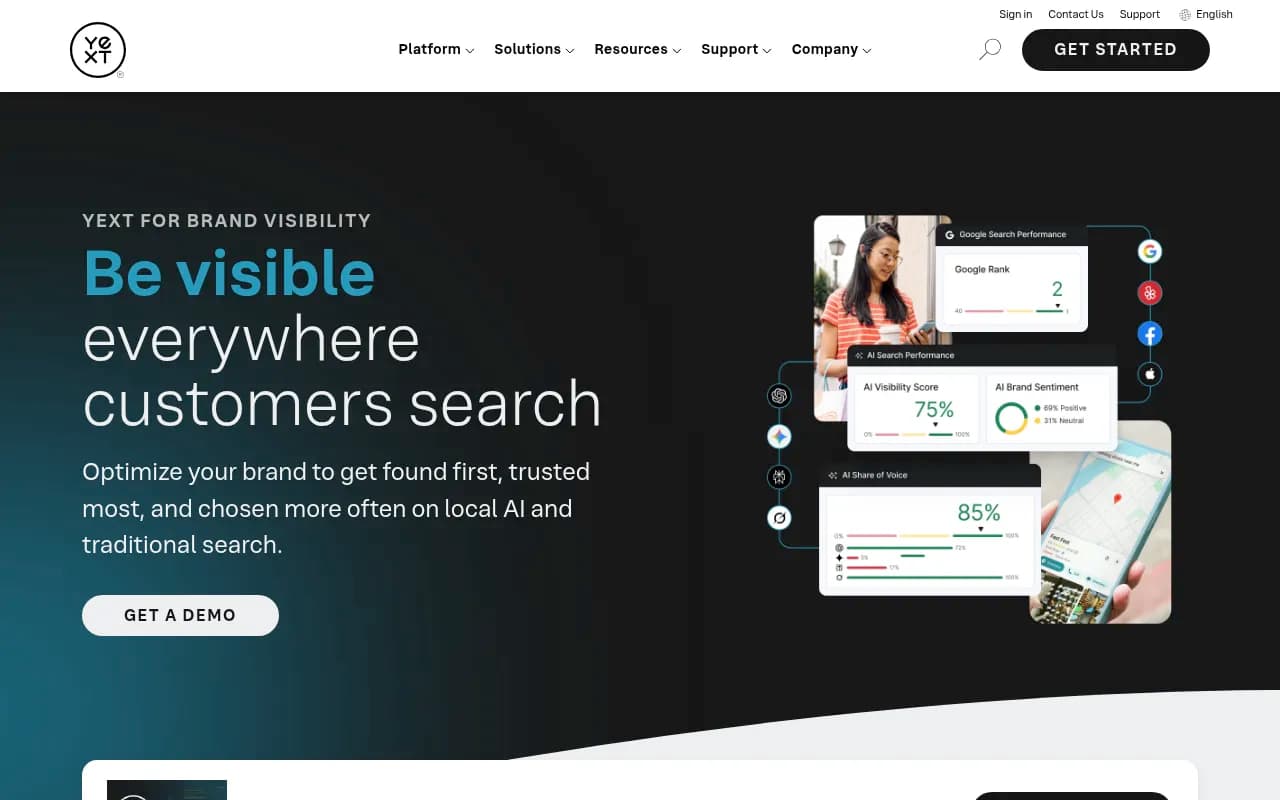
Tracking tells you where you are invisible. Local data platforms help fix one common cause, inconsistent location data. Yext is built for multi-location brands and the vendor's own research argues that national and local performance both matter for AI visibility.
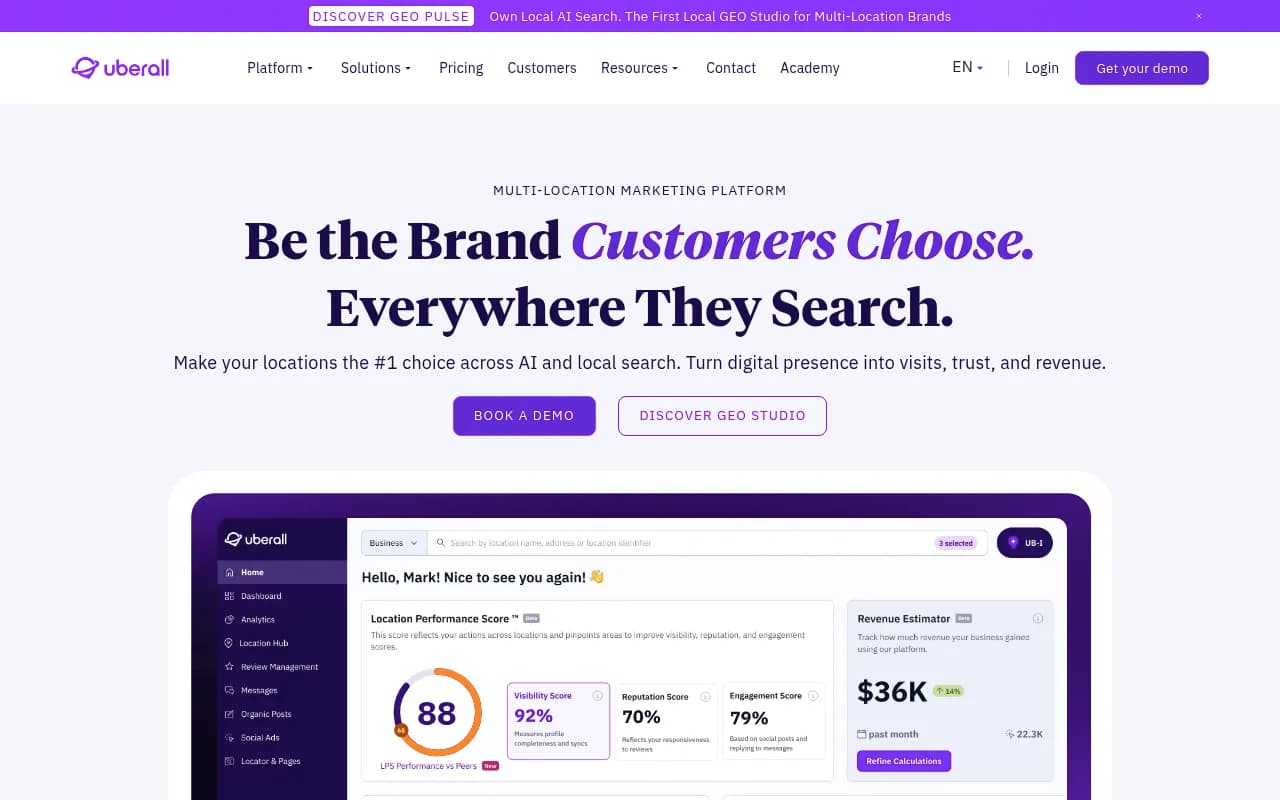
Uberall positions itself around turning thousands of scattered locations into one searchable presence.
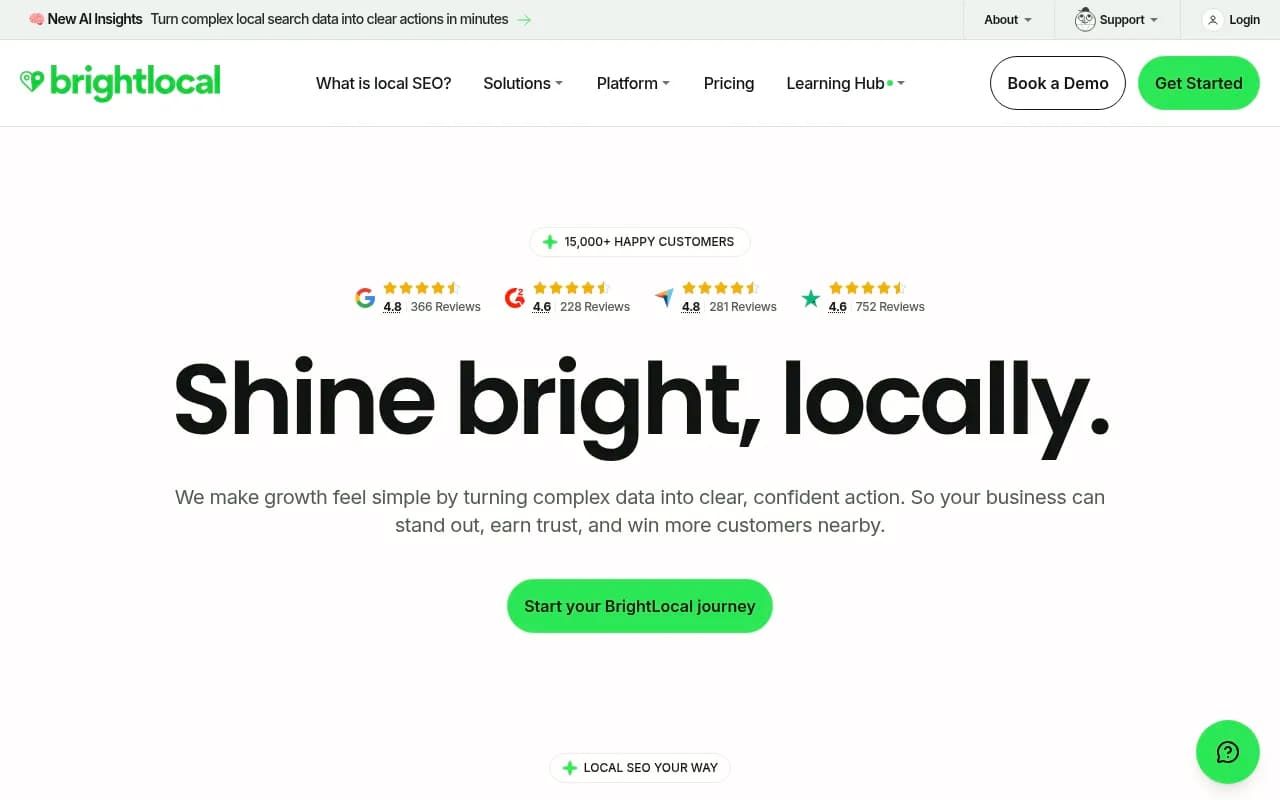
BrightLocal covers local SEO monitoring, citations and rankings, and is a common choice for agencies.
Other multi-location reputation tools in the catalog include Birdeye, Chatmeter, Synup and Reputation.com, which matter because review text is one of the signals AI can quote about a specific store.
For smaller local operators, Tibly is aimed at local-business AI visibility.

If you are comparing generic trackers, the GEO software directory at bestgeosoftware.com and ai-rank-tools.com list many more, but filter hard on location support.
How to set up local tracking, step by step
1. Pick your markets
Start with the markets that matter commercially: your top 10 revenue cities, a few under-performing ones, and a few where you plan to open. Do not try to track every store on day one.
2. Build the prompt grid
Use the template above. For each market, write 15 to 30 prompts across discovery, product availability, comparison and branded intent. Keep wording natural. People type messy things.
3. Set the location context
Track each market with country, state or city targeting where your tool supports it, and keep an explicit city in a portion of prompts as a control. Compare the two sets. If "near me" results differ wildly from named-city results, you have learned something about how location is being resolved.
4. Establish a baseline for four weeks
Answers fluctuate. Collect at least a few weeks before you declare a market weak. Record visibility, position, cited domains and how the store is described.
5. Find why each weak market is weak
A simple diagnostic:
- Low share of voice across the market: a coverage problem. The model does not associate you with that area.
- You appear but late in the answer: a prominence problem.
- You are mentioned but your own pages are never cited: a content or crawlability problem.
- Cited sources are all marketplaces or directories: you may need to win on those surfaces or give the model something more quotable.
6. Fix the local evidence
What tends to help, based on the practitioner write-ups in our research and general local SEO practice:
- Consistent name, address, phone and hours across Google Business Profile, Bing Places, Apple Maps and major directories
- Unique location pages with real details: neighbourhood, services, brands in stock, staff, parking, photos
- Reviews that mention the store and city in natural language, with owner responses
- Local schema markup on location pages. Schema App is one tool built for structured data at scale.
- Mentions on local news, community sites and relevant forums
One tension worth admitting: this is slower than national content work and harder to centralize. It also scales badly if your location pages are templates with a swapped city name. Models appear to prefer specific, opinionated, quotable content, so thin duplicates tend to be the weak point.
7. Check shopping surfaces separately
If you sell products, remember shopping features are a separate surface. Promptwatch's shopping usage data shows shopping features appear on only a low single-digit share of web-search responses, concentrated on commercial and transactional prompts, and the rate moves in steps. The advice there is complete Product schema, accurate prices and availability, and a clean merchant feed. Do not let a spike or drop in that rate drive local strategy.
8. Re-measure and compare against stores, not brands
Tie results to store outcomes where you can: foot traffic, directions requests, local conversions, and AI referral traffic in analytics. Visibility is a means. Traffic and store visits are the point.
Reading the results: a quick framework
| Signal you see | Likely meaning | First move |
|---|---|---|
| Strong nationally, absent in one city | No local evidence for that market | Build location pages, reviews, local mentions |
| Mentioned, but competitors listed first | Prominence gap | Improve quotable local content and sentiment |
| Mentioned without citing your site | Crawl or content issue | Check crawler logs and page structure |
| Wrong hours or address in answers | Inconsistent listings | Clean listings across directories |
| Marketplaces dominate citations | Intermediary wins the answer | Strengthen presence on those marketplaces |
| Big swing in one week | Model or fanout change | Wait, re-run, check update notes |
Mistakes to avoid
- Reporting a national average to regional teams. It tells them nothing about their stores.
- Tracking only branded prompts. You will see yourself and miss where you are never suggested.
- Treating one run of a prompt as truth.
- Spinning up hundreds of near-identical city pages. Specific beats templated.
- Ignoring crawler access. If AI crawlers cannot read your store pages, no amount of copy helps.
- Assuming ChatGPT behaves like Google Maps. It draws from broader written evidence, and the mix of sources differs from local pack logic.
Where the evidence is thin
It is worth being honest here. I found no public dataset that splits ChatGPT citations by city or region, and the exact way ChatGPT infers user location is not documented in the sources I used. The claims about local relevance come from practitioner posts and vendor research, which are useful but not independent. Your own tracking, run per market, is the best evidence you will get. For broader context on how AI answers are assembled, the Promptwatch Data hub is worth bookmarking.
If you want outside help designing a multi-market tracking plan, 1001 SEO Media works on AI search and local SEO strategy, though a good in-house analyst with the grid above can get you started.
Bottom line
A national score is a fine headline and a bad diagnosis. Retail customers buy in a place, so measure in a place. Build a prompt set per market, run it with location context, read results store by store, and spend your effort on the cities where the national average was hiding a zero.