Key takeaways
- City-level tracking gives you one answer per city. Coordinate or grid tracking gives you one answer per pin. Which one you need depends on how your customers search and how many locations you run.
- Most AI answers are probably personalized to an IP-derived city or region, not exact coordinates. That is an inference from secondary sources, not something OpenAI or Google has confirmed in documentation.
- Grid tracking is cheap per pin but gets expensive fast. A 15x15 grid is 225 credits per keyword, per run.
- Most brands should start at city level, then add coordinate-level checks for the specific locations where the numbers look strange.
- Vendor claims about block-level variation are positions, not independent evidence. I could not find a neutral study that measures it.
The question behind the question
There are two things people call "local tracking," and mixing them up wastes money.
The first is classic local rank tracking: where does your Google Business Profile show up in the map pack when someone searches from a specific spot? The second is AI visibility tracking by location: does ChatGPT, Gemini or Google AI Overviews recommend your business when the question is asked from that spot?
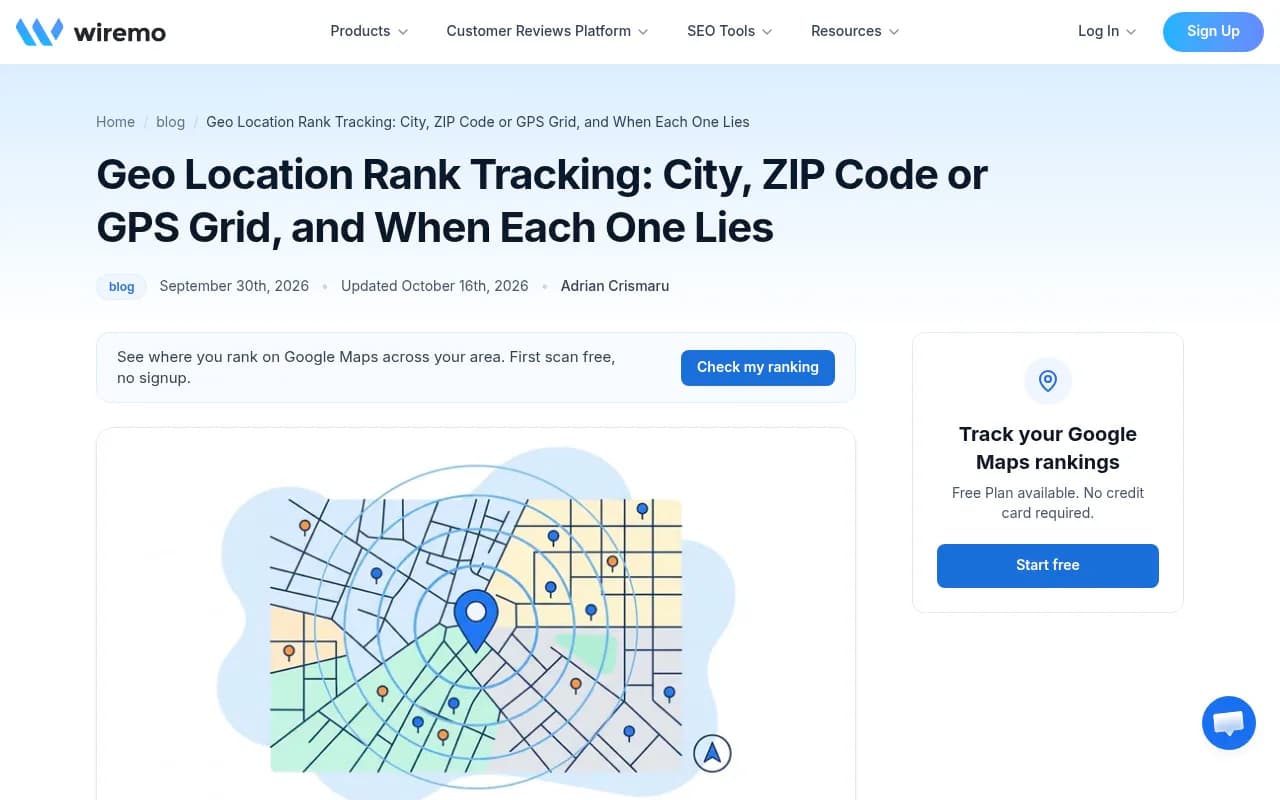
They share vocabulary and even some vendors. They do not share the same mechanics. One of the sources I used, a Wiremo post on geo-rank tracking, makes a point of saying that the "GEO" in geo-location rank tracking has nothing to do with generative engine optimization. Worth remembering when you read vendor pages that blur the two.
The argument that follows applies to both, but the evidence is much stronger for the first than the second. I will keep flagging which is which.
What each precision level actually gives you
City-level tracking
You set a city, the tool runs your prompts as if asked from there, and you get one visibility number per prompt. It is simple, cheap and easy to report on. It also averages away anything happening inside the city.
ZIP or neighborhood tracking
One number per postal area. A reasonable middle ground for service-area businesses such as plumbers, dentists and home cleaners, where your customers sit in clusters rather than being spread across a metro.
Exact coordinates and grids
You pin a point, or lay a grid of points over a map, and run the same prompt from each. Local Falcon, for example, runs grids from 9 points (3x3) up to 441 (21x21). Whitespark's ranking grids use 4 to 225 points. Rank.ai offers 3x3, 5x5 and 7x7.
The case for this is easy to state. Wiremo puts it as: a city check gives one number per city, and a GPS grid is the only version that shows you at position 2 next to the shop and position 20 three miles away. For traditional map rankings, that is true and well documented.
Why precision matters for traditional local rank
Google's own help page on local ranking says results depend on relevance, distance and prominence, and defines distance as how far each business is from the person searching. If the searcher does not share where they are, Google uses what it knows about their location.
Google's page on location in Search lists the sources it uses: device location, IP address, home and work addresses saved in the account, and areas searched before. It also separates a "general area" (larger than 3 sq km with at least 1,000 users) from a "precise location" used when you grant permission.
So for map-pack results, distance is a built-in ranking factor and phones report precise location. Grid tracking is not a gimmick there. It measures the thing Google says it ranks on.
Does the same logic hold for AI answers?
This is where I would slow down.
ChatGPT may use approximate location from your IP address, and can use more precise device location if the user opts in. That claim comes from a secondary source (Enginely), so check it against OpenAI's documentation before you build a strategy on it. Users on the OpenAI community forum have also reported being surprised that ChatGPT inferred their city without being told, which is anecdotal but consistent with IP-based defaults.
My reading, and it is an inference: most AI answers are personalized to a city or region derived from IP, not to a pair of coordinates. If that is right, a 21x21 grid in ChatGPT might mostly return the same answer 441 times, with variation caused by the model's own randomness rather than geography.
Local Falcon argues the opposite emphasis. Its stated reason for running many grid points is that AI responses vary, so you need many samples to get a meaningful mention rate and consistency. That is a fair point about sampling, but notice it is a point about noise, not necessarily about location. A grid doubles as a way to average out randomness.
I could not find an independent study measuring how much AI answers differ at block level versus city level. I also could not confirm in OpenAI or Google documentation whether ChatGPT or AI Overviews use exact coordinates. Anyone claiming certainty either way is selling something.
What the fanout data suggests
Promptwatch Data does not have a location-segmented report, so I will not pretend it does. Two reports give context, though. Promptwatch's ChatGPT query fanout data shows average fanout query length falling from about 117 characters in early December to about 53 characters in April, and average fanouts per response falling from 2.15 to about 1.84 by early March. Short, keyword-style web searches leave little room for a precise location modifier, so a city name or "near me" is likely a small slice of each query. The report does not test this, so treat it as a hint.
Promptwatch's content type data (Sep 28 to Oct 4, 2026) shows landing pages at 16.8% of ChatGPT citations, listicles at 13.6% and reviews at 1.7%, with branded prompts pushing landing pages to 22.8%. For a local brand, that points to location pages and "best X in city" roundups as the likely citation surfaces. Again, an inference, not a measured local result.
The case for staying at city level
- Your data matches how AI most likely localizes. If the assistant thinks in cities, tracking in cities mirrors the user experience.
- It is stable. Fewer points means less noise, and week-to-week changes mean something.
- It is affordable and easy to explain to a client or a CFO.
- Localogy's July 2026 piece frames the real gap as geography at the level of Chicago vs Denver, Pennsylvania vs Ohio, or Canada vs the U.S. Most AI visibility tools work nationally, and moving down to city level fixes the biggest blind spot by itself.
The case for coordinates and grids
- You compete in the map pack. Distance is a stated ranking factor there, and grids show it.
- You have many locations and need to prioritize. Local Falcon's argument that neighborhood-level views let multi-location businesses and agencies decide which locations need attention first is sensible, whatever you think of the AI part.
- You are in a dense metro where a city is too large to be one market. Manhattan and Staten Island are both "New York."
- You sell "near me" services where the nearest competitor is the story.
Local Falcon also says that local ranking trends do not transfer directly to AI search performance. I think that is right, and it cuts both ways: it justifies tracking AI separately, but it also means a pretty heat map of your map-pack rank tells you little about ChatGPT.
What it costs
The pricing below comes from a competitor-written comparison (rank.ai), so confirm every number on the vendors' own pricing pages.
| Tool | Precision | Platforms | Pricing signal |
|---|---|---|---|
| Local Falcon | Grids from 9 to 441 points | ChatGPT, Gemini, AI Overviews, AI Mode, Grok | From $24.99/mo annual (90,000 credits/yr); 1 credit per pin |
| BrightLocal | Local Search Grid plus AI Visibility Tracker | ChatGPT, AI Mode, AI Overviews | $31 to $49/mo per location, annual |
| Rank.ai | 3x3, 5x5, 7x7 grids | ChatGPT, Claude, Gemini | $0 to $399/mo; daily tracking from $49/mo |
| Whitespark | Grids of 4 to 225 points | Local rankings | Check vendor |
The credit math is what catches people. A 5x5 grid is 25 credits and a 15x15 grid is 225, per keyword, per run. Five keywords on a 15x15 grid once a week is about 4,500 credits a month. That is manageable on a bigger plan and painful on a starter one. Multiply by locations and it grows quickly.
A practical way to decide
Step 1: Count your locations and radius
One location serving a 5-mile radius is a different problem from 60 franchise sites. Single-location shops often do fine with a small grid around the storefront. Franchises need consistent city-level data first so the comparison across locations is apples to apples.
Step 2: Start at city level for AI prompts
Track the prompts your customers actually ask, per city. This is the same logic as the local GEO guidance from Localogy: can you answer whether you are recommended in Chicago the same way you are in Denver? If not, fix that before buying more pins.
Tools like Promptwatch can pin a monitor to exact coordinates (with an accuracy radius from 20 m to 5 km) so ChatGPT, Google AI Overviews and AI Mode answer as if asked from that spot. It also handles country tracking on every paid plan and state/city tracking from the Business plan, so you can begin coarse and tighten up where the data warrants it.

Step 3: Add coordinate checks where something looks off
When one location underperforms, or a competitor suddenly dominates one neighborhood, spin up a few coordinate-level monitors there. That is cheaper than blanket grids and tests whether location actually changes the answer for your category.
Step 4: Run a variation test before you pay for a grid
Take one prompt. Run it from the storefront, from a point three miles away and from the city center, several times each. If the answers differ no more than they do between repeat runs from the same point, geography is not driving the variation and a dense grid will mostly measure noise. If they differ consistently, you have a case for finer precision. It costs almost nothing and beats trusting any vendor's blog post.
Step 5: Keep map-pack and AI tracking separate
Use a local rank tool for map-pack grids and an AI visibility tool for assistant answers. Combined dashboards are fine for reporting, but do not assume one explains the other.
Who needs what
| Business type | Starting precision | Add later |
|---|---|---|
| Single-location service business | City plus a small grid around the shop | Larger grid if map rank matters |
| Multi-location franchise | City-level per location | Coordinate checks on weak locations |
| Dense-metro retailer or restaurant | ZIP or neighborhood | Grid for map pack |
| Regional or national brand with local pages | State and city | Exact coordinates for flagship stores |
| Agency with many local clients | City-level templates | Per-client grids for pitches |
Several other tools in the directory handle parts of this problem. Local Falcon-style grids are covered in the AI rank tracking directory, and listings and reputation platforms such as Yext, Uberall and Synup matter because local AI answers pull heavily on listings and reviews.


If you want to compare AI visibility platforms more broadly, the GEO software directory is a good starting point.
What the AI-and-GPS research says
One more caution. The Spatial Edge newsletter covered research in April 2026 on whether LLMs understand GPS coordinates at all, with the takeaway that for precise geographic reasoning you still need external calculators. That is about models doing math on coordinates, not about search systems using location signals, so do not over-read it. But it is a useful reminder that a pair of latitude and longitude digits is not something a language model reasons over cleanly. The location logic most likely lives in the search layer around the model, which again suggests coarse signals like IP-derived city do most of the work.
What actually moves local AI visibility
Whichever precision you pick, tracking does not change the answer by itself. What changes it is the content and signals AI draws on: location pages with real local detail, consistent listings, reviews, and third-party roundups that name you. Pair monitoring with work on those, and check whether crawlers can read your location pages in the first place.
Bottom line
For most local brands, city-level AI tracking is the right default, because it matches how assistants most likely localize and keeps your data stable. Use coordinate-level monitors surgically: for problem locations, dense metros and map-pack work. Grids are worth it when distance is a documented ranking factor, which is true for Google's local results and unproven for AI answers.
Run the variation test first. If three miles changes the answer more than a repeat run does, buy precision. If not, spend the credits on better location pages.