Key takeaways
- A single brand-wide AI visibility score hides the problem. ChatGPT answers "best [service] in [city]" by looking at local sources, so every location has its own citation record.
- One vendor-cited figure, from Cintra's page referencing a "2026 Local Visibility Index", claims only 1.2% of franchise locations are recommended by ChatGPT, against 35.9% in Google's local 3-pack. I could not find the original index, so treat it as directional, not independent proof.
- Promptwatch Data shows organic prompts like "best X in city" pull from many domains: 52.5% of responses cite 10 or more (Sep 28 to Oct 4, 2026). Location pages alone will not carry you.
- Reddit is no longer a safe bet for ChatGPT. Facebook, Instagram, YouTube and review sites matter more for local work, especially in Google AI Overviews.
- Report at two levels: brand for the board, location for the franchisee who actually has to fix something.
The problem with one number for the whole brand
Imagine you run 400 locations. Your AI visibility dashboard says the brand is mentioned in 22% of tracked prompts. Looks fine. Now picture what that average hides: 60 locations where you show up constantly, and 250 where ChatGPT recommends a competitor every single time.
That is the franchise reporting problem. The average is true and useless. A franchisee in Tulsa does not care how the brand does in Boston. Their customers ask a question phrased around Tulsa, and the answer is built from Tulsa-relevant sources.
Google trained franchise marketers to think in templates. Claim the Business Profile, keep the NAP data consistent, push reviews, done. AI answers do not work that way. They synthesize, and what they synthesize varies by city.
What the numbers say (and how far to trust them)
Cintra, a vendor, published a page saying that only 1.2% of franchise locations are recommended by ChatGPT for queries like "best [service] near me", while 35.9% of the same locations show up in Google's local 3-pack. That is a 30x gap, if you accept it.
I would be careful. The figure is attributed to a "2026 Local Visibility Index" and I could not locate the index or its methodology. Use it as a reason to go measure your own locations, not as a benchmark to quote in a board deck.
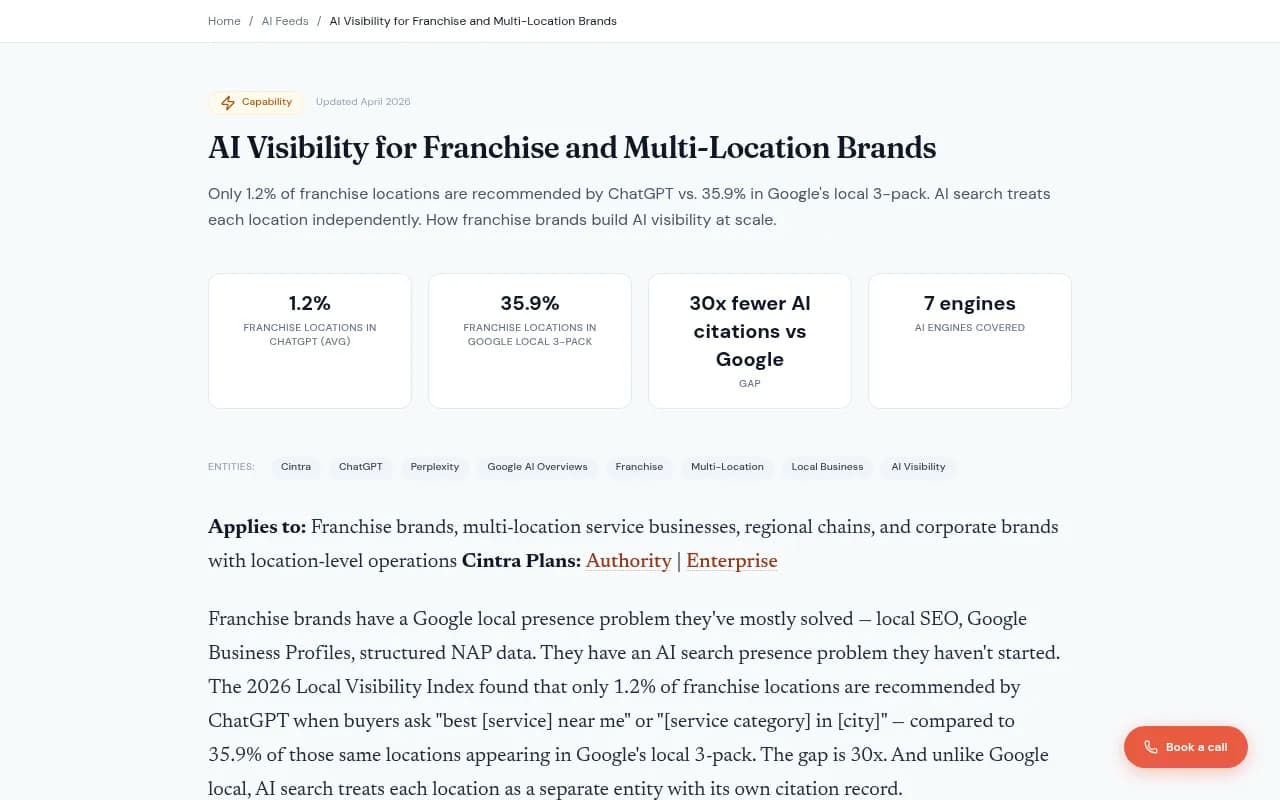
The independent data points in a different but compatible direction. According to Promptwatch Data on unique domains per ChatGPT response (Sep 28 to Oct 4, 2026):
- 47.6% of responses with citations cite 10 or more domains, and 66.1% cite at least 8.
- For organic prompts with no brand named, which is what "best dentist in Denver" is, 52.5% cite 10 or more domains.
- For brand-specific prompts, only 21.3% cite 10 or more, and 5 domains is the most common count.
Read that carefully. When a customer asks a generic local question, the answer leans on a wide spread of third-party sources. Your franchise website is one voice among many. When the customer already names your brand, the field narrows, but then you have already won the harder battle.
Why each location is its own entity
AI engines do not look up a franchise the way a directory does. For a local question they pull from editorial roundups that mention the city, review profiles tied to a specific location, structured data on a location page, and local publications. Corporate blog posts produce corporate-level citations. They do not produce "the Austin team specializes in..." citations.
So the same brand can be a regular recommendation in one metro and invisible in the next, depending on:
- whether that location has its own page with unique content, not a name-swapped template
- how many reviews it has, and where
- whether any local listicle or news piece mentions it
- how strong the local competitors are
That last point is the one corporate dashboards miss entirely. Visibility is relative. Being mentioned in 30% of Phoenix prompts is great if rivals sit at 10%, and a problem if one competitor sits at 70%.
What a location-level report should contain
The Yext guide on evaluating AI visibility platforms for multi-location brands makes the same point: measure at both brand and location level, because each franchisee depends on performance in their own market.
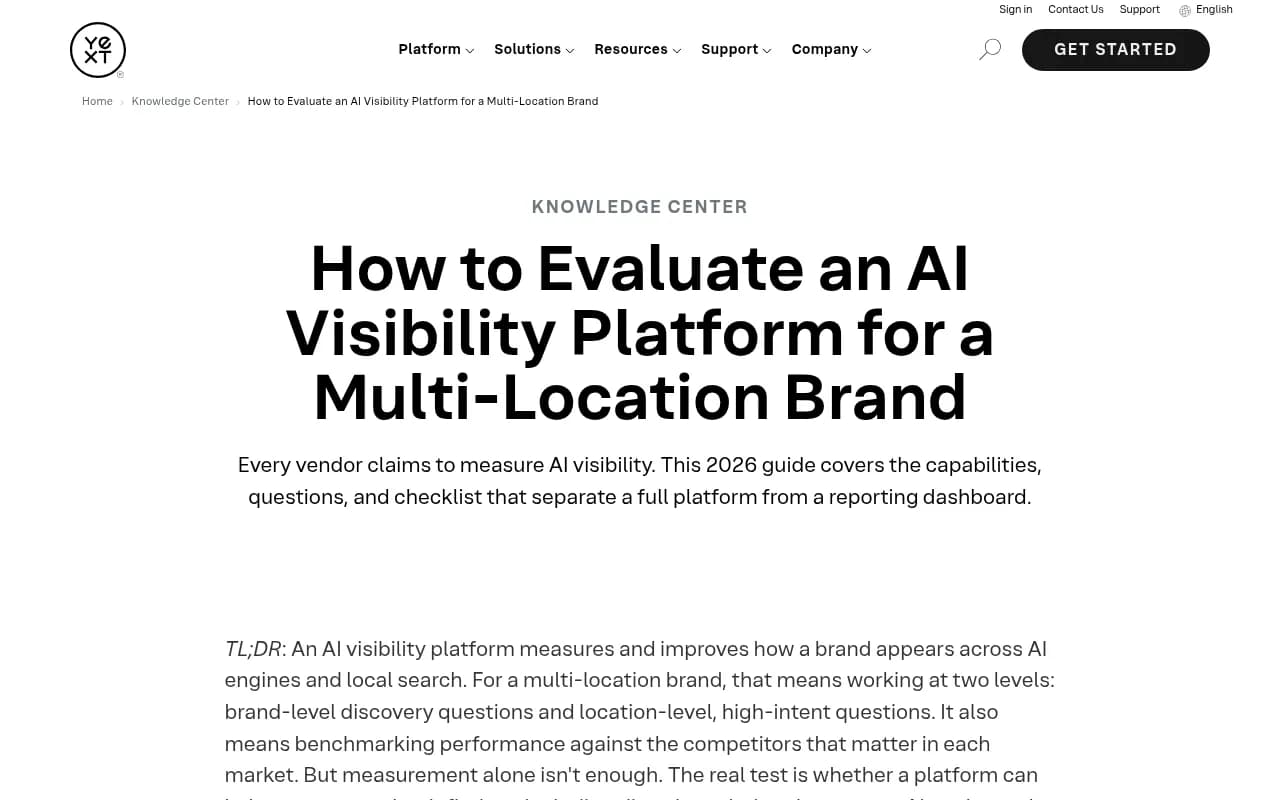
Here is what I would put in each location's report.
Mention rate and share of voice against local rivals
Did the location appear at all, and how often versus the three or four competitors that actually share its market? Not national competitors. The ones within a 10-mile radius.
Citation URLs
Which sources did the AI use? A mention without a source tells you there is a problem. The cited URLs tell you where to go fix it: a roundup you are missing from, a review site where you have 4 reviews and the rival has 200.
Position and sentiment
Being named fifth in a list of five is different from being named first. Sentiment catches the location whose reviews drag its summary down even though the brand is strong overall.
Prompt set built around the city
Use the real phrasing: "[service] in [city]", "best [service] near [neighborhood]", "[service] open Sunday". Run them from the right geography. A prompt answered as if asked from Dallas is not the same as one asked from Miami.
Brand versus location rollup
The franchisor needs the rollup. The franchisee needs their slice. Same data, two views.
What to do with the data: the location asset checklist
| Location-level asset | What it answers | Notes for 2026 |
|---|---|---|
| Unique city or location landing page | "[service] in [city]" | Landing pages are 16.8% of ChatGPT citations; product pages 22.4% (Promptwatch Data, Sep 28 to Oct 4, 2026) |
| Location-specific reviews | Branded and comparison prompts | Reviews jump to 5.6% of citations on branded prompts, over 3x their overall share |
| Local "best of" listicle placement | Commercial prompts | Listicles are 13.6% of citations overall, 15.0% on commercial prompts |
| Location FAQ content | Specific questions | FAQ pages are 4.8% of branded-prompt citations |
| Local press and community mentions | All engines | Local backlinks and mentions as authority signals |
| Public Facebook, Instagram, YouTube presence | Google AI Overviews | See the social section below |
The content-type split comes from Promptwatch's report on which content types ChatGPT cites most. It does not mention franchises. My inference is that unique location landing pages and location reviews are the natural citation surfaces for a multi-location brand.
One rule from the vendor material holds up well: each location page needs unique content. Fifty near-identical pages with the city name swapped will not earn individual weight.
A note on Reddit and social advice
A lot of franchise AI advice still tells you to engage city subreddits. Be skeptical. Promptwatch's data on Reddit citations shows reddit.com's share of ChatGPT citations fell from roughly 4% to 0.5% on August 14, 2026.
The broader picture from Promptwatch's social media citations by AI model report (Sep 28 to Oct 4, 2026):
| Engine | Share of citations from social | Notes |
|---|---|---|
| ChatGPT | 0.46% | LinkedIn top at 0.3%; Reddit down to 0.09% |
| Google AI Overviews | 12.2% | YouTube 4.28%, Facebook 2.38%, Reddit 2.15%, Instagram 1.61% |
| Perplexity | 2.7% | LinkedIn and Reddit tie at 0.86% |
For a location, that means a maintained public Facebook page, an Instagram profile and local YouTube content do more for AI Overviews than a Reddit strategy does for ChatGPT. Do not abandon community presence, just stop treating it as the ChatGPT lever. These numbers shift month to month, so recheck before committing budget.
Not every location needs the same investment
A sensible split:
- Run the baseline across all locations. Cheap, and it shows you the spread.
- Pick the strong-market locations where visibility is close to a tipping point and push those first.
- Handle the weak, low-volume locations with a standard template plus reviews, and revisit quarterly.
- Give franchisees a short monthly report, not a dashboard login they will never open.
Tools worth looking at
The market splits into three kinds of tool: AI visibility platforms, local listings and reputation platforms, and local SEO suites. For franchises you usually need pieces of more than one. I did not verify pricing or detailed feature differences for the tools below, so check each vendor before committing.
AI visibility platforms with local targeting
Promptwatch can pin a monitor to exact coordinates so ChatGPT, Google AI Overviews and Google AI Mode answer as if asked from that spot, with state and city tracking on Business plans. It also logs AI crawler visits and ties citations to traffic, and its Content Agent helps close the gaps it finds. That matters for franchises because you need to see why a location is missing, then fix it.

Other AI visibility trackers in our catalog include Profound, Scrunch, and Otterly.AI, which are mostly monitoring-focused.

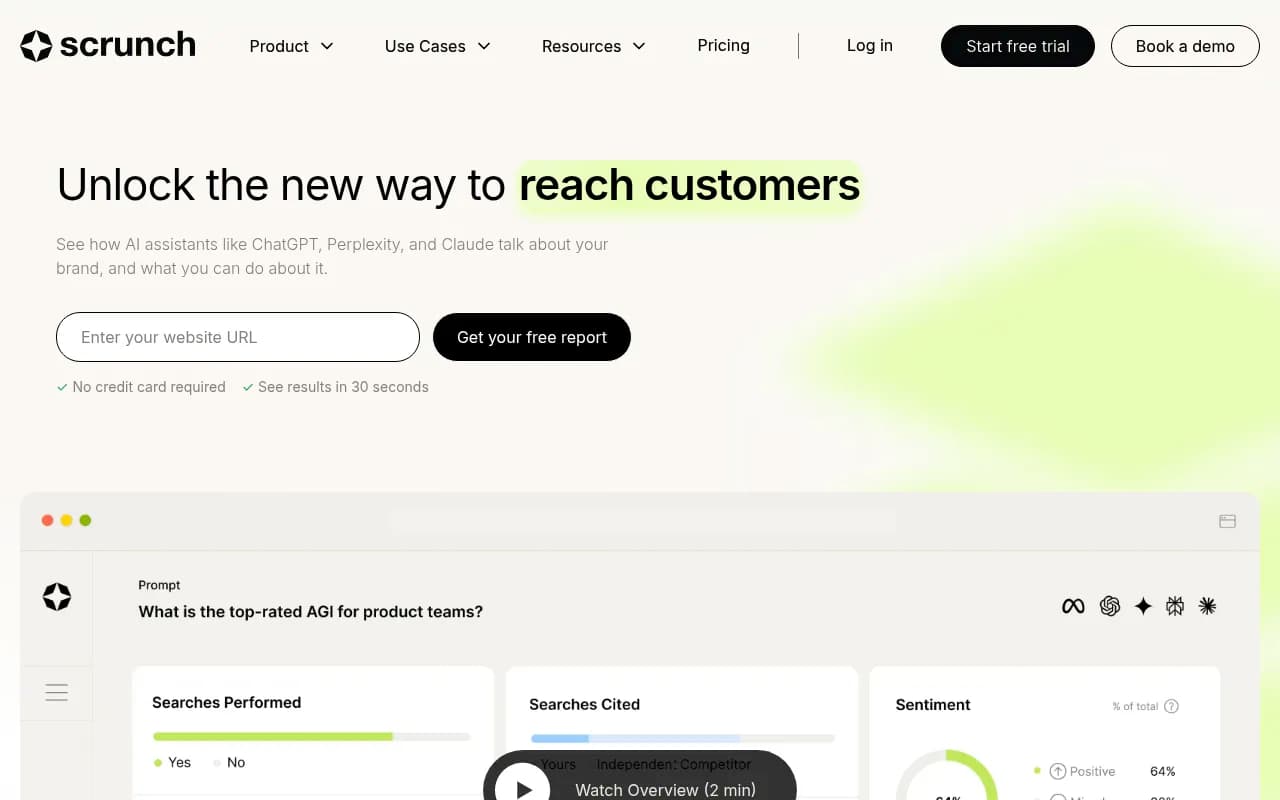

For a wider look, the GEO software directory at bestgeosoftware.com lists more options.
Multi-location listings and reputation tools
Yext frames AI visibility as a two-level problem and ties it to the listings AI engines rely on. Birdeye, Uberall, Synup and Chatmeter focus on listings, reviews and local presence across many locations.
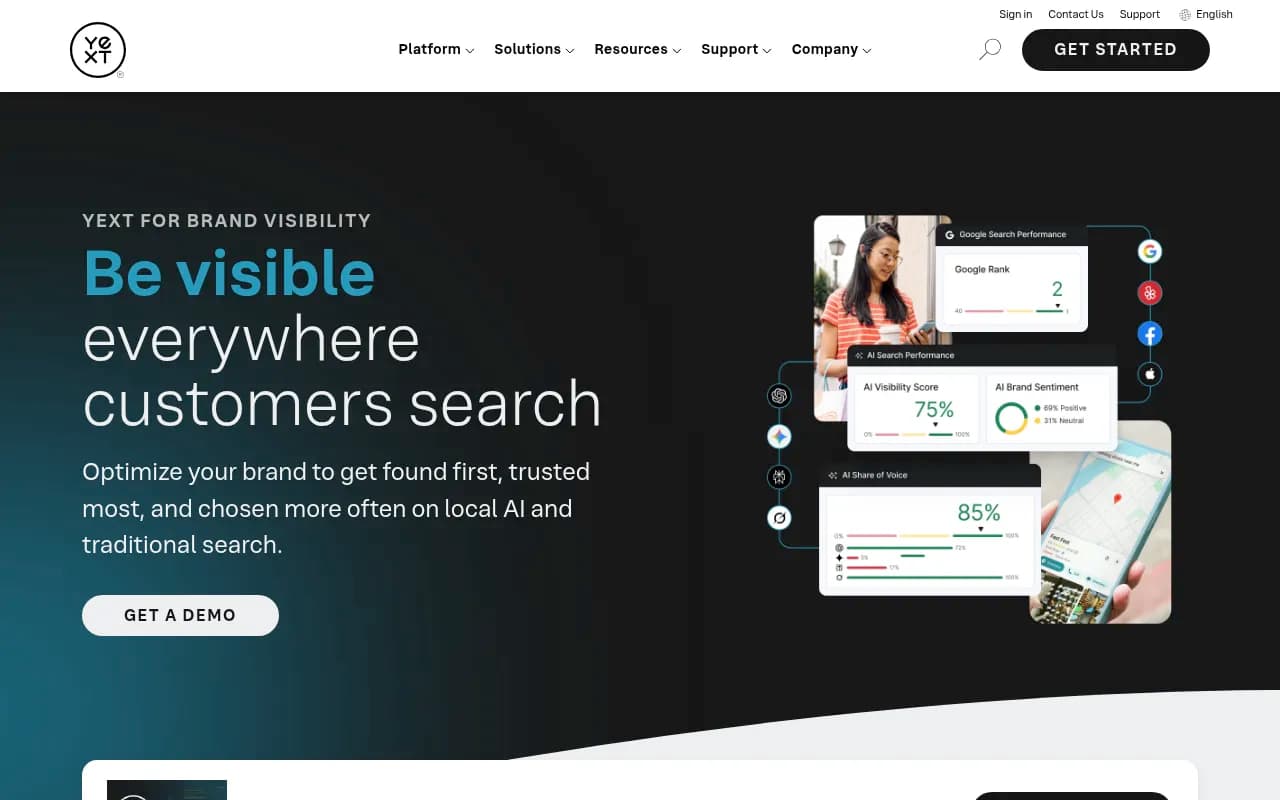
BrightLocal is a local SEO platform that suits agencies handling many client locations, and SOCi covers localized social media, which matters given the Facebook and Instagram numbers above.
Quick comparison
| Tool type | Examples | Good at | Gap to watch |
|---|---|---|---|
| AI visibility with local targeting | Promptwatch | Per-location prompts, crawler logs, content fixes | Needs a well-built prompt set per market |
| AI visibility monitoring | Profound, Scrunch, Otterly.AI | Tracking mentions and citations | Often stops at reporting |
| Listings and reputation | Yext, Birdeye, Uberall, Synup | Consistent data, review volume | AI-specific measurement varies by vendor |
| Local SEO | BrightLocal, Moz Local | Citations, rank tracking | Classic local focus first |
A starting plan for the next 30 days
- Choose 10 to 20 locations that represent your range: strong, average, weak, big metro, small town.
- Write 8 to 12 prompts per location using real customer phrasing and the right city.
- Run them across ChatGPT, Google AI Overviews, AI Mode, Perplexity and Gemini.
- Record mention rate, position, and cited URLs, plus the top three local competitors.
- Find the pattern. Is it missing pages, thin reviews, absent listicle coverage, or crawler problems?
- Fix the most common cause first. Usually it is the same one across many locations, which is the good news about doing this at franchise scale.
- Rerun in 30 days and report change per location, not per brand.
If you would rather hand the program to specialists, an agency like 1001 SEO Media handles GEO work across many markets.
The bottom line
Corporate AI visibility tells you the brand is known. It does not tell you whether the Tulsa franchisee is being recommended to someone searching in Tulsa. Build a prompt set per location, benchmark against local rivals, read the citation URLs, and give each franchisee a report they can act on. The 1.2% figure may or may not hold up, but you will not know your own number until you measure it location by location.