LLMrefs Review 2026
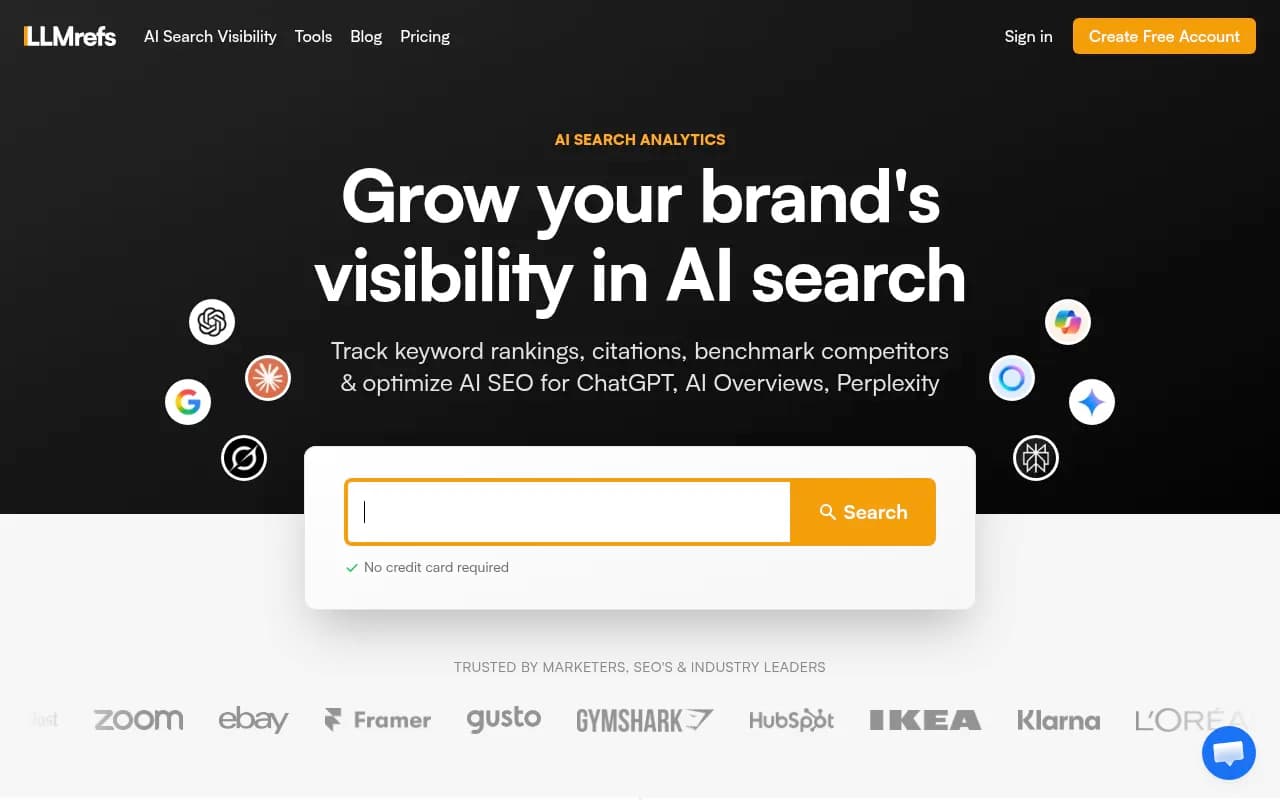
LLMrefs is an AI search analytics platform that tracks how brands rank in ChatGPT, Google AI Overviews, Perplexity, Claude, Gemini, and other generative answer engines. Monitor keyword rankings, citations, and competitor visibility across 50+ countries. Used by eBay, HubSpot, Shopify, and 10,000+ ma
Summary
LLMrefs is a keyword-based AI search visibility tracker that monitors brand mentions, rankings, and citations across 11 AI search engines including ChatGPT, Google AI Overviews, Perplexity, Claude, Gemini, Grok, and Copilot. Unlike prompt-focused competitors, LLMrefs lets you import existing SEO keyword lists and automatically generates fan-out prompts based on real user conversations. The platform aggregates results across multiple prompts to calculate statistically significant share of voice and position metrics for each keyword. Used by brands like eBay, HubSpot, Shopify, IKEA, and 10,000+ marketers.
Key strengths: Keyword-first approach (not prompt-based), unlimited projects and team seats, geo-targeting in 50+ countries, citation tracking, weekly automated reports, affordable single-tier pricing at $79/mo for 500 prompts.
Key limitations: Lacks content gap analysis, AI content generation, AI crawler logs, and traffic attribution that Promptwatch offers. Monitoring-only -- no optimization tools to help you create content that ranks in AI search. No Reddit/YouTube tracking, no ChatGPT Shopping monitoring, no prompt volume estimates beyond basic monthly figures.

What LLMrefs is and who built it
LLMrefs is a generative engine optimization (GEO) platform founded by James Berry that tracks brand visibility across AI search engines. The tool launched to address a specific pain point: most GEO platforms force you to track individual prompts, which is impractical when there are infinite ways users can phrase the same question. LLMrefs flips this model by letting you track keywords (the way SEOs already think) and automatically generating prompt variations behind the scenes.
The platform monitors 11 AI models: ChatGPT (including ChatGPT Search), Google AI Overviews, Google AI Mode, Google Gemini, Perplexity, Claude, Grok, Microsoft Copilot, Meta AI, and DeepSeek. It's used by major brands including eBay, HubSpot, Shopify, IKEA, Gymshark, NVIDIA, Ralph Lauren, Screaming Frog, Twilio, and The Washington Post. The company claims 10,000+ marketers use the platform.
LLMrefs is aimed at SEO teams, marketing departments, and agencies managing multiple client domains who want to understand AI search visibility without learning a completely new workflow. If you already track keywords in Ahrefs or Semrush, you can import those lists directly into LLMrefs and start monitoring AI visibility within minutes.
How it works: keyword tracking, not prompt tracking
The core differentiator is the keyword-first methodology. You add a keyword like "best running shoes" and LLMrefs automatically generates 20-30 prompt variations based on real conversations users have with AI chatbots. These fan-out prompts cover different angles: "What are the best running shoes for beginners?", "Top running shoes for marathon training", "Most comfortable running shoes 2026", etc.
The platform queries each AI model with these prompts, captures the full response text, extracts brand mentions and citations, then aggregates the data to calculate two key metrics:
- Share of Voice (SoV): The percentage of total brand mentions your brand captures across all prompts for that keyword. If your brand appears in 15 out of 25 prompt responses and competitors appear in 10, your SoV is 60%.
- Position: Average ranking position when your brand is mentioned. Position 1.0 means you're consistently the first brand mentioned. Position 3.5 means you're typically the third or fourth brand in the list.
This aggregation approach solves the non-deterministic problem with LLMs -- responses vary each time you ask the same question. By running multiple prompts and averaging results, LLMrefs claims to deliver statistically significant rankings. The dashboard shows which prompts were tested, full response text, and which sources (URLs) were cited.
AI search engine coverage
LLMrefs monitors 11 models with no per-engine fees (some competitors charge extra for certain models):
- OpenAI: ChatGPT and ChatGPT Search
- Google: AI Overviews, AI Mode, Gemini
- Perplexity AI
- Anthropic Claude
- xAI Grok
- Microsoft Copilot
- Meta AI
- DeepSeek AI
You can filter results by engine to see how your brand performs in ChatGPT vs Perplexity vs Google AI Overviews. This is useful because different models cite different sources -- Perplexity heavily favors Reddit and YouTube, while Google AI Overviews pulls from traditional web results.
Geo-targeting is available in 50+ countries and 20+ languages. You can track "best CRM software" in the US, UK, Germany, and France separately to see regional differences in AI recommendations.
Citation and source tracking
LLMrefs captures every URL cited in AI responses and aggregates them into a sources report. You can see which domains AI models trust most for your keywords. Common patterns:
- Reddit threads dominate for product recommendations and "best of" queries
- Wikipedia and official brand sites for factual/informational queries
- YouTube videos for how-to and tutorial queries
- Review sites (Yelp, TripAdvisor, Amazon) for local and product queries
- Industry publications (Forbes, Gartner) for B2B software queries
The sources view shows domain-level aggregation (e.g. "reddit.com cited 47 times") and lets you drill down to specific URLs. This helps you identify content gaps -- if competitors are being cited from Reddit threads you're not participating in, that's an outreach opportunity. If a specific blog post keeps getting cited, you know that content format works.
However, LLMrefs doesn't offer Reddit thread discovery tools or YouTube video tracking as standalone features. You see citations after the fact, but there's no proactive monitoring of Reddit discussions or YouTube mentions like Promptwatch provides.
Competitor benchmarking
You can add competitor brands to any keyword and LLMrefs will track their SoV and position alongside yours. The dashboard shows a ranked list of all brands mentioned for that keyword, sorted by share of voice. This is more transparent than vague "visibility scores" -- you see exactly how often each brand appears and in what position.
The competitor view includes trend charts showing SoV changes over time. If a competitor's share of voice jumps from 20% to 45% in a week, you can investigate which new content or citations drove the change.
One limitation: LLMrefs doesn't show you why competitors rank higher. There's no content gap analysis showing which topics or angles competitors cover that you don't. You see the outcome (they rank higher) but not the specific content differences. Promptwatch's Answer Gap Analysis solves this by showing exactly which prompts competitors are visible for that you're missing, plus the specific content your site lacks.
Agency and team features
LLMrefs is optimized for agencies managing multiple clients:
- Unlimited projects: One subscription covers unlimited domains. Add 50 client sites without paying per-project fees.
- Unlimited team seats: Invite your entire team at no extra cost. Most competitors charge per user.
- Client dashboards: Organize keywords by client, assign team members to specific projects, and generate client-specific reports.
- White-label exports: CSV exports don't include LLMrefs branding, so you can present data as your own.
This makes LLMrefs significantly cheaper for agencies than competitors that charge per domain or per seat. A 10-person agency managing 20 clients pays $79/mo total, not $79/mo per client.
Setup and workflow
Setup takes about 5 minutes:
- Create a project and add your brand name and domain
- Import keywords (manual entry, CSV upload, or paste from Ahrefs/Semrush)
- LLMrefs generates fan-out prompts and starts querying AI models
- Results appear in the dashboard within minutes
Weekly reports refresh automatically. You don't need to manually re-run queries. The platform continuously checks prompts in the background to maintain statistical significance.
The interface is clean and SEO-tool-familiar. If you've used Ahrefs or Semrush, you'll recognize the keyword list view, filtering options, and export buttons. There's no learning curve for the core workflow.
What's missing compared to Promptwatch
LLMrefs is a monitoring platform. It shows you where you rank and which sources are cited, but it doesn't help you optimize or create content. Key gaps:
- No content gap analysis: You can't see which specific prompts or topics competitors rank for that you don't. LLMrefs shows aggregate SoV, not prompt-level visibility differences.
- No AI content generation: There's no built-in writing agent to create articles optimized for AI search. You get the data, then you're on your own to create content.
- No AI crawler logs: You can't see which AI models are crawling your site, which pages they read, or errors they encounter. Promptwatch provides real-time logs of ChatGPT, Claude, Perplexity, and other AI crawlers hitting your site.
- No traffic attribution: LLMrefs doesn't track actual visitors or revenue from AI search. You see visibility metrics but can't connect them to business outcomes. Promptwatch offers code snippet, GSC integration, and server log analysis to close this loop.
- No Reddit/YouTube tracking: Citations are shown after the fact, but there's no proactive monitoring of Reddit threads or YouTube videos mentioning your brand.
- No ChatGPT Shopping monitoring: LLMrefs doesn't track product recommendations in ChatGPT's shopping features.
- No prompt volume estimates: The platform mentions "monthly AI prompt volume estimates" in the pricing page but doesn't provide the detailed prompt intelligence (difficulty scores, query fan-outs) that Promptwatch offers.
Pricing and value
LLMrefs has one plan: $79/mo for 500 prompts (roughly 20-25 keywords with fan-out prompts). This includes:
- All 11 AI search engines (no per-engine fees)
- Unlimited projects and domains
- Unlimited team members
- Geo-targeting in 50+ countries and 20+ languages
- Weekly automated reports
- Citation tracking
- CSV export and API access
- Priority support
There's a 7-day free trial with no credit card required. You can upgrade to add more keywords as needed.
Compared to competitors:
- Otterly.AI: $99/mo for 100 prompts, limited to 3 AI models
- Peec.ai: $149/mo for 150 prompts, 5 AI models
- AthenaHQ: $199/mo for 200 prompts, monitoring-only
- Promptwatch: $99/mo Essential (50 prompts, 1 site), $249/mo Professional (150 prompts, 2 sites, crawler logs, content generation)
LLMrefs is the cheapest option per prompt and the only one with unlimited projects/seats. For agencies, this is a significant cost advantage. However, it's monitoring-only -- if you need optimization tools (content gap analysis, AI writing agent, crawler logs, traffic attribution), Promptwatch is the stronger choice despite the higher price.
Who should use LLMrefs
LLMrefs is best for:
- SEO teams who already track keywords in Ahrefs/Semrush and want to extend that workflow to AI search without learning a new methodology
- Agencies managing 10+ client domains who need unlimited projects and seats at a fixed cost
- Brands with established SEO programs who want to monitor AI visibility as a new channel but don't need deep optimization tools yet
- Marketing teams who need simple dashboards and weekly reports to track AI search as a KPI
LLMrefs is NOT ideal for:
- Teams who need to optimize, not just monitor: If you want content gap analysis, AI content generation, or crawler logs, Promptwatch is a better fit
- Brands tracking high-volume keywords: 500 prompts (20-25 keywords) may not be enough for large SEO programs. You'll need to upgrade or pay for more prompts.
- Teams who need traffic attribution: LLMrefs doesn't connect visibility to actual visitors or revenue
Integrations and exports
LLMrefs offers:
- CSV export: Download keyword rankings, citations, and sources as CSV files
- API access: All plans include API access to pull data into custom dashboards or workflows
- No native integrations: There's no Looker Studio connector, Slack alerts, or GSC integration
The API is documented but basic. You can fetch keyword data, prompt results, and citation lists programmatically. There's no webhook support for real-time alerts.
Support and documentation
Support is available via live chat (bottom right widget) and email ([email protected]). The company emphasizes "priority support" for all paid plans. Response times are typically within a few hours during UK business hours.
Documentation is minimal -- there's no public knowledge base or help center. The FAQ section on the homepage covers basic questions, but there's no detailed guide on methodology, API usage, or advanced features. This is a weakness compared to competitors with extensive docs.
Bottom line
LLMrefs is the most affordable AI search visibility tracker for agencies and SEO teams who want to monitor brand mentions across ChatGPT, Perplexity, and other AI models without changing their keyword-based workflow. The unlimited projects and seats model makes it a no-brainer for agencies managing multiple clients. The keyword-first approach (vs prompt-based tracking) lowers the learning curve for traditional SEOs.
However, it's monitoring-only. You see where you rank and which sources are cited, but you're on your own to figure out why competitors rank higher or how to create content that improves your position. If you need optimization tools -- content gap analysis, AI writing agent, crawler logs, traffic attribution -- Promptwatch is the stronger platform despite the higher price. LLMrefs shows you the problem; Promptwatch helps you fix it.
Best use case in one sentence: Agencies managing 10+ client domains who need affordable, keyword-based AI search monitoring with unlimited projects and seats, but don't yet need deep optimization or content creation tools.
Similar and alternative tools to LLMrefs