Chatmeter Review 2026
Chatmeter is an AI-powered reputation and local listings management platform for multi-location brands, now merged into Alchemer's customer intelligence suite. It helps franchises, retail chains, and multi-location service businesses monitor reviews, manage directory listings across 70+ sites, and b
Key takeaways
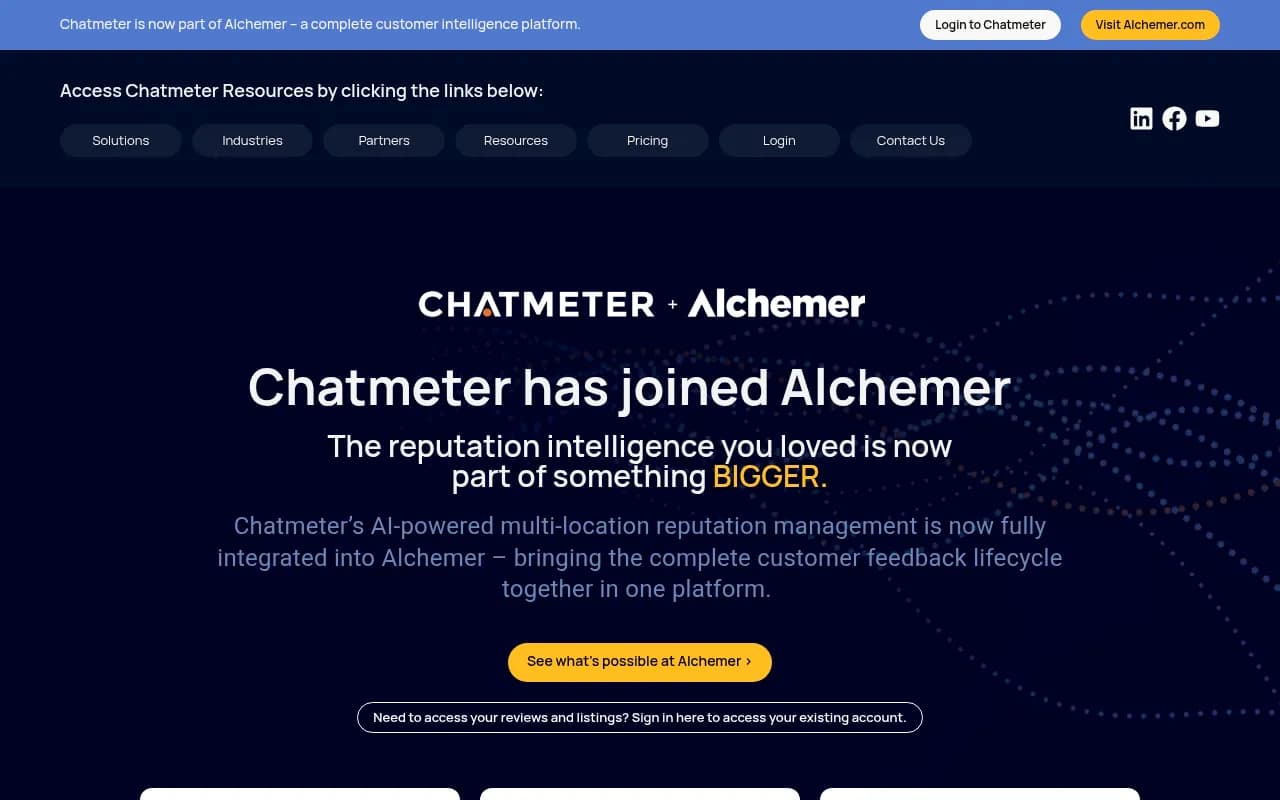
- Chatmeter no longer operates as a standalone product. It was acquired and folded into Alchemer, a broader customer intelligence platform, in mid-2026.
- Existing customers can still log in through the legacy Chatmeter portal, but new sign-ups and feature development now happen under the Alchemer brand.
- The core value proposition, managing reviews, listings, and local pages for multi-location brands, survives the merger and is arguably stronger now that it sits next to Alchemer's survey and feedback tools.
- This is a local SEO and reputation tool, not an AI search visibility or GEO platform. It has nothing to do with tracking brand mentions in ChatGPT or Perplexity, so comparisons to that category don't apply here.
- Best suited for multi-location businesses (franchises, retail chains, healthcare networks, auto dealer groups) that need to manage online presence across dozens or hundreds of physical locations at once.
Chatmeter built its name over more than a decade as one of the go-to platforms for multi-location brands trying to keep their online presence consistent across hundreds or thousands of storefronts. If you've ever managed a franchise network and dreaded the idea of updating business hours across 300 Google Business Profiles one by one, this is the kind of headache Chatmeter was built to solve.
In 2026, the company was absorbed into Alchemer, a customer intelligence platform that also handles surveys and voice-of-customer data. The Chatmeter website now functions mostly as a redirect and login portal, with the actual product roadmap, marketing, and sales motion living under Alchemer.com. That's an important thing to know before you evaluate this tool: you're not really buying "Chatmeter" anymore, you're buying into Alchemer's reputation management module, which happens to be built on Chatmeter's technology and team.
The target audience hasn't changed much. This is enterprise and mid-market software for multi-location operators: restaurant chains, retail brands, auto dealership groups, healthcare systems, and financial services branches. It's not really aimed at single-location small businesses or solo marketers, and it's definitely not built for freelancers or agencies managing a handful of clients the way, say, a smaller local SEO tool might be.
Key features
Listings management handles the unglamorous but critical job of keeping business information accurate across Google Business Profile, Apple Maps, Bing, Yelp, and more than 70 other directories. Instead of manually updating an address change or new phone number location by location, operators push the update once and it syncs everywhere. This is the feature most multi-location brands buy the platform for in the first place, since inconsistent listings directly hurt local search rankings and confuse customers.
Reputation management is the review monitoring and response engine. It aggregates reviews from Google, Yelp, Facebook, and other platforms into one dashboard, flags sentiment trends, and lets teams respond at scale, sometimes with AI-assisted draft responses. For a 500-location retail chain, this means one regional manager can realistically keep on top of review responses instead of it being an impossible task spread across store managers with wildly inconsistent quality.
Local pages generates SEO-optimized landing pages for each individual location. Rather than a single generic "contact us" page, each store or branch gets a page with its own address, hours, reviews, and local keywords, which is meant to help that specific location show up in local search results. This is a fairly common feature in the multi-location SEO space, but Chatmeter's version ties directly into the listings and review data it already collects, so the pages stay current without extra manual work.
Competitive benchmarking lets brands compare their review volume, star ratings, and response times against named competitors, which is genuinely useful for a regional manager trying to make the case internally that a market is underperforming.
Sentiment and text analytics dig into review text to surface recurring themes, like complaints about wait times or praise for a specific menu item, without someone having to read every review manually.
Reporting and dashboards roll data up by region, brand, or individual location, which matters a lot for enterprise customers who need to show performance to franchisees or regional VPs rather than just look at aggregate company-wide numbers.
Who is it for
Chatmeter (now Alchemer's reputation module) makes sense for operations teams at franchise brands with 50 or more physical locations, where the cost of inconsistent listings and unmanaged reviews compounds quickly. Think a regional pizza chain with 150 franchised locations, a multi-state dental practice group, or a dealership network spread across a dozen metro areas. These are organizations where a single marketing person cannot realistically manage local presence store by store, and where the ROI on consolidating that work into one platform is obvious.
It's a poor fit for single-location businesses, solo consultants, or small agencies managing three or four client accounts. The pricing and feature set are built around scale, and a lot of the value (bulk listing sync, cross-location benchmarking, franchise-level reporting) simply doesn't apply if you only have one or two locations. Smaller operators are usually better served by lighter local SEO tools.
It's also worth noting this tool has nothing to do with AI search visibility or how brands show up in ChatGPT or Google AI Overviews. If that's what you're actually trying to solve, look at a GEO-specific platform instead; this is squarely a local search and reputation product, not a generative engine optimization one.
Integrations and ecosystem
Chatmeter connects to Google Business Profile, Apple Maps, Bing Places, Yelp, Facebook, and dozens of other directory and review sites for both listings sync and review aggregation. As part of Alchemer, it now sits alongside Alchemer's survey and feedback collection tools, which opens up the possibility of connecting review sentiment data with formal customer satisfaction surveys, something the standalone Chatmeter product couldn't do on its own.
Details on API access and specific developer documentation are less publicly visible since the migration to Alchemer's site structure. Prospective buyers should ask directly about API availability, CRM integrations, and export options during a sales conversation, since a lot of the old marketing pages describing these details have been replaced by Alchemer's own materials.
Pricing and value
Chatmeter historically sold on a custom quote basis tied to location count rather than publishing flat tiers, and that model appears to carry over under Alchemer. There's no public self-serve pricing page with dollar figures; instead, prospective buyers are pointed to a contact form to get a quote based on the number of locations and which modules (listings, reputation, local pages) they need. This is standard for enterprise multi-location software, but it does mean you can't quickly comparison shop the way you could with a self-serve SaaS tool.
For a franchise network with hundreds of locations, the math tends to work out favorably once you account for the labor cost of manually managing listings and reviews location by location. For anyone smaller, the lack of transparent low-tier pricing is a real friction point, and it's worth asking whether a lighter-weight competitor with published pricing might actually cover your needs for less.
Strengths and limitations
Chatmeter's biggest strength is depth in multi-location listings sync, built up over years of dealing with the messy reality of 70+ directory APIs and formats. The competitive benchmarking and franchise-level reporting are also genuinely differentiated for large operators who need to roll data up by region or brand.
The honest limitation right now is transition risk. Being folded into Alchemer means the product roadmap, support structure, and pricing model are all in flux, and existing customers have reported some uncertainty about what changes going forward. There's also no public pricing, which makes it hard for a prospective buyer to self-qualify before talking to sales. And because it's a local SEO and reputation tool, not a broader marketing or AI visibility platform, brands with wider AI search or content optimization needs will need a separate tool for that side of things entirely.
Bottom line
If you're running local marketing or operations for a multi-location brand with dozens or hundreds of physical locations and you're tired of chasing listing accuracy and reviews store by store, Chatmeter's technology, now sold as part of Alchemer, still solves that problem well. Just go in expecting an enterprise sales process and a product that's actively being integrated into a bigger platform, not a stable standalone tool frozen in time.
Tags:
Frequently asked questions
Is Chatmeter still a standalone product?
What does Chatmeter actually do?
Who is Chatmeter built for?
How much does Chatmeter cost?
Does Chatmeter track brand mentions in ChatGPT or AI search results?
Is there a free trial?
Similar and alternative tools to Chatmeter